Feeds:
Posts
Comments

Posts Tagged ‘Van Gogh’

The Fatigue

Vincent Van Gogh- The Red Vineyard 1888


I am unable to describe exactly what is the matter with me; now and then there are horrible fits of anxiety, apparently without cause, or otherwise a feeling of emptiness and fatigue in the head.

–Vincent van Gogh, in a letter to his sister, Wilhelmina, April 30, 1889


I am right there with you, Vinnie, my friend.

Didn’t feel like sharing a post this morning, mainly because of the same sort of feeling that van Gogh described to his sister in the passage above. Been swamped with a feeling of emptiness and fatigue in both my head and body in the past week or so that has been debilitating.

The anxiety was already there. It is standard equipment for my model and, like that of Vincent, often comes on without rhyme or reason. It’s like an irritating friend you can’t ditch and just when you think you have shaken free from them, there they are waiting for you when you pull in the driveway.

Of course, Vincent didn’t know the cause of his torments at the time he wrote this letter. It was just months after he had cut off his ear so he was deep into his mental problems then.

Mine on the other hand, were predictable and knowable. Though I have had problems with bouts of depression in the past, my current situation is the result of my cancer treatment. The fatigue is a natural by-product of the anemia that comes as a side effect of the combination of the hormone therapy and radiation with which I am being treated. Treat doesn’t seem like the right word here but we won’t dwell on that.

Today marks a month since the end of my radiation and the fatigue would normally be on the downswing. Since my slight overexertion two weeks ago which set off what I describe as a sort of systemic inflammation, the fatigue has seemed to deepen rather than lessen. I am okay just after waking up but it increases geometrically through the day and by the afternoon, I am wiped out. The dark rings around my eyes and my slow shuffling walk are testament to that.

The empty headedness is more of a brain fog, or perhaps I should describe it as a lag or slowing down of function. Can’t really say and don’t know what causes this, if it is the from the anemia or just from being bone-tired all the time. Whatever the reason, it affects the focus and thought process needed to properly paint or write effectively.

Painting for me is more than a mechanical process. It is not simply a matter of sitting down and painting, which is sometimes the answer when there is a creative block. This doesn’t feel like a normal blockage. My mind doesn’t seem to be reacting in the same way as I expect. As I said, there seems to be a lag in my thinking and a feeling of general emptiness.

When I call on the mental part to concentrate, to solve the problems painting presents, it doesn’t always respond right now. However, there are short periods where it seems to be close to normal. The work is good then and feels right and full.

It’s just those empty periods in between. They bring on a glum tone in me, one that has me questioning the validity of everything. It makes me yearn for the days of radiation and the steroid, dexamethasone, that brought on a what I describe as a giddy elation. It felt like I was then on the manic side of manic-depression and am now experiencing the depression side.

While I do not like this in any way, I am not worried, at least in the existential way that Vincent’s depression brought on. I know that feeling all too well and this is not that.

This has a reason for being here with me now and will most likely soon pass. Knowing that makes all the difference.

Fortunately, it also gives me glimpses of that return to some sort of normality on most days, usually in the early morning when my energy level is as high as it will likely be for the day. That’s why I try to get to work early, including writing this blog.

On days like today, when I start off not wanting to write anything, it is important for me to stay at it. I think I’ve posted something for around 160 straight days and I find that I need to do this right now. It may not produce anything that interests anyone, including myself, but the sheer act of doing it is vital in staving off a descent into real depression. That’s an altogether different animal.

It lets me know that as energy returns, my painting time and the requisite focus will also increase.

And that’s all I really need to know.

I am including the post below from 2019 concerning the Van Gogh painting at the top, The Red Vineyard. I thought his words to his brother Theo had pertinence to today’s post. Plus, as I say, the painting is a peach.

[From 2019]


“I can very well do without God both in my life and in my painting, but I cannot, suffering as I am, do without something which is greater than I, which is my life, the power to create.”

― Vincent van Gogh, letter to his brother, Theo, September 1888


Amen.

Love the passion in the words above from Van Gogh but really just wanted to share the painting at the top of the page. It’s The Red Vineyard from 1888. It is considered to be the only painting ever sold by Van Gogh in his lifetime.

It was bought by the Belgian Impressionist artist Anna Boch in 1890, the year of Van Gogh’s death. It was bought for what would be abut $2000 in today’s dollars. I include that because when Boch let it go to auction in 1909, its value had shot up to what would be about $150,000 today. Van Gogh’s sister-in-law, the widow of his brother Theo, wanted to get it back but the price went well past her means.

It was purchased by a Russian collector who gave up ownership of it when all private property was nationalized by the Bolsheviks after the Communist Revolution. Today, it hangs in the Pushkin Museum in Moscow.

More than likely I will never see this painting in person but it remains a peach.


I don’t expect that many will but if you got this far today, thanks for sticking to it for this long. It is much appreciated.

Read Full Post »

Vincent Van Gogh- Memory of the Garden at Etten (1888)


My aim in life is to make pictures and drawings, as many and as well as I can; then, at the end of my life… looking back with love and tender regret, and thinking, ‘Oh, the pictures I might have made!’ But this does not exclude making what is possible…

–Vincent Van Gogh, Letter to Theo van Gogh, 19 November 1883


Love this painting from Vincent Van Gogh with its wonderful color and the abstraction of the forms that comes from eliminating the horizon line. It was a piece that came to mind when I ran across this passage from Van Gogh. The words reminded me of something else, a thought that has been on my mind in recent times.

I was asked at my Gallery Talk at the Principle Gallery this past September [2019] if I ever had thoughts of retiring from my painting career. I think I made a bit of a joke about it, saying that I couldn’t afford to retire and would no doubt die while working away at a painting.

And that’s most likely true. I couldn’t imagine ever saying I am done as a painter.

It goes back to Van Gogh’s words above. I still see my artistic future brighter than my past, still envision important projects and better works to come. I still see my best work as being in the future, not dwelling in the distant past.

I can’t imagine that feeling ever changing. I can see myself on the day of my death, if I am capable of taking a moment to reflect on that day, will have that same regret that Van Gogh expressed: Oh, the pictures I might have made!

That being said, I must get to work. I am not retired yet and there are pictures to be made. The future is calling.


I have a few things that need to be done so I am running the post above from five years back. There are a couple of things to add to this post. The Van Gogh quote was taken from a wonderful letter to his brother, Theo, that addresses another question that has often hung with me over the years, that being whether or not I am an artist. I like Van Gogh’s answer that he would rather spend his time thinking about painting than using it to worry about labels or what he might or might not be. That’s pretty much where I have ended up after all these years, not giving a damn what label other might pin on me. I used to worry about whether I deserved to call myself an artist or even what to call whatever style my work might be. I’ll just do what I do and let others sort it out for themselves, if that’s what they want to do.

Let’s also add a song to this mashup. Here’s a song from Leonard Cohen (yay, Canada!) that I have shared a couple of times but by other artists. They were great covers from Willie Nelson and Tom Jones. I loved both but there’s often nothing like the original thing.

Okay. Got to run– the future is still calling…


Read Full Post »

+

It is the treating of the commonplace with the feelings of the sublime that gives to art its true power.

–Jean-Francois Millet

++++++++++++++++

Jean-Francois Millet (1814-1875) is mainly known for his peasant scenes painted in the genre of the Barbizon school, of which he was an originator.  This genre marked the move from Romantic painting to Realism which depicted the reality of all aspects of the world, including the rural working class which were seldom portrayed heretofore.

This work played a huge role in the evolution of modern art as a number of artists from subsequent generations ran with this work , adding their own voice and style to the subject matter. Van Gogh, for example, directly copied a number of Millet works, such as The Sower below, in his own distinct style.

I am not moved by all of Millet’s work. Some of it feels generic but I think that is understandable as its style was so influential that it was emulated, creating a vast body of similar work. But there is something in a segment of his work that I feel is truly visionary in a way that lends credence to the statement from Millet at the top of the page. Here are a few of my favorites.

Read Full Post »

The power of imagination makes us infinite.

John Muir

**********************

The image above was taken by NASA’s Juno spacecraft of the tops of the clouds surrounding Jupiter. I find myself constantly staring into it this morning with a mix of awe and dejection.

Awe at the sheer beauty and power of it. It is spectacular on a visual level in so many ways, at least to my eyes. The force of its rhythm is immense and the enhanced colors capture an emotional tone that rivals the work of the greatest painters. Looking at it, I see the ghosts of Van Gogh– I mean, this image is Starry Night taken up to the next several levels— Picasso, Goya, Chagall, Bosch and so many more.  With my last glimpse I saw Munch and Dali and an image of the Minotaur. And Thomas Hart Benton. I think any of these painters would look at this and find inspiration, would see that intangible force in it that begs to be painted.

I know that I feel that way but that is where the dejection enters the picture. It inspires but in a way that seems far beyond my meager talents and my simple mind. It’s like being a Golden Retriever watching his master, let’s say it’s Einstein, pondering the Theory of Relativity at his chalkboard. I know there’s something there because it seems so important to my master and I want to help but all I can do is bark and wonder what the hell I am looking at.

I am like a frustrated dog trying to describe the power of the universe.

But it’s early. I’ve only been looking at this for forty minutes or so. Maybe the dejection will pass and the longer I look, the more I will move myself into those swirls of cloud and color to find a rhythm, or even a trace of one, that aligns itself with the simpler ones that run within myself.

And maybe something will come of it. You can never tell what the end product, if any, will be from any point of inspiration. Maybe it will set off a series of thoughts and ideas that takes you galaxies away from the original inspiration. But an image like this has an effect in some way, even if it does show up right away.

I feel the need to look a little more. Take a deeper look for yourself.

Read Full Post »

I think I have seen this before but it caught my eye this morning.  It’s a video of Turkish artist Garip Ay who works in the art of ebru, known to us as paper marbling.  In this video he takes on Van Gogh’s Starry Night but that is only the start. What turns out in the end is a bit of a surprise although you may see it coming in the process.  Just a neat video and a wonderful display of total craftmanship.

I’ve also included another video of Garip Ay at work.  Just seeing the process and the manipulation of the colors and the way they move on the dark water is fascinating. Mesmerizing.


Read Full Post »

Van Gogh Still Life- Blue Enamel Coffeepot, Earthenware and Fruit 1888When I came into the studio this morning there was a question waiting for me in my inbox.  In response to yesterday’s post, a blogger, JM Nowak, asked : I wonder what van Gogh would have thought? What would he think now about the popularity and sales rate of his Art? Would it make him feel more confident and self-assured…I wonder?!

The question set my mind in motion.  Would have recognition in his time affected Van Gogh’s work?  Would it have changed the arc of his evolution as we know it?  Would his style have changed to meet the will of the market if he had started to sell his work at the time?

These are hard questions.  Part of me is selfishly glad that we will never know, happy in the fact that his work came about in just the way it did, relatively uninfluenced by the market or the words of critics.  Though I do have to confess that I wish he had found some sort of satisfaction or happiness in knowing that his work became so loved and revered.

But his work evolved in much the same way as outsider and folk artists who toil for the absolute necessity of self expression, without any outside affirmation.  There is a sort of pristine purity in this that presents an interesting dichotomy:  established artists crave this purity that they can no longer have and the artists with it often desire the acknowledgment that the established artists receive.

Can the line between the two be walked?

It makes me wonder how my own work would have evolved without the galleries or patrons who have supported me these many years now.  Would my own arc or direction be the same as it is now?  I think it would be different if only for the assurance that  that the knowledge that there are waiting eyes to see your work brings.  That in itself propels the work forward at times.

But it would undoubtedly be different.  But whether it would be better or worse is debatable.  It might be narrower in scope just because I might be more tempted to follow an even more personal and esoteric path.  But I’m not really sure about that because the real question would be how long would I be able to continue without some outer affirmation for the work.  Would I be able to maintain the passion or would I abandon the work or continue to follow Van Gogh down that  vortex of madness which he ultimately followed?

A lot to ponder at 6 in the morning…

Read Full Post »

Stan Herd's Take on Van Gogh

Stan Herd’s Take on Van Gogh

Stan Herd is an an American artist who uses the land as his canvas, creating large earthworks that reveal themselves from great heights.  He has been at this for over 40 years, beginning in 1981 after a short and less than satisfying career as an abstract expressionist painter.  Working in the tradition of other great earth artists such as Robert Smithson and Christo, Herd has traveled around the globe for his art and has been tabbed as the  “Father of Crop Art.”  He has even been the subject of an acclaimed movie, Earthwork, that tells the story of a 1990’s project where he creates an environmental artwork on a NYC property owned by Donald Trump— yeah, that guy.

His most recent is a project from this year that he took on in conjunction with the Minneapolis Institute of Art (MIA) that had him replicating Van Gogh‘s famed painting, Olive Trees, in plantings.  It was situated so that fliers arriving at the Minneapolis airport would be able to see it as they were landing.  There’s a great short film below that shows a little of the process and gives you a better idea of the artist.

Take a look at Stan Herd’s website by clicking here.  Great stuff…

Stan Herd  NYC- CountrysideStan-Herd-art2-Stan Herd Land Crop Art

s

Read Full Post »

Many of us are familiar with the work of Stuart Davis (1892- 1964), the American Modernist whose paintings presaged the Pop Art of the 60’s.  They were bold and colorful abstracted collages that use imagery from the landscape of the popular culture at the time they were created, creating works that immediately evoke a time.  When I see them I a transported to the New York or Paris of the 40’s and 50’s, with Jazz and poetry blossoming in the aftermath of a devastating war that really changed our perceptions of the world.

But it is Davis’ early work that always intrigues, particularly a small group that was painted not to far from where I live.  There are three landscapes painted just over the state line  in rural Tioga, Pennsylvania in 1919 that are very different from the work for which Davis is best known.  They show a young artist still working in the style of those artists who inspired him, trying on their style and brushstrokes in an effort to find his own voice. 

You can see how  he had been affected by seeing the work of Van Gogh and Picasso for the first time at the legendary Armory Show in 1913, where his own work hung among the emerging giants of modern painting.  Davis was then a student of Robert Henri and painted in a style associated with the  NYC Ashcan school of painters , of which Henri was a leader.  These three pieces have thick. expressive stokes of paint and scream of Van Gogh and have few hints at where Davis’ road would eventually lead him.

The pieces are very accomplished and have a certain charm but it is obvious that they are still derivative and that Davis is still in the midst of his evolution from talented mimic to an original voice.  To me, they are an interesting insight to how we synthesize our broad spectrum of  influences into something truly original.  I would be hard-pressed to say that the man who painted these pieces would eventually become a leading light of abstract modernism but they somehow moved him along in his search for his own distinct voice.  It only goes to show that we should take in everything that excites us even if it seems out of our normal area of comfort.  It may open new and exciting worlds to us that we could never foresee.

Stuart Davis--Self Portrait 1919


Read Full Post »

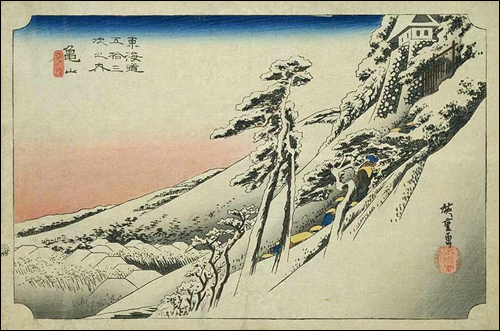
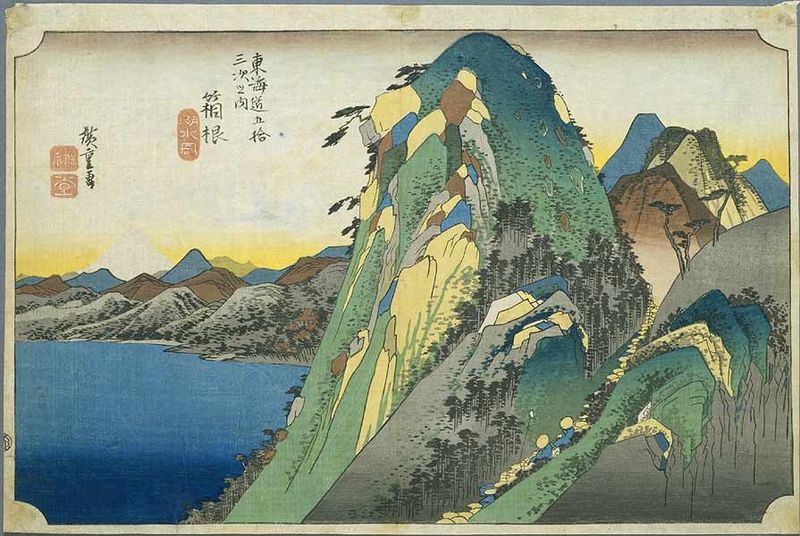
Watching the coverage of the disaster taking place in Japan has brought to mind the many Japanese influences on my work.  I have always been drawn to the work of the Japanese print masters such as Hokusai, who I have written about before, and Hiroshige.  I was influeneced by their work before I was even aware of it, mostly through their influence on the European artists in the late 19th century.  Artists like Whistler and Van Gogh were enthralled by the beauty of their woodblocks, Van Gogh even going so far as simply copying them for some of his earlier paintings.

When I began to look more closely at the work of Hiroshige, I too was captivated.  There is great unity and totality in the work, a harmony of color and line rhythm that fills the picture frame.   The colors are softly graded yet there is deep saturation  that is like a feast for the eyes.  The landscapes seem to grow organically with lovely curves and lines that evoke that sense of rightness I have often struggled to describe here.  They have a great polarity as well.  They are bold yet subtle.  They are quiet yet not timid.  they are simple yet complex. They are both earthly and ethereal. 

In short, they are just wonderful.

Take a look at this beautiful work and how it reflects its homeland.  If you can, take a few minutes and donate what you can to relief organizations whose help a great part of this nation is desperately desiring in this time of disaster. 

Read Full Post »

Steal from everyone but copy no one.

—-Charles Movalli


I received a call yesterday from a gallery in another state that sells my work.  They mentioned during the call that a painter living in their city, who is a regular attendee of the events at their gallery, was selling work at another gallery there that was looked to be copies of my work.  They were a bit upset and asked that I take a look and see what I thought.

So I went to the other gallery’s website and clicking on the artist’s name was surprised to see four pieces that, at first glance, looked very much like my work.  All of the four pieces had compositions that were very much like mine.  No big deal, lot’s of paintings use similar elemental compositions. 

 The color palette was very much like mine as well but, again, no big deal. 

 The texture of the panel was very evident and one had a pronounced fingerpaint-like feel, one that I use often.  Again, not a big deal.  I often outline my normal technique at gallery talks and have described the process I use here in this blog.

The artist used trees as the central character in his pieces but who hasn’t at some point?  He used a blowing tree with reddish leaves and intertwined trees as well, both staples of my work.  Is any of this a big deal?

I want to say no.  I have had a number of people over the years do this with my work ( even to the point of adopting my own titles for their copies) and I have always resignedly viewed it as a form of flattery.  They obviously have seen something in the work that makes them want to try to recreate it in their own form.  There’s a form of validation for the original in this copying, a verification that something is working well.

It only becomes a problem for me when the copying painter stays solely in the realm of my work and doesn’t evolve their work into something that has its own voice and vocabulary of imagery.  Serving as inspiration and influence in the form of being copied is fine for the short term but a real artist will soon move beyond the inspiration and create work that is their’s and their’s alone.  Would we know the name Van Gogh if he had continued copying works such as Millet’s The Sower, as he did early in his painting life?

The problem of copying other people’s work is that, while one can try to emulate composition, strokes, texture and color, there is no way of copying the intent and mindset behind the original.  Or the rhythm of the actual physical act of the original artist.  Basing one’s work solely on the work of another reduces that person to the level of a musician playing in a cover band, playing the hits of others.  That’s fine and dandy,  if that is this person’s only aspiration but most people turn to art because they feel a need for self-expression, to create something that says who and what they are.

I know that’s why I came to painting.

Now, I happen to know this person whose work so resembles mine and have known him for a number of years, having done business with him at one point.  He’s a really good guy and I don’t suspect for minute there is anything amiss in his study of my work.  Hopefully, his work will soon start to make the evolution and I will see only his mind’s voice at work when I check on his work in the future.

Which I will…

Read Full Post »

Older Posts »