Feeds:
Posts
Comments
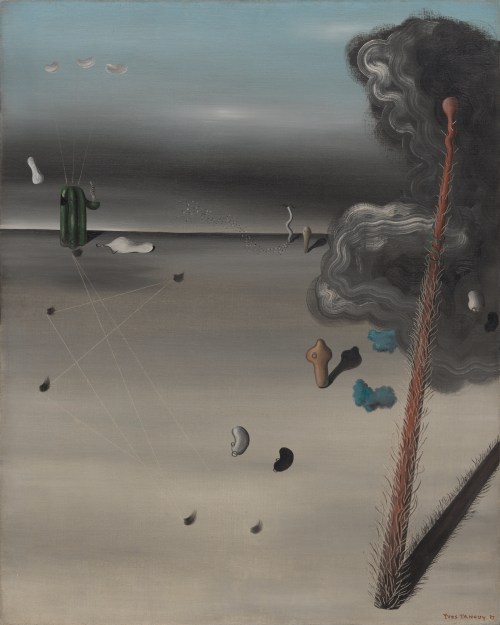
Yves Tanguy - Indefinite Divisibility 1942

Yves Tanguy – Indefinite Divisibility 1942


I found that if I planned a picture beforehand, it never surprised me, and surprises are my pleasure in painting.

–Yves Tanguy


The post below is from several years back. I was reminded of it while I was working on a new painting yesterday. It had started with a general, kind of hazy desired outcome. But it soon became apparent that it was going in a much different direction and n a way that I could not have planned. And it was better for it.

Tanguy’s idea of automatism, of letting the painting tell you where it wants to go, certainly plays well in my studio.


Let’s take a quick look at the Surrealist painter, Yves Tanguy. I can’t say I know a lot about Tanguy, who was born in Paris in 1900, raised in Brittany and died in Connecticut in 1955. He first was attracted to painting in 1922 after seeing a Giorgio De Chirico painting in the window of a Paris art dealer as he was riding a passing bus. He jumped off the bus and went back to study the painting. That was the experience that set off his career.

But with the little info I could quickly glean, I found that we shared a few similarities. One was coming to painting with little training. I consider myself basically self-taught and, while he had done some sketching before his brush with De Chirico’s work, Tanguy basically set out on his career as a painter with no formal training. His self-taught style developed quickly and was recognizable and celebrated within several years.

He also practiced automatism in his work, which is just a more formal word for having no real plan as you start a painting. I actually didn’t know there was a word for this though I’ve been practicing it for decades now. Much like he said in the quote at the top, I also take great pleasure in the surprises that come from working this way. There’s a form of revelation in working this way that I can’t get when beginning a piece with a predetermined outcome.

Tanguy also described the effects of his automatism this way: The painting develops before my eyes, unfolding its surprises as it progresses. It is this which gives me the sense of complete liberty, and for this reason I am incapable of forming a plan or making a sketch beforehand.

I understand this completely.

He also said: I believe there is little to gain by exchanging opinions with other artists concerning either the ideology of art or technical methods.

I hate to admit it but I kind of agree with this. Don’t get me wrong, I very much enjoy talking with other artists, hearing about their experiences and their breakthroughs. But I don’t really like to talk about my own process or my ideology with other artists. Oddly enough, I am more likely to do this with a group such as at a gallery talk. There, I feel like I am simply describing what I do and not giving advice or direction, which I dislike giving to other artists.

I think art comes from having an idea of what one wants and needs to get from their art as well as their individual knowledge of their strengths and weaknesses as applied to technique and materials. I can’t tell someone what they need from their own art or how it should make them feel. Nor can I tell them how they will better understand what they know about the paints or tools they use. I can give little ideas but they must gain their own insights through their own experiences.

I’ve often said there is no right or wrong in art and this hesitancy to exchange opinions is just an extension of that. What might be right for me or Yves Tanguy might not be right for another artist.

Okay, I know there is a that can be debated here but I am tired of even talking about this right now. Let’s just look at few Yves Tanguy paintings, okay?

______________________________________________________________________________
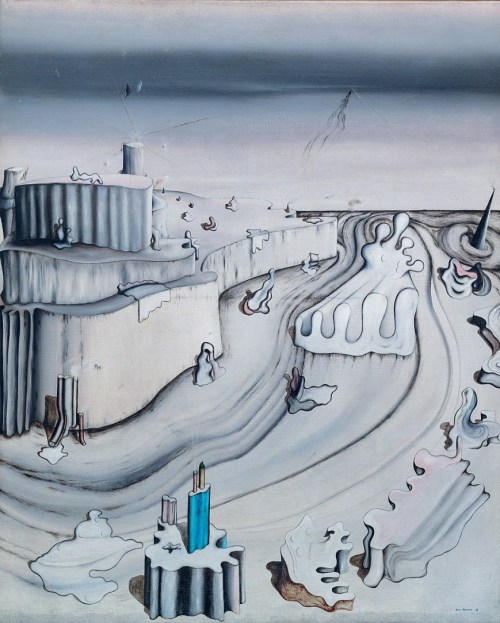
Yves Tanguy - Promontory Palace 1931

Yves Tanguy – Promontory Palace 1931

Yves Tanguy - Mama , Papa Is Wounded 1927

Yves Tanguy – Mama , Papa Is Wounded 1927

Azure Day 1937 by Yves Tanguy 1900-1955

Yves Tanguy- Azure Day 1937

Yves Tanguy The Sun In Its Jewel Case 1937

Yves Tanguy –The Sun In Its Jewel Case 1937
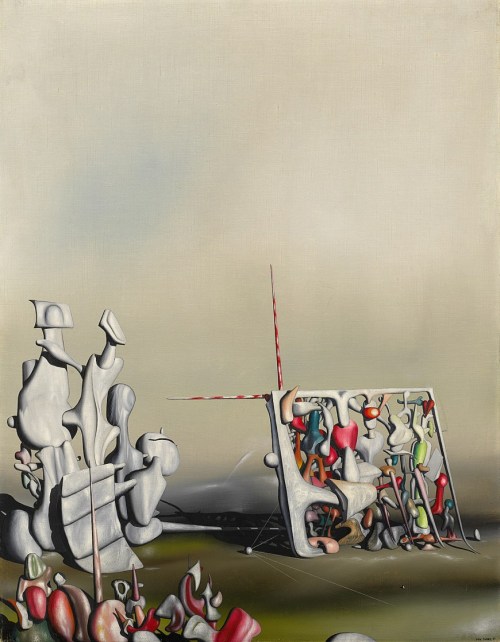
Yves Tanguy- There, Motion Has Not Yet Ceased 1945

Yves Tanguy- There, Motion Has Not Yet Ceased 1945

Little Gidding

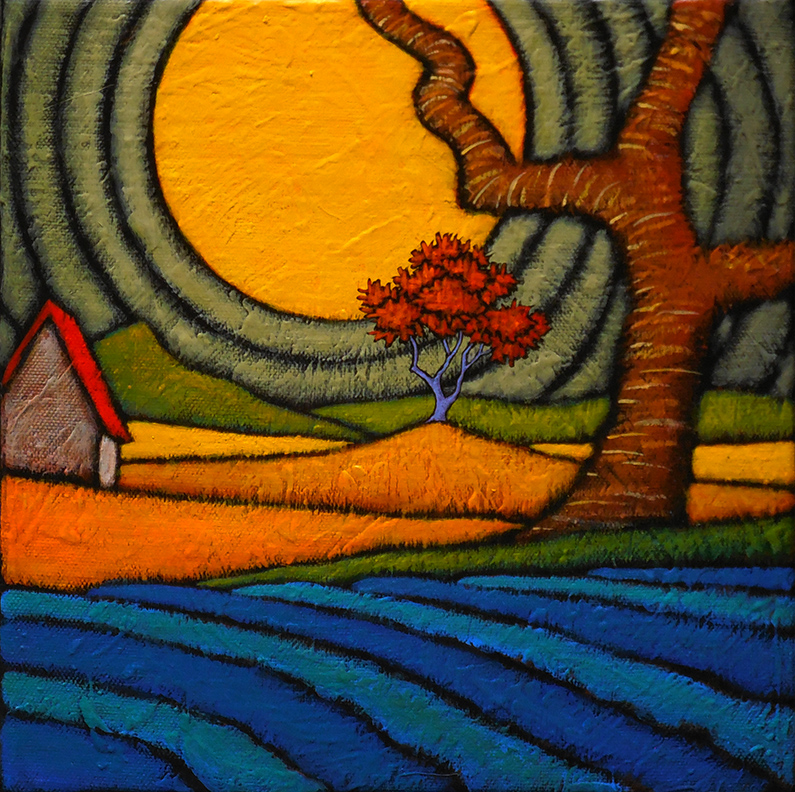
GC Myers-  Silent Dusk

Silent Dusk– At the West End Gallery


We shall not cease from exploration
And the end of all our exploring
Will be to arrive where we started
And know the place for the first time.

–T.S. Eliot, Little Gidding, V


One of those days. A bit somber. I have a lot of other things that need to be done and don’t feel like writing. I am at the part of the process for my upcoming show where it feels like I would rather put what I am feeling in paint rather than in words. At least for today. So let’s just leave it here with a few lines from T.S. Eliot and a reading by Tom O’Bedlam from the final section from his Little Gidding, the last of his Four Quartets.


In a Silent Way

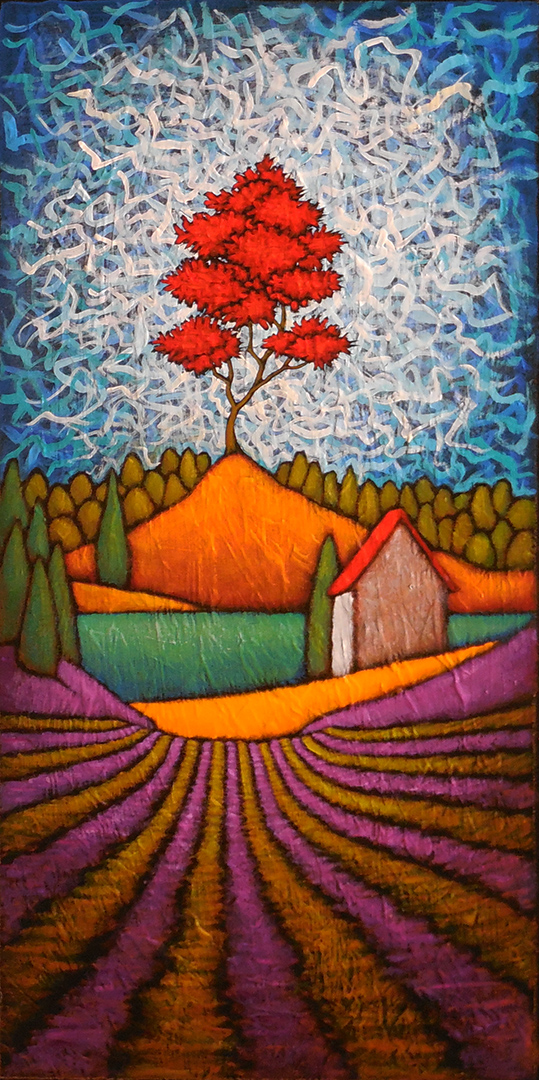
GC Myers- Tempus Quietis sm

Tempus Quietis— Coming to Principle Gallery, June 2023


Under all speech that is good for anything there lies a silence that is better. Silence is deep as Eternity; speech is shallow as Time.

Thomas Carlyle, Sir Walter Scott (1838)


Have things that need to be done today so I will maintain a silence. And as Carlyle noted, isn’t that better?

Here’s Miles Davis and his In a Silent Way. Worth a listen.

But I’ve said too much…


Breaking Joy

GC Myers- Breaking Joy  2023

Breaking Joy— Coming to Principle Gallery, June Show 2023


The drum of the realization of the promise is beating, we are sweeping the road to the sky. Your joy is here today, what remains for tomorrow?
The armies of the day have chased the army of the night,
Heaven and earth are filled with purity and light.
Oh! joy for he who has escaped from this world of perfumes and colour!
For beyond these colours and these perfumes, these are other colours in the heart and the soul.
Oh! joy for this soul and this heart who have escaped the earth of water and clay,
Although this water and this clay contain the hearth of the philosophical stone.

— The Drum of the Realization, Rumi 


The new painting at the top is part of my upcoming solo show, Passages, at the Principle Gallery in Alexandria, VA. The show opens on Friday, June 9th. This piece is titled Breaking Joy and is 24″ by 18″ on canvas.

I think the opening lines of the poem above from Rumi, the 13th century Persian poet, describe very well what I see in this painting:

Sweeping the road to the sky… your joy is here today…the armies of the day have chased away the army of the night…Heaven and earth are filled with purity and light…

That’s the kind of joy I saw in this painting when I first finished it which gave me its title. It’s the idea of finding one’s joy in rising above the earthly bonds of traits such as desire and envy and finding it in light and nature and in the world of thought and imagination.

Not an easy thing to do, of course. But this serves as a reminder that this is not simply a goal that we might hopefully attain in some future time or distant place. Joy is always near at hand, always breaking with each new day.

Joy is in the here and now.

Here’s a lovely version of Beethoven’s Ode to Joy from German pianist Igor Levit. A fine way to start the week.


GC Myers-In the Window- Flower of Doreen sm

In the Window: Flower of Doreen, 2005


I am sure that if the mothers of various nations could meet, there would be no more wars.

–E. M. Forster, Howards End


Just a brief post today to wish a Happy Mothers Day to everyone out there– mothers and children, alike. Just appreciate your moms today. I will be thinking of and missing my mom who passed away back in 1995. The painting at the top from 2005 was a dedication to her around the tenth anniversary of her death.

Below is a post from 2017 that talks a bit about my mom:


Buried in my work right now and there doesn’t seem to be enough time for much of anything beyond it for the next few weeks. So I miss some things here and there. But I did remember, a couple of days ago, to think about my mom on the date that marked the 22nd year [28th this year] of her death. I’m not going to get too sentimental here. It’s an unfortunate fact that most of us experience our parents’ passing at some point so my bit of sadness is no greater or different than that of most other folks.

But I do miss her. She was a =n interesting case, a mass of paradoxes. She was battle-hardened tough but also fragile and generous to a fault. Uneducated but highly intelligent. Stubborn but always willing to change. Deeply private and funny. Loyal and surprisingly fair-minded and principled. I wish I could have seen her live into old age–it would be wonderful to sit with her once more and have a cup of her coffee. Ask her all the questions that went unasked, tell her all the things that went unsaid.

But life is like that, leaving us a handful of memories to recall when we need them. It’s been good doing just that this morning.

Here’s a song form her favorite singer, Eddy Arnold. I remember the album cover this song comes from like it is burnt into my memory. The song, fittingly, is You Still Got a Hold on Me. The painting at the top is named after my mom-it’s called In the Window: Flower of Doreen.

Have a great day…

My Sacred Space


To have a sacred place is an absolute necessity for anybody today. You must have a room or a certain hour of the day or so, where you do not know who your friends are, you don’t know what you owe anybody or what they owe you. This is a place where you can simply experience and bring forth what you are and what you might be.

Joseph Campbell


The short post below is from a bout five years back as is the panoramic photo above. The studio looks pretty much the same today though there is a constant shifting of the work on the walls, for the most part. I’ve worked in this space for about 16 years now and it has truly transformed from a workspace into what I think of as a sacred space, like that which Campbell describes.


I was thinking about my studio and how it influences the work I do. Its size sets some limitations on how large I can work and I sometimes wish I had twenty-foot ceilings where I could do massive canvasses. But that mild complaint does little to take away from how wonderful a space it has been in which to work on a daily basis.

It is comfortable and warm with views that look out on a very private yard with mature trees, several huge rhododendrons and a constant parade of wildlife. It has room to work with a large, well-appointed basement for framing and prepping my surfaces. One of the three bedrooms serves as a library and the other two hold paintings and papers. The stone fireplace that I face most of each day in my main space gives me an elemental, grounded feeling and the light that streams muted by the trees provides a coolness to play off the warmth of the space.

The seclusion it offers is all I could ask for. My large front window looks out on the driveway that curves gently in and whenever I see anyone coming in, it almost feels like an affront, like an invasion into my private world that I see as an extension of the internal one that provides the landscapes I paint. My studio complements that inner world so well, creating a sacred space for me to hopefully bring forth what I am and what I might be, as Joseph Campbell points out in the quote at the top.

It might be the one place on this earth where I feel completely at ease. Not always, but most of the time.

I thought I’d share a shot today of the studio, my sacred space, in all its cluttered glory. It has come to reflect me and I, it.

-2018


[2023] Looking at the photo from several years past, I noticed that the image on the television was the opening title credits for the film It’s a Wonderful Life. I don’t recall if that was intentional at the time but it made me smile today. Since we’re looking back, here’s an old favorite from Jeffrey Gaines that I haven’t heard in a while. It speaks very much of the Hero’s Journey so associated with Joseph Campbell. This is The Hero in Me.


Crescendo

GC Myers-Crescendo sm

Crescendo– Coming to Principle Gallery, Alexandria, VA


Sometimes I sit, sometimes I stareSometimes they look and I don’t careRarely I weep, sometimes I mustI’m wounded by dust

–Laura Marling, Sophia


My annual solo exhibit at the Principle Gallery opens four weeks from today on June 9th.  This means I have about three weeks to finish and prepare the remaining paintings for the show. As the experience of doing this show for the past 24 years have shown me, the coming weeks is filled with a wide variety of emotions for me.

There is the excitement of the work itself as it builds toward the show. Inevitably, it is in these final weeks and the final pieces that the direction of the work hones itself to a fine point. A rhythm (there’s that word again) develops in the months leading up to now and in the final weeks, it is racing fully forward. Everything comes easily and the momentum of one piece carries into the next with full force.

The work seems self-propelling at these times, and I just need to make myself available as the tool which creates the work. It is the excitement of a performer who has rehearsed for months and months and at some point, the work they are rehearsing becomes built-in and natural. It becomes part of them in that moment.

I think that’s what you hope for whatever creative field you might be in.

It might also be like an athlete training for many months for an event. Ideally, their training builds and builds so that at the moment of the event every motion, every stride, is at full effort and in full rhythm.

But there are also moments of despair and doubt, as I have pointed out here before. You worry if you’ve done enough or made the right creative choices when they have appeared. You wonder if you are good enough or if this will be the time when your inadequacies are fully revealed.

Do I have what it takes to finish this race, to reach the crescendo?

Sounds neurotic, I know. And that might be correct. It might also be integral to the process. I don’t know.

It makes for a roller coaster ride of emotions each day.

It’s the best and it’s the worst. 

I’ve had quite a few jobs that were far too imbalanced with worst moments so this is a relative picnic, neurotic as it might seem. At least it has those best moments to counter the worst ones.

Thanks for listening to me babble for a few minutes. It serves a purpose for me–I think. Here’s a favorite song that I haven’t heard in a while. I chose it because of the manner in which it builds to a crescendo. Seems fitting. This is Sophia from Laura Marling.


GC Myers- Force Natural 2022

Force Natural— Coming to the Principle Gallery, June 2023

My father was very sure about certain matters pertaining to the universe. To him all good things — trout as well as eternal salvation — come by grace and grace comes by art and art does not come easy.

–Norman Maclean, A River Runs Through It and Other Stories (1976)


“grace comes by art and art does not come easy”

I think about this line from Norman MacLean’s A River Run Through It quite often, especially in the weeks before a show. It’s a period of time filled with the elation and excitement of new work brimming with new life. But with that there are also intense feelings of doubt and smallness.

I look around and see the familiar singular Red Trees and Red Roofs and round balls of suns and moons and wonder if I have reached my limit. It’s not unusual to find myself asking if I have wrung out the dishrag of whatever little talent or potential I possess.

It’s a maddening time that has me questioning why I continue doing it. Starting work on the next piece becomes harder and harder but I force myself to it. Maybe it’s from force of habit or maybe I see it as my one last attempt.

And I wonder to myself what exactly I am attempting.

It’s at this point that I think of the words above from MacLean.

Maybe it is that grace of which he writes. An action repeated again and again in an attempt to reach a degree of the ultimate rightness. Not perfection because we are, as humans, imperfect and each attempt begins already carrying a measure of our imperfection.

Perfection, no. But perfecting, yes. Perhaps an ultimate rightness, something refined from repetition and persistence, might be attainable. What that ultimate rightness might be varies for each of us. It takes into consideration our inherent and unique imperfections and flaws– those things that differentiate works of art.

Thinking of things in this manner makes this period of time before a show more tolerable. I begin to see each piece as a distinct attempt to reach my ultimate sense of rightness and starting a new piece no longer feels like a great chore but more like the beginning of a journey that might take to me a that hard-fought form of grace I seek.

Maybe this time…

GC Myers- Blaze  2014

GC Myers- Blaze, 2014


When men sow the wind it is rational to expect that they will reap the whirlwind.

–Frederick Douglass


Amplified consequence.

In his 1892 essay, Lynch Law in the SouthFrederick Douglass used the proverb from biblical book Hosea, to illustrate how man often sets things in motion that have results that extend far beyond– and often in stark opposition to– their intended goals. Douglass wrote that the deadly violence being shown against the black citizens of the south at that time would eventually come back to haunt those that perpetrated the deed or stood idly by, complicit in their silence.

The biblical proverb in Hosea was about how the the citizens of Israel of that time (ca 725 BC, I believe) took to idolatry, the worship of false idols, and how their actions brought down upon them the wrath of God. In that book the author uses the concept of farming to make his point, that a  a single seed of grain sowed by a farmer returns to him many times over.

An amplified consequence.

Of course, the farmer can usually tell what the result of his sowing will be. Planting X amount of seed will allow him to reap Y amount of grain at harvest under normal circumstances. Predictable.

But that same degree of predictability doesn’t apply to all other actions man sometimes sets in motion. While we might initially think we control the outcome, we sometimes put actions into motion — sow our seed– that we cannot control, that return to us with such amplification and intensity that we are overcome and sometimes decimated by the result.

One small, seemingly insignificant action, such as not paying attention to a rising dangerous wind, can sometimes turn into a maelstrom of destruction that we never saw coming.


The entry above ran several years back. I wanted to say something today about yesterday’s verdict in the civil case against the former president*** and today’s coming indictment of a sitting congressman along with what no doubt will be many more serious legal actions in the coming months. I believe that anybody that watched closely over the past six or seven years has been anticipating this action for much of that time.

It was an act of faith, this believing that dire consequences would finally come to those characters who twisted and broke laws for their own gains, who lied without end in betraying the public trust. Thise who gained power not to serve the people but to serve themselves.

Justice, however, has been slow in coming and the faith in karmic justice of many has been strained. One was left to wonder why anyone would follow the rule of law when those entrusted to serve us were exempt from doing so. It felt as though unless justice was meted out to those usurpers of the power of our government, everything would come apart.

The center could not hold.

After all, when one has lost all beliefs and trust, what holds their world together?

Maybe yesterday was hopefully a beginning to a coming whirlwind. A righteous and justified whirlwind that will cleanse the landscape and restore the faith of many in that which is right.

Using lines from a couple of other earlier blogposts, Robert Louis Stevenson claimed: Everybody, sooner or later, sits down to a banquet of consequences.

Or to put it in even more direct terms, from the song from Rival Sons:

When it comes back around you’re gonna get what’s coming.
You sit on your fence and you scream about justice.
Between the have and have-not’s only one feels the difference.
And when it comes back around you’re gonna get what’s coming.
When it comes back around you’re gonna get what’s coming.

I’ve played this song a couple of times in the past several years in the anticipation of a coming whirlwind of justice. Let’s hope yesterday’s first breeze foretells of a mighty storm.


GC Myers-  Endless Possibility

Endless Possibility– Coming to Principle Gallery in June


George Gray

I have studied many times
The marble which was chiseled for me–
A boat with a furled sail at rest in a harbor.
In truth it pictures not my destination
But my life.
For love was offered me and I shrank from its disillusionment;
Sorrow knocked at my door, but I was afraid;
Ambition called to me, but I dreaded the chances.
Yet all the while I hungered for meaning in my life.
And now I know that we must lift the sail
And catch the winds of destiny
Wherever they drive the boat.
To put meaning in one’s life may end in madness,
But life without meaning is the torture
Of restlessness and vague desire–
It is a boat longing for the sea and yet afraid.

–Edgar Lee Masters, Spoon River Anthology, 1915


The painting at the top probably represents how George Gray, studying his gravestone in the poem above from Edgar Lee Masters, wished he had lived his life instead of being a boat at rest in the harbor, longing for the sea and yet afraid.

There’s something to think about there, how we let our fears and inner demons squash our greatest desires and rule our lives. 

Maybe we should take a bit of advice from this song, Shake It Out, from Florence and the Machine. As she sings: It’s hard to dance with a devil, on your back, So shake him off…

I bet old George Gray wish he had taken that advice.