Feeds:
Posts
Comments


gc-myers-the-sky-doesnt-pity-1995sm

GC Myers- The Sky Doesn’t Pity, 1995

Competitions are for horses, not artists.

–Bela Bartok


The quote above from Hungarian composer Bela Bartok pretty much sums up my feelings about entering my work in competitions. Don’t get me wrong– I have been a highly competitive person in most things through most of my life. But I never liked the idea of judging one painting against another as though there was some objective scale on which to judge them. Art is always subjective, in the eye of the beholder. Plus, the idea of a judge or group of judges trying to get a grasp of your work with 10 seconds exposure to it seemed kind of unfair in some way.

That being said, I did enter my work in competitions early in my career and have also served as a judge in several others. I had a pretty decent level of success competing, taking a third place in a national competition and a couple of Best in Shows along with a couple of other awards in regional events. But it never felt good to me and when I felt like it no longer served my needs I stopped entering them. 

It was pretty much the same with judging. As much as I tried to be objective, my selections in these competitions always ended up subject to my own likes and dislikes, on whether they moved me in some way. They were honest choices but it always bothered me that these artists were judged on a scale that most likely was unknown to them.

As it was with entering my work in competitions, I no longer judge competitions.

But I do have to add that those competitions did wonders for me early on in my development and I may not be writing this today if not for them. Here’s what I wrote ten years back about the painting above which was the first painting I ever entered in a competition:

I was looking around my studio, taking in some of the work hanging on the walls throughout the house. There are pieces from other artists, including some talented artist friends and young fans along with some notables such as David Levine and Ogden Pleissner. But most of it is older work of my own. There are a few orphans, paintings that showed extensively but never found a home. I see flaws in some of these that probably kept potential collectors from taking it home but most just didn’t find that right person with which to connect. Most of the other hanging work is work that I won’t part with, work that somehow has deeper meaning for me. Work that I just keep close.

One of these paintings is the one shown here, The Sky Doesn’t Pity, a smallish watercolor that’s a little over 4″ square. It was painted in 1995 after I had started publicly showing my work for the first time at the West End Gallery in Corning, NY, not too far from my home.  The gallery has been what I consider my home gallery for 18 years [28 years now], hosting an annual solo show of my work for the last eleven [ 21 now] years.

But when this piece was painted, I was still new there, still trying to find a voice and a style that I could call my own. I had sold a few paintings and had received a lot of encouragement from showing the work at the gallery but was still not sure that this would lead anywhere.  I entered this painting in a regional competition at the Gmeiner Art Center in Wellsboro, a lovely rural village in northern Pennsylvania with beautiful Victorian homes and gas lamps running down its Main Street.

It was the first competition I had ever entered and, having no expectations, was amazed when I was notified that this piece had taken one of the top prizes. I believe it was a third but that didn’t matter to me. Just the fact that the judges had seen something in it, had recognized the life in it, meant so much to me. It gave me a tremendous sense of validation and confidence in moving ahead.

Just a fantastic boost that opened new avenues of possibility in my mind.

I still get that same sense even when I look at this little piece today, a feeling that keeps me from even contemplating getting rid of this little guy. I can’t tell you how many times I have glimpsed over at this painting and smiled a bit, knowing what it had given me all those years ago.

And it keeps giving, encouraging me even now.

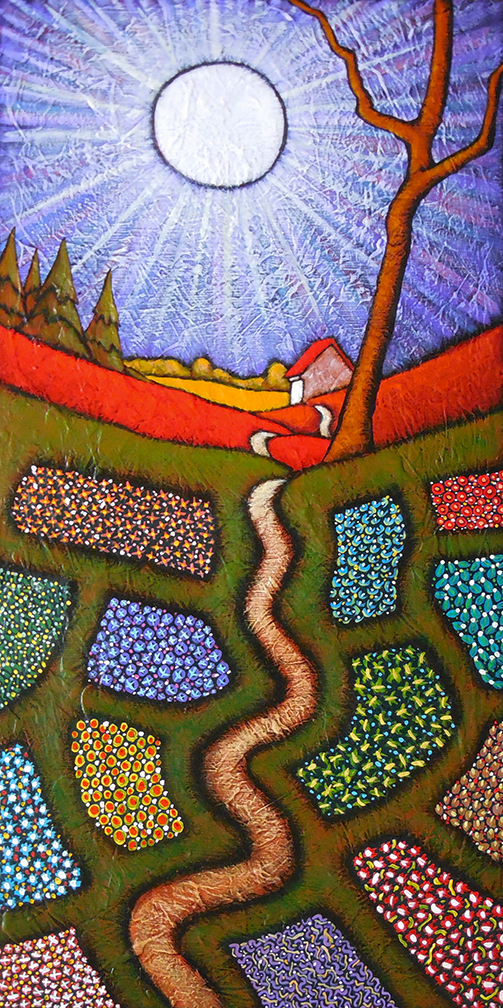
GC Myers- White in the Moon 2023

White in the Moon— At the Principle Gallery, June 2023


White in the moon the long road lies,
The moon stands blank above;
White in the moon the long road lies
That leads me from my love.

Still hangs the hedge without a gust,
Still, still the shadows stay:
My feet upon the moonlit dust
Pursue the ceaseless way.

The world is round, so travellers tell,
And straight though reach the track,
Trudge on, trudge on, ’twill all be well,
The way will guide one back.

But ere the circle homeward hies
Far, far must it remove:
White in the moon the long road lies
That leads me from my love.

–A.E. Housman, A Shropshire Lad, XXXVI


When I was finishing up this new painting that is headed to the Principle Gallery for my June show, I thought of it only in terms of the color blue. But the more I lived with it, the more I realized that the blue, though it seems to dominate the space, held a secondary position in this piece. The white of the moon and the light it sheds on the middle landscape and road carries the emotional weight, at least to my eyes.

And that subtle change in perception makes a significant difference in how I see this piece now. Seeing it in blue made me think of a somewhat sad, perhaps regretful, recollection of the past whereas when viewed with the white light of the moon, it felt more like a clarified remembrance. It is as though the onlooker here is looking back not with remorse or sorrow but with a new understanding of the past.

Maybe a wistful clarity.

Well, that’s how I see this piece which I am calling White in the Moon, after the lines above from A.E. Housman’s A Shropshire Lad. You might see it differently. You may very well see it bathed in blue with all the feeling and meaning that the color carries. In a way, I hope you do because that indicates you’ve engaged with it in even a fleeting way.

And that is a start.

My annual solo exhibit, this year titled Passages, at the Principle Gallery in Alexandria, VA opens Friday, June 9, 2023.

For this week’s Sunday Morning Music I am going with a theme of white light. There are a couple of classical pieces with male voices written for this particular verse– white in the light the long road lies— but they didn’t move me in any way so I decided to go another route. It’s not necessarily a song that you might normally pair with this painting or the verse of Housman. It’s a version of the old Lou Reed/Velvet Underground song White Light/White Heat which has long been a favorite of mine. This is a version from a casually gathered group (for a film, I believe) called The Bootleggers which consists of Nick Cave (who has been a regular on this blog) and Warren Ellis with the late Mark Lanegan on vocals. It has a bluegrassy feel to it that appeals to me on this fine-looking Sunday morning. Enjoy.


Georges Rouault The Old King

Georges Rouault- The Old King, 1936


I don’t know in the world why anyone would consent to be a king, and never to be left to himself, but to be worried and wearied and interfered with from dark to daybreak and from morning to the fall of night.

–Augusta, Lady Gregory,  The Dragon: A Wonder Play in Three Acts, 1920


I somehow found myself awake and watching the coronation of King Charles III early this morning. Not planned, of course. I am not a royal watcher nor a fan of monarchies in general. I did admire Queen Elizabeth II for a number of reasons but that is an exception. The idea of someone believing that they are born to a divine right to rule over anyone kind of ruffles my feathers as I sit here– unkempt, unwashed, unshaven.

I think the idea of kings and crowns speaks more to a need and desire by the majority of people to be ruled over than any divine right that any monarch truly possesses.

But I do appreciate the history of the moment as well as the rituals that go along with the ceremonies of the day. The Brits certainly know how to put on a show. 

Watching the ceremony and trying to write this post took me to the passage above from Isabella Augusta, Lady Gregory, the Irish playwright and co-founder of the Abbey Theatre with W.B. Yeats. While I don’t know the context in which it was written, the sentiment certainly matches up with my thoughts. For the life of me, I could never understand the desire to rule over others. If you are a good and caring person, the responsibility would be a giant and endless task

And if you go the other way, if you are an evil tyrant, you might not have the burden of caring weighing on your mind. You would instead be worrying day and night about who was trying to assassinate you or remove you from power. 

Either way sounds like a drag and who needs that? 

I don’t want to be ruled over nor do I want to rule over anything but my own little space in the world.

My own little kingdom.

Here’s my national anthem, You Can Have the Crown, from Sir Sturgill of Simpson.

Now get the hell out of here before I call out the palace guards. And stay off my royal lawn!


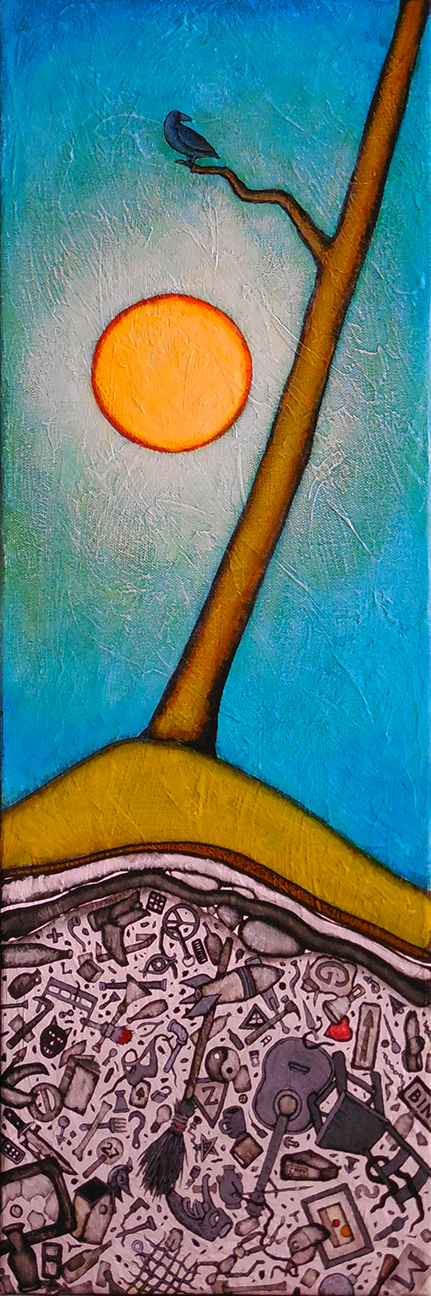
GC Myers-- Archaeology: Executor

Archaeology: Executor— Coming to Principle Gallery

Archaeology is rather like a vast, fiendish jigsaw puzzle invented by the devil as an instrument of tantalizing torment, since: (a) it will never be finished (b) you don’t know how many pieces are missing (c) most of them are lost forever (d) you can’t cheat by looking at the picture.

–Paul Bahn, Bluff Your Way in Archaeology, 1989


This is a new Archaeology painting that is headed to the Principle Gallery for my upcoming solo exhibit there next month. Titled Archaeology: Executor, it is 24″ by 8″ on canvas.

The Archaeology series has been one of the most popular since it was first introduced back in 2008. In the past decade I have only painted a few of these pieces for a variety of reasons. But I decided late last year that I would create a small number of new pieces from this series for this show.

One of the reasons these pieces have been in short supply is that they are difficult to paint. I don’t mean that in the technical sense, except in that they are time consuming with all their little details and such.

No, they are difficult because they present a challenge to my own curiosity. In the earliest examples from the series, I could easily fill the layers of artifacts with little thought as to what was there or how one artifact related to another or what tale they might tell in their jigsaw manner of storytelling.

But as I painted more of these pieces, I began to think about the artifacts and how they related to each other and what story they might be telling. As a result, painting these pieces became even more time consuming because I pondered and weighed each artifact a little more.

And all this additional thinking was off putting.

I know that sounds odd. You would think an artist would want to claim that everything that appears in their work is of their design, a product of their thought process. But early on in this series, I found that the appeal of it for me was the fact that I could just start painting with a minimum of thought, in a kind of stream of consciousness, and that it would produce a pile of jigsaw pieces waiting for someone else to put them all together. Some future archaeologists of art, maybe a kid in a gallery seeing a story come together in their imagination from the disparate pieces.

And that process of just allowing the subconscious to do its thing worked well.

But in trying to work on newer Archaeology pieces over the years, I found that I was trying to make out the story as I was painting. I was putting myself in the place of an archaeologist thinking of what they should find rather than just accepting and reading what they did find.  It was frustrating and often kept me from starting or finishing new pieces.

However, I might be past that now. With the this and a few other recent Archaeology pieces, I seem to have adapted the process. I find that they begin slowly– too much thinking!– but if I can get past a certain point and let my mind wander off on its own somewhere else, it all begins to fall into place.

Well, into whatever place puzzle pieces fall when thrown into a pile.

Do they tell a story? Sure, as much a story as the imaginative mind can glean from found odd bits and pieces. And since each imagination is unique each story will most likely be different in most every way.

And this open-ended way storytelling, that every viewer can see something completely different in them, is one attraction of these pieces for me.

I am still reading the artifacts from this piece. Obviously a primitive culture…

Here’s one of those rare songs about archaeology. This is The Archaeologist from Heather Nova.


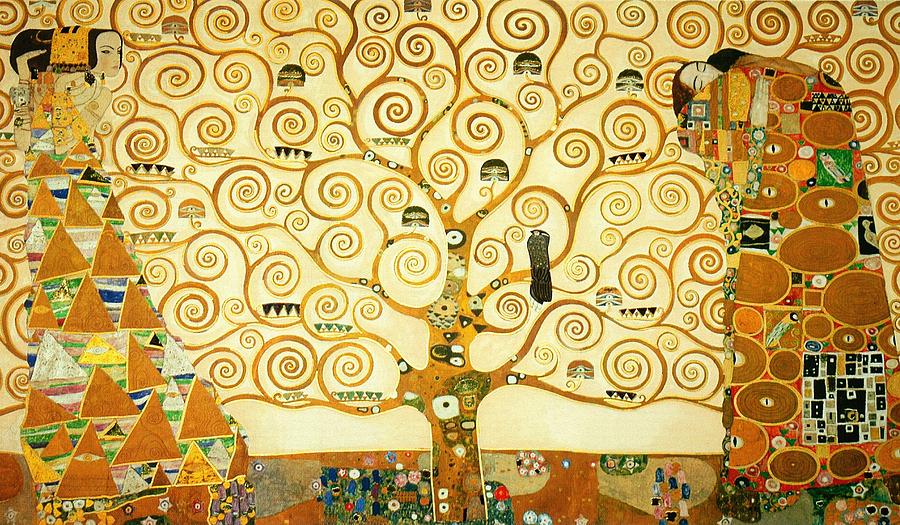
Gustav Klimt the-tree-of-life 1905
Gustav Klimt- The Tree of Life, 1905


There is always hope, as long as the canvasses are empty.

–Gustav Klimt


This quote from Gustav Klimt made me smile this morning, a little knowing smile. When I am getting ready for a show, such as I am now, the studio is initially filled with prepared empty canvasses of a wide variety of sizes, coated with layers of gesso and topped with a thick layer of black paint. They are everywhere, all propped up against any available surface that will support them.

Having them around is comforting, representing possibility. It is the hope of which Klimt speaks. Each blank canvas has the possibility of being a whole new world, a new experience, a new revelation. There is almost a hum of potential life coming from them.

But as the weeks and months pass and many of the canvasses are painted, taking on their new lives and identities, the supply of blank surfaces dwindles down to the point where there is now only a smattering of blank canvasses scattered around the studio. It is at this point when I get anxious, most likely from no longer being surrounded by those empty surfaces that have come to symbolize hope and potential for me.

It is at this point that I can begin to see the end of this painting session, that soon I will have to stop for a bit to ready the work, to photograph, to stain frames and varnish paintings to make them presentable for the show. This makes me a little glum because I am usually very hyped up from the momentum that has been building as the work for the show progressed. This makes me want to paint and push even more, to further explore all the new avenues that are opening up before me in the paintings in which I am working.

Looking around now and seeing just a few empty canvasses is a reminder of that coming point. It makes me pause in for a moment, anticipating that coming shift of gears, and for that moment I am a bit down. But reading Klimt’s words makes me smile, knowing that I just received a new shipment of canvas the other day which is waiting patiently downstairs to be prepped so that it soon can carry all my hopes and possibilities.

And the glumness fades.


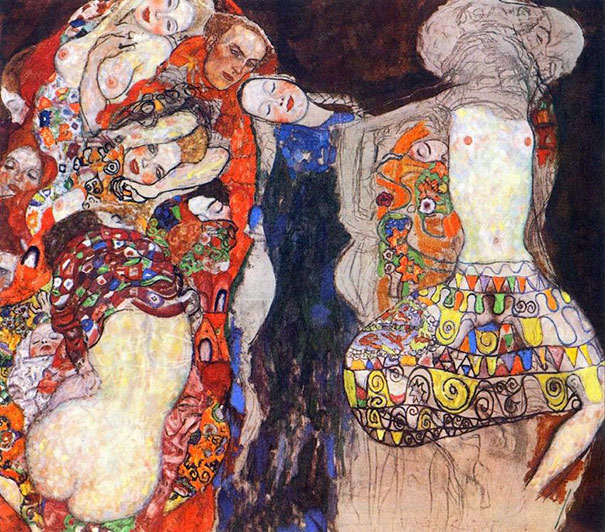
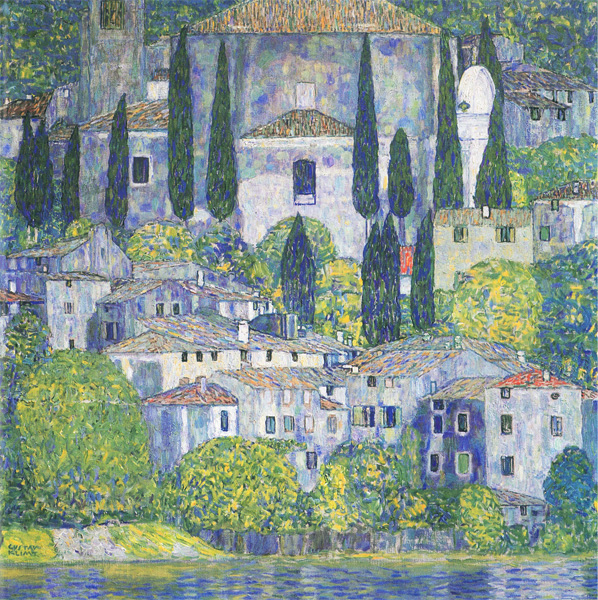
This post originally ran back around this time in 2019. Some things are constants. I have added a few other Klimt paintings that didn’t appear in the earlier post.


adorn the bride with veil and wreath by Klimt.jpg

Gustav Klimt- The Bride, 1918

Church in Cassone Gustav Klimt

Gustav Klimt- Church in Cassone

Gustav Klimt The-Sunflower 1907

Gustav Klimt The-Sunflower, 1907

Gustav Klimt-Beech Grove I

Gustav Klimt- Beech Grove I

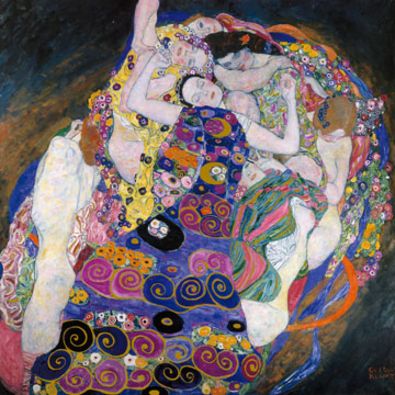
klimt-gustav-la-vergini

Gustav Klimt- La Vergini

klimt-portrait-of-adele-bloch-bauer

Gustav Klimt- Portrait of Adele Bloch Bauer

Persisting…

GC Myers- 2023 Work in Process


If the fool would persist in his folly he would become wise.

–William Blake, The Marriage of Heaven and Hell, 1790 


I have just a few weeks of painting time remaining before I have to do final prep and delivery of my annual show at the Principle Gallery. This year’s exhibit, Passages, opens on Friday, June 9th, at the Alexandria, VA gallery that has hosted my shows since 2000, making this my 24th show there.

That creates a lot of history and experience to pull from, which has proved invaluable as I go through this always stressful process. The process itself is very much like the actual painting process for me. At least, much like one of the two processes I employ.

Let me explain for those of you who don’t know much about my work.

I paint with two very different processes. I began my career painting mainly with watercolor or ink. It was wet work and the process I developed for myself had me applying lots of wet paint then pulling off pigment until I reached the level of color and transparency that suited my needs. I call this my reductive process.

The reductive  process uses the whiteness of the surface as a light source and allows color to immediately shine brightly on that surface. It is a great process for the part of me that desires instant gratification. Once in the process, my job consists of maintaining that original brightness, to not allow any additions to dull the painting’s surface.

It requires a lighter hand than the other process which is a more traditional manner of painting. I call it my additive process because it consists of beginning with a blackened surface and adding layers of color until I reach my desired levels of saturation and tone. use those terms– saturation and tone– but it is not that easily defined. I should say I keep adding paint until some little inner voice tells me to stop, that there is a sense of rightness on the surface. 

This year’s show is almost equally divided between the two processes. Usually, it skews one way or the other, in recent years much heavier towards the darker based additive process. But this year I am finding it easier to transition between the two. Maybe it has to do with simplifying and comparing the processes in my mind.

The wet reductive process takes me to its peak quickly and I have to totally concentrate on keeping the painting at that peak. I have several unfinished pieces from this process waiting for me to return to them but they still have so much of that peak glow and shine that I am hesitating until I can fully devote my mind to them. It is a matter of preservation from the get-go.

The additive is more about persistence. It is a process that takes me through a kingdom of dullness at many points. The detail at the top is from a painting I am currently working on and is good example of this. Yesterday, I worked on this section for many hours and most of the time I absolutely hated it. Layer after freaking layer, my frustration continued to grow. There were several times when I truly felt like bringing out the black paint to cover the whole of it and restart. 

This is where the year’s of experience and knowing how each process progresses comes into play. I knew I had been through this part many times before. It is actually a part of the additive process. I know going in that it is going to be frustrating, that this is a matter of tolerating the dullness until the desired glow finally appears. I kept telling myself to go on, that I can make it right, that I can fix it.

And like most of the times in the past, I moved past the dullness and found the peak. 

Persistence.

Having these two processes — one of preservation and the other of persistence — is kind of like being bi-polar. One is high, one is low. One is about the initial thrill of color on the surface, about finding myself on a high peak and trying to not fall off. The other is about making your way to and clawing your way up to that peak.

Each has its own difficulties and challenges. I guess each matches up to the highs and lows that abound in my own psyche. I’m probably pretty fortunate to have developed the two together. I don’t know if one alone would have sufficed.

Who knows? Just rattling on this morning. Thanks to those of you who endured in reading this far. For those that didn’t– they can take a hike.

Better yet, let’s all take a hike. You guys go on ahead. I got work to do.

The show must go on, you know.


GC Myers- Secret Garden

Secret Garden— At the Principle Gallery

Well, I wake up in the mornin’
And the ding dong rings
You go a marchin’ to the table
You see the same old thing
Baby, all I want to tell ya
A knife, a fork and a pan
And if you say a thing about it
You’re in trouble with the man

Let the midnight special
Shine a light on me
Let the midnight special
Shine it’s everlovin’ light on me

The Midnight Special, Leadbelly


A little busy this Monday morning but I thought I’d share another song from the recently departed Harry Belafonte. This is his take on the folk classic, The Midnight Special, from 1962. It’s a notable performance because it marks the first time that Bob Dylan appears on a released recording. Relatively unknown at the time, Dylan was brought in at the last minute to fill in on harmonica when Sonny Terry, the celebrated bluesman who Belafonte and his producers wanted for the session, became suddenly unavailable. 

Belafonte wrote of the session and how Dylan came in with a bag filled with harmonicas. After they established the key and tuning, Dylan picked out one from the bag, soaked it in water, then did his part. When Belafonte was satisfied with the take, they asked if Dylan wanted to hear the tape. Dylan said no. He then headed out the door, stopping to throw the harmonica into a garbage can.

Belafonte watched and wondered if this was a display of disdain and disrespect for Belafonte’s music. He later found out that Dylan was using cheap dime store harmonicas and that they were often of little use after the way he had soaked and played them. Belafonte became a Dylan fan but it wasn’t until many years later when he read Dylan’s autobiographical book Chronicles that he learned that Dylan was a huge Belafonte fan as well. Dylan felt that his experience with that recording session was one of the most special of his career, being transformative for him. He wrote that he felt “anointed” by having recorded with one of the great men of the time.

It’s a fine version and an interesting story with two giants of music at different points in their careers.


PG GCMyers-- Comforter sm

Comforter – At the West End Gallery


That life is difficult, I have often bitterly realized. I now had further cause for serious reflection. Right up to the present I have never lost the feeling of contradiction that lies behind all knowledge. My life has been miserable and difficult, and yet to others, and sometimes to myself, it has seemed rich and wonderful. Man’s life seems to me like a long, weary night that would be intolerable if there were not occasionally flashes of light, the sudden brightness of which is so comforting and wonderful, that the moments of their appearance cancel out and justify the years of darkness.

–Hermann Hesse, Gertrude (1910)


It was one of those mornings when you wake up with an air of glumness around you. You know it’s going to rain all day, that there will be no sunshine to hold you up like a crutch. No light to wash out the stain of gray. In the early light of morning, the grayness seems even more stark, the rain giving everything out the window a graininess, like you were looking at an old photograph.

You sigh and it feels like the glum and the gray might infect everything for the day. Maybe longer. It makes you reflect and all you can pull up are other memories of this glumness and all the other difficult passages of life.

Hesse’s words begin to ring true, that life is difficult and miserable. A long and weary night.

You gird yourself for the coming day, knowing that it might be a constant struggle. One of those days where nothing goes the way you desire and everything feels like it’s turned to pure crap…

That’s how my morning began.

An absence of light.

I was ready to simply find a song to play for this week’s Sunday musical selection and get on with it. Face the day and do battle with it. But in doing so, the first song that caught my eye on the opening YouTube page was an old song from Tommy James and the Shondells. From 1968. Heard it a thousand times before and always liked it. Probably played it here before after it was used to great effect in a late episode of Breaking Bad.

So, I clicked on it. It was a video that had the lyrics so I read along. It felt like one of those flashes of light that Hesse mentioned above, with a sudden brightness that is comforting and wonderful. In that flash of light, the glumness receded and I felt that my spirit was lightened.

I am ready now for the day. Maybe even eager.

Such is the power of music, of art. And, man, am I thankful for that.

Here’s that song, Crystal Blue Persuasion.


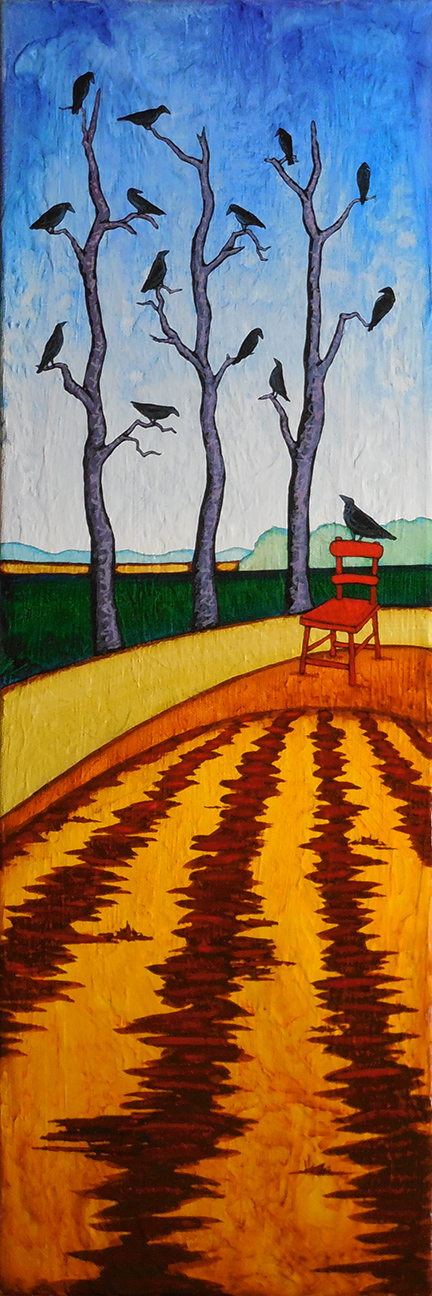
GC Myers- The Impossibility of Crows sm

The Impossibility of Crows– Soon at Principle Gallery

The crows like to insist that a single crow is enough to destroy heaven. This is without doubt, but it says nothing about heaven, because heaven is just another way of saying: the impossibility of crows.

-Franz Kafka, The Zürau Aphorisms, #32


When I finished this new painting that is headed to the Principle Gallery for my annual solo show there in June, I thought of the above aphorism from Franz Kafka. It’s sometimes eludes my understanding when I come across it and it takes me several moments to recall the logic it holds.

Basically, at least in my reading of it, it declares that crows know that since they have always been the targets of hatred and scorn among humans, they are not part of heaven as constituted by humans. Therefore, they know they could not exist in that realm. Thus, if one crow were to appear in heaven it would destroy the very illusion of heaven that humans had constructed.

Now, I know nothing of heaven — don’t even have an opinion on the reality of its existence– so I can’t speak on it with any certainty. I am also a longtime fan of crows, believing them to possess an intelligence and consciousness that we have long misunderstood.

But I know they have also historically been vilified by most people so the idea that they would be excluded from the average conception of heaven makes sense to me. So, the idea of a crow suddenly appearing in heaven being a calamitous event makes sense as well.

In real world terms, anytime we hold a belief that denies the existence of others, we are creating a world — a heaven, if you will– that is ripe to be upended when those whose existence we deny show themselves to be.

I think this could be applied to the past and current cultural wars surrounding the civil rights of minority groups. There are those who wish to deny the existence of these groups, to exclude them from the deniers’ concept of what the world should be. When it is proven that they do in fact exist and are present in this world, it creates a sense that the world — their conceived heaven — is in the midst of being destroyed.

Ultimately, I find myself both understanding and questioning this aphorism. First of all, I wouldn’t want to have a heaven that didn’t include crows or for that matter, any other creature or being. Just as I wouldn’t want a world without the full variety of people that make up this world.

Because who’s to say that I might not appear as a crow in the eyes of others? Couldn’t we all be the crows in some way in this exercise?

Like I said, I don’t know if there is a heaven. But I do know there is the here and now and, in the absence of a heaven, we need to make of it what we can. For all– crows included.

I am calling this new 24″ by 8″ canvas The Impossibility of Crows. Maybe it should be called The Possibility of Crows? After all, it shows what could be considered an idyllic landscape complete with crows.

Here’s version of a folk song, The Crow on the Cradle, that was written in 1963 by English songwriter Sydney Carter. It has been covered by a variety of artists but this one from Jackson Browne, accompanied by David Lindley, is a favorite of mine.


GC Myers- The Incantation ca 1994

GC Myers- The Incantation, ca 1994


Trouble in the jailhouse, trouble out in the street
You can’t blame it on someone else, you’ve got no place to retreat
Trouble in your courtroom, trouble written on the wall
And all the pieces of your mistakes are starting to fall

How long have you been blind
Been coming a long long time

–How Long Have You Been Blind?Floyd Red Crow Westerman, 1984


Got things to do this morning but thought I’d share a song performed by the recently late and always great Harry Belafonte from back in 1985. The song, How Long Have You Been Blind?, was written and originally recorded in 1984 by Floyd Red Crow Westerman, a Dakota Sioux musician and political activist. Belafonte’s version never appeared on album or single, only appearing as part of a Canadian television special, Don’t Stop the Carnival.

But the song with its words of warning against complacency and this performance had real staying power. Lenny Kravitz recently recorded the song in tribute to Belafonte. I am including Belafonte’s 1985 performance and the new Lenny Kravitz version.

[ Sorry, there has been a problem with the videos on this post. We are trying to rectify the problem. For the time being, you can view these videos by following the links below]

https://youtu.be/Ibd5wajy9AY?si=AlAkTIaN4afIKpmU

https://youtu.be/TR5DNlgQJVs?si=-H-EqYzkBEDaMEPi