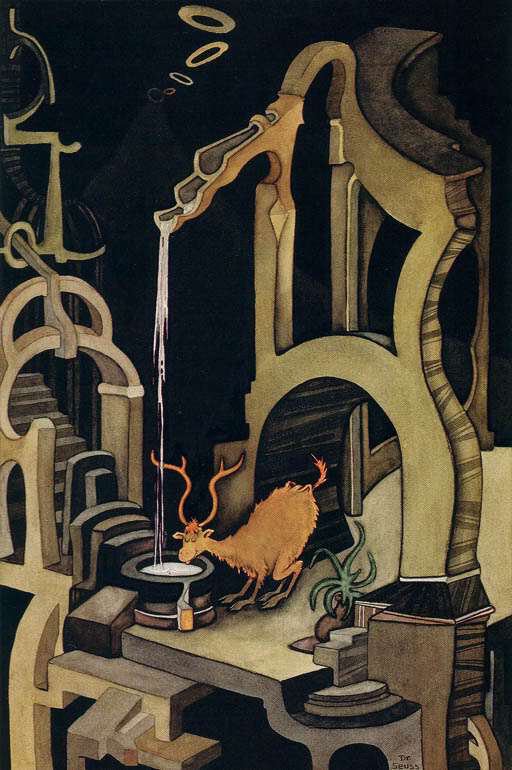
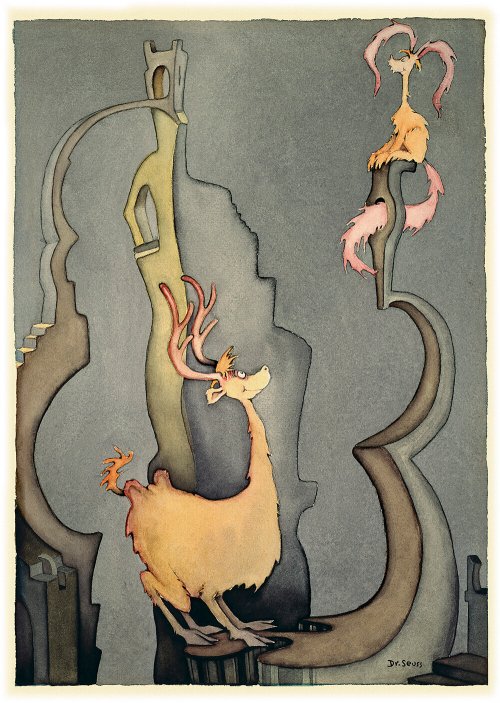
I think these words about sincerity from the wonderful and wise Dr. Seuss are good advice for just about anybody. For myself, I pass this advice on to young artists. Make your own meaning and feeling the focus of your work…
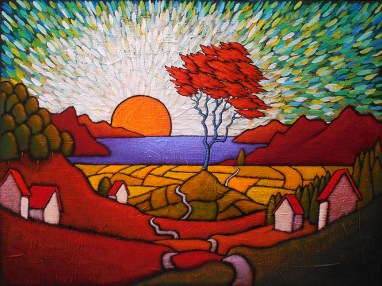
I ran the short post above several years ago and it resonated with me again this morning. For one thing, it reminded me of how much the imagery and messaging of Dr. Seuss influenced and informed my own perspectives and art. I never thought about it at the time I started drawing and painting but his way of representing the landscapes of his worlds very much infiltrated my own way of looking at my own inner worlds. I see the bendy curves of his trees and smile because I see them in many of my own Red Trees.
The other reason this older post resonated with me were his simple words about honestly saying what you mean and acting how you feel. There are many days when I am trying to write this blog and I feel inhibited by not wanting to offend anyone with my own personal views. I have many times set aside posts that I deemed potentially too offensive. But more and more, I am less shy about sharing my honest opinions for just the reasons that the good Dr. points out: those that matter don’t mind and those who mind don’t matter.
And that also translates to my work. I am also less shy in sharing work that moves outside my comfort zones for this same simple reason. I figure if I am being honest and sincere in my work and in my opinions, what do I have to fear from the opinions of others?
So, thanks for that Dr. Seuss, wherever you may be. Your words and art and storytelling have changed the worlds of many, myself included.
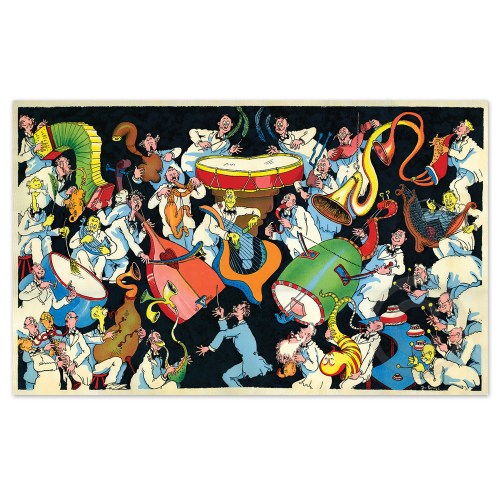
Here are a few more of his paintings that weren’t in the original post. [ The above post ran on this date, April 27, back in 2000. I have added several more Seuss paintings for your enjoyment]
Time will say nothing but I told you so, Time only knows the price we have to pay; If I could tell you I would let you know.
If we should weep when clowns put on their show, If we should stumble when musicians play, Time will say nothing but I told you so.
There are no fortunes to be told, although, Because I love you more than I can say, If I could tell you I would let you know.
The winds must come from somewhere when they blow, There must be reasons why the leaves decay; Time will say nothing but I told you so.
Perhaps the roses really want to grow, The vision seriously intends to stay; If I could tell you I would let you know.
Suppose all the lions get up and go, And all the brooks and soldiers run away; Will Time say nothing but I told you so? If I could tell you I would let you know.
Now I’ve done my best, I know it wasn’t much I couldn’t feel, so I tried to touch I’ve told the truth, I didnt come here to London just to fool you And even though it all went wrong I’ll stand right here before the Lord of song With nothing, nothing on my tongue but Hallelujah
–Leonard Cohen, Hallelujah
A video came up on my YouTube feed this morning that I remembered sharing here several years ago. It’s a fine performance of the Leonard Cohen classic Hallelujah performed by Choir!Choir!Choir! which is a loose knit group of singers that was formed in a Toronto pub back in 2011. The group requires no commitment and still meets twice a week in the back of a local pub. Over the years it has performed publicly in many venues in Canada and the US with greatly expanded choirs — sometimes well over 2000 singers! –made up of folks who just want to get out and sing in a communal way.
There’s something wonderful and powerful in the collective voice.
They’ve had a number of guest singers join in over the years: David Byrne, Patti Smith (her Because the Night is one of the group’s unofficial anthems), Eddie Vedder, Rick Astley and others, including Rufus Wainwright on this song.
This particular version is filmed at the Luminato Festival in Toronto in a decommisoned power plant with an assembled choir of 1500 people with Rufus Wainwright singing the lead.
Just a lovely version of the song and not a bad way to kick off a Tuesday morning, as I also wrote about seven years ago when I first shared this song here on another Tuesday morning. It was good then and good now. Hope you’ll enjoy…
My work embodies little visions of the great intangible. … Some will say he’s gone mad – others will look and say he’s looked in at the lattices of Heaven and come back with the madness of splendor on him.
–Marsden Hartley
I have a busy morning so I thought I’d run a trio of three short posts from the past about a favorite artist of mine, Marsden Hartley. Hope you’ll enjoy his words and paintings.
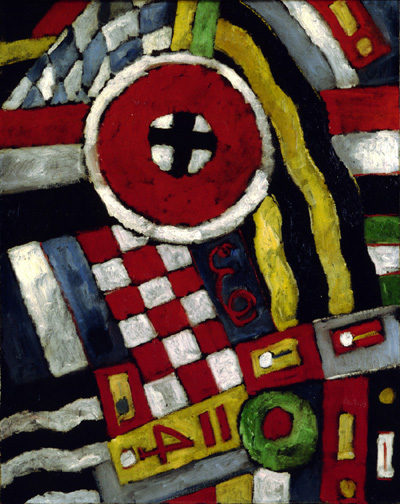
Marsden Hartley- Berlin Expression
I have come to the conclusion that it is better to have two colors in right relation to each other than to have a vast confusion of emotional exuberance. . . I had rather be intellectually right than emotionally exuberant.
–Marsden Hartley
I have been a fan of the paintings of Marsden Hartley (1877-1943) for some time now. I was reading about him earlier and came across this quote that caught my attention, making me think about what I hoped to accomplish in my own work.
I often speak about creating work that has an immediate emotional impact achieved with colors and forms. But maybe, as Hartley’s words have prompted me to think, this first purely visceral and emotional impact is pure exuberance. Just a gut reaction that comes in that instant before the mind has time to engage.
A shout that makes you turn and look.
While that is good and desired, it’s doubtful that it can stand by itself and have a lasting effect unless it has an intellectual aspect to engage the viewer’s mind. There needs to be a balance between the mind and the gut.
If you turn at hearing a shout and the person doing the shouting is shouting just to make you turn and has nothing more to say to you, you keep moving and soon forget that person. But if you turn and the shouter has something more to offer, you might linger a bit to consider what is being said and engage in a conversation.
When you do move on, you take something from this engagement with you, something that will stay with you.
I am not sure this an apt analogy but it immediately came to mind on reading Hartley’s words. I don’t exactly know how this mind/gut balance works or how it can be accomplished in reality. Maybe even consciously trying to do so throws the whole thing off kilter.
It’s early in the morning and I am just thinking here. Time to go try to put it into action…
—From April 2018
Marsden Hartley- Portrait of a German Officer, 1914
I have always said that you do not see a thing until you look away from it. In other words, an object or a fact in nature has not become itself until it has been projected in the realm of the imagination.
– Marsden Hartley
Marsden Hartley (1877-1943) is a favorite of mine both for his paintings and his words, which often express thoughts about painting that ring true for my own experience. For example, I love this quote above. Some of the strongest images for me are those that are taken at a glance, sometimes while driving down the highway at 70 miles per hour.
If the imagery strikes me in a powerful way, my mind immediately starts breaking down the image into a sort of shorthand, blocking in the forms and organizing them in a way that registers deeply. It is simplified but contains the elements and the effects that struck me. Sometimes I will move my arms while doing this, trying to create a muscle memory of the rhythm of that which I am seeing in my mind.
The image is thus entered into my imagination. Everything else around it that is not part of image that spoke out to me seems to not exist in that moment. It s a funny process and is deeply ingrained to the point that I don’t even think about it but for this reminder from Hartley.
Got to get to work. Have a great day.
–From March, 2019
Marsden Hartley- Painting Number 5, 1914-15
All things that are living are expression and therefore part of the inherent symbology of life. Art, therefore, that is encumbered with excessive symbolism is extraneous, and from my point of view, useless art. Anyone who understands life needs no handbook of poetry or philosophy to tell him what it is.
–Marsden Hartley
I think this is an important point from a favorite artist of mine, Marsden Hartley. Trying to paint work that is pointedly symbolic, that tries to force meaning that doesn’t naturally flow from the subject, often feels flat and lifeless to me. Or extraneous and useless as Hartley put it.
Generally, the subject evokes its own meaning and feeling and the best the artist can do is enhance it with their own skills and style — the artist’s tools for storytelling– to make it apparent to the viewer.
Sounds easy. It’s not.
We often add symbology or clutter that either clouds, alters, or detracts from the inherent meaning of the subject.
We complicate when we should simplify.
It’s the story of communication throughout time. Simplicity always triumphs.
I hope that makes sense. I am tired this morning and it sounded okay halfway through my first cup of coffee. A couple of hours from now I might have questions about this.
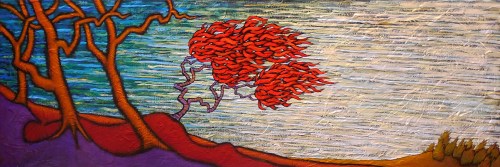
All of Time– Coming to the Principle Gallery, June 2023
But at my back I always hear Time’s wingèd chariot hurrying near; And yonder all before us lie Deserts of vast eternity.
–Andrew Marvell, To His Coy Mistress, 1650
This is a new painting that is part of my annual solo exhibit opening in June at the Principle Gallery in Alexandria, VA. It’s an 16″ by 8″ canvas that I am calling All of Time. which refers to the Baucis and Philemon aspect of the painting as depicted in the two intertwined trees.
If you recall the myth, Zeus granted a wish to the poor elderly couple who had treated him with warmth and generosity when he appeared in their village in the garb of a beggar. Their wish was that when they died they should remain together for all of time. They later died simultaneously and were transformed into two separate trees growing from the same trunk, forever as one.
While that is the obvious subject, this piece is primarily about the depth and juxtaposition of the colors throughout it. The magenta in the foreground, for example. Or the opal-like quality of the colors in the sky and even in the way the light breaks through those colors.
Even without having that myth in mind, this painting would make me think of some form of eternity. Or at least a contemplation and reminder of our limited time here. That’s why I chose the lines above from the 17th century British poet Andrew Marvell. They are from his To His Coy Mistress which is considered one of the finest examples of a carpe diem poem. Seize the day. In it, the narrator of the poem is attempting to seduce a young woman who is resistant to his advances. He tells her that if they had the benefit of eternity, he would gladly spend centuries wooing her. He then stresses that their time here on earth is short and that their time for love and passion is now.
Those are two different views of love and eternity. In the Baucis and Philemon myth, love can exist for all of time while in the Marvell poem, we only have a limited time to love and that eternity is a vast and empty desert devoid of love. However, I think both work for this painting, that both can be equally true.
Just the way I see it. You may see it differently.
As it should be.
Here’s a fitting song for this week’s Sunday Morning Music. It’s a strong cover of the Bee Gees classic To Love Somebodyfrom TheRevivalists, the roots rock band from New Orleans. Recorded in a specially equipped van at California music festival back in 2013, their version gives off strong Levon Helm/ The Band vibes for me. Which is to say, it’s good stuff. See — or rather, hear for yourself.
“I wrote to Picasso once: I did not receive a reply. I saw Picasso at a party or an opening or something crowded and awful in New York. I spoke to him. I repeated what I had written in my letter: How do we do it? What do we do when the images and the words do not come forth? How do we survive? How do we remain artists? He looked at me with those glorious eyes, snapped back that shiny, bald head and told me that we are not artists; we do not concern ourselves with ‘art.’ We are workmen, day laborers–who happen to work with paints and clay and actors, and curtains part on occasion to display what we do. Tell the truth, he said. As you know it. Art may happen; it may not. We are not owed its presence. His point was made.”
–Tennessee Williams/Interview with James Grissom/New Orleans/1982
I still cringe a bit when I tell people that I’m an artist. It seems presumptuous to take on that label or to assume that I am creating art at any time. How do I know if my work reaches the level of art? Can anyone ever say with certainty that they are creating art?
I am much more comfortable with the definition Picasso put forward to Tennessee Williams in the passage above.
Workman.
Day Laborer.
Though I believe it does in many cases, the question of whether whatever I do reaches the level of being categorized as art is out of my hands. I just do what I do and hope for the best. Keep my head down and work at expressing a truth as a I know it with the hope that someone sees something in it that sparks some feeling in them.
But, as Picasso pointed out, art may happen; it may not. We are not owed its presence.
I reflect on the fact that I am in my 25th year of doing this as a full-time day laborer in this field and I realize what a leap of faith it has been to keep doing this year after year with the hope that something approaching art will be produced, never knowing if art will deign to attach its label to my work.
Like Picasso, I know that it doesn’t matter. I just have my appointed tasks before me each day and I do them as best I can.
And maybe that is where the art begins, in continuing to diligently work each day, year after year, with the dogged belief that there is something in the work beyond myself. Something to be expressed, to be seen and transmitted.
Maybe it is in the whole of it that art approaches. Maybe it comes in pure persistence, in finding meaning in both those grace-filled days when the work comes effortlessly and on those days when the work feels like Sisyphus pushing his rock up that steep hill.
Maybe it is the accumulation of time and effort and thought and desire.
Maybe not.
Who am I to say?
I just work here.
Though I see myself as a worker and not a prisoner, this song feels right for the morning. It’s a historic Alan Lomax recording of a prison work song from Parchman Farm, a former plantation turned maximum security prison in Mississippi. This is Early in the Mornin’.
To see a World in a Grain of Sand And a Heaven in a Wild Flower Hold Infinity in the palm of your hand And Eternity in an hour
These are the first four lines of a poem, Auguries of Innocence, from William Blake. It was written in 1803 but not published until 1863, 36 years after Blake’s death in 1827. These first lines point out the interconnectedness of all things, that all living things possess meaning in the grand scheme. These four lines might well be the best-known lines of Blake’s work but is much beyond those four lines in this piece.
The poem serves as a plea for compassion and empathy as well as a warning (an augury is an omen) against cruelty and deception, pointing out that these harm not only the offended but also damages the offender and the rest of the world as a whole. It’s a wonderful piece filled with a multitude of notable couplets that speak to the cruelty and deception of our current time. For example:
A Truth thats told with bad intent Beats all the Lies you can invent
To twist and manipulate a truth for less than honorable gain weakens society and demeans us all. Or there’s this:
He who shall teach the Child to Doubt The rotting Grave shall neer get out
Or this:
A dog starvd at his Masters Gate Predicts the ruin of the State
You get the idea, I’m sure. There’s a lot more to say about it but, in short, it’s a poem worth reading and hearing. I am sharing a marvelous reading of it from the actor Michael Sheen. I suggest reading along to it by clicking here which takes you to the poem at the Poetry Foundation site. I assure you that it is 6 minutes or so well spent.
I know now: I do not hope for anything. I do not fear anything, I have freed myself from both the mind and the heart, I have mounted much higher, I am free. This is what I want. I want nothing more. I have been seeking freedom.
–Nikos Kazantzakis, The Saviors of God, 1923
Can we ever be fully free of fear?
I don’t really know how to address that question. There seems to be so much fear in this country and around the world that it seems like a futile question at this point.
It’s a form of fear that has become so ingrained in the culture that it has become one of the prime market motivators. It has transformed into a manufactured entity that moves product. It creates ratings, builds political power and sells guns and gold and so much more.
I guess the question should not be whether we can be free of fear but rather: Can we continue to exist with so much fear?
I’m thinking of this past week and the several young people who were simply in the wrong place being shot without confrontation by people filled with unfounded fears. I sometimes end my posts here kidding around about being an old codger waving my fist at kids, telling them to stay off my lawn. That doesn’t seem so funny at the moment because now Grandpa is scared and might be shooting to kill.
How do we function as a society when the simple act of approaching someone to ask a question or ask for help becomes a potentially life-threatening act?
Bertrand Russell had it right: Fear is the main source of superstition, and one of the main sources of cruelty. To conquer fear is the beginning of wisdom.
We are experiencing that fear and cruelty right now. Can we get past it? Can we begin to aspire to such wisdom?
I don’t know.
I guess we can only focus on ourselves as individuals. Try to move to a point where we are above fear. That’s not to say we should not live with a degree of caution– there are dangerous things in this world– but we cannot continue to exist in our current state of paranoia and cruelty.
Okay, I’ve had my say. It’s up to you now. You have to get to that loftier point on your own even though as the song goes, I want to take you higher. The original versions of that song from Sly Stone are unmatched and I have played them here before. But Tina Turner did many damn fine performances of this classic. Here’s a great television performance of it from the late 60’s.
No fear present in this. Just a whole lotta energy.
Now listen and leave. I am not shaking my fist but I do ask you to please stay off my lawn.
I painted like that because I wanted to get through to something new – a kind of painting that was my own.
–Georges Seurat
Sometimes when I speak to schoolkids, they show me their work. The kids display an interesting mix of pride and embarrassment as they sometimes tell me that they don’t think their drawings or paintings are very good. I know that feeling well. I was those kids once, with an aim that far exceeded my ability at that point. A friend sent me an image from a 6th grade newsletter that had a drawing of mine from that time in it that had me gasping at how poorly I drew at that time. I think it was supposed to be Dr. J dunking a basketball but who could tell? It might have been Eleanor Roosvelt.
It was cringeworthy but it helped me in being able to tell these kids that where they are now is not where they will end up so long as they continue to practice and take small steps forward. You can’t judge a journey by the first steps on the path.
I thought I would share this post from about four years back that dealt with this idea of development and growth. Plus, it’s just a great way to share some good work from Georges Seurat.
I subscribe to a service that provides information such as auction results for artists, both living and dead. It is always interesting to scan the auction results for my favorite artists, to see how they are currently viewed by buyers. For example, anything by Vincent Van Gogh always draws huge money, even the work that doesn’t possess the signature brushwork and color of his better-known works. The iconic pieces, of course, go for astronomical sums. His popularity with the public is as strong as ever but that is no surprise.
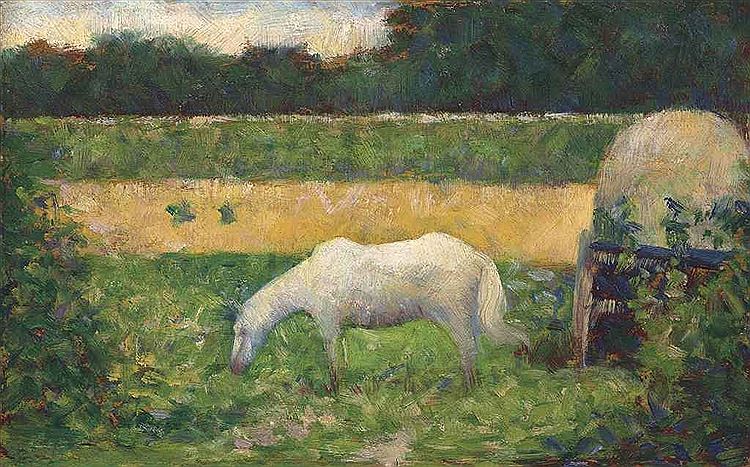
It’s also interesting to scan the results to see work from artists other than their more famous paintings that hang in museums. We tend to think of artists by their best work and seldom see the complete chain of work that runs through their career, never really seeing their weak links or the developmental work that led to their signature style or voice.
The image to the right, Paysage Avec Cheval, a painting that recently went up for auction at Christie’s London, is a good example of this. It’s a lovely piece but you might not guess the artist. This is from Georges Seurat whose work, such as his most famous work shown at the top of the page, is forever tied to pointillism. But scanning through his records, you can get a better sense of the evolution of his work. [ Note: This painting of a horse, small at about 6″ x 9″in size, sold in 2014 for over $1.8 million which, while it is a large number, is a tiny fraction of what his better-known work sells for.]
I am also looking for consistency in the artists whose work I am scanning through. Again, we always think of the artists in terms of their best-known works and are often unaware of the totality of their body of work. Some artists are incredibly consistent, even in their early formative years. Others have high peaks and deep valleys, with a huge disparity between their best and not-so-best work. I am always encouraged by both types of artists.
I strive for consistency in my own work and am proud of the consistency of quality and style that has been established. But, of course, there have had dips and valleys in my work, particularly in the formative days of the early days.
At that time, I still thought of the great artists only in terms of their best works that hung in the great museums of the world, thinking that they simply got up and turned out this incredible work each day. I could not fathom the possibility that they had swings and misses, that they had periods of struggle and uncertainty. It’s encouraging to see that those icons whose work I revere often struggled in the much same way as me and that the great works we know them for were not created in a vacuum. They came with great effort and day after day of moving ahead in often small increments.
I think any aspiring artist who feels intimidated by the great works should take a few minutes to look through the whole of the works of their heroes. They might be encouraged, as I often have been, to know that the path they are on is not so much different.
While we’re here, let’s look at some of Seurat’s other work. It starts with a video that combines his work and the music of Vivaldi. It does a nice job of interspersing his earlier work with the work displaying the pointillist style that is so associated with him. Then the first two images below the video are examples of his earlier pre-pointillist work and then several examples of his better-known pieces.
[This is a mashup of a couple of posts from years past]
We do not succeed in changing things according to our desire, but gradually our desire changes. The situation that we hoped to change because it was intolerable becomes unimportant. We have not managed to surmount the obstacle, as we were absolutely determined to do, but life has taken us round it, led us past it, and then if we turn round to gaze at the remote past, we can barely catch sight of it, so imperceptible has it become.
–-Marcel Proust, In Search of Lost Time (1913-1927)
I keep thinking about this passage from Proust, about how our desire sometimes changes because of our inability to change other things. I know that it’s true for most things.
Once we see that we have no chance at altering whatever situation we wish to change, we rationalize away our reasons for desiring that change in the first place. The process of minimizing its importance begins.
As Proust writes, life takes us around it.
But I wonder if there are things that are impervious to this? Things too big, too important to rationalize away our concerns and desires. Things that we just can’t normalize and accept.
I think I know the answer, at least for myself. You might see it differently. Human nature allows us to pick and choose our desires and passions irrespective of those of others.
I guess the best you can do is hope that others share your desires, your passions, and your concerns. In numbers, the intolerable has a chance to be remembered.
Just thinking this morning while I drink one more cup of coffee. That brings me to this Bob Dylan song, One More Cup of Coffee, from his 1976 album which is titled– you guessed it– Desire.









 It’s also interesting to scan the results to see work from artists other than their more famous paintings that hang in museums. We tend to think of artists by their best work and seldom see the complete chain of work that runs through their career, never really seeing their weak links or the developmental work that led to their signature style or voice.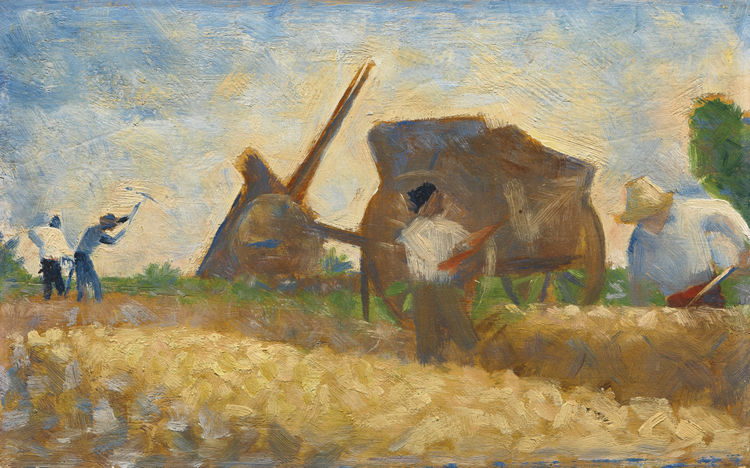


 Redtree Times