Feeds:
Posts
Comments

Dove Forms


Arthur Dove -River Bottom, Silver, Ochre, Carmine, Green- 1923.

Arthur Dove- River Bottom, Silver, Ochre, Carmine, Green, 1923.


It is the form the idea takes in the imagination rather than the form as it exists outside.

–Arthur Dove


I’m in the middle of working on a large group of new work for my upcoming solo shows. At such times I am always looking for a groove where the work flows easily and in one direction, like a river. But sometimes the groove begins to feel more like tunnel than a river, constricted and with no chance of overrunning its banks and expanding its scope. At such times, I find it’s sometimes good to pull back and examine earlier work and the work of those who influenced it.

When I was first starting to paint, one of the artists whose work I looked to for inspiration was the Modernist painter Arthur Dove, 1880-1946. It was the way in which he merged abstraction with representation and his use of recurring elements in his work that drew me in. Even now, when I look at the ball/circle shape that I use so often as my sun/moon I think of some of Dove’s paintings. My upcoming show has many so Dove has been on my mind lately.

I was also attracted to his work since we were both from the Finger Lakes region, Dove born and raised in Canandaigua and educated at nearby Cornell. The idea that we both experienced many of the same landscapes growing up made me want to look closer at his work. Like the Lawrence Durrell passage I quoted last week, I believe “we are children of our landscape” and examining the work of an artist shaped by a similar landscape is always intriguing, seeing how the forms they take in are transformed within the artist’s imagination.

There is sometimes commonality, which might be viewed as reinforcing, but more often there are much different takes on the common landscape. And that is actually more inspiring and influencing as it allows me to take a different perspective on a landscape I know. It opens the mind a bit. And that’s what you’re looking for in your influences, the work that pushes you forward.

Though there is not a lot of writing from Dove, there are a couple of other Dove quotes that mesh well with my own viewpoint on painting:

I look at nature, I see myself. Paintings are mirrors, so is nature.

and this one, which has appeared here in the past:

We cannot express the light in nature because we have not the sun. We can only express the light we have in ourselves.

Here’s a video of Dove’s work that I shared here several years ago.
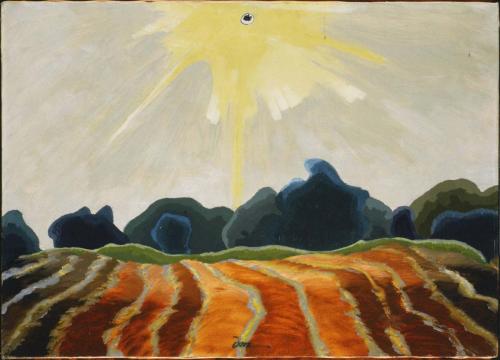


Arthur Dove- Morning Sun

Arthur Dove- Morning Sun, 1935


Arthur Dove- Sunrise, Northport Harbor 1929

Arthur Dove- Sunrise, Northport Harbor, 1929
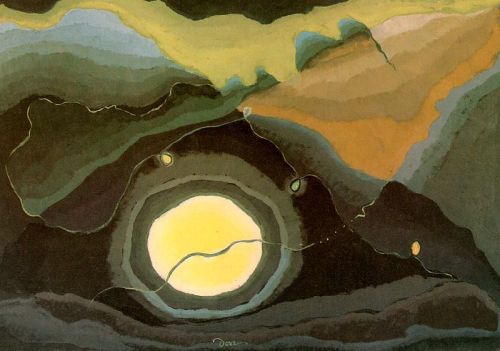


arthur-dove-me-and-the-moon-1937

Arthur Dove- Me and the Moon 1937

Blue Moon

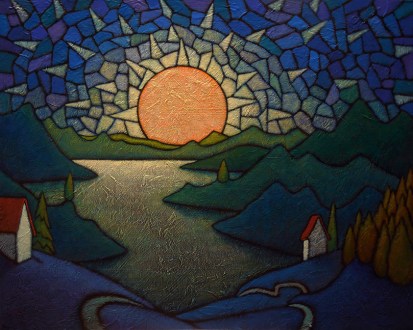
GC Myers- Symphony Serene sm

Symphony Serene— At the West End Gallery


Sweet moonlight, shining full and clear,
Why do you light my torture here?
How often have you seen me toil,
Burning last drops of midnight oil.
On books and papers as I read,
My friend, your mournful light you shed.
If only I could flee this den
And walk the mountain-tops again,
Through moonlit meadows make my way,
In mountain caves with spirits play –
Released from learning’s musty cell,
Your healing dew would make me well!

― Johann Wolfgang von Goethe, Faust


I have been working on a large canvas in recent days and it has been calling to me all night It’s at that point where moves past the awkward stages in the process. There are steps in my painting process where the surface sometimes goes flat and listless before suddenly transforming into something quite different and alive. Coming into the studio this morning, I have been eager to get to it, to experience that transformation.

As a result, I am making this short this morning. For this week’s Sunday Morning Music, here’s Beck and his Blue Moon. No, not that Blue Moon— his own Blue Moon.

Now, excuse me, There’s the best part of a painting waiting for me.


GC Myers Fragment 2023

GC Myers, Painting Fragment 2023


invent yourself and then reinvent yourself,
don’t swim in the same slough.
invent yourself and then reinvent yourself
and
stay out of the clutches of mediocrity.

–Charles Bukowski, No Leaders Please


This morning, I was looking for a photo on my phone of a page from a book. It had a paragraph that resonated with me and I thought I might write about. But in whizzing through the images on my phone– my feral cats, paintings in progress, a tick bite on my wrist, and so on– I came across the image at the top of the page.

It was simply a closeup of a segment of a new painting where three blocks of color converge. I don’t really remember taking this photo but it must have spoken to me in the same way as it does this morning, even with the uneven lighting on it.

After just a quick glimpse of this small detail within a painting, I could see numerous other pieces rising from its inspiration. It felt like looking at a portal that transports one to a different dimension filled with different possibilities and potential, one that allows you to see yourself as a different version of yourself.

A fleeting glimpse of self-reinvention.

There’s something exciting in this quick view of what could be. It presents itself and you take it in, seeing its possibility. It then becomes a challenge. A dare to move past the what-is to the what-might-be.

Do I dare?

I don’t know yet. We build up all sorts of reasons to ignore the possibility, to stay safely within our boundaries, that which we know to be. A fear of the unknown. Like the maps of old times used to say: Beyond this point lie dragons.

But  growth, artistically and personally, requires the courage to at least take tiny steps into that unknown at some point.

Do I dare?

I don’t know but most likely, the answer will get to a yes at some point.

Art is reinvention, after all.

Maybe studying this fragment a bit more will get me there.

In the meantime, here’s well known Charles Bukowski poem, No Leaders Please. I was surprised at how many videos of this poem were online. A number of them use the Tom O’Bedlam reading from SpokenVerse along with a variety of background music and imagery. Of these, I like the one below though they don’t use the Bukowski title, instead opting for Reinvent Your Life. But it works.


Simplicity

GC Myers- 2002

GC Myers, 2002


Simplicity is the final achievement. After one has conquered all the difficulties, after one has played a vast quantity of notes and more notes, it is simplicity that emerges as the crowning reward of art.

–Frédéric Chopin


I was going through some images of older work from the early 2000’s and was struck by the sheer simplicity of some of it. Not that my current work doesn’t have considerable simplification of form and composition. It does.

But this work seemed even more starkly simple and direct. It had a different sort of certainty and confidence than I possess now. Maybe naively bold?

I don’t know.

But I find myself envying that level of daring, that willingness to cut away all detail in order to get right to the point. It was work that went in a straight line where my later and more recent work takes a more roundabout route to get to what is pretty much the same destination.

I have no preference in comparing the two. There is a sameness in both in that I see myself in each. Then and now. Both are products and representations of their time and where I am or was in my life and where we were or are in this world. Both routes have their charms. At least, I think they do.

There’s no real point here this morning. Just a reflection on the value in simplifying things. It’s something I have to do periodically to remind myself about the value and understanding contained in simplicity. As C.S. Lewis put it:

It’s like the sound of a chuckle in the darkness. The sense that some shattering and disarming simplicity is the real answer.

We often get lost in the maze of life, seeing complexity where we should see simplicity. Maybe simplicity is the real answer to everything–to life, art, music, science as Teller points out below, and so on.

I’ve had my reminder. I can get happily back to work now. Here’s some simple Chopin from pianist Chad Lawson to enjoy as you leave.


It is often claimed that knowledge multiplies so rapidly that nobody can follow it. I believe this is incorrect. At least in science it is not true. The main purpose of science is simplicity and as we understand more things, everything is becoming simpler. This, of course, goes contrary to what everyone accepts.

–Edward Teller, Conversations on the Dark Secrets of Physics


GC Myers- Archaeology: Deja Vu

Archaeology: Deja Vu– At West End Gallery

Genius is the gold in the mine. Talent is the miner who works and brings it out.

–Marguerite Blessington (1789-1849)


I came across the quote above from the Irish Countess Marguerite Blessington, who was a writer and hostess of a famed literary salon in London who is best known for her published conversations with Lord Byron. Hers was yet another name with which I was not acquainted.

But her words made me both think and chuckle a bit. Made me think of some of the lyrics from the old Lee Dorsey song, Working in the Coal Mine:

Five o’clock in the mornin’I’m already up and goneLord, I’m so tiredHow long can this go on?

So, here I am at a little after 5 in the morning, getting ready to head down in my own version of a coal mine. Not quite the same, of course. Not as dark and dirty though if you saw the clothes I work in you might not think there was much of a difference.

I am ready to head down in the mine looking for my own version of the gold, the genius contained within according to the good Countess. Now, I would hesitate to call it genius but whatever is contained in that mine it has value to me.

Maybe we all have genius of some sort in our mines in which we toil. Maybe we don’t recognize it as such and don’t value it as highly as we should.

But if it is genius, mine is a very thin and spotty vein. Takes every bit of effort I can muster and all the limited talent I possess to extract the tiniest of nuggets.

To quote another song: It don’t come easy.

But it is the mine I in which I chose to toil. That’s probably another difference between real coalminers and me though we both might feel equally at home in our respective mines. I like my mine even on those many days when there is no gold, coal, or even lead ore to be found. Just being in the dark stillness away from the outer world is a form of gold in itself.

But there are days when the lines from the song above ring true. Oh, lord, how long can this go on? Except for those times when I am going through creative blocks, which I guess that would be the equivalent of running into a vein of granite(?), that feeling doesn’t last long. Once I start digging, that fatigue pretty much goes away.

Okay, enough of this. I got to get back to swinging my pick. There’s something good– gold, coal or whatever– down there I can pull out today, I just know it.

Here’s Lee Dorsey and his Working in a Coal Mine, written by the great Allen Toussaint.


GC Myers- At Land's End

At Land’s End— At West End Gallery

God, it was good to let go, let the tight mask fall off, and the bewildered, chaotic fragments pour out. It was the purge, the catharsis.

Sylvia Plath, The Unabridged Journals of Sylvia Plath


I came across an article this morning that had been forwarded to me by a friend several years ago in response to a blog post.  Appearing in the online magazine Psyche, it was written by three researchers ( Julia Christensen, Guido Giglioni, and Manos Tsakiris) and was largely about how creativity and wellness were often boosted by allowing the mind to wander. It’s an interesting article that discusses the neuroscience behind their research into the wandering mind.

While those that daydream have often been chided through history as being lazy and counterproductive, there has also been a school of thought that encourages random thought and rumination, believing that it can lead to creative breakthroughs and greater productivity. The Germans had a phrase for this concept of the wandering mind, ‘die Seele baumeln lassen,’– ‘let the soul dangle.

Interesting stuff. One part of the article that struck a chord with me discusses how art causes biological responses and often serves as a prop for emotional catharsis. As they put it:

“…art can help us adapt to the immediate source of pain by acting as a prop for emotional catharsis. We all know the strange, pleasurable, consoling feeling that comes after having a good cry. This experience appears to be precipitated by the release of the hormone prolactin, which has also been associated with a boosted immune system, as well as bonding with other people. The arts are a relatively safe space in which to have such an emotional episode, compared with the real-life emotional situations that make us cry. Even sad or otherwise distressing art can be used to trigger a kind of positive, psychobiological cleansing via mind-wandering.”

I immediately responded to this point as this is something that I experience on a regular basis. I often am moved to tears by artistic stimulus while in the studio, most often in the form of music, film or the written word. It is such a common occurrence that I have come to use this response as a barometer for how emotionally invested I am in the work I am doing at that time. When I feel most immersed in my work, I find that I am receptive and reactive to emotional stimuli. I have found that the work I consider my strongest comes at times when I am on this edge of induced emotional catharsis.

It’s something that has taken place with me for decades now and it’s interesting to see that there might be a neurological component behind my response. I think I am going to go now and see if I can produce some more prolactin this morning.

Click here to go to this article. It’s a relatively short read plus there is an audible version available on the page if you would rather listen.

[I posted this article here about three years back. I thought it fit the morning and added the words at the top from Sylvia Plath, changed the accompanying painting and added the song below which is Falling Slowly. This version of the song is from Cristin Milioti and Steve Kazee from the Broadway cast of Once. I still prefer the original Glen Hansard/ Markéta Irglová version from the film but this is a lovely performance of the song and I’m a Cristin Milioti fan.]


GC Myers- The Color of Night  2023

The Color of Night– New & Coming to Principle Gallery

We are the children of our landscape; it dictates behavior and even thought in the measure to which we are responsive to it. I can think of no better identification.

–Lawrence Durrell, Justine, 1957


This is a line I have highlighted in an old dogeared copy of Justine, the first book in the Alexandria Quartet from Lawrence Durrell. Even before I had an inkling that I would ever be an artist and painter of landscapes, this idea of our landscape affecting our behavior and becoming an integral part of how we see ourselves struck a chord in me.

I think we have two landscapes, the one that we live in externally and an inner landscape primarily based on our external world but manipulated and shaped in a way that allows us to find those things we need in either. Maybe it is security, tranquility, connection or communion with something larger than we find in the external world.

I am not putting this very eloquently, I know. It’s one of those concepts that is more felt than articulated. I have often pointed out that if I could put these thoughts and feelings in words, I would have no need to be a painter.

This is probably as good an example as you’re going to come across which means I am going to just let it be as it is except to add that what I believe the artist is trying to do is create a better version of the landscape in which they live and love. At least, better in ways that speak to that artist.

The hope is that the altered world created speaks to and appeals to others as well. Maybe inspires something in them that allows them to add a new color, form, or feeling to their own inner landscape.

Sometimes that is the case. Sometimes not.

After all, you may not want to live in my world– inner or outer. And that’s okay. As it should be.

Here’s a song I like very much from the Black Pumas. It’s called Colors and might well fit for today as singer Eric Burton describes his own inner and outer landscapes. I can see his world from here.


The Creative Urge

GC Myers- The Restless Edge

The Restless Edge– Available through the West End Gallery


The pursuit of science is more than the pursuit of understanding. It is driven by the creative urge, the urge to construct a vision, a map, a picture of the world that gives the world a little more beauty and coherence than it had before.

–John Archibald Wheeler, Geons, Black Holes, and Quantum Foam: A Life in Physics, 1998


I know that the quote above is primarily concerned with science since it comes from John Archibald Wheeler, the late (1911-2008) theoretical physicist who was a superstar in his field, responsible for originating terms such as Black Holes and Wormholes.

But as he points out, scientific pursuit is not unlike other endeavors that begin with the creative urge. I very much like his description of the driving need behind the creative urge: to construct a vision, a map, a picture of the world that gives the world a little more beauty and coherence than it had before.

Actually, the first thing that came to mind after reading his words was that the creative urge is a survival skill.

Art and every other thing brought into being by this desire to create ultimately aid in our survival. It provides insight and tangible evidence of the purpose and meaning of our lives in a world that constantly challenges our understanding of it.

The creative urge has been perhaps the dominant survival skill in my life. Without it, I have no idea what my life might be now. Or if I would still even exist. The creative urge has saved my life more than once.

I have no doubt that it will continue to do so.

It’s a powerful force. I urge you all to construct, as Wheeler said, your own vision, map and picture of the world. It might well provide you with better understanding of this world for yourself and others.

That being said, here’s a Nick Lowe classic, When I Write the Book.

Now get out of here– I have a creative urge that needs to be fed.


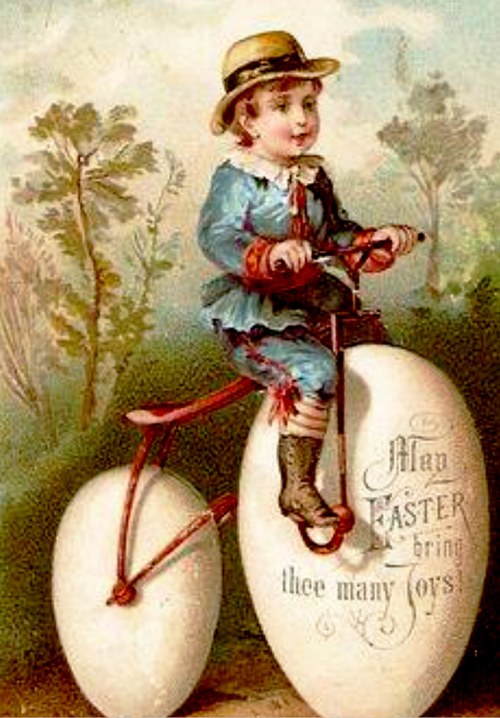
easter 3Not your typical Easter egg, I suppose. Most definitely different than the brightly colored eggs of my youth. I don’t recall any topless young women on any of the Easter cards back then. 

Maybe I was just looking in the wrong places.

Back then I never knew much about the origin of the egg in the Easter tradition. Never gave it much thought at all. But there is a story behind that iconic egg. Like the rabbit which has come to symbolize Easter as well, the egg stems from the pagan Easter festival which celebrated both as symbols of fertility and the emerging new life of spring. The coloring of the eggs, done in earliest times by boiling the eggs with flowers petals, also symbolized the budding colors of spring.

For the Christians part, the egg also had a part in their tradition. There is a legend that states that Caesar summoned Mary Magdalene before him after the crucifixion of Jesus, and upon hearing her claims that Jesus had been resurrected is claimed to have said, pointing at a nearby basket of eggs, “Christ has not risen, no more than that egg is red.”  At that point, the eggs supposedly turned red. Many orthodox Christians traditionally color their eggs red to symbolize this story as well as the sacrificial blood of Christ.

There’s also a pragmatic part to the story of the Easter egg. The festival of Lent, the 40 days prior to Easter that symbolize Jesus’ 40 days spent fasting in the desert, had long had a prohibition on all meats and animal by-products including milk and eggs. This created quite a surplus of eggs which would have gone to waste in those days long before modern refrigeration without their preservation by boiling.

Now, where the topless lady in that Victorian era card at the top falls into the story, I have not a clue.

The Victorians certainly had unusual tastes in their greeting cards. I’ve shared some in the past here but some of the ones below have me scratching my head. That last one with the bunnies riding on chickens behind a sword wielding Rabbit General raise a lot of questions.

Hmm. 

For this Sunday morning music, I opted to not play an Easter song. I usually play a bit of gospel music from Sam Cooke or Mahalia Jackson. But here is a gospel tinged song from the great Sister Rosetta Tharpe. Here’s her This Little Light of Mine.

Rockin’ good way to start your Sunday.


Victorian Easter Egg 1Victorian Easter Egg 2Victorian Easter Egg 3Victorian Easter Egg 4Victorian Easter Egg 5Victorian Easter Egg 6Victorian Easter Egg 7

The West Wind

GC Myers- Navigating Chaos  2022

Navigating Chaos– At the Principle Gallery


It’s a warm wind, the west wind, full of birds’ cries;
I never hear the west wind but tears are in my eyes.
For it comes from the west lands, the old brown hills,
And April’s in the west wind, and daffodils.

–John Masefield, The West Wind 


I can see the painting at the top fitting well with the tone of the times, as we try to find our way through the current storms of craziness that seem to batter us from all sides. To keep it simple for this morning, I thought I would pair it with a poem, The West Wind, from poet John Masefield from his 1902 collection Salt-Water Ballads.

In it, the West Wind is the voice of home and things familiar calling out to a weary sailor at sea. This idea of wanting to make our way past the perils of storm and disconnectedness to return to some simple form of stability, security, and warmth probably describes the desires of most of us in this moment. 

I’m including the entire poem at the bottom. I am also including a reading of it taken from a radio program, The Big Show, in 1951. Lots of legends involved here. Actress Tallulah Bankhead introduces the poem which is performed by Ethel Barrymore. The background music is a composition written by her brother, Lionel Barrymore, who was a talented musician as well as an extraordinary actor. 

Safe voyage to you…


The West Wind

It’s a warm wind, the west wind, full of birds’ cries;
I never hear the west wind but tears are in my eyes.
For it comes from the west lands, the old brown hills,
And April’s in the west wind, and daffodils.

It’s a fine land, the west land, for hearts as tired as mine,
Apple orchards blossom there, and the air’s like wine.
There is cool green grass there, where men may lie at rest,
And the thrushes are in song there, fluting from the nest.

“Will you not come home, brother? you have been long away,
It’s April, and blossom time, and white is the spray;
And bright is the sun, brother, and warm is the rain, —
Will you not come home, brother, home to us again?

The young corn is green, brother, where the rabbits run,
It’s blue sky, and white clouds, and warm rain and sun.
It’s song to a man’s soul, brother, fire to a man’s brain,
To hear the wild bees and see the merry spring again.

Larks are singing in the west, brother, above the green wheat,
So will ye not come home, brother, and rest your tired feet?
I’ve a balm for bruised hearts, brother, sleep for aching eyes,”
Says the warm wind, the west wind, full of birds’ cries.

It’s the white road westwards is the road I must tread
To the green grass, the cool grass, and rest for heart and head,
To the violets and the brown brooks and the thrushes’ song,
In the fine land, the west land, the land where I belong.