 I’ve been going to Alexandria, VA, a lovely and historic town that hugs the Potomac River just a few miles below Washington DC, for a long time, often several times a year. Outside of my link with the Principle Gallery and the relationships that have grown from that, I never thought I had a connection of any sort with that area.
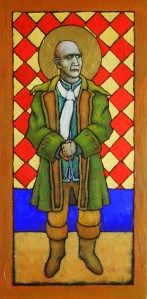
Col.Eleazer Lindsley
But, as many of you who read this blog on a regular basis already know, I am an avid genealogist. I have documented some of my ancestral discoveries in a series of paintings, Icons, like the one shown here on the right, that I hope to get back to soon. While going through one of my lines earlier this year I came across a great-grand uncle by the name of Charles C. Mulford, who was the great grandson of Colonel Eleazer Lindsley who is shown in the Icon painting on the right.
Mulford was born in nearby Lindley in 1821 and lived a quiet life as a farmer until the Civil War broke out. Serving for the 6th Regiment of the NY Heavy Artillery, he saw combat in battles at Spottsylvania, Cold Harbor, the Wilderness, Totopotomy and Petersburg. At the Battle of Petersburg, Mulford was shot in the upper thigh and, during his hospitalization, contracted typhus and died in early July of 1864.
It was the same tragic ending that many of my ancestors met while serving this country. But the interesting detail in the account was that he had died in Alexandria at the Fairfax Seminary hospital and was buried in the National Cemetery not too far from the gallery.
So Friday morning when I went out for coffee at a local cafe that I frequent when I am in town I decided to seek out my great-grand uncle. Under threatening skies, I strolled the few blocks to the cemetery that is tucked quietly among neighborhoods filled with townhouses. It only took a few moments to find the grave, sitting in the first row facing a stone wall.
The marble headstone was well weathered as you can see at the top of the page. I stood there for quite a while. I wondered if any others had looked closely at that stone in recent years, had uttered the name over that grave.
It’s a small thing but just standing in front of that stone for a few minutes was very calming for me, especially on the day of an opening when I am normally very anxious. Just knowing that he and I shared a tiny bit of DNA and a common beginning had meaning for me, connecting to me to my family, our history as a nation and to Alexandria, as well. I felt like I belonged in so many ways.
And there was great peace in that moment.
So, besides the many paintings that I know populate the homes of Alexandria and the friends that I have made there, a small part of my past will always reside in that city. I finally feel truly connected there.
Some extra info: Charles Mulford was the first cousin of General John E. Mulford (my first cousin 6 generations removed) who was President Lincoln‘s Commissioner of Exchange which meant that he arranged for the exchange of prisoners during the war. He is shown below in uniform in a photo from Matthew Brady.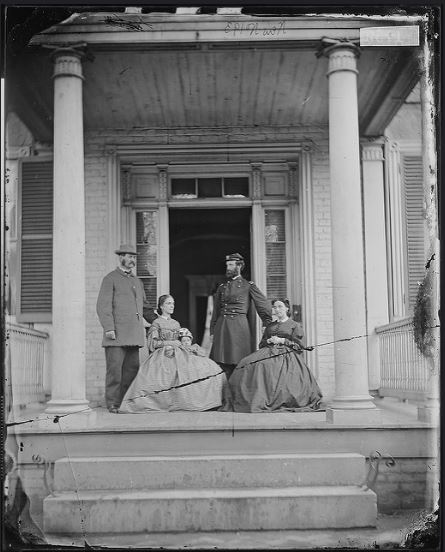
 The more I read about this ancestor,the latest entry in my Icon series, the more interesting I find her. Her maiden name was Tacy Cooper and she is my 10th great-grandmother, born around 1609 in England. Little is known of her parentage or when exactly she came to America but she is known to have lived in Dorchester, near Boston in the Massachusetts Bay Colony in the early 1630’s.
 When you delve back into your ancestry you often uncover surprises, some pleasantly exciting and some a bit disappointing. In some cases, it’s a bit of both. Such is the case of the person behind this latest painting from my current Icons series. This piece is 24″ by 12″ on masonite and is titled Icon: Eleazer.
 As pointed out in recent posts, I’ve been working on a group of new work that I am calling Icons, images that put people that I have come to know through doing some genealogical work. They are not intended to be accurate depictions of these ancestors. In each case, I have just found something compelling that sticks with me. Such is the case with the painting above, a 10″ by 20″ canvas that I call Icon: William England.
 Redtree Times