Feeds:
Posts
Comments

Posts Tagged ‘Andrew Wyeth’

Andrew Wyeth -Mother Archie's Church 1945

Andrew Wyeth -Mother Archie’s Church 1945

We went to Cooperstown this past Monday to catch the last day of the Wyeth Family exhibit at the Fenimore Art Museum.  It was a great show featuring work from patriarch NC Wyeth,   son Andrew, grandson Jamie, daughter Henriette and daughter Carolyn as well as Henriette’s husband, Peter Hurd and NC’s primary influence Howard Pyle.  That’s a lot of talent to jam into a relatively intimate space.  You might think that it would be less than satisfying but the curating of this show was masterful, showing each artist in a truly representative manner that gave a real taste of their body of work.   Just a wonderful show.  I am glad I got to see it  if only to see a few of NC Wyeth’s gorgeous works and to discover more about his son-in-law, Peter Hurd, whose work is wonderful, bringing to mind the regionalist painters such as Grant Wood.

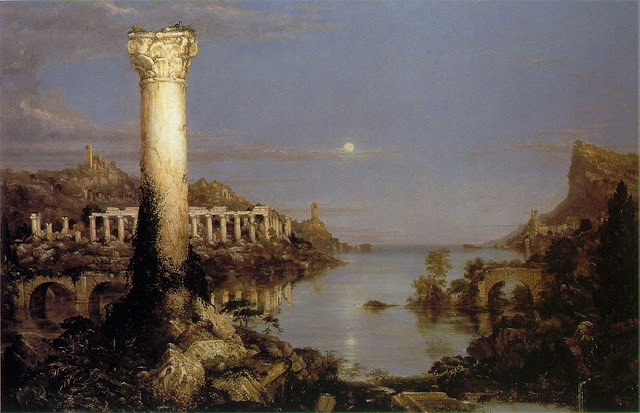
Thomas Cole- The Course of Empire- Destruction

Thomas Cole- The Course of Empire- Destruction

Of course, there was also the spectacular Thaw Collection of American Indian Art to see.  As always, it was a thrill to see the beautiful aesthetic of the native culture.  And as good as both the Wyeth show and the Thaw Collection were, I was truly bowled over by the current show, The Hudson River School: Nature and the American Vision, featuring works from the Hudson River painters of the 19th century,  Just beautiful and strong examples from the genre, highlighted for me by the works of Asher Durand and the spectacular Thomas Cole series of five paintings, The Course of Empire , which features the rise and fall of an empire in the landscape, a rocky peak with a precariously perched boulder standing as a constant witness.  You have probably seen some of the paintings from this series but to see them together  in their full scale is to really get a great appreciation for their power.  It hangs at the Fenimore until September 29, so if you can, take a trip and see some incredible work.

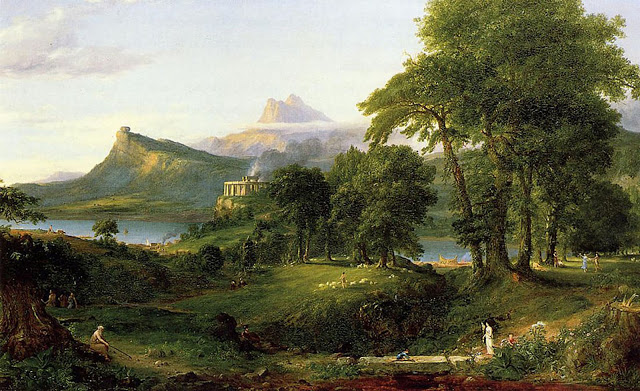
 

Cole, Course of Empire - Savage State 1834 Cole, Course of Empire - Arcadia, Pastoral State 1834 Cole, Course of Empire - Consummation of Empire 1835 Cole, Course of Empire - Desolation 1836


Read Full Post »

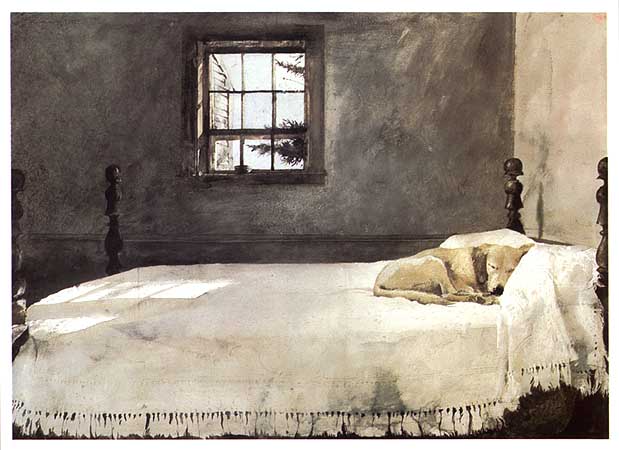
I recently picked up a book, Andrew Wyeth: Autobiography, which is not really an autobiography but features over 130 of his pieces throughout his career along with short descriptions about them by the artist.  It’s quite a striking collection of images especially if you’re attracted to the Wyeth palette of  earthy browns and greys, as I am.

I have many favorites here  but perhaps the one I like best is this piece, Night Sleeper.  There’s a lot here to look at yet it maintains a quiet and  contemplative stillness that one associates with Wyeth’s work.  The two windows provide two separate examples of landscapes, the moonlit mill in one and the dam and millstream in the other,  that could be great paintings on their own.

  It’s all held together and anchored by the tee of the interior windows and the sleeping dog, an image I’m really drawn to.  There’s something about the posture and comfort that dogs adopt when sleeping that I find interesting, something that plays on a sense of reciprocity that I have with dogs, one where they watch out for me when they are  awake and I watch out for them when they are asleep.  Their sleep indicates a deep trust and a sense of security.

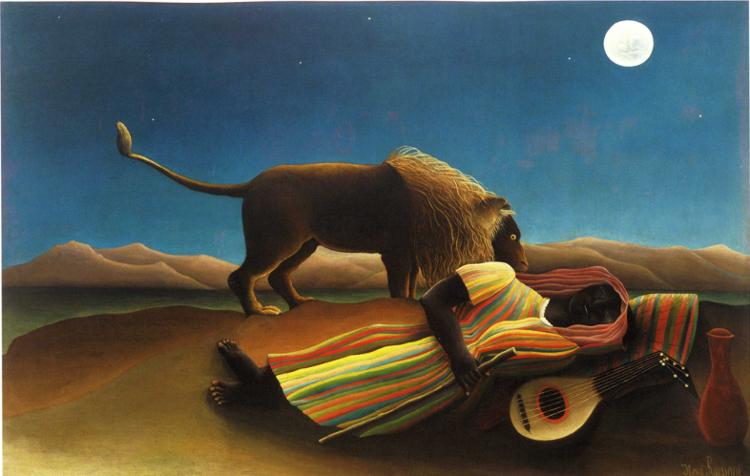
But the bit of this painting that makes the whole thing sing for me is the pale blue striping on the pillow or bag or whatever it is that the dog rests against.  That bit of color adds a whole layer of depth that would not be there otherwise and creates a beautiful harmony, echoing the moonlight that plays on the window frame on the right.  For me, it immediately brings to mind Henri Rousseau’s Sleeping Gypsy and its whole feeling.  They are very different paintings in many obvious ways but there is a ribbon of feeling that runs between them, in my mind at least.  I think this immediate visceral association adds a layer of appreciation of this painting for myself.  That little blue striping adds all the warmth of the Rousseau painting to my sense of this Wyeth painting.

In short, I think this painting is a peach.

Have a great Saturday.

Well,

Read Full Post »

NC Wyeth The GiantIn an earlier post I talked about the great American painter Andrew Wyeth on the day after he died.  His father was NC Wyeth who was the preeminent illustrator of the early 20th century, illustrating some of the great books of the time.

Throughout his life, he wanted to be known not as an illustrator but as an easel painter, a fine artist.  There seemed to be this fine distinction that because an illustrator brought the scenes and ideas of others’ stories to life that they were somehow below the work of those who painted solely their own ideas.  I never understood that concept because it was still Wyeth who composed the paintings and created the colors and brushstrokes that distinguished the work.  Wasn’t this very much the same as many Renaissance artists who painted many of their great works for the Church?  Are they not considered fine artists?

NC Wyeth- Rip Van WinkleI’ve always been attracted to the work of NC Wyeth having seen it innumerable times in print.  There was a real dynamic quality, punch, in his paintings.  However, it wasn’t until I saw his work in person that I truly appreciated how beautiful his work truly was.

He treated many of his illustrations as fine paintings, with glorious paint appplication that created beautiful surfaces within the painting.  His colors were complex, hardly ever a pure single color.  His blues often had glazes of red, his whites tinged with yellows.  All of his colors had an  earthy base that gave them a dark edge and weight. His compositions were bold and inventive, highly contrasting and dramatic to best illustrate many of the adventure stories on which he worked.  In person, many of these paintings are even more stunning than on the printed page.

NC Wyeth Last of the MohicansHis non-illustrative work was much more mundane, less dramatic but well executed.  His real spark seemed to be from the stories he was bringing to life.  The Arthurian legends, the Leatherstocking tales of Cooper, the pirates of Robert Louis Stevenson–  all seemed fresh and new in his paintings.  Unlike many artists, I think being freed from having to create a narrative of his own actually gave him the opportunity to fully exploit all the knowledge of technique and composition he held.  As though having the decision of what to paint taken from his hands allowed that energy that would be expended to be used on making the painting stronger.  Whatever the case, whether you choose to call it fine art or illustration, the resulting work was memorable and deserves a nod.  It continues to inspire to this very day.

NC Wyeth Blind PewNC Wyeth

Read Full Post »

Andrew Wyeth

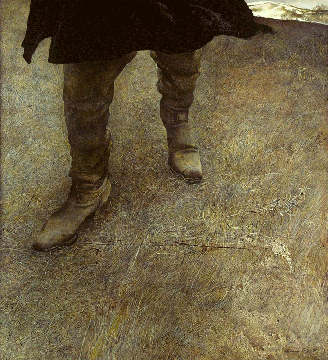
Wyeth Trodden WeedAndrew Wyeth died yesterday.  Age 91.

Damn great artist.

I’m showing the piece to the right, Trodden Weed, because I always feel a sense of awe when I see it.  

The gorgeous color.  

The daring composition.  

It raises more questions in the viewer, both about the painting and the viewer himself, than it answers yet there is a sense of satisfaction.

Of completion.

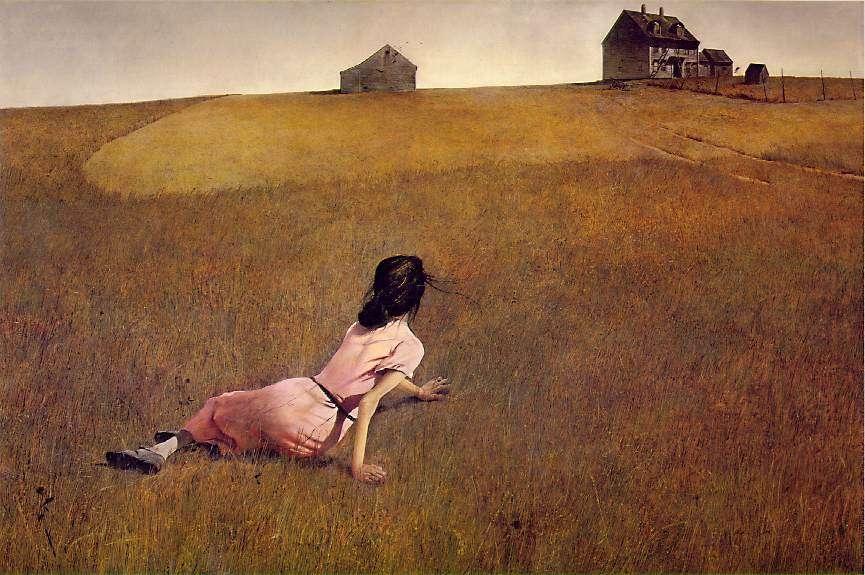
Wyeth Christina's WorldAndrew Wyeth was not the darling of art critics and I think there’s a simple reason for this:

His work didn’t need them.

His work transcended the need for their explanation and validation, translating at once to the viewer.  

There was no warming up to his work, no need to try to feel his message.  It was immediate and powerful.andrew-wyeth

And to someone who is considered the arbiter of taste, this could only be the work of sentimentalism.  This bias would not allow themselves the effort to truly see the work’s beauty and power.  It’s graceful simplicity.

Well, that’s their loss.  Screw them and thank you for all you gave us, Mr Wyeth.

Wyeth Master Bedroom

Read Full Post »

« Newer Posts