I do not know whether I was then a man dreaming I was a butterfly, or whether I am now a butterfly dreaming I am a man.
–Zhuang Zhou
I love this famous anecdote above from the great Daoist philosopher Zhuang Zhou, who was born sometime in the 4th century BCE. Like most things worth thinking about, it has no answers for us, only questions. In this case, the question being how we discern what is reality and what is a dream.
I am not going to get into a philosophical argument here this morning on that question. I only mention it because it reminded me of the painting above and the feeling I take away from it.
It is an early piece of mine from thirty years ago, back in 1995, that I call Summerdream. I’ve been looking at it a lot recently as I prep it to be part of the upcoming annual Little Gemsshow at the West End Gallery.
It’s a small piece that has always resonated with me. I love its forms and simplicity. But more than that, it has a sense of solidity in the way it is painted with deep saturated watercolor while still giving me a dreamy, ethereal sense of floating. I like this dichotomy, its appearance of earthly solidity alongside a diaphanous airiness in its felt atmosphere.
Like Zhuang Zhou, I find myself asking which is real and which is the dream here.
I don’t know for sure. Perhaps I am actually a butterfly dreaming that I am a man wondering such a thing? Or maybe both I and my butterfly alter ego are just a tiny part of a dream dreamt by a tiny being that dwells forty dimensions of time and space from where I sit?
Maybe or maybe not. We will most likely never know and that, in itself, might be the only correct answer. We deal with the reality in which we find ourselves at any given moment.
Right now, I am a guy sitting in the dark of a winter morning. That’s my reality right now. But later, I might look at this painting and find myself as a floating butterfly.
And that will be an acceptable reality then.
Here’s a well-worn song, from the Cranberries and the late Dolores O’Riordan, Dreams.
Summer dream is a 5″ by 7″ watercolor on paper, framed at 11″ by 14″. It will be available at the West End Gallery as part of their annual Little Gems show, which opens February 7. This painting and a group of new small paintings will arrive at the gallery later this week. The gallery is currently on a short winter break and will reopen this coming Tuesday, January 21.
Our minds must have relaxation: rested, they will rise up better and keener. Just as we must not force fertile fields (for uninterrupted production will quickly exhaust them), so continual labor will break the power of our minds. They will recover their strength, however, after they have had a little freedom and relaxation.
–Seneca the Younger, On Tranquility of the Mind
Just a reminder that today is the last day to visit the West End Gallery in Corning, NY before they go on a short winter break from January 5 through January 20.
Everyone needs a little break, as Seneca pointed out in the passage above from about two thousand years ago, in order to recharge one’s batteries and regain some vigor. I have kind of been on a hiatus myself for the last couple of months, barely lifting a brush during that time. I had been feeling a bit beaten down and had lost a bit of pep in my step.
Just a feeling of blah. I don’t know if blah itself is a real thing but if you’ve felt it, you know what I mean.
But I believe I am emerging slowly from it. I have just finished some of a group of small pieces for the upcoming Little Gems show that opens on February 7 at the West End Gallery. It was awkward at first, but momentum grew with each small painting. The urge to pick up the brushes and see paint on a surface has returned and seems to grow with each passing day.
It has been very beneficial to me that the Little Gems show has always fallen at this time of the year when I am ebbing low. The small scale of the paintings allows me to work on things that I might otherwise put off, to explore new themes and possibilities. To learn and attempt new things. To sometimes fail then take the lesson learned from failing and make something better.
Though it is work, it is most invigorating, not depleting at all. Like priming a pump.
Or fertilizing a field– maybe that’s the more apt description?
I don’t know about that, but it feels good to feel the giddiness of creating something new again, to feel that there is something ready to come out once again. It has been absent for the last month or two and has been sorely missed. From going through this cycle many times before, I knew it would come eventually. It seemed to take a little longer this year and the wait became excruciating.
But it is close to being back in full and I am excited.
I may be taking a short break here on the blog for the next couple of weeks to more deeply reengage with this newly recovered rhythm. While I was on my short hiatus from painting my work here on the blog continued and it might be that I need a break. Might need to fertilize the field?
Maybe. We’ll see how it goes.
If you get a chance today, stop into the West End Gallery before they go on break. Hope they can fully recharge their batteries.
Here’s an absolute favorite Beatles song. I don’t know when I last shared it but it feels like it needs to go with this post. This is Tomorrow Never Knows.
I can hardly understand the importance given to the word research in connection with modern painting. In my opinion to search means nothing in painting. To find is the thing. Nobody is interested in following a man who, with his eyes fixed on the ground, spends his life looking for the purse that fortune should put in his path. The one who finds something no matter what it might be, even if his intention were not to search for it, at least arouses our curiosity, if not our admiration.
—Pablo Picasso, “Picasso Speaks,” 1923
To find is the thing…
I often write here about searching for something with my work. It’s usually something I can’t describe in any way that helps myself or the reader. It’s just something that pulls me forward.
Well, that’s what I thought, for the most part.
Reading the passage above from Picasso recently set me thinking that perhaps it was not a search at all, at least not in the way I had portrayed it.
Perhaps I was driven onward because I had found something and felt the need to express and share it. Or perhaps to keep that feeling of discovery, that eureka! moment, alive within myself– and within others who sensed whatever I had found for themselves when they viewed the work.
I can’t say for sure. I am still wrangling with this. But it makes some sense to me. A painting begins as an exploration, a search, but as it progresses it moves toward a revelation of some sort. The search is in the process, not in the resulting work.
At least, for the artist. It may differ for the viewer. They may see it as a way toward something they need and seek. Something they may not even realize is needed or sought. Perhaps they will find that same thing in the final work that that I had found, that same thing that seems to somehow answer vague, unasked questions.
Who knows for sure? But this idea that the work in not so much a search as it is a revealing of what has been found satisfies something in me.
Maybe that what was I was looking for in the first place?
Or maybe this is all one of those dreams where everything you wonder about suddenly seems to make perfect sense and there is that momentary feeling of elation that is then suddenly and completely gone once your eyes open.
Could it be that?
I don’t know but here’s an old song from Todd Rundgren that came to mind while I was finishing up. I haven’t heard this tune in many years and Todd Rundgren is one of those artists who was very popular in the 70’s but has faded somewhat from the front of the public mind the in the decades that followed, though he still is actively recording and performing. Just on a smaller stage as the musical outlets became narrower and more niched. This is I Saw the Light.
“The tides of time should be able to imprint the passing of the years on an object. The physical decay or natural wear and tear of the materials used does not in the least detract from the visual appeal, rather it adds to it. It is the changes of texture and colour that provide the space for the imagination to enter and become more involved with the devolution of the piece. Whereas modern design often uses inorganic materials to defy the natural ageing effects of time, wabi sabi embraces them and seeks to use this transformation as an integral part of the whole. This is not limited to the process of decay but can also be found at the moment of inception, when life is taking its first fragile steps toward becoming.”
― Andrew Juniper, Wabi Sabi: The Japanese Art of Impermanence
The post below is from four years back. It got a bunch of hits yesterday and when I went to see what it had to say (I often forget what I’ve written) I was struck by the image at the top of the post. The whiskey-brown color just grabbed me and at the bottom of the image I noticed wear around an exposed knothole that reminded me of a wave. Maybe Hokusai’s Great Wave in wood? I began to see the image as a painting, something I had not done before. Anyway, I read the post and liked it a lot, which pleased me. I am sometimes surprised when I read something from years ago and am impressed with it, like I was reading it for the first time. As I’ve added to my own patina in the past four years, I thought this would be worth replaying.
I added a song at the bottom that is kind of about wabi sabi. It’s called The Wino and Iknow from Jimmy Buffett. It’s from his 1974 album, Living and Dying in 3/4 Time, long before there were Parrotheads or Margaritaville. Hard to believe I bought it about 50 years ago. This song has been a favorite of mine for that long.
The photo at the top is the floor of our garden shed. It’s a simple structure that we bought new probably 35 [ about 40 now] years ago. Over the years, the once pristine plywood floor has darkened, taking on a smooth rich patina on the parts that have not pitted or worn away from decades of comings and goings.
It’s a beautiful thing and I often find myself stopping while I’m in there, which is every day, just to take some small pleasure in looking at its worn surface. The fact that it took a long period of time and innumerable footsteps, along with the mud, snow, grass trimmings, and oil that come along for the ride, to smooth and wear down the surface adds to my appreciation. It’s not something that could be replicated easily. Oh, you could try but it would lose that organic depth that comes with time.
Just a bit of the wabi-sabi of things around us. That’s the Japanese concept of finding beauty in the imperfection and natural wear shown by things.
And I guess that applies to people, as well. I know I am fascinated in seeing how folks age, how their faces and bodies reflect the life they have lived. There is beauty in the lines on the face or the graying of one’s hair.
Of course, I am talking about other people. I don’t find any beauty at all in my wrinkles or my whitened and thinning hair. In fact, I close my eyes now when I walk past my bathroom mirror out of the fear that some old man will jump out of it at me.
Nah, that’s not true. As much as I would sometimes like to have the smooth skin and the darker, fuller head of hair of my youth, I am satisfied, even pleased, in seeing the wear and tear written on my features. I see a small scar high on my forehead and remember the wound that left it so well.
It was many years ago and I was playing with my Magpie– her name was actually Maggie Blackwater–our highly charged husky-shepherd, chasing her around our yard. As I pursued her, I went through some low hanging branches on a birch tree next to the deck I was building off the back of our home. Midway through, as I ducked my head lower to avoid the sweep of the branches, I slammed it suddenly into a deck board that I had not yet cut off. I was knocked on my back and could feel the instant throb of pain on my forehead from the blow.
Maggie was on me in an instant, licking and urging me to get up and play some more. I laid there on the ground on my back and just laughed as hard as I could while the blood trickled down my forehead. I tend to laugh at my own misfortune, especially when it is of my own doing, which is almost always the case.
Maybe there is a bit of wabi-sabi in our laughter? Maybe it comes from the recognition of our imperfections, our humanness, in those moments?
And even while I was there on the ground, that same garden shed was not far away, its floor not yet so deeply darkened or worn. It didn’t yet have the accumulated memory of its being written on its surfaces. It was newer but it certainly wasn’t as beautiful.
And maybe that’s the attraction of this concept of wabi-sabi for me, that the wear and tear that appears is evidence of our being here, that we existed in this place and in this time. It’s much the same way in which I view my work, my paintings. Evidence that I was here, that my hand made these things and in some way my voice was heard.
That I, like that garden shed and its floor, had a purpose in this world.
Appreciate and enjoy the wabi-sabi in your own life.
The man who believes that the secrets of the world are forever hidden lives in mystery and fear. Superstition will drag him down. The rain will erode the deeds of his life. But that man who sets himself the task of singling out the thread of order from the tapestry will by the decision alone have taken charge of the world and it is only by such taking charge that he will effect a way to dictate the terms of his own fate.
― Cormac McCarthy, Blood Meridian, or the Evening Redness in the West
I hesitated a bit about the use of the excerpt above from a book by author Cormac McCarthy, Blood Meridian, that I read probably thirty years ago.
It’s considered by some as McCarthy’s magnus opus and one of the greatest of American novels. My memory of it is of its powerful imagery of the relentless chaotic violence that marked the tale, which is set in the Texas-Mexico borderlands in the late 1840’s. It’s a powerful told story that has the feel of the most lurid Hieronymus Bosch painting one could imagine.
It’s a book I would like to revisit but I keep putting off, especially in the context of America at this moment in time. It might be too disheartening to see parallels from that book in a contemporary reality.
Even so, the excerpt above describes what I see as the basis for much of my work, which is the need to seek some sort of order in the chaos, mystery, and seemingly senselessness which this world presents to us on a daily basis.
It might be a fool’s errand. I’ve said that many times before. But to not seek some sense of order in the swirl of chaos, some light in the dark, is unimaginable. Unacceptable.
To seek order means that we have not ceded control over our lives and fates to superstition and fear. That we have chosen to think and reflect on those mysteries of life.
And maybe if we can somehow pull one single thread of order from that vast tapestry of mystery and chaos, we will count ourselves among the fortunate ones who live outside the realm of chaos and fear.
Just one thread…
This post ran a few years back but I thought I’d share it because it included the painting at the top, An Orderly Life, which has been at the West End Gallery for several years now. It’s one of those pieces that really resonate for me personally and every time I come across it in the gallery I feel a pang for it. It’s a mixture of wanting it back for myself– as I said, it holds personal meaning for me– and sorrow that it hasn’t spoken to anyone else in the same way. The sorrow is always more pronounced for those pieces that I feel hold something special or that really strike a chord within me. I think this piece will soon come back to me and I will accept it with that same mix of happiness and sorrow. It actually makes the piece feel more alive to me in that we humans experience that same sort of acceptance and rejection throughout our lives, often going unrecognized for whatever their special purpose might be. In a way, the painting is just living a normal life.
And that is okay.
Here’s a 2009 song from Yusuf Islam, formerly known as Cat Stevens. This is titled To Be What You Must.
There is surely no greater wisdom than well to time the beginnings and endings of things.
–Francis Bacon, Of Delays, 1625
I came across the post below from a couple of years back this morning and thought I would use it to accompany the painting shown above. It’s a small watercolor from 1994 called Greenie’s Barn. It represents for me a beginning as it was painted in that period where I was discovering an artistic voice, at a point coming after what I feel was the major breakthrough in my development. Everything was fresh and exciting, with new discoveries coming with every session of painting. I look at this painting and that jumps out at me because I can remember how thrilled with what I was seeing in this small piece at the time. I loved it the colors at its edges, the ragged nature of its form, its quietude and contrast of light and dark. All things I desired in my work. It felt like it was signaling a direction for me to follow, as though it were a weathervane on that barn.
The barn itself reminded me of the old barns in this area. Many that I knew as a youth have long fallen to the ground from neglect as the farmers who built and used them for generations died out or moved into other forms of work. I see some now, teetering and ready to fall, sections of their roofing peeled back, exposing their roofbeams, and I feel a sadness for them. They were such important structures in their time, often maintaining an almost regal presence in their landscape, and now their kingdom was gone.
So, for me, this small painting of a barn represents both beginnings and endings. I don’t know why I named it Greenie’s Barn. It just felt right at the time and I remember referring to barns by their owners’ names as a kid. It has been with me for 30 years now and I never wanted to offer it in a gallery, but I felt now was the time. It’s at the West End Gallery now as part of their holiday show.
The post below from a few years back deals with beginnings and endings as well. It ends with this week’s Sunday Morning Music selection.
I tromped up through the woods yesterday. The snow wasn’t deep and it was cold enough to freeze up some of the boggier parts of the hillside so that I could wander through. It was something I hadn’t done for some time. Too long. Even though it’s only less than a quarter mile up in the woods, it seems like a world removed from the home and studio down below, which themselves often feel far removed from the world at the end of our long driveway.
It’s quieter than down below, the trees and the terrain muffling sound. The crunch of the snow underfoot is clean and clear. It’s a good sound.
With the snow on the ground and the leaves now gone, I could see deeper into the woods. I was able to better see the individual trunks and crowns of the trees. Some were like anonymous people in a crowd scene in a film, not really standing. While I could still appreciate their individual beauty, they didn’t stop my eye.
It was the bigger trees that jumped out at me, the beech and maples and the now dying ash trees that have been ravaged by the borer beetles. It made me think how loggers must look through the woods, their eyes measuring and taking in the shape of each tree until one large tree sets off their inner alarms. It made me wonder how my great-grandfather, who at the age of 17 first set out into the Adirondack forests in 1872 leading his own crew of loggers, would look through these woods. Would he simply see the trees as a form of income or would he look upon them as companions? After all, this was man who spent much of about 60 or so years in the deep woods in all sorts of weather conditions, most of the time coming before the use of tractors and chainsaws.
It’s one of those times when you wish you had a way to spend a few minutes speaking with an ancestor.
As is always the case in nature, the forest reminds you of the beginnings and endings. The floor of the forest is littered with dead trees that have tumbled over in wetter and windier times or, in the case of the mighty ashes that have died from the damage of the beetles, rot then fall in large chunks until all that is left is the lower trunk of the tree. The remnant ash trunks are sometime twenty plus feet tall.
I am always a bit sad when seeing these dead trees who by virtue of location and environment didn’t last as long as they might have in other places. But even so, among their bony remains on the forest floor new saplings and young trees abound, all straining upward trying to push their faces to the light.
It’s a reminder of the inborn desire to struggle and survive that is present in all species. We all desire to exist, to feel our faces in the sunlight of this world. But, as the forest points out, we all have beginnings and endings.
And that’s as it should be. How would we be able to appreciate this world, to see it as the gift it is, if we knew our time here was without end?
I don’t know the purpose of this essay. I simply started and this is what it ended up as. A beginning and an ending…
Here’s a song that is about beginnings. Not a holiday song. You most likely will get your fill of those everywhere else. Not to say I won’t play one or two in coming days but today let’s go with From the Beginningfrom Emerson, Lake & Palmer.
Pieter Bruegel the Elder- Netherlandish Proverbs, 1559
I was following the pack, all swallowed in their coats With scarves of red tied ’round their throats To keep their little heads from falling in the snow And I turned ’round and there you go And Michael, you would fall and turn the white snow red As strawberries in the summertime
—White Winter Hymnal, The Fleet Foxes
I felt like hearing the song White Winter Hymnal though it is still technically not yet winter. But it is cold and there is a light covering of snow on the ground in these parts. I checked to see when I had last played it here and saw that it was in 2018 along with the post below. Since it was a favorite Bruegel painting, one that never fails to grab my attention, I decided to run it again.
I was listening to some music early this morning and came across this song, one that I hadn’t heard in a number of years. Thought it might be a good one to share if only to show the painting that adorned the album cover from which it came.
The painting is from Pieter Bruegel the Elder from 1559. It has come to be known as Netherlandish Proverbs though its original title was The Blue Cloak or The Folly of the World. It has also been known as The Topsy Turvy World which I personally like.
Like any Bruegel painting, it is a pleasure for the viewer with their gorgeous warm colors and dense compositions that make it feel like there is always something more to see. The painting certainly lives up to that feeling, containing depictions of over 120 proverbs or idioms used by the Dutch at the time.
Many are comical, pointing out the absurdity of the world, and some are still in use, such as “Banging your head against a brick wall” which you can see in the bottom left-hand corner. Others have faded from usage, like “Having one’s roof tiled with tarts”which indicates that one is very wealthy. Some are surprisingly scatological, such as “He who eats fire, craps sparks,” which is about the same as our current “If you mess with fire expect to get burnt.”
If you go to the Wikipedia page for the painting there is a complete list of the proverbs along with the imagery for each. I am enjoying it as I work my way through the list. Even without the list, looking closely at a Bruegel painting is always a great pleasure, as I pointed out above.
The painting was used on the cover of the Seattle based Fleet Foxes‘ self-titled 2008 first album. The song is White Winter Hymnalwhich works well for this time of the season. The lyrics are actually kind of nonsensical (the verse at the top is basically the whole song) but the song with its ringing harmonies is lovely and the video is interesting. The song has also been covered by the acapella group Pentatonix.
So, take some time to really look at the painting and use the list to see if what can identify what Bruegel was saying.
First, he does not attach such intense importance to natural form as do so many realist critics, because, for him, these final forms are not the real stuff of the process of natural creation. For he places more value on the powers which do the forming than on the final forms themselves.
He is, perhaps unintentionally, a philosopher, and if he does not, with the optimists, hold this world to be the best of all possible worlds, nor to be so bad that it is unfit to serve as a model, yet he says:
‘In its present shape it is not the only possible world.’
Thus he surveys with penetrating eye the finished forms which nature places before him.
The deeper he looks, the more readily he can extend his view from the present to the past, the more deeply he is impressed by the one essential image of creation itself, as Genesis, rather than by the image of nature, the finished product.
— Paul Klee, On Modern Art
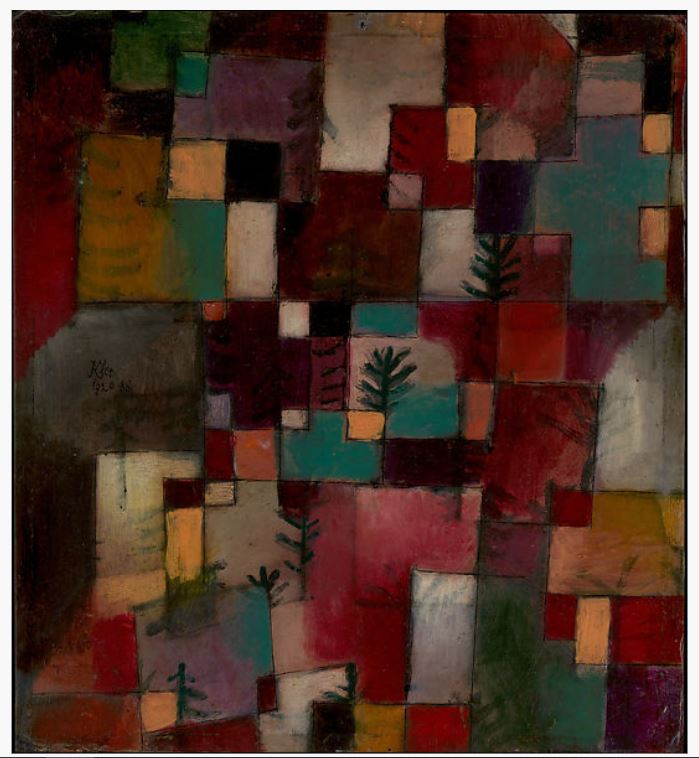
This excerpt from On Modern Art, the 1924 treatise from the great Swiss artist Paul Klee.
For me, he was a big influence not only for his distinctive works but for his attitude and his views on art that he expressed so well in his writings. His use of color also influenced me. I always think of his work in terms of the color– sometimes muted yet intense and always having a melodic harmony to it.
It always feels like music to me. Like Klee, I often equate the visual with music.
I like his idea that the world is in the process of creation, of Genesis, and that it is not a final form. It allows for visionary work, for imagining other present worlds that extend beyond our perception because, as he writes, “In its present shape it is not the only possible world.”
And to me, that is an exciting proposition.
This is a reworked version of a post that originally ran in 2015. I needed a little kick of Klee this morning.
Paul Klee- Fish Magic 1925
Paul Klee,, Blossoms in the Night
Paul Klee- Redgreen and Violets-Yellow Rhythms 1920
Dreams come true; without that possibility, nature would not incite us to have them.
–-John Updike, Self-Consciousness: Memoirs (1989)
I ran this post last year on Small Business Saturday. It’s an echo of yesterday’s post, urging people to support local businesses, craftspeople, and artists. I thought this particular post made a reasonable case for supporting local artists and businesses as well as for people pursuing their dreams. The only change has been the song at the end. Please give a read and a listen and if you’re out and about, remember to support those businesses and artists in your area.
[From 2023]
It’s another Small Business Saturday, that Saturday after Thanksgiving when people are urged to go out into their communities and shop in locally owned small businesses. It’s one of the best ways to keep your local community vibrant and alive. The money spent for the most part stays local and multiplies many times as it radiates out into the community.
It can be a huge economic engine for the small businesspeople in your local area.
But it is also something more– it is the sustaining lifeblood for a multitude of dreams. Every local small business represents the fulfillment of a dream of someone in your area. It required that someone believed in an idea or ability that they possessed and then risked something– often everything– in putting themselves out there in front of their friends and neighbors.
It can be a gigantic gamble where failure can sometimes mean financial ruin, public humiliation, and lifelong dreams being forever crushed.
But you can look at that risk as the only chance you might get at following your dreams. A chance to finally be the person you once imagined yourself being. Even the humblest small business is the realization of a dream for someone.
And anyone’s dream is a big deal, in my opinion.
I am an artist and a small businessperson, as is every working artist and artisan. We don’t like to talk about it as a business, of course, but after the making of the art it is that thing that keeps our dreams alive. Our dreams and our livelihoods depend on people dealing with us or the local shops and galleries that carry our work– all small businesses.
Small but consequential.
Every gallery I work with provides income for at least 50-80 artists and artisans. That’s 50-80 dreams fulfilled in each gallery.
And, again, that’s a big deal.
I’ve been extremely fortunate to have my dream kept alive for the past 28 or so years. And I have those dream-enablers at the galleries that represent me as well as the many of you out there who have supported my work to thank for that. As much as I might like to think I achieved anything on my own, my dream has been dependent on so many people.
Like anyone with a dream of following their passion, it has meant the world to me. I would love to see many others achieve their own unique dreams in the same way.
So, help them out if you can. I am not asking you to buy locally as a charitable act. View it as more of an investment in your neighbors and your community and an act of humanity in that you are feeding someone’s dream. Whatever you might purchase from a small local business — be it a painting, a cup of coffee, a piece of clothing or pottery, a cupcake, or any of the many things made and sold in your area–is your first dividend on that investment. It is money well spent.
And to those of you out there with a dream who have yet to find the nerve to take the leap, I urge you to follow your dreams. Sure, it might be hard. And sure, you might fall on your face. That’s a given. But keep in mind that there is always the possibility of achieving your dream only if you take that leap.
You don’t want to be one of those people who go through life saying, “What if?” At least if you fail, you have the chance to chase another dream.
Here’s a song from the late Roy Orbison. He’s backed here by an all-star band as he performs In Dreams.
By health I mean the power to live a full, adult, living, breathing life in close contact with what I love — the earth and the wonders thereof — the sea — the sun. All that we mean when we speak of the external world. A want to enter into it, to be part of it, to live in it, to learn from it, to lose all that is superficial and acquired in me and to become a conscious direct human being. I want, by understanding myself, to understand others. I want to be all that I am capable of becoming so that I may be (and here I have stopped and waited and waited and it’s no good — there’s only one phrase that will do) a child of the sun. About helping others, about carrying a light and so on, it seems false to say a single word. Let it be at that. A child of the sun.
—Katherine Mansfield (1888- 9 January 1923)
October, 1922, Her final journal entry
About ten years back, I came across this final journal entry from the Modernist writer Katherine Mansfield, who died much too early from tuberculosis at age 35, and employed it for a painting called Proclamation. The feel of that painting very much mirrors that of the painting above, Proclaim the Day, which is at the West End Gallery as part of their Deck the Walls show which opened yesterday. The sense I get from both paintings remind me very much of the emotions expressed by Mansfield.
This is a painting that speaks to me of having come to an understanding of oneself, to be willing to stand strong against the prevailing winds in order to show that true identity. It is at once strong yet fragile, flawed yet beautiful. A strength derived from the challenges it had overcome and a fragility in that it recognizes its limits and mortality. Flawed by the scars of attained wisdom and change. Beautiful because it is honest and authentic, open to the elements and all who look upon it.
In these ways, it has become a source of light in its own right or, to use Mansfield’s term, a child of the sun.
A child of the sun.
If only we could all see ourselves in that way.
Here’s a song I shared a couple of years back. It often comes back to me in a haunting kind of way. It’s a remake from horn player Takuya Kuroda of the 1976 song, Everybody Loves the Sunshine, from jazz artist Roy Ayers. The original is great, but I personally prefer Kuroda’s remake. Has more of that child of the sun feel in my opinion. But, hey, that’s just me…







 Redtree Times