Feeds:
Posts
Comments

Posts Tagged ‘Creativity’

The Wanderer’s Compass— Coming to the Principle Gallery


I think while appropriation has produced some interesting work … for me, the most interesting thing is to back yourself into your own corner where no one else’s answers will fit. You will somehow have to come up with your own personal solutions to this problem that you have set for yourself because no one else’s answers are applicable.

[…]

See, I think our whole society is much too problem-solving oriented. It is far more interesting to [participate in] ‘problem creation’ … You know, ask yourself an interesting enough question and your attempt to find a tailor-made solution to that question will push you to a place where, pretty soon, you’ll find yourself all by your lonesome — which I think is a more interesting place to be.

— Chuck Close, 2006 interview with Joe Fig for Inside the Painter’s Studio


I have written about late artist Chuck Close (1940-2021) a few times here before. While I was fan of his distinctive work, it was his words that really hit close to home for me. For example, his Inspiration is for amateurs, the rest of us just show up and get to work has been a credo of sorts for me for some time now. In this article which spawned that credo, Close also spoke the words above and they have the same sort of meaning.

Back yourself into your own corner where no one else’s answers will fit.

I love this and can easily identify with it. I have sometimes described it as working to a place where all your influences have faded away completely and your work becomes distinct, almost self-referential.

Painting is about problem solving. Just the process of taking paint and using it to give form and meaning in two dimensions is, at its heart, a major problem. Some artists follow the lead of those who came before them in solving the problems that come with painting. That’s the appropriation that Close mentions.

But as he also says, it is most interesting when the well-worn answers no longer solve the problem as you see it. You must depend on your own unique set of skills and intuition. That is when the work of any artist takes on a new dimension and singularity for a solution. It also creates a great sense of autonomy in the artist, one that feels freed from the constraints of the influence of the past.

I also like Close’s thoughts on problem creation versus problem solving in the creative process. Problem creation forces us into those corners where new answers emerge as solutions.

I think the painting at the top is microcosm or shorthand version of that principle. It was started at the Painting Demo I gave at the Principle Gallery in June. I had a young lady from the assembled group make the first mark on the canvas.

It was a slash in a difficult spot on the surface. Definitely a problem that somewhat backed me into a corner. But it was actually a good thing because it allowed me to demonstrate how I react to such problems and the problems that arose from my initial reactions. And in my own way.

I often think that my best work comes when I encounter a problem that stretches me out and makes me uncomfortable., forcing me to look beyond the toolbox of skills I have assembled. The creation of new problems allows us to react in different ways, to climb out of our own ruts.

To create new solutions and maybe open new avenues to follow forward– that is where growth begins.

The painting, a 20″ by 20″ canvas, from the Demo is now finished, framed, and titled The Wanderer’s Compass. It will be coming with me to the Gallery Talk this Saturday, September 27, along with a group of new work. The Talk begins at 1 PM.

Gallery Talks also fall into the province of problem creation and problem solving. A big part of my talks is Question & Answer, which by its very nature is problem creation which often makes me scramble to come up with an answer that makes sense. It’s much like painting in that way.

Of course, I can cover up all my mistakes at the Talks by giving away a painting at its end. The painting this year is A Place of Sanctuary, shown below. Hope you can make the Gallery Talk on Saturday. You might well walk away with this painting!


A Place of Sanctuary— You Could Win This Painting!


Read Full Post »

The Passing Parade— Now at the Principle Gallery


It’s akin to style, what I’m talking about, but it isn’t style alone. It is the writer’s particular and unmistakable signature on everything he writes. It is his world and no other. This is one of the things that distinguishes one writer from another. Not talent. There’s plenty of that around. But a writer who has some special way of looking at things and who gives artistic expression to that way of looking: that writer may be around for a time.

–Raymond Carver, A Storyteller’s Shoptalk,  New York Times (1981)


I am in the midst of a deep funk, a depressive event that comes on the heels of every show or gallery talk. Every show or talk–good, bad, or indifferent. It’s just the way it is. I think it’s a blend of several things.

One is simply being worn down with the effort of both creation and promotion. The promoting part– this blog, for example– becomes difficult and depleting just before and after each event.

Another is in creating unrealistic expectations for the event. This is especially true when I have stronger than normal feelings about the work.

Some of it comes in questioning my own efforts. Did I do enough? Did I break new ground? Or the simple but deadly– Am I good enough? 

Some of it comes from second-guessing my interactions with people. In her diary, author Anaïs Nin described very much what I go through after any event:

I have never described, even in the diary, the act of self-murder which takes place after my being with people. A sense of shame for the most trivial defect, lack, slip, error, for every statement made, or for my silence, for being too gay or too serious, for not being earthy enough, or for being too passionate, for not being free, or being too impulsive, for not being myself or being too much so.

You add in the deadline for the show being met which means that an endpoint, a destination, has been reached. It seems as though it should be a time to feel free but for a short time after each event, I feel unmoored, without direction, until a new destination is put in place.

These post-show depressions usually find me questioning what I do and the choices I have made. The questions that usually satisfies and begins to put me back on course comes by asking myself if I am painting the paintings I want or need to see. Am I doing work that is mine alone?

For the answer to those questions, I am going to continue here with a blog entry that has ran a couple of times here, the last time being in early 2020. The painting at the top of the original post  has been switched out for one, The Passing Parade, from my current Entanglement exhibit at the Principle Gallerystill promoting!— which satisfies now what I wrote then. I have also added the passage at the top from the late Raymond Carver. It’s another one of those quotes about writing where one can easily substitute artist for writer. It very much ties into the idea of painting the paintings you want to see for me. Or to create the world in which you wish to live, to put it another way.

Here’s that earlier blog post:


This painting really captivates me on a personal level and reminds me of a thought that once drove me forward as a younger painter. It’s a thought that I often pass along as a bit of advice to aspiring artists:

Paint the paintings you want to see.

Sounds too simple to be of any help, doesn’t it? But that simplicity is the beauty and strength of it.

For me, I wasn’t seeing the paintings out there that satisfied an inner desire I had to see certain deep colors that were being used in a manner that was both abstract and representative. If I had seen something that fulfilled these desires, I most likely would not have went ahead as a painter. I wouldn’t have felt the need to keep pushing.

It was this simple thought that marked the change in my evolution as a painter. Before it, I was still trying to paint the paintings that I was seeing in the outer world, attempting to emulate those pieces and styles that already existed as created by other artists. But it was unsatisfying, still echoing the work of others, forever judged in comparison to these others.

But after the realization that I should simply paint what I wanted to see, my work changed, and I went from a bondage to that which existed to the freedom of what could be found in creating something new. For me, that meant finding certain colors such as the deep reds and oranges tinged with dark edges that mark this piece. It meant trying to simplify the forms of world I was portraying so that the colors and shapes collectively took on the same meditative quality that I was seeing in each of them.

In my case this seems to be the advice I needed. But I think it’s advice that works for nearly anything you might attempt.

Paint the paintings you want to see.

Write the book you want to read. Toni Morrison said this very thing at one point.

Play the music you want to hear. Make the film you want to see. Cook the food you want to eat. Make the clothes you want to wear.

Make the world in which you want to live.

Simple.

Now go do it.


It was good advice then and it still is now. Time for me to claw my way out of this hole. Paint toward the light…

Read Full Post »

In the Free World-– Now at Principle Gallery, Alexandria


Every artist dips his brush in his own soul, and paints his own nature into his pictures.

–Henry Ward Beecher, Proverbs from Plymouth Pulpit (1887)


As an artist, if you will allow to call myself that, I believe these words the famous 19th century preacher Henry Ward Beecher are true. I know that I feel closest to my work when it most reflects a feeling and tone that I recognize deep within myself. You just hope that this aspect of your nature is equally reflected outward, that people see that same aspect in you as a person.

Sometimes they do and sometimes they do not. It is not always an easy transition when trying to bring anything from the inner to the outer world. I guess the best one can do as an artist is to be sincere, to represent those aspects which truly are part of your true nature.

To try to do otherwise produces insincere work. And while it can exist and even prosper in the short term, it eventually reveals its insincerity.

I don’t know, maybe I am just spinning my wheels this morning. I often do that in the aftermath of a show opening. It’s a matter of finding something to hold on to before I fully fall into the abyss of funk that I seem to encounter after every show. In this year’s case, I am holding on to the fact that I know the work I produced is indeed sincere and represents what I believe is my true nature.

Well, most of my true nature. You know, the good parts. The aspirational. The inspirational. But in reality, even the darker aspects of my true nature show up in what I consider my best work. I think it is that tension between the dark and light aspects of an artist’s nature that produce meaningful art.

Sincere art. Art of the soul.

Okay, a little more info on Henry Ward Beecher, for those of you not familiar with the name. He was one of the biggest celebrities of the late 19th century, on an equal footing with the actors, musicians, and writers of the era. At one point, he was referred to as the Most Famous Man in America. He was even on popular trading cards and had his own sex scandal that culminated in one of the most celebrated trials of the time. He was also a great social reformer as an abolitionist and advocate for women’s suffrage. He was the brother of Harriet Beecher Stowe of Uncle Tom’s Cabin fame, as well as the brother of Thomas K. Beecher. I throw in Thomas because of his local connection to my hometown. He was the big fish in our small pond at the time, a preacher who drew huge congregations as well as a civic leader. He was a good pal of Mark Twain and buddied around with him, playing pool and such, during Twain’s many summer stays here in Elmira. Beecher also presided over Twain’s wedding to local girl Olivia Langdon.

Okay, enough extra info. Let’s have a song. Since we’re discussing the nature of the soul, here’s Soul Time from Shirley Ellis. You might know her from her fun big hits The Name Game and The Nitty Gritty. A video for The Nitty Gritty with some exuberant dancer, highlighted by the wild moves of well-known dancer/choreographer Bobby Banas, became a viral hit. Lots of fun.


Read Full Post »

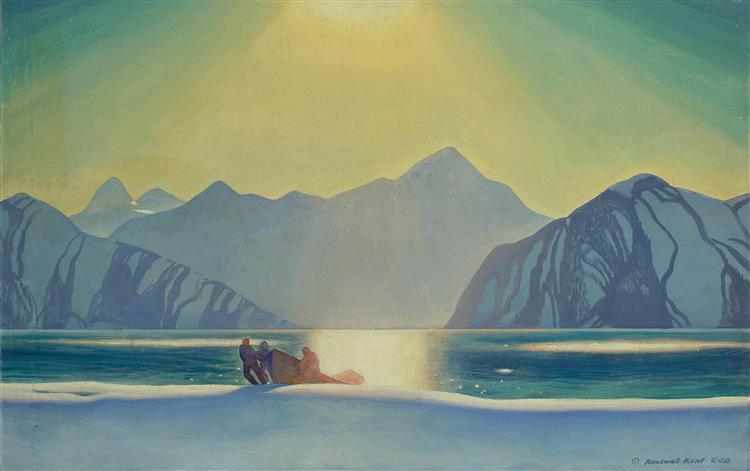
Rockwell Kent– Sunglare, Alaska (1919)


Often I think that however much I draw or paint, or however well, I am not an artist as art is generally understood. The abstract is meaningless to me save as a fragment of the whole, which is life itself… It is the ultimate which concerns me, and all physical, all material things are but an expression of it… We are part and parcel of the big plan of things. We are simply instruments recording in different measure our particular portion of the infinite. And what we absorb of it makes for character, and what we give forth, for expression.

–Rockwell Kent, Wilderness: A Journal of Quiet Adventure in Alaska (1918)


I am sometimes a little hesitant in using the words of other artists in describing my own. After all, art is so subjective, both in viewing and creating, that the driving forces and subjective criteria of one can be quite different than those of another. In short, my what and why may not be the same as yours.

But I came across this passage from the journal of Rockwell Kent, an artist whose work and words I have always admired. One of the big moments in my early career was being chosen for a museum exhibition in which his work was also shown. It sure felt like a big deal then to have my name listed alongside his on the brochure for the show.

Kent kept this journal during the time in 1918 when he withdrew to an island off the coast of Alaska, along with his seven-year-old son. He was fleeing to a remote place where he could get away from marital and financial problems and a world where a World War raged and the Spanish Flu pandemic was in full, deadly force. The same world that at that time seemed to care little for the work he passionately created.

In this time, he deeply felt his own apartness from this world while at the time finding an understanding of the interconnectedness of all things. The idea that we are all part of the infinite was something which became a theme for much of his work.

I can understand that. It is basically the theme for my current show and much of my work throughout my career.

The paragraph above just slayed me when I read it. It hit on several things that I feel in my own life and work. The end of that first sentence– I am not an artist as art is generally understood— is a thought that has been with me for many years, long before stumbling across Kent’s words.

For me, I often don’t think of myself as an artist first since I didn’t come to it because of a natural and readily evident physical talent. My main impetus was instead the need to express something felt deep within, something that could not find form in any other way, something I could not easily identify or even know. That need to express the inexpressible far outweighed any innate ability that I possessed. 

I’m not sure that is the same for all artists. I don’t know, of course, and I am certain that there are plenty who have this same feeling, this sense of being both apart from the world of art even as they are seen as part of it. Perhaps as many or more than those who easily made their way to a life in art because of their natural facility and talents, those artists who feel comfortable and accepted within the world of art, never doubting their place in it. 

The latter part of this paragraph where Kent states that all physical, material things are mere expressions or physical manifestations of the infinite– the ultimate, as he calls it– echoes in what I have described as the belief system behind the work in my Entanglement series.

And that is reinforced even more in the next part: We are part and parcel of the big plan of things. We are simply instruments recording in different measure our particular portion of the infinite. 

We are all part of that one infinity and we uniquely serve purposes that we may never know or understand, hard as we may try to do so. For some like Rockwell Kent–and myself as I see it– that task or purpose is to give form to feeling so that others might somehow find some understanding of the infinite and their own unique part in it. 

Another short passage from this journal says:

These are the times in life — when nothing happens — but in quietness the soul expands. 

This sentence also struck a resonating chord with me. It wasn’t always that way. There are times in one’s life when sound and action is more welcoming than stillness and quiet, times when doing and going seem more important than simply being.

It seems that stillness creates space in which the soul can expand. 

That’s my take on Kent’s lovely words for the day. Does it make sense for anyone other than me? I can’t say. 

Just looking to expand my soul this morning with a little quietness,,,


Read Full Post »


Art is a human product, a human secretion; it is our body that sweats the beauty of our works.

–Émile Zola, Le Moment Artistique (1868)


Calvin and Hobbes from artist Bill Watterson has long been a favorite comic strip of mine. Though the strip ended its run in 1995, it is still rerun daily in newspapers around the country. The strip above was rerun yesterday and while Calvin’s sales spiel made me chuckle, it also reminded me of a blog entry from back in early 2009. It concerns the question of how long it takes to finish a painting, a question that has been asked of me many, many times at openings and gallery talks. I usually tell the story of a commission I did for a Finnish diplomat a number of years back and how the work I did on that piece became the template or rehearsal for a larger piece soon after.

The answer that I gave in 2009 still pretty much applies although I have noticed that in recent years that it is taking me longer to finish paintings. The processes I employ in my work have evolved, sometimes gaining steps that were not in place in the earlier years. I also tend to dwell on each piece a little longer now and am more apt to set them aside so that I can simply consider them before forging ahead. But there’s even a variable in that– sometimes the energy and direction of a piece is so determined that there is a danger in losing its momentum by setting it aside.

So, there is no one answer to the question. Here’s what I wrote in 2009:


I am asked this question at every opening and gallery talk:  How long does it takes to finish a painting?

Though it’s a question that I’ve answered a thousand times, I still have to stop and think about my answer.

You see, there are so many variables in my painting technique at different times that sometimes the actual process can be much longer or shorter on any given painting. Sometimes I can toil over a piece, every bit of the process requiring time and thought. There may be much time spent just looking at the piece trying to figure out where the next line or stroke goes, trying to weigh each move. Then there are times when the painting drops out effortlessly and I’ll look up after a very short time and realize that it’s almost complete. Any more moves from me and the piece would be diminished.

I often cite an example from a number of years ago. I had been working on a series of paintings, working with a particular color and compositional form. Over the course of a month, I did several very similar paintings in several different sizes from very small up to a fairly large version. Each had a very distinct and unique appearance and feel but the technique and color were done in very much the same way.

One morning at the end of this monthlong period, I got up early and was in the studio at 5 AM. I had a very large panel, 42″ by 46″ if I am not mistaken, already prepared and pulled it out.

Immediately, I started on the panel. Every move, every decision was the result of the previous versions of this painting I had executed over the past month. I was painting solely on muscle memory and not on a conscious decision-making thought process. I was painting very fast, with total focus, and I remember it as being a total whirl. The piece always seemed near to disaster. On an edge.  But having done this for a month I trusted every move and forced through potential problems.

Suddenly, it was done. I looked over at the clock and realized it had only been two hours. I hadn’t even had breakfast yet. Surely, there must be so much more to do.

But it was done. Complete.

It was fully realized and full of feeling and great rhythm. I framed the piece and a few weeks later I took it to the Principle Gallery in Alexandria, VA with a number of other new pieces. This painting found a new home within hours of arriving at the gallery.

I realized at that point that every version of that painting was a separate performance, a virtual rehearsal for that particular painting.  I had choreographed every move in advance, and it was just a matter of the having that right moment when plan and performance converged.

It had taken a mere two hours, but it was really painted over the course of hundreds of hours.

And perhaps many years of painting, listening, reading, and observing before that.

I hope you can see why I always have to think about this question…

Read Full Post »

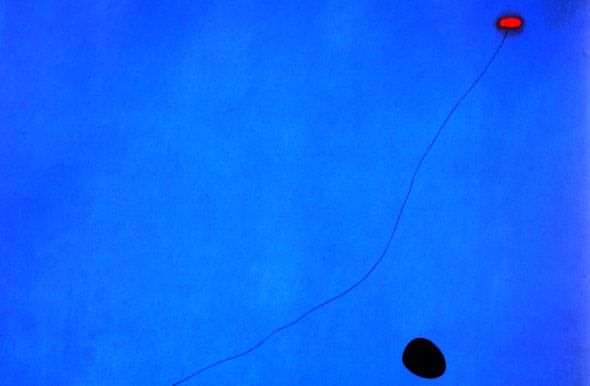
Blue II– Joan Miró

*****************

The picture should be fecund. It must bring a world to birth.

-Joan Miró

****************

The thought behind these words from Joan Miró is one that I often keep in mind. Art succeeds when it creates its own reality, when it brings a world to birth in the mind of those who behold it. The artist’s own belief in the reality of that new world is a large determinant in whether this birth takes place.

For myself, I almost always feel like I am taken to a different world, one as real as the world I inhabit in my human skin, by whatever is on the surface before me.

That is, when it works. Sometimes it is difficult to climb into that new world and that new reality that wants to be born on the surface is nothing more than a lifeless mishmash of paint blotches and lines. That is frustrating, to say the least.

But when it works, it is an easy glide into that new world with its own atmosphere and landscape, so familiar yet new and fresh in the nose and to the eye. It’s a thrill just to be in there for that time when taking on its lifeform.

Joan Miró (1893-1983) did such a thing with such ease. I am showing his Blue triptych from 1961 today. I find it interesting how intimate and alive they feel as single images on a screen where their scale fades away. These could easily be small paintings. But when you see them as they are in the two photos below, you can see their size and how it magnifies their lifeforce.

They are a world unto themselves.

Take a look for yourself. I have also included a video oDave Brubeck’s Bluette at the very bottom of the page that is played over a slideshow of Miró’s work. As Brubeck fans know, he sometimes employed Miró’s work in his own as well as on his album covers. All in all, just plain good stuff…


Didn’t feel like writing this morning and wanted to start out the week with something not troubling my mind. Something that is more about art, something that perhaps inspires or at least eases the mind. Something to make me feel fecund, to use Miró’s term. This post is from five years ago and felt good this morning, especially with the Dave Brubeck accompaniment to Miró’s paintings.


Blue I- Joan Miró


Blue III- Joan Miró


Read Full Post »

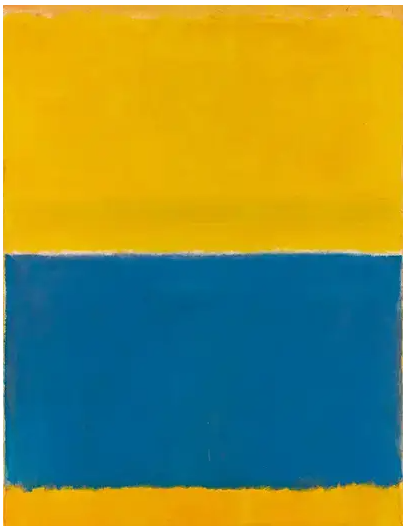
Mark Rothko –Untitled (Yellow and Blue) 1954


“You might as well get one thing straight. I’m not an abstractionist… I’m not interested in the relationships of color or form or anything else. I’m interested only in expressing basic human emotions—tragedy, ecstasy, doom and so on. And the fact that a lot of people break down and cry when confronted with my pictures show that I communicate those basic human emotions… The people who weep before my pictures are having the same religious experience I had when I painted them. And if you, as you say, are moved only by their color relationships then you miss the point.”

― Mark Rothko, 1956 Interview with Selden Rodman


I used a representation yesterday of the colors of the flag of the Ukraine that was actually a detail, shown above, taken from the large Mark Rothko painting shown at the top. I had used this detail before in a post around this time in 2022, one which drew a lot of attention yesterday. Enough so that I went back to check out that post which I am sharing again today as the quotes in that post from Rothko speak so clearly to a lot of things that I have been focusing on recently, on both this blog and in my work.

And since it is Sunday, I am also sharing some Sunday Morning Music at the bottom. In light of what is taking place in this country, the calming effect of Gnossienne No. 1 from Erik Satie seems like the right choice to accompany Rothko as Satie’s work followed similar paths of deep expression and silences. The version I am sharing is a mesmerizing performance from celebrated Finnish guitarist Otto Tolonen.


Busy morning ahead with painting and plowing from what I hope is the last snowfall of this winter. But I thought I would share a Mark Rothko painting (the image at the top is only a detail of its lower section- the whole painting is shown here on the left) and a video on it from Sotheby’s auction house (where it sold for $46.5 million in 2015) along with several Rothko quotes.

Rothko (1903 -1970) was a big influence on my early work. The idea of expressing the big human emotions through simplified forms and color really spoke to me because I never looked at painting as a craft but more as a means to express those forms of emotion that well up inside because they are sometimes too difficult to express in words and voices.

Another aspect that attracts me to Rothko is that he, like Kandinsky, was often eloquent in speaking about his work and art in general. And in those words I found that my own already developed perspectives often largely meshed with and echoed both of these artists’ words and views.

For example, in the quote below the idea that a picture lives by companionship is one that is central to my work.

“A picture lives by companionship, expanding and quickening in the eyes of the sensitive observer. It dies by the same token. It is therefore risky to send it out into the world. How often it must be impaired by the eyes of the unfeeling and the cruelty of the impotent.”

Here a few more that also speak to me, things I have often written about here, about the need of emotional expression in art and of the searching for silence.

“It is the poet and philosopher who provide the community of objectives in which the artist participates. Their chief preoccupation, like the artist, is the expression in concrete form of their notions of reality. Like him, they deal with the verities of time and space, life and death, and the heights of exaltation as well as the depths of despair. The preoccupation with these eternal problems creates a common ground which transcends the disparity in the means used to achieve them.”


“When I was a younger man, art was a lonely thing. No galleries, no collectors, no critics, no money. Yet, it was a golden age, for we all had nothing to lose and a vision to gain. Today it is not quite the same. It is a time of tons of verbiage, activity, consumption. Which condition is better for the world at large I shall not venture to discuss. But I do know, that many of those who are driven to this life are desperately searching for those pockets of silence where we can root and grow. We must all hope we find them.”


Read Full Post »

The Resistance– At West End Gallery


The aim of every artist is to arrest motion, which is life, by artificial means and hold it fixed so that a hundred years later, when a stranger looks at it, it moves again since it is life. Since man is mortal, the only immortality possible for him is to leave something behind him that is immortal since it will always move. This is the artist’s way of scribbling “Kilroy was here” on the wall of the final and irrevocable oblivion through which he must someday pass.

–William Faulkner, Paris Review interview (1958)


Faulkner perfectly captures something I have been writing about here for years, the urge to leave something behind as evidence of your onetime existence in this world. It’s the driving force behind creation of all sorts, from human procreation to multiple forms of artistic expression, from the caves of Lascaux to the Sistine Chapel to the simplistic image of Kilroy left all over the world by American soldiers in WW II. Graffiti, which might be the purest form of saying I was here, has been around as long as mankind.

For the artist, it is an act of faith that your work will somehow survive into the future. You can never know with any degree of certainty. Oh, it may well make its way into museums or collections that span generations. It might well exist.

But will it be truly seen? Will it stay relevant, will its voice clearly speak in the future? Will it still maintain its movement, its life?

This idea of relevance– or rather irrelevance– is not a concern that only applies to the future for the artist. As an artist, after decades of creating work, I often question the relevance of my work at any given moment. Is it alive in this present, let alone the future?

I don’t know that you can fully know the answer to that question for anyone but yourself. Your relevance, now or a hundred years in the future, is not something you have a lot of say in.

The best you can do is to focus only on creating something that feels alive now. If it captures the motion, the feeling, the voice, and the humanity of our existence, it might well escape oblivion and might make its presence known in the future.

If it does, great. If not, you at least created something for this moment in time. And that’s great in its own right.

I chose the painting at the top, The Resistance— currently part of the West End Gallery’s Little Gems show– not only because of the obvious motion of it but because so much of what we do as humans is comprised of acts of resistance, of fighting to be heard or not relegated to some form of oblivion, one where we have no control over who and what we are.

I guess that could be applied to creating unique work, as well. Here’s a performance that I shared here several years ago. It is Ukrainian guitarist Nadia Kossinskaja performing an Asor Piazzolla composition, Oblivion. Felt like it went well this painting this morning.


Read Full Post »

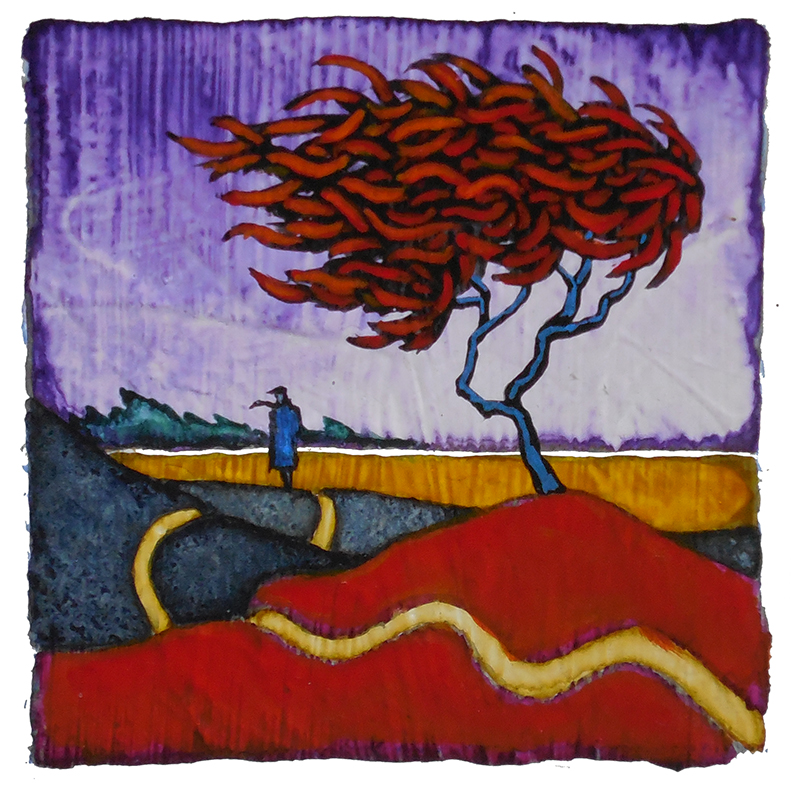
GC Myers-- Moment of Pride 2023

Moment of Pride— At West End Gallery


Pictures must be miraculous: the instant one is completed, the intimacy between the creation and the creator is ended.

Mark Rothko


I came across the words above from the late painter Mark Rothko and found myself relating very much to their meaning. The process of creating a picture is ideally a period of intimacy, one where the maker ideally opens their inner self and exposes their totality to the surface. There is a transference of energy and thought in that moment that forms the new life taking place on that surface.

Each move, each change to the surface pulls bits from the inner stores of the creator and alters the new reality being formed. For a rare moment, the two entities– the maker and the surface–are locked together.

They are one.

But as the picture takes shape and form, beginning to express its own life force, it moves away from the maker. At completion, the painting takes on its own being and at that point is beyond the reach and influence of the maker.

As a maker of pictures, I can say that this moment is both wistfully sad and exhilarating. When that moment of completion is at hand, I immediately miss that time of transference when the air is still filled with excitement and possibility. But seeing the new picture, self-contained and speaking for itself, brings a kind of parental pride. I know that I will never be as close to that picture as I was in that moment. But that moment binds us forever, even if it will be always as a faint memory when I glimpse its image in the future.

I chose the piece at the top for this post- fittingly titled Moment of Pride because it sums up the feeling felt when that transference has taken place and the piece stands apart, living and breathing on its own. I certainly felt the feeling depicted when completing this piece.

There was a definite moment of transference when this painting made the leap from being me to being it. It had its own story to tell that was then beyond me, speaking with its own voice, its own meaning that it will someday make known to someone other than me.

And they will hopefully experience their own rare moment….


This is a reworked post from 2016. It seemed to perfectly fit the painting at the top, Moment of Pride, which is now at the West End Gallery as part of their Deck the Walls exhibit, opening tomorrow. I’ve been adding songs to most every post lately and I’ll keep that going today.

Don’t think this song fits the painting here but it has a wistful feel much like that feeling felt when you realize that you’ve lost a closeness with someone or something that you will never be able to recapture, so it might. Whether it does or not, it’s a song that like a lot from an album that I like a lot and that’s good enough for me. It’s the title track from the Anodyne 1993 album, the last album from Uncle Tupelo before splitting up the next year as its members moved on separately to form the bands Son Volt and Wilco.

The tune and lyrics have a weary, disenchanted feel that seems to fit my own lately and probably a lot of others out there:

You threw out the past
When you threw out what was mine
Throughout the years
It was hard to make it last

Anodyne, anodyne

No sign of reconciliation
It’s a quarter past the end
Full moon from on high
Across the board, we lose again

Give a listen if you are so inclined. And don’t slam the door when you leave, okay?


Read Full Post »

GC Myers- Time Patterns 2024

Time Patterns– At West End Gallery


The point is, art never stopped a war and never got anybody a job. That was never its function. Art cannot change events. But it can change people. It can affect people so that they are changed… because people are changed by art – enriched, ennobled, encouraged – they then act in a way that may affect the course of events… by the way they vote, they behave, the way they think.

― Leonard Bernstein


This is not meant to be a political post and I will try to not veer into rhetoric. But, as I have pointed out in the past, everything ultimately is political in some way.

I have been thinking lately about the difference between the two presidential candidates. Not the obvious things. Those are too glaringly obvious in almost every way to go unnoticed. I don’t have to go into detail here. You see and know. Even those people who say they don’t know Kamala Harris can see the differences.

And I am not talking about gender or skin color.

The difference that sticks out for me is a little less obvious. It is something that the felonious former president*** lacks, at least in my observations. And it makes me wonder if this particular deficit is a bond between him and his most ardent followers.

What I see him lacking is a sense of art. He is a person who has obviously never felt nor been changed by art. He has seemingly never felt the communion that occurs between someone and any particular piece of art that stirs something deep within them.

For him, art is like everything else in his world–a transactional tool or commodity, something to be used to gain something tangible for himself alone. When he encounters art, it is to be used, not experienced or felt with awe or joy.

There is not art for art’s sake in his worldview.

You could see it in the years he was in office. There was no music in the White House. No celebrations of music and culture at the Kennedy Center. It was a time when the titular leader of our nation refused to honor the arts because its purpose and meaning both evaded him and failed to serve him.

It was a time devoid of art and joy for us a nation.

And that begs the question: Is that same deficit of feeling for art one of the unifying bonds between him and his most slavish followers? Have they never been changed by art, never responded to deeper feelings that art offers? Have they not seen themselves in, and been transformed by, the words, images or music of others?

And if they do lack this relationship with art, does it make them resent those who openly experience and feel art, seeing them as being somehow elite?

I don’t know that there is an adequate answer or if this is even a legitimate question. I just find myself wondering. It seems like it could be so.

But again, I don’t know.  I just feel that art, while it may not end the suffering felt by so many, expands the experience one feels of this world, creating new avenues of reality. And denying art limits our possibilities as humans. Much like the sage words at the top from Leonard Bernstein.

One guy’s opinion…

Read Full Post »

Older Posts »