Feeds:
Posts
Comments

Posts Tagged ‘Early Work’


Winter Park — 1994


Silience

n. the kind of unnoticed excellence that carries on around you every day, unremarkably—the hidden talents of friends and coworkers, the fleeting solos of subway buskers, the slapdash eloquence of anonymous users, the unseen portfolios of aspiring artists—which would be renowned as masterpieces if only they’d been appraised by the cartel of popular taste, who assume that brilliance is a rare and precious quality, accidentally overlooking buried jewels that may not be flawless but are still somehow perfect.

–The Dictionary of Obscure Sorrows, John Koenig


The painting at the top is from the autumn of 1994 making it an early piece for my work. I immediately called it Winter Park when it was completed– if you can call it completed. I wasn’t sure at the time if I was done with it. The white negative space was still up in the air in my mind and I was thinking it might need some color.

But the more I looked at it, the more that negative space took on a positive form for me. Color would have sullied it, made the sky less prominent which was a big factor in choosing to leave it as it is. This was painted not long after I had experienced my Eureka! moment with a painting that I called First View from August of 1994. I have discussed that painting several times here over the years, describing how when I first saw it, I knew that I had found something important to me that I didn’t even know I was seeking.

This painting felt like a continuation of that moment. Especially in its sky. It had the same sort of mixture of muted tones that created a complex color that was hard to describe. It was both beautiful and appealing to my eye but at the same time had the feel of a deep bruise in the sky. And that appealed to me, as well.

It created a great polarity of emotion for me within this seemingly simple piece. The negative space took on the form of snow in my mind and had a joyful feel in the way its clean, cool whiteness played off the muddle of the sky. But it also felt a bit wary and weary for me in the next moment, as though it represented enduring the journey through a long, hard winter that wasn’t yet over.

It’s been a piece that I come back to quite often when I review my past work. It has roughness and rawness that appeals to me. That’s something I still crave in my work but is sometimes hard to find after years of practice and refinement of whatever skills I possess.

In the refinement you sometimes lose a hard emotional edge that can’t be replicated no matter how far one’s abilities have progressed. I don’t know that I can properly explain that.

I think that’s why I am always looking for the next Eureka! moment. I know there’s something still out there but don’t yet know what it is. It will make itself known with unmistakable clarity when it comes.

If it comes.

Who knows? I may have already exceeded my given allotment of Eureka! moments. If so, I am grateful for the few I’ve been fortunate to experience. All were unexpected gifts. All were lifechanging.

What more can you ask?

I thought I would run the post below that was coupled with Winter Park about five years back. It doesn’t have an awful lot to do with the painting itself but speaks to how Eureka! moments and bits of serendipity sometimes lead a fortunate few to destinations they didn’t even know they were seeking. Perhaps at the end of that path in Winter Park


[From 2021] I came across the word at the top, silience, while browsing through a site I’ve mentioned here a number of times in the past, The Dictionary of Obscure Sorrows. It reminded me of the many bits of serendipity that brought me to the life and career I have been so fortunate to have and how lucky I have been in encountering people who didn’t just walk by without noticing my work.

It makes me feel grateful, indeed. It also makes me feel somewhat guilty for my good fortune when I know with absolute certainty that there are equally or more talented people out there whose work and abilities has gone unnoticed. I often see or hear the work of folks who have yet to find an audience and wonder how this could be. I find myself rooting for them, wanting them to continue to do whatever they do so that their work might someday find its way into a situation that will shine a light on it.

It also makes me somewhat guilty for the time that I have wasted, for the bits of hubris I have displayed at times when mistaking the serendipity I have encountered for some sort of entitlement or inevitability.

It’s a needed reminder that any notice my future work receives must be earned anew and that I must take notice of and encourage the talents of others.

Here’s a well-done video for silience:


Read Full Post »

Odd Bodkins Blue Sky– At West End Gallery


And where are the dreams I dreamed
In the days of my youth?
They took me to illusion when they
Promised me the truth
And what do sleepers need to make them listen,
Why do they need more proof?
This is a strange, this is a strange affair

Richard Thompson, Strange Affair (1978)


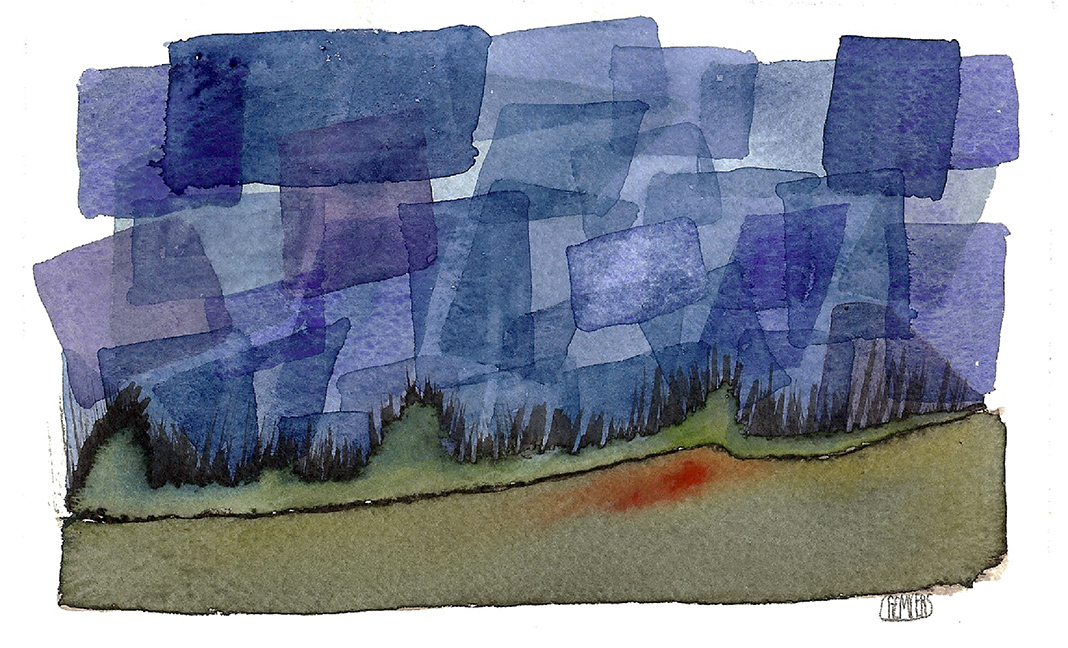
This is another of the small early paintings that I have released from their captivity. This one carries a memorable title, Odd Bodkins Blue Sky. which in itself indicates that it is a favorite of mine. It was painted in August of 1994 and it is being shown at the West End Gallery as part of the annual Little Gems show that opens on Friday.

It’s a piece that has always elicits an approving reaction those many times I’ve looked at it over the years. It makes me both happy and slightly regretful. I get a lot of joy from the painting itself but there’s just something in it that makes me wonder what might have been if I had followed the path that it promised me.

And it seemed to promise a lot.

It has a sort of organic abstraction that gives only hints of a narrative. It gives no answers but instead raises many questions. What is that red patch in the upper foreground? Are those clumps of grass? Is this even a landscape or something else altogether? What is the significance of the blocks of blue and violet making up the sky?

I, of course, can’t answer these questions for anyone but myself. And I am not sure I can fully answer them for myself. This enigmatic quality think that is part of this piece’s appeals for me.

Another part of that I am particularly drawn to is the organic feel of its forms and lines. It has the feel of a living thing, if that makes any sense. One part of it that gives me great pleasure comes in the line between the two green forms that make up the foreground. You might not be able to see this unless you zoom in to the image, but there are little flecks of white from the underlying paper. I don’t know why they give me such joy but they do. It’s a tiny aspect of this painting but for me, it makes the whole piece resonate.

It’s a strange little piece in many ways. And that is also part of its appeal.

A special child whose oddness is its gift to the world.

Odd bodkins, by the way, is an old English exclamation that comes from the Middle Ages. It was a way of swearing without actually blaspheming. If you yell Gosh darn it! after you hit your thumb with a hammer now, you might have yelled Odd bodkins! if you did the same thing in England a thousand years ago. How this applies to this painting, I have not a clue except that it kind of points out its strangeness.

Speaking of strange things, here’s a favorite song that, much to my surprise, I discover that I haven’t shared since early 2016. This is the great Richard Thompson song, Strange Affair, performed beautifully by June Tabor, accompanied by another of my favorites, Martin Simpson, on guitar. Tabor’s smoky voice makes this a memorable interpretation.


A quick note: The Opening Reception for the Little Gems show at the West End Gallery is this Friday, February 6, from 5-7 PM.


Read Full Post »


Into the Valley (1995) – At West End Gallery


There was a long hard time when I kept far from me the remembrance of what I had thrown away when I was quite ignorant of its worth.

–Charles Dickens, David Copperfield (1850)


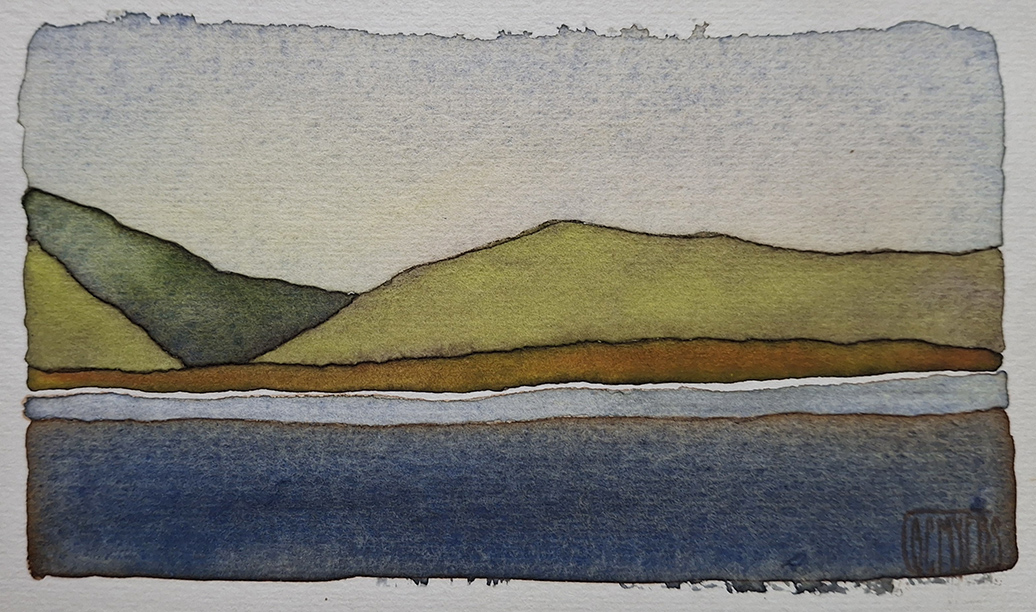
 The painting at the top is another early piece that is going to be included in the Little Gems exhibit opening at the West End Gallery this coming Friday, February 6. This painting, Into the Valley, has a direct connection to the Little Gems show of 1995, which was the first such exhibit for the gallery as well as the first public showing of my work.

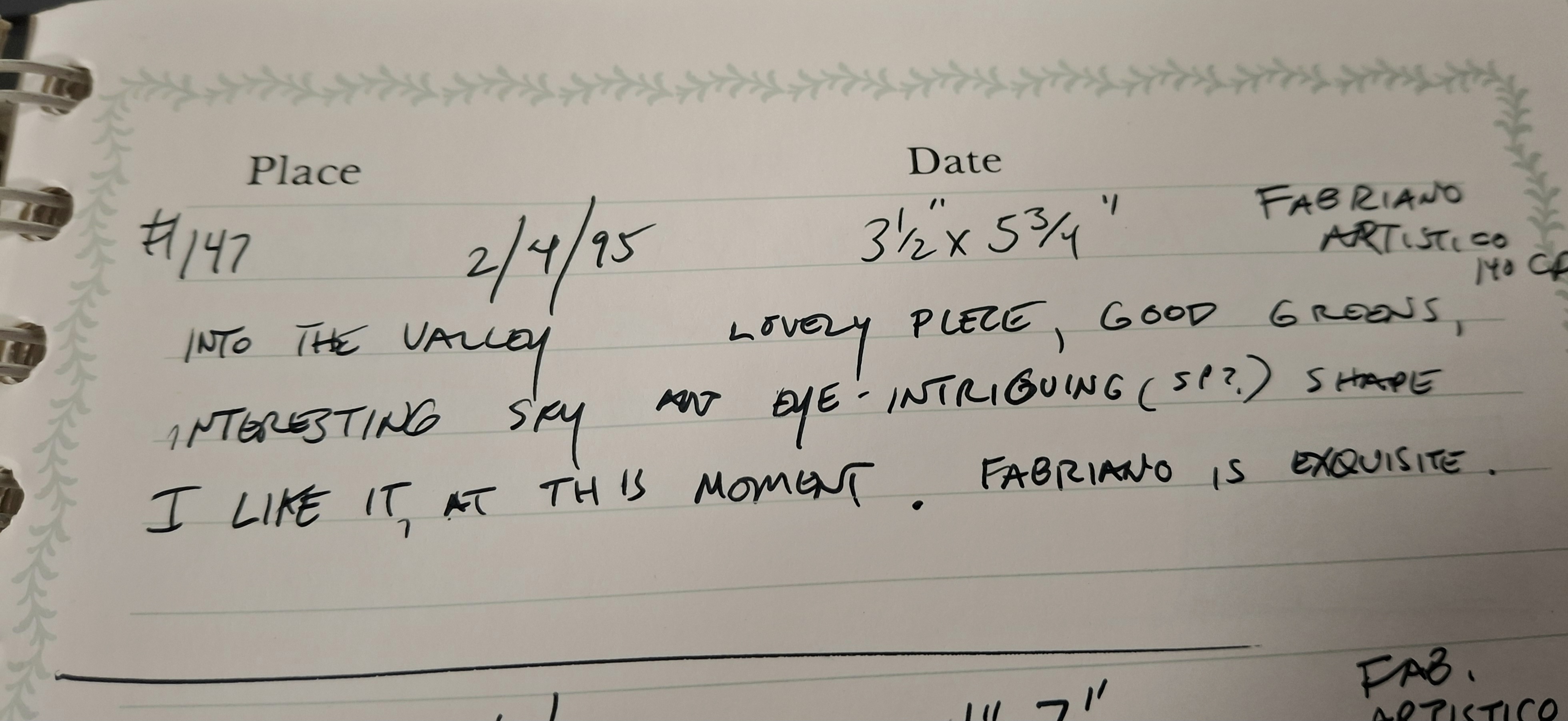
Painted on February 4, 1995, this was the first work produced after I had attended the opening of the show the night before, on February 3. In the painting diary I kept at the time there was no mention of the night before. I was a bit surprised that there was no mention of the opening since it had an immediate effect on me. But after looking at the diary a little more, I wasn’t so surprised. It included mainly simple direct information about each piece such as the date, title, the type of paper used (I was working solely on paper at that point), and some notes on the piece. These notes sometimes pertained to the paints I was using as well as my first impressions of the painting.

Here’s the entry for this painting what will be from 31 years ago in just two days:

Lovely piece, good greens, interesting sky and eye-intriguing shape. I like it, at this moment. Fabriano is exquisite.

It’s a short entry but it gives me a world of pertinent info. Mainly, it tells me that my first impression of it was very positive, but I wasn’t totally confident in my own opinion of it. Some things never change. It was this hesitation in my judgment that probably kept this painting in a box for the past three decades.

My first impression of Into the Valley as I wrote then was right on the money. It is a lovely piece. It does have good greens and its sky is interesting and its shapes are eye-intriguing. And the Fabriano paper that I was just working with for the first time around then was and is exquisite.

Looking at it now, I realize that I made a mistake in not freeing this little guy long ago. I hope that it gets to have a long life of the appreciation it due.

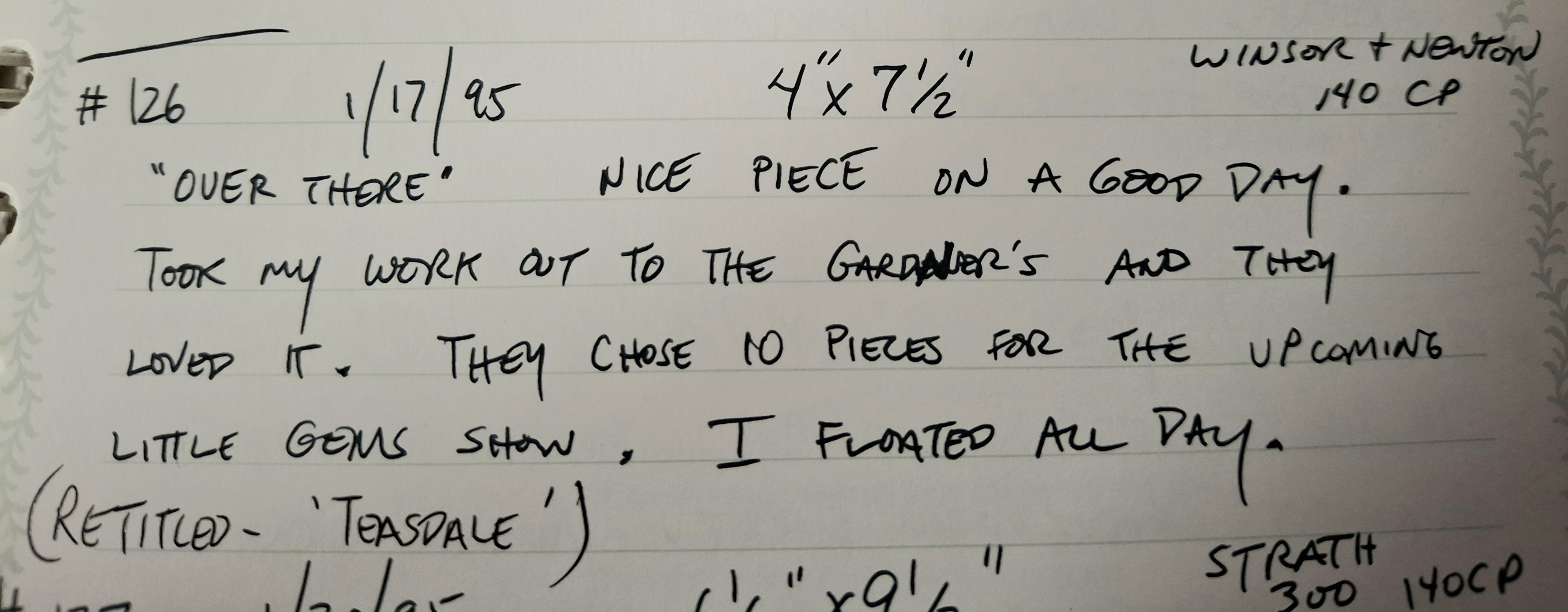
A little side note. I stopped using this painting diary at the end of 1995. My entries for the time after that are regrettably even less informational. But I am thrilled in having these notes for the earliest works. Reading recently, I noticed that I seldom went beyond this terse format in my painting diary.  One interesting except was an entry a few weeks before I painted Into the Valley.

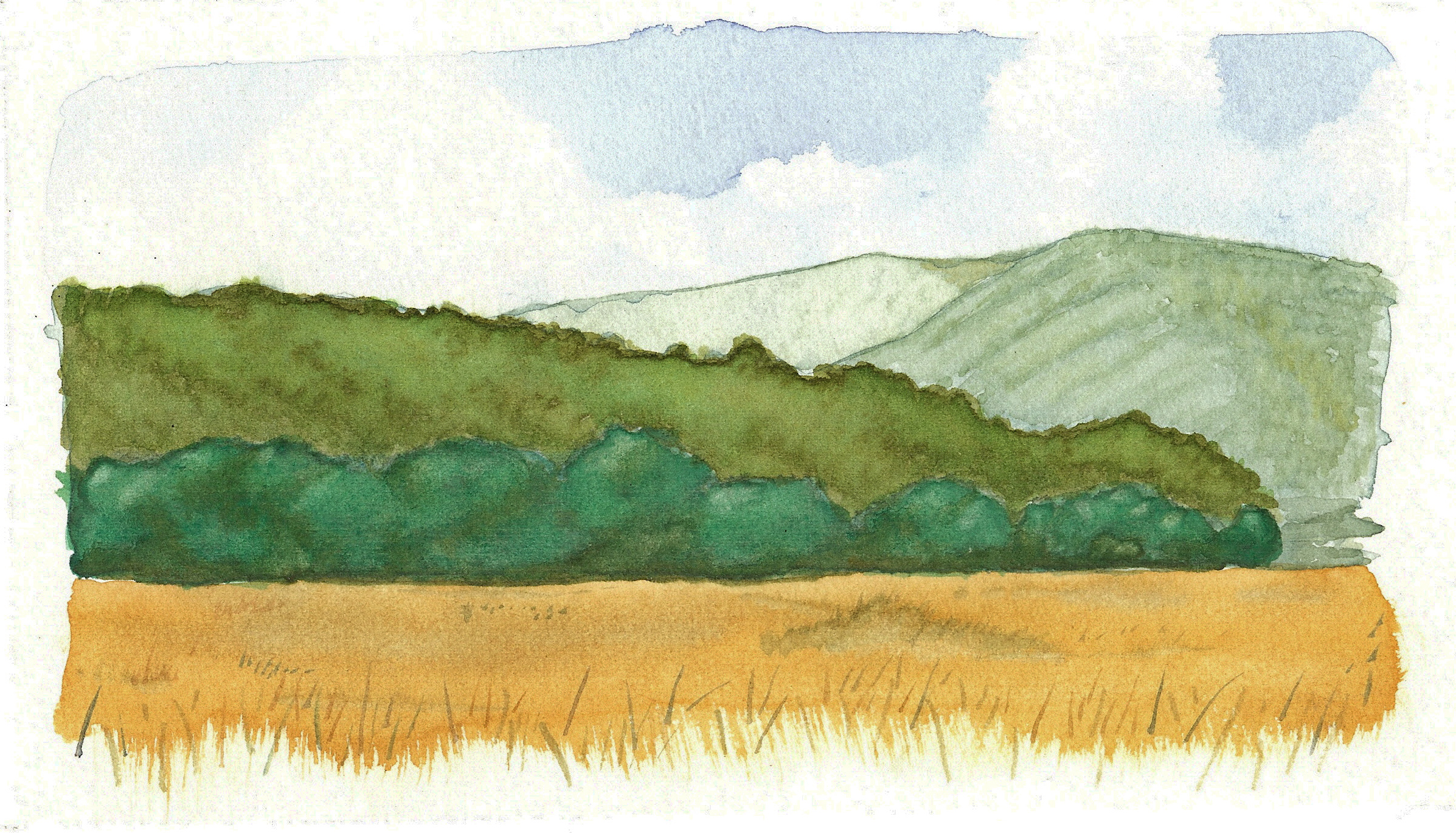
It came on January 17, 1995. I don’t remember much about the painting from this entry except that it was renamed Teasdale which I remember did find a new home later in the year. I don’t think I even have an image of that painting or, if I do, it is lost in a jumble of poorly shot slides from that time.

But the painting is not the interesting thing here for me.

More importantly, this short entry came from the day I took my work stuffed willy nilly into man old blue milk carton out to the West End Gallery. That was the day when all kinds of new horizons opened for me that I hadn’t even dared to imagine before that day. Here’s what I wrote after that meeting with Tom and Linda Gardner at the West End:

A good day… I floated all day. It now seems like such a restrained understatement for what I was feeling on that day and for what it came to mean for my future.

This probably gives you an idea why I have such deep appreciation and fond feelings about the Little Gems show. It is an integral part of my career, the point of departure for my artistic path. Without that day in January back in 1995 and that first opening a few weeks later, I have no idea where I might be now. The only thing I can say for certain is that I could not be any more content wherever I might have ended up.

When I see new artists, especially the younger ones, show for the first time at the West End, or any gallery for that matter, I look at them closely, knowing how excited and hopeful they must be. I can only hope they use the opportunity to find a path forward that is as satisfying for themselves as mine has been for me.

I’ve said it before, but I owe so much to Tom and Linda Gardner for that opportunity, that good day back in January of 1995.  Thank you, Linda. Thank you, Tom. Thanks to you both, I still find myself floating.


The 32nd annual Little Gems opens Friday, February 6, 2026, with an Opening Reception that runs from 5-7:30 PM.  Hope to see you there.


Read Full Post »


But above all, in order to be, never try to seem.

― Albert Camus, Notebooks, 1935-1951


I am going to try to share an older piece every Monday. I say try because I may simply forget to continue the series at some point or it might run out of steam. It’s happened with me before. Like the old line from Robert Burns: The best laid plans of mice and men often go awry.

But for now, I will try to keep it going.

This small painting, Summerfield, from 1994 has been a favorite in recent years for me. To be fair, I liked it when it was painted. However, I was just finding my voice at around the same time, transitioning to a more personalized style and process that would better speak for me.

This piece represented that period in my development where I was still trying to make work that was comparable to others. It’s a period most artists go through, when the work of others serves as gauge against which they can compare and gauge their progress. It’s helpful and sometimes satisfying as you approach what you consider an acceptable level of ability. You begin to feel as though you’re part of the club.

But for some there comes a point where you sense that this is not the path for you. You realize that you don’t really want to be in the club, however prestigious that club might be. You don’t want to be compared to the others in the club, don’t want to be limited by the constraints of the rules of the club, some of which felt arbitrary.

If I felt that the sky should be red or the fields purple, why should I not paint them in those colors?

This piece was one of the last pieces where I was still thinking about joining the club. Maybe the last one actually. I never signed it, nor do I believe I have ever shown it publicly even though the progress and quality it showed pleased me greatly.

It just didn’t seem to fit into where I saw my work going at the time.

But over the years it has become a favorite, always bringing a warm feeling when I come across it. Its sense of place and time resonates with me. Perhaps more now than when I painted in over 30 years ago.

I no longer see it as an echo of someone else. I view it as a helpful stop along the way where I was deciding which way to go.

More than that, I simply appreciate it now for what it is in front of me.

Much like Camus’ words at the top, it doesn’t seem to be trying to be what it is not.

It has its own sense of being. It just is what it is.

And though it took time to come to this recognition, I like what it is.

Here’s a song that came on while I was writing this. Its tone seemed so perfect for the feeling I was getting from Summerfield that I can’t resist sharing it. This is Blue Skies from Tom Waits. It’s a stark contrast to his The Earth Died Screaming that I included in a post a few days back.

This is one of his earlier songs so maybe this is his Summerfield?

Who knows?

Doesn’t matter. It just is what it is. And that is all I need to know.


Read Full Post »

GC Myers- Late Fragment- Raymond Carver ca 1997 sm


And did you get what
you wanted from this life, even so?
I did.
And what did you want?
To call myself beloved, to feel myself
beloved on the earth.

–Late Fragment, Raymond Carver


I was looking for something yesterday in the bedroom here in the studio that I call the library. It’s a room lined with bookshelves and the floor littered with boxes with old unframed paintings. It’s a great place in which to retreat when I am feeling stuck. I can pull out a book and read a passage that I haven’t thought of since I last read it, in some cases that being forty years ago. It always feels like there is something new or old or, at least, interesting to find in there.

But yesterday I stumbled across two long thin pieces of old matboard held together with artist’s tape. I couldn’t remember what might be sandwiched between them and opened it, revealing the piece shown at the top. Seeing it brought back a flood of memories.

It was an old painting done back in the 1990’s, probably 1997. It is called Late Fragment after the short Raymond Carver poem above. I had once had it framed and displayed it at the West End Gallery many years ago. I remember distinctly discussing it with several folks at an opening. But it eventually came back to me and for some reason it ended up being unframed. It obviously has bounced around in my old studio in the woods and now my current one as it is stained and a bit grimy.

But there are things in it that had slipped my mind that came back yesterday. I remembered that this piece was originally meant to be in a handmade book of my small paintings accompanied by favorite short poems. I did a couple back around that time. I haven’t seen them in many years and have no documentation on them that I can find but I remember binding them with thick heavy thread along with bookcovers made from heavy dense cardboard covered in rice paper. I would love to see them again.

This piece was meant to be in the center of one of these books and would fold out to reveal itself in whole. You can see the creases where it was folded which gave it a segmented look that I have replicated in paint may times since. If I remember right,  the heavy watercolor paper made it too thick for the book in which it was intended so it ended up in a frame instead.

It’s not a great piece. There are so many ways in which it would be different now. But there’s something in it that is endearing to me. Maybe it’s rawness of it which is accentuated now by the grime and stains that adorn it. Maybe it’s attraction comes from this as a metaphor for the aging process we all go through.

Or maybe it’s the nascent quality of the painting itself. The way the tree is handled as more of a silhouette than with real details of any sort. Or the tiny sun/moon off in the distance. That was not uncommon in my work at that time.

Or maybe it was just the reality and potential held in it. It was a whole entity then, both as a painting and as a symbol of who I was then. It remains true now but I have changed in the intervening years and while I remain basically the same, I am different. My views and ways of expression have changed and evolved, hopefully for the better.

But who knows? Maybe twenty some years from now, if I can keep myself alive that long, I will look back on this post or a recent painting and say the same thing:

Yes, that was me and while all in it is still true, this is where and who I am now. 

Read Full Post »


“Nothing is original. Steal from anywhere that resonates with inspiration or fuels your imagination. Devour old films, new films, music, books, paintings, photographs, poems, dreams, random conversations, architecture, bridges, street signs, trees, clouds, bodies of water, light and shadows. Select only things to steal from that speak directly to your soul. If you do this, your work (and theft) will be authentic. Authenticity is invaluable; originality is non-existent. And don’t bother concealing your thievery – celebrate it if you feel like it. In any case, always remember what Jean-Luc Godard said: “It’s not where you take things from – it’s where you take them to.”

― Jim Jarmusch, MovieMaker Magazine #53 – Winter, January 22, 2004 


GC Myers - Early Work 1994A friend of mine has picked up his brushes and is attempting to try his hand at painting. He sent a message saying that he was kind of copying my work and hoped that it was okay with me. I told him that it was perfectly fine. In fact, it was expected and maybe even necessary for someone to “borrow” from others.

That’s how I started painting, after all. For example, this watercolor from back in 1994 is my take at that time on the work of Georgia O’Keeffe. Some of you may see it immediately and some may not. I know that’s all I see when I look at it.

I liked this piece at the time but knew that it wasn’t enough of mine to really show. I hadn’t transformed it enough, hadn’t proclaimed it with my own voice.

To be honest, I didn’t fully have my own voice yet. But doing pieces like this and others that were derived ( a fancier way of saying stolen) from the work of others helped me get there.

Borrowing” is a big part of making art. Like filmmaker Jim Jarmusch states above: Nothing is original.

You first take, but then you add your experience, your perceptions, your own way of expression to make something that is something all its own even though it may have the DNA of others within it.

The idea is to get to a point where you have transformed all your stolen ideas into something that is singular and honestly your own.  Something beyond what you first recognized in the work of others.

That’s good thievery.


Read Full Post »

Folk Blues- LeRon's Yellow Guitar -GC Myers 1994


This morning, I thought I would combine another old piece with this week’s Sunday morning musical selection. The painting above is one of my earliest pieces, completed in early 1994.

It was at a point before I had what I considered then and now to be a breakthrough with my work. I was still working with watercolors solely and using them in as close to a traditional manner as someone who is self-taught can. I still find the qualities of that medium really appealing and use many of them– in a manner that is adjusted to fit the way I think– in much of what I call my transparent work with inks.

This piece was titled which meant that I saw something in it that deserved a name. That’s one way I judge some of this earliest work. There are some pieces in my files that don’t have titles which means that while I may like the piece or see something of value in it, I don’t feel it is complete and whole.

I think I saw this piece as being whole even though at the time I didn’t feel it was good enough to exhibit. Maybe it wasn’t that I didn’t think it was good enough, maybe it was more that by the time I was showing my work a year after this my work had changed, moved away from this style.

It’s titled Folk Blues/ LeRon’s Yellow Guitar. It certainly has flaws but there is much in it that I like.

Anyway, thought this would pair up with an old blues tune written and first recorded in the 1920’s, Nobody Knows You When You’re Down and Out. This version is from early blues artist Scrapper Blackwell who is an interesting case.

Blackwell was born in South Carolina in 1903 and moved to Indianapolis, Indiana as a child. He built a cigar box guitar and taught himself to play, becoming a performer in the Indy/ Chicago areas as a teenager. Around this time he met and partnered with pianist Leroy Carr. In the late 1920’s until around 1935, the two were very successful as songwriting and recording artists. One of their best known songs was Kokomo Blues which was later transformed into the song most of us know as Sweet Home Chicago.

The duo lived pretty large at that time with lots of drink and partying. However, Carr died from physical complications from this lifestyle in 1935. Blackwell floundered for a couple of years before dropping out of the musical scene altogether. He settled into an obscure life in Indianapolis as a manual laborer in an asphalt plant for the next 20 years. In the late 1950’s he reemerged as a musician, recording several albums of his early blues over the next few years. The song below was recorded during this period and is pretty poignant in that at that time he truly knew the highs of stardom and the lows of poverty and obscurity.

His renewed career was taking hold at a time when the blues were undergoing a revival in the early 1960’s when he was shot and killed while being mugged in an Indy alley in 1962. He was 59. As a result, his influence in the blues revival never really extended out to the wider audiences that other blues artists were able to tap into in the mid 1960’s. Most of you have most likely never heard of Scrapper Blackwell.

This is a really nice recording of an old blues song. The kind of song LeRon at the top would feel right at home with. Give a listen to Nobody Knows You When You’re Down and Out.


Read Full Post »


I was looking at some more old small paintings, stuff from before I ever showed my work in public. This piece from late 1994 always jumps out at me. It has a title written below the image (cropped out in the photo above) that says Lester’s Place. I don’t really know why I called it Lester’s or to who or what the name might refer. 

There’s something about this little piece that I really like. Maybe it’s as simple as its colors. Maybe it’s the sense of place it evokes for me. Or the mystery of its narrative.

I don’t know. 

And I don’t think I need to really know. I just like it for whatever reason. The funny thing is that I often think of this old John Lee Hooker song, Rock House Boogie, from the mid 1950’s when I look at this piece. This shack has the same sort of roughness and emotional coloration of this song. I can imagine someone in 1954 stumbling upon this after hearing years of music from groups like the Four Freshmen and the Modernaires on the radio. 

It’s hard driving beat and sharp snapping guitar riffs would most likely create a sense of revelation or one of bewilderment and maybe even terror.

For me, even twenty years later, it was revelation.

Now, that beat has me wanting to get to it for the day. Give a listen and get to your own day.


Read Full Post »


Short on time this morning. Things are swinging along well in the studio and I feel like I need to be at it before that momentum says “see ya’ later” as it heads out the door. But I thought I’d share an old piece from around 1995 that I am pretty sure I haven’t shared here yet.

Not that it’s a great piece. It’s one of those pieces that never made it out of the studio, never even titled, so I obviously had determined at some point that I didn’t want to put it out there. I guess I am comfortable enough in what I am that I don’t figure it can hurt my reputation now by sharing it.

Actually, it’s a piece that I always stop on in order to take a better look. I always thought that it lacks something but there seems to be something in it, some intangible feeling to it, that I like. Maybe it’s just for me, in my own secret language that only I recognize.

I don’t know. But it felt good pondering it for a moment this morning.

Here’s Richard Thompson song, an acoustic take on his I Misunderstood. That might be what the guy standing in the doorway is thinking. 

Who knows?


Read Full Post »


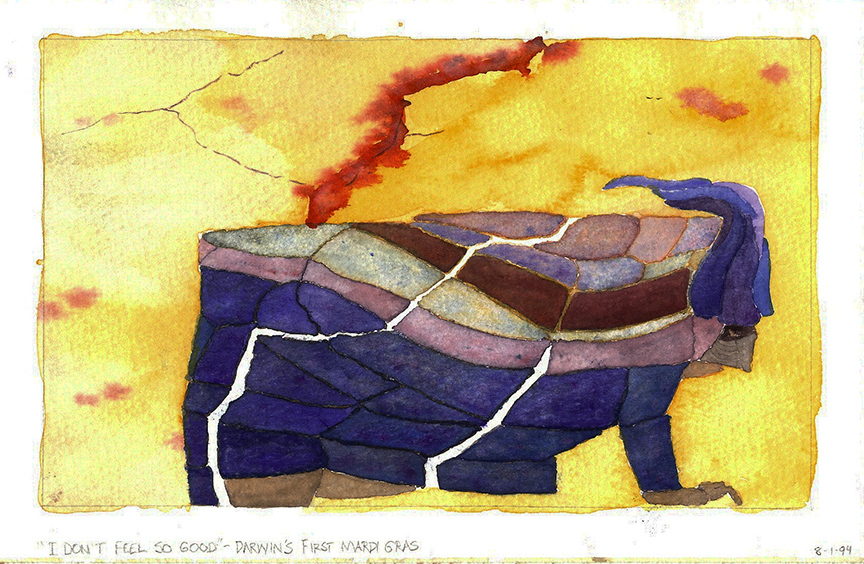
I came across this old piece the other day. I was sure I had shared it here before but after a couple of searches, discovered that I had not. This surprised me because this little piece never fails to make me smile. Just kind of goofy. Maybe not Dracula Hates Killer Icicles level goofiness but it’s on the scale.

This piece is titled “I Don’t Feel So Good”- Darwin’s First Mardi Gras and was painted on or about September 1, 1994. This is one of those pieces that started as just blocks of color, most likely with the intention of eventually becoming a landscape. I can’t remember what happened that set it off in a whole different direction but at some point I began to see an almost abstract figure. It looked to me like someone on their hands and knees, perhaps wearing a colorful cape, a pointy cap, and a mask, one of those half face things. 

With that info in mind all I could think was that someone in that getup on their hands and knees was either looking for a lost contact or was perhaps feeling the effects of a night that was a wee bit too wild for them. The background easily transformed from a sky to a city wall with cracks and stains. The perfect milieu for an epic knees-to-the-pavement hurl.

Thus, the title, “I Don’t Feel So Good”- Darwin’s First Mardi Gras, was born. 

I like this piece a lot, as I said, mainly for its goofiness. But I also like it for its semi-abstract qualities and look. There are forms and colors within it that really draw my eye and remind me of things I wish I was still using but have long neglected. 

As I have said before, there’s almost always a lesson in there somewhere.

Here’s a song that also a  forgotten throwback in time. It’s Nervous and Shaky from The Del Fuegos in 1984. I mentioned them in a post a few months back but most likely they are not a name many of you remember. That is a great commentary on potential and the difficulty of really making it. The Del Fuegos were a hot band from  Boston in 1984, a favorite of a wide swath of critics. Their first album was acclaimed, they had one of their songs used on  nationally distributed TV ad for beer, and they looked like a can’t-miss act. But the two brothers that were at the core of the band had an uneasy, contentious partnership which eventually blew up the group by the end of the decade. As one of the brothers said, “The ’80s were over, we were over.”

I was an early fan of their first album and this song comes and goes in my consciousness every so often, especially when I am little nervous and shaky myself. Give a listen, if you’re so inclined. I bet Darwin felt a little nervous and shaky back at his first Mardi Gras. Could have used some Del Fuegos to get him through the rough spots.


Read Full Post »

Older Posts »