One never finishes learning about art. There are always new things to discover. Great works of art seem to look different every time one stands before them. They seem to be as inexhaustible and unpredictable as real human beings.
–Ernst Gombrich, The Story of Art (1978)
I think the passage above from art historian Ernst Gombrich (1909-2001) is an apt flourish to this reminder that my solo exhibit, Guiding Light, at the West End Gallery comes to its conclusion at the end of the day this Thursday, November 13. There are three days to arrange to see the show.
I believe Gombrich’s statement applies here because as he says, art looks different every time one stands before it. And I think when a show is hung it creates a unique atmosphere created by the dynamics of the individual pieces in relation to one another, the space, and the viewer. It makes viewing any painting in an exhibit, as well as the exhibit as a whole, a unique experience for the viewer.
Maybe I am out of place in saying this, but I felt that this show at the West End Gallery was one of those unique experiences with its own atmosphere. Each piece stands out in their individuality but is reinforced by the work surrounding it.
Like strong individual voices gathered in a choir.
Hope you get a chance to catch the show before the choir disbands and the singers go solo.
Here’s a favorite song from the Talking Heads and David Byrne performed during his American Utopia tour of 2018. This is This Must Be the Place (Naive Melody).
The less we say about it the better Make it up as we go along Feet on the ground, head in the sky It’s okay, I know nothing’s wrong, nothing
Thought I would share a recap of this past weekend at the Principle Gallery in the aftermath of my opening there on Friday evening.
The opening itself was a bit more subdued than in previous years but that was something that was anticipated by the gallery and me. With the high temps (94° on the highway during the drive into town) and humidity along with the threat of severe thunderstorms, we knew that the crowd might be smaller. You can add to that the scheduling of the political circus/parade that was centerstage in DC this weekend, tying up traffic and both driving many people out of the area and keeping others away. And there was also my scheduled painting the following day which no doubt would keep those who wished to attend that making the decision to skip the opening. Thus, we lowered expectations accordingly.
But the turnout was fairly good, for all of that. I was engaged in many conversations for the entire time and before I knew it, it was time to close up. Time flew by. Many thanks once more to those who made it out to the gallery on Friday.
Then came the painting demonstration late the next morning. Due to the uncertainty of the weather, we held in the gallery as opposed to being out on the closed-off street as originally planned. The turnout was exceptional for this event with about as many people as we could comfortably fit in the space. And they were exceptional in other ways as well.
Up to the minute it started I was unsure what I was going to do with the demo. I opted at the last second to make it a little more interactive– and a little riskier. I asked if anyone would like to make the first mark on the 20″ by 20″ canvas I had prepared first with multiple layers of gesso then a final layer of black paint. I explained that I would then work off that first mark, that it would dictate my reaction the next steps in the painting. Everything after that first mark would be an unplanned reaction.
A familiar and friendly face to me, Jesse (hope that is spelled correctly!), volunteered to make the first mark. I loaded a brush with the red oxide paint I use to compose the underpainting and handed it to her. She hesitated a bit then made a swooping and bending downward moving line.
Now, allowing someone to make that first mark can be a risky proposition. It’s a bit like a circus highwire performer working without a net. The difference is that the circus performer rehearses their act over and over and there is only one way to go once you’re on the wire.
I immediately saw Jesse’s swooping line as a path. That was the good news. The bad news was that the mark began in the upper left quarter of the painting. I quickly realized that this first mark put some limits on where I could go compositionally. Kind of like my tightwire suddenly came apart and I was left with several narrower but shakier paths ahead. None were the optimal, easiest wire to walk.
On the other hand, being put in a tighter, more awkward spot allowed me to better show how decisions pop up during the process of painting that are often unforeseen but have to be quickly made in order to make progress. In this case, I decided to keep the mark as a path and build a sloping hill around it, one that allowed more space for a sky to the right of it. What that sky would be was another question, another decision to be made, along with many others.
I am not going to go into every decision made or every twist and turn that the painting took here. As I told the folks there on Saturday, I was painting much faster than I would in the studio, making those decisions much quicker and putting on paint a bit sloppier and at a much faster pace. I was sometimes making instantaneous decisions.
As we got near the end of the demonstration, the piece had taken on a somewhat complete appearance and most folks there felt it was complete. The image at the top is the painting at that point. All it could very well be complete. But there were things that I can see– then and even more so back in the studio when I looked it over yesterday–that still need to be addressed along with a few changes that I would like to make but am not sure are even possible. These were mainly the result of decisions that I made before taking every possibility into consideration. Kind of like real life, right?
Overall, I was pleased to get to that point of completion while working so quickly. It still has work to be done which I will be doing in the coming days. I think you will be surprised at the transformation– if I can pull it off. Either way, I will share the change.
Time being such a precious commodity in this lifetime, the group that spent those several hours with me on Saturday were exceedingly generous with not only their time but with the good humor and kindness they offered me. In return, I hope they got a better glimpse of the thought process behind the making of a painting, at least in the way I work.
As is often the case, I believe I got more from them than they from me. Thank you to the many who were there on Saturday. I am as appreciative as can be.
Here’s a short video slideshow that shows the process. Many thanks to my friend Larry Robertson who I met along with lovely wife, Kai, many years ago at the gallery, for the photos from the demonstration.
I conceive of the art of painting as the science of juxtaposing colours in such a way that their actual appearance disappears and lets a poetic image emerge. . . . There are no “subjects”, no “themes” in my painting. It is a matter of imagining images whose poetry restores to what is known that which is absolutely unknown and unknowable.
–Rene Magritte, 1967, In a letter two months prior to his death
I am getting ready for my annual solo exhibit at the Principle Gallery. This year’s edition, Entanglement, my 26th such show at the Alexandria, VA gallery, opens five weeks from today on Friday, June 13th. I will also be doing a Painting Demonstration at the gallery the following Saturday, June 14, from 11AM until 1 PM. There is still a ton of work to be done so I am simply sharing a reworked post from several years back.
The quote above from Belgian Surrealist Rene Magritte reminds me of an instance where I didn’t fully get across what I was trying to communicate in response to a question while speaking to a group. It occurred at a demonstration and talk I gave before a regional arts group consisting of enthusiastic painters, some amateurs and some professional.
While I was working, a question was brought up about the importance of subject. Magritte elegantly stated in his words what I was trying to say that evening, that the purpose of what I was doing was not in the actual portrayal of the object of the painting but in the way it was expressed through color and form and contrast. To me, the subject was not important except as a vehicle for carrying emotion.
Of course, I didn’t state it with any kind of coherence or clarity. Hearing me say that the subject wasn’t important visibly angered the man who was an art teacher and an accomplished lifelong painter of realistic landscapes. He said that the subject was most important in forming your painting. I fumbled around for a bit and don’t think I ever satisfied his question or got across a bit of what I was attempting to say.
I think he was still mad when he left which still bothers me because he was right, of course. Subject is certainly important. It is the artist’s relationship that with the subject and the emotional response it elicits that allows the artist to create this poetry of the unknown, as Magritte may have put it.
While I am not interested in depicting landscapes of specific areas, I am moved by the rolls of hills and fields and the stately personae of trees that populate my work. I believe it comes through in my painting. Yes, I can capture emotion in things that may not have any emotional attachment to me through the way I am painting them, which was part of what I was saying to that man that evening, but it will never be as fully realized as those pieces which consist of things and places in which I maintain a personal relationship. It is always easier to find the poetry of the unknown in those things which we know.
But there is a caveat: The subject is often not the tree or the landscape, as much as it may seem the case. Often, it is the vague poetry made from that tree, the sky, the landscape, or whatever is chosen to paint along with things not visibly apparent that makes up the atmosphere of the painting.
If you’re a painter, you are not alone. There’s no way to be alone. You think and you care and you’re with all the people who care. You think you care and you’re with all the people who care, including the young people who don’t know they do yet. Tomlin in his late paintings knew this, Jackson always knew it: that if you meant it enough when you did it, it will mean that much.
–Franz Kline, Evergreen Review interview, 1958
Just taking a moment to announce the dates for two upcoming events at the West End Gallery in Corning.
The first is for my annual solo exhibit at the gallery. I have normally had my solo show at the West End Gallery in July. This created a short turnaround between my annual June show at the Principle Gallery and the July show at the West End which was very stressful. It has become more and more difficult as I have aged and my processes evolve. By that, I mean it simply takes longer to complete each painting. As a result, we have moved this year’s West End Gallery show– my 24th solo effort there— to the autumn. The 2025 exhibit will open on Friday, October 17 and run until November 13. The date for the accompanying Gallery Talk will be announced later, closer to the show opening.
The second announced date is much sooner and for something I seldom do for a variety of reasons. However, after being asked for a number of years, I will be doing a painting demonstration at the West End Gallery in a little over two weeks, on Saturday, April 26. My demo begins at 10 AM and runs to about 12 noon or thereabouts.
This event is being held in conjunction with the Arts in Bloom Art Trail of Chemung and Steuben County which involves open tours of artists’ studios and events such as this in the area’s art galleries. Painter extraordinaire Trish Coonrod will also be giving a demonstration at the same time. We will both be in the Upstairs Gallery so if you’re interested it serves up a nice two-fer. A chance to witness two starkly different processes.
As I said, I seldom do these demos. However, I felt that it was important, with what looks to be a challenging year for the artists and galleries, to do all I could do to support the gallery that has been my home for 30 years now.
It’s definitely out of my comfort zone and I am more than a little self-conscious about painting in front of people. I think it’s partly because, being self-taught, I don’t necessarily paint in a traditional manner. It’s not always flashy and fast. I also worry that someone will be there only when the painting is in one of the flat and unflattering stages that almost all my paintings go through.
But despite my apprehensions, I am certain it will come off well. Things usually do okay when I am this nervous.
I know it’s early in the day, but if you’re interested, please stop in at the West End Gallery on Saturday, April 26 to watch and chat for a bit. It might be fun. No kibitzing though!
Here’s a time-lapse video from 2011 that shows the stages some of my work goes through on the way to being a painting.
I know only that I was born and exist, and it seems to me that I have been carried along. I exist on the foundation of something I do not know. In spite of all uncertainties, I feel a solidity underlying all existence and a continuity in my mode of being.
-Carl Jung, Memories, Dreams, Reflections
A couple of days before the Principle Gallery show opens. I am, of course, filled with anxiety. It’s to the point that I find myself leery about writing anything about this show.
I know that in the greater scheme of things, this show and all I do is insignificant. But every show from any artist has great significance and meaning to that artist. The artist defines themself and what they do by how their work is received in the world. You try to act like it doesn’t matter what people think of your work or how they respond to it but that is just a mask.
You want people to like and respond to it, especially when you feel the work is among your best.
But sometimes the artist’s perception of the work and that of the viewing public don’t correspond. The artist might be responding to some personal prompts within the work that don’t mean anything to others. Maybe it is too close, too personal, to the artist. I guess that is why I worry so much when I feel that a group of work is exceptionally strong.
Maybe it is work meant for only me. I don’t think that’s the case with this show. I hope it isn’t but don’t really have a way of knowing.
I find that you don’t have to prepare to be pleased by how a show turns out, but disappointment takes some preparation. So, I spend these days before any show getting ready for that result, creating rationales that will sooth me. That way, I’m ready.
After 25 years, you would think this horrid angst would have gone away by now. But it never does. It’s a funny and maddening thing, this art gig. The best and the worst.
Here’s a slideshow preview of the work from the show. Take a look. I promise you that this is a mere echo of how it looks in person.
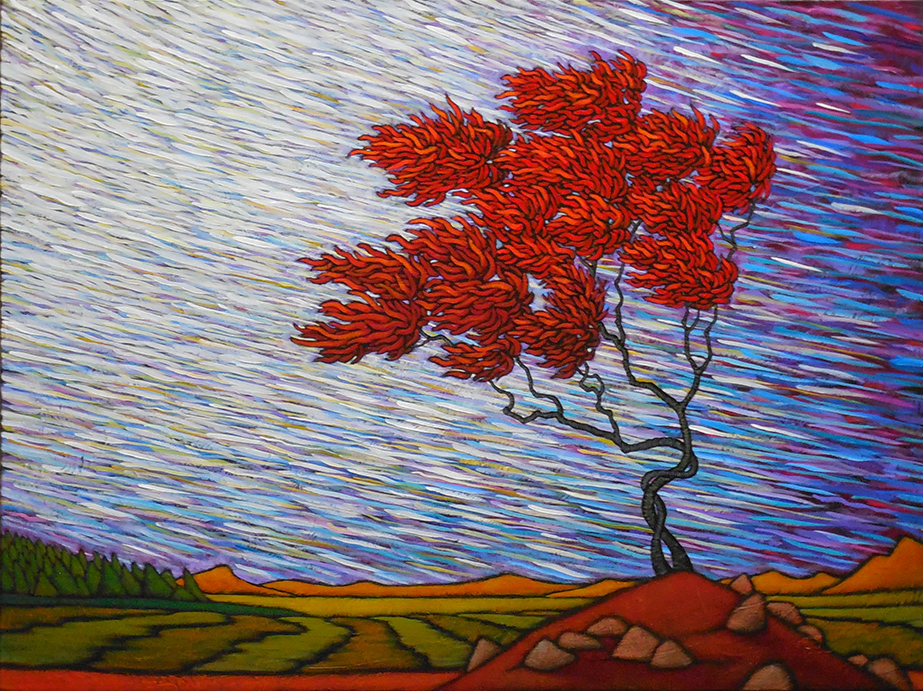
The painting at the top is Flame Feeding Flame, a 30″ by 40″ canvas included in the show. The show is called Continuum: The Red Tree at 25 which opens Friday, June 14, at the Principle Gallery in Alexandria. The opening reception runs from 6-8:30 PM on Friday. I invite you to come to the gallery to see if I can cover up my anxiety.


 Redtree Times