Feeds:
Posts
Comments

Posts Tagged ‘Flow’

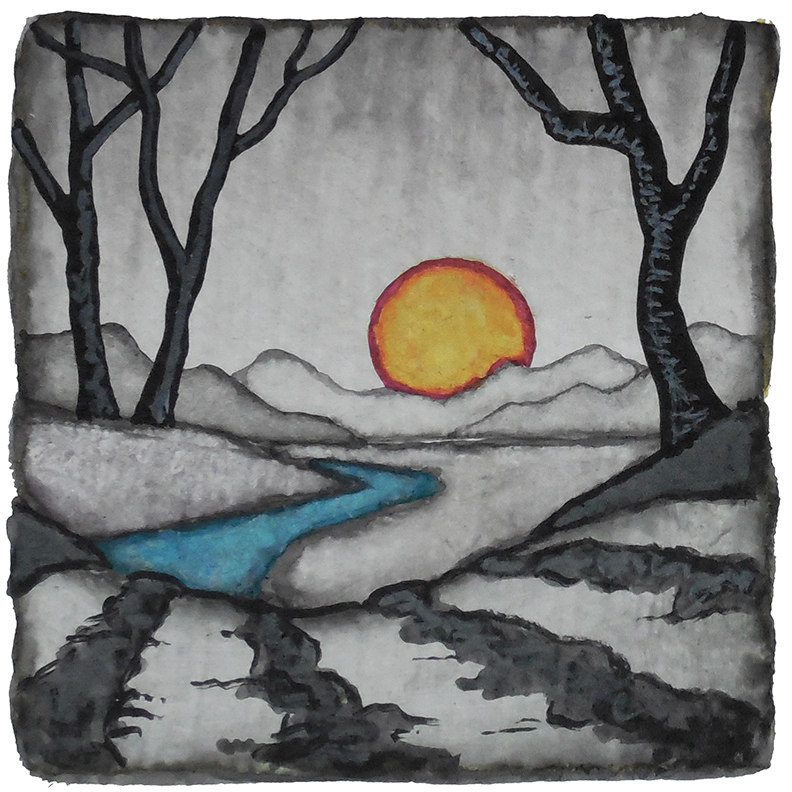
Blue Flow– At West End Gallery


“To overcome the anxieties and depressions of contemporary life, individuals must become independent of the social environment to the degree that they no longer respond exclusively in terms of its rewards and punishments. To achieve such autonomy, a person has to learn to provide rewards to herself. She has to develop the ability to find enjoyment and purpose regardless of external circumstances.”

― Mihaly Csikszentmihalyi, Flow: The Psychology of Optimal Experience


This is another new small painting now at the West End Gallery in Corning, NY. It is titled Blue Flow and is a tidy 2.5″ by 2.5″ on paper. It is right on the mark for the annual Little Gems show at the gallery which opens on February 7.

I chose the passage above from late psychologist Mihaly Csikszentmihalyi to go along with this painting today. Csikszentmihalyi first introduced the concept of flow in 1975 and his 1990 book, Flow: The Psychology of Optimal Experience, which I have discussed here in the past, became a classic in the field of positive psychology.

Flow is basically being in the zone in a creative sense, shutting out all external noise and distraction to deeply focus on the task at hand. It is described as being at that point of balance found when one’s skill level meets its highest challenge. Flow has become a well-worn term for musicians of the highest skill level. You now often hear the word used to describe the soaring solos of guitarists like Jimi Hendrix or Stevie Ray Vaughan.

I often use the term rhythm in describing that hyper focused state of creating. It also involves doing whatever is being done for the sole purpose of doing it. It doesn’t depend on the approval or consent of anyone other than its creator.

It’s a letting go of that which is outside– fears and doubts– and just going with the flow.

There’s a lot more involved in his book on the subject but for my purposes today I am going with the simplest form of flow and how it symbolically relates to this little piece. I see the blue stream as being the flow of creativity and the distant sun as its endpoint. Everything around it is in tones of gray and black, their colors lost in the act of focusing on the flow of creation.

It’s a simple reading of it, of course. But sometimes the best pieces find their power in that simplicity. I think that’s the case here.

I came across a song from an artist who was not on my radar. His name is Shawn James and the song is fittingly called Flow. I liked the song a lot, both in sound and meaning, and have enjoyed listening to his other music this morning. Solid stuff. Look forward to hearing more. Here’s a taste:

So you think you got it all figured out?
All this money in the bank and the women all about
Well, now what you gonna do when your ship starts to sink?
Caught in a monstrous sea and you won’t be able to think
Yeah, and it’s there you’ll learn what I know
That all of this world will fade
You gotta learn to let it all go, oh
And flow like the river


Read Full Post »


"La Vigne Rouge"- The Only Painting Sold in Van Gogh's Lifetime

“La Vigne Rouge”- The Only Painting Sold in Van Gogh’s Lifetime

I came across an interesting little film, Painting in the Dark:The Struggle For Art in a World Obsessed With Popularity, from video essayist Adam Westbrook that speaks about the life and struggles of Vincent Van Gogh.

While already a well documented tale, one with which many of us are very well acquainted, Westbrook uses Van Gogh’s life in a way that makes us question whether we would have the same sort of inner urge to continue creating without the encouragement of others.  Van Gogh, after all, basically painted for an audience of only himself and his brother throughout his entire creative life yet painted incessantly, producing work at a prodigious pace.

Autotelic DefinitionHe also introduces us to the word autotelic, taken from the book, Flow, from famed psychologist Mihaly Csikszentmihalyi.  The word refers to a self contained activity, one that is not done with the expectation of future benefit, but simply because the doing itself is the reward.  In short, it’s what you do when you are your only audience, when you are the only one who can judge the work.

I think of my current Icon series in that way, even though I have been sharing the work here.  It is done solely for my own pleasure and satisfaction, without a thought of trying to please someone else with it.  It’s just something I have to do and what will become of it is of no concern to me at this point.

There’s something very liberating in that but whether I could sustain this passion for it through a decade of hardship is a difficult question, one that I hope to never have to face.

This film is a little over 10 minutes in length and very well done so if you have the time, take a look.  If you like the work of  Adam Westbrook check out his site which contains his video essays, delve.  Or his regular website. Or if you would like to lend financial support, you can visit his page on Patreon.


The Long Game Part 3: Painting in the Dark from Delve on Vimeo.

Read Full Post »

Flow Chart--mihaly csikszentmihalyiI wrote the other day about my search for that intangible thing in my work, that quality that will set me off on a new path.  I’ve been thinking about it and what I think I am really looking for comes down to one word:  Flow.   There’s a famous book, Flow: The Psychology of Optimal Experience, from psychologist Mihaly Csikszentmihalyi ( please don’t ask me how to pronounce his name) that describes flow as a sense of being in the zone or in the groove, of being so totally immersed in the task before you that the external world is blocked out.  He describes it as being like playing jazz, where each action, thought and movement rises from the previous one.

He points out that this flow occurs when there is a balance between the level of the challenge and the skill of the person facing it.  Basically, this person is working at the far end of their skill level, pushing themselves to their boundaries in order to conquer the task before them.  There can be no thought other than that thing before them.  Total concentration and dedication.  I think of it in terms of a mountain climber facing a climb that seems at the far end of their limits, who must muster up all their knowledge and concentrate on each movement in order to scale the daunting peak before them.

I have known this feeling, this flow that he describes, in painting.  I have often described this feeling of immersion, of a level of concentration where each action leads to the next and time seems to fade into nothingness.  I don’t hear the music playing, don’t feel thirst or hunger, don’t think about other things that I need to do or things that might be worrying me.  When I have been in this state it seems so real and so concrete that it feels as though it is always right there and attainable.  It is intoxicating.

But it is not sustainable forever without creating new challenges.  One you have conquered one peak, you need a new one to face down.  Without this challenge, you are at a  comfortable plateau, something I have attempted to describe in the recent past.  Your skill exceeds the challenge and total immersion is not necessary.  While there is a level of needed concentration to simply maintain this elevation, there is also room for outside thoughts and concerns.  The once difficult task has become the normal course.  Comfortable.

And this is fine  and, as I have said before, most artists reach a comfortable level and settle in for the long  term at this high level.  But deep inside, at least for me at the moment, there is a gnawing feeling to find myself hanging  tenuously on a new, scary ascent, pushing my abilities to new levels.  Riding the flow of the thrill of this tunnel-like focus.

That’s where I find myself at the moment– at a plateau, looking up for a new peak to attack.

Read Full Post »