Feeds:
Posts
Comments

Posts Tagged ‘Folk Art’

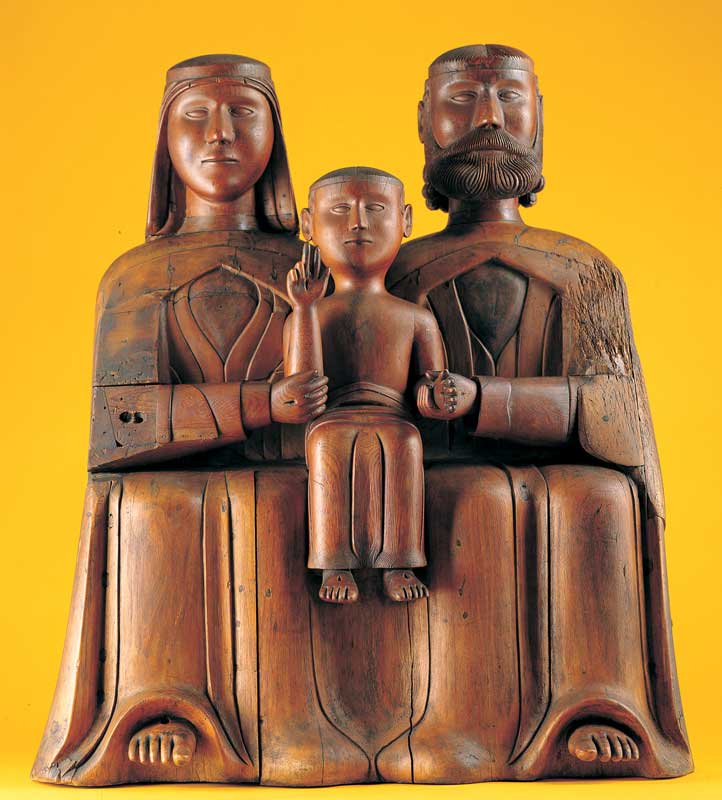
Holy Family-  American Folk Art MuseumI wasn’t going to write anything today but I opened a book that I have featuring works from the American Folk Art Museum, one that I browse on a regular basis.  The page I turned to is near the middle of the book, a page that I always seem to turn to when I open the book,  showing a carved piece, Holy Family,  that I  just love.  It is attributed to the 19th century  woodcarver John Philip Yaeger, a German born craftsman who worked in the Baltimore area.  I’m not religious in any traditional sense of the word but I thought this would be a fitting image to show today, which is Ash Wednesday on the Christian calendar.

There’s something irresistibleabout this carving,  beyond the subject matter,  that I just can’t put my finger on.  The color of its patina is beautifully golden and warm. The lines are smooth and rhythmic.  There’s a wonderful balance of fineness and roughness in the way the pieces of wood that make up the sculpture are put together.  It has a modern feel yet seems old– a timeless quality.  Everything about it has that sense of rightness that I have tried to describe here without much success in the past.

I also am intrigued but he damage on the left shoulder of the father.  I don’t know if this is just a property of the wood after these many years but it looks like it may have been near a cat who saw this as a perfect scratching post.  But even that doesn’t lessen the power of the piece.  It fits right into the wholeness of it.  Imperfectly perfect.

Read Full Post »

Chester Cornett  CrucifixChester Cornett  CrucifixI came across an image of a hand-carved crucifix that caught my eye.  it had rough craved ribs and was painted in a haphazard fashion and adorned with human hair.  The photo made it look small and intimate but it was huge, about eight  feet tall and four feet wide.  It would be a truly dynamic thing to see.  I knew nothing of its maker,  Chester Cornett.  This wild expression, while effecting in its presence,  didn’t give me any real idea of the story behind the name or of the nature of his true special talent.

You see, Chester Cornett was born and raised as a traditional chairmaker from the hills of Kentucky, learning at the knees of his grandfather and father.  He was born in 1912 and died in 1981, living a life filled with hardship as the  world surged progressively into the modern era,  moving further and further away from the need for the handmade.  But Chester persisted, perhaps because he knew no other way or because his special talent, his genius, was too great to forsake.

Chester Cornett Rocing Chair BookcaseHe made all sorts of chairs, simply built traditional chairs and rockers.  But it was when he moved beyond that form that his genius manifested itself.  Folding chairs with eight legs.  Rocking chairs with bookcases built around them.  They were masterfully crafted with innovative joinery and intricate engineering.  Just amazing creations.

I’m just learning about Chester Cornett so I’m not going into much depth here.  There’s not a wealth of info out there outside of a film, Handcarved, from 1981, and a book that features him among other mountain craftsmen, Craftsmen of the Cumberlands.  But I find his work and his life captivating.  There’s something special in seeing ingenuity show itself in unlikely places and conditions.  And Cornett seems to me an unlikely genius that deserves greater examination.

I like this exchange from the book, Craftsmen of the Cumberlands:

Chester Cornett Snake Chair“Do you think it takes a special talent to be a chairmaker?” I asked Chester. 

“I don’t b’lieve so,” he said. 

“You think anybody could be a chairmaker?” 

“No, I don’t b’lieve just anybody could… too hard a work.” 

“Does it take some special skill?” 

“Yes sir, it does. It takes a skill specially for, uh, you got to learn how to use that drawin’ knife—use it just right to take off hick’ry bark with or whatever you’re making.” (Though other chairmakers used a drawing knife much less frequently and for fewer tasks than Chester did.) 

“Can anyone learn how to use a drawing knife?” 

“I’d say so, excepting uh, you got to learn to get interested in anything to learn it… you have to learn to get interested in a thing like that before you could learn it. And anyway, I b’lieve anyone could learn how to use a drawin’ knife and do that work.” 

“Anybody could learn how to be a chairmaker, then?” 

“Well, yes, they could, but they’d have to learn to be interested in that first.”

Maybe that’s the whole point of life– finding that thing that we can learn to be interested in.

Read Full Post »

Morris Hirshfield TigerThere are so many artists out there, both now and from the past,  that I’m not surprised when I come across an artist with which I am not familiar whose work knocks  me out.  But sometimes I come across work that is so strong and consistent in its vision that I just can’t understand why the name is not known to me.  That’ happened recently when I was browsing through a book on the collection of the American Folk Art Museum and came across the name Morris Hirshfield.  The name didn’t ring a bell but the work was so wonderful.   It had a naive feel in the rendering of the figures but there was a sophistication in the composition and coloring that made me feel that it was anything but folk.

I definitely had to find out more about Morris Hirshfield.

Morris Hirshfield Angora CatBut there’s little to learn about the man.   Not a lot is written, only a few mentions in books. That surprised me.  But his story is pretty simple.

He was born in Poland in 1872 and came to America around 1890 at the age of 18.  Like many many of the Jewish immigrants of that time who settled in the New York area he began working in the garment industry.  With his brother, he opened a coat factory that evolved into a slipper factory which was very successful.  Morris  encountered health problems and retired in 1935, at which point he took up painting, following up on an artistic urge he had as a child but had put aside long ago.

Morris Hirshfield Girl With PigeonsWithin four short years, his work had attracted the attention of collector and art dealer Sidney Janis, who used two of Hirshfield’s paintings for an exhibit he was putting together in 1939 for the Museum of Modern Art, Contemporary Unknown American Painters.  MoMA , at that time, was committed to collecting and showing the work of self-taught artists.  In 1941, MoMA purchased two of Hirshfield’s paintings for its collection and in 1943 gave  Hirshfield a solo show.  He had only painted 30 pieces up to that point in his career.   There was great controversy over the show at the time as the critics of the era savaged it.  It was, according to Janis’s biographer,  “one of the most hated shows the Museum of Modern Art ever put on.”  It led to the dismissal of the museum director at the time.

Morris Hirshfield Dogs and PupsBut Hirshfield survived and painted his paintings of animals and the occasional figure for a few more years until his death in 1946.  His career spanned a mere 9 years over which he produced only 77 paintings.

I don’t really understand the controversy of the time or why Hirshfield hasn’t inspired more  writers or artists.  Or maybe he has and I just can’t find  much evidence of it. When I clicked on the Google image page for him, I was immediately smitten.  There was that sense of rightness that I often speak of here.  Just plain good stuff.  Just wish Morris Hirshfield had been around longer so there might be more to see.

Morris Hirshfield Beach GirlMorris Hirshfield Baby Elephant With Boy 1943Morris Hirshfield Lion 1939Morris Hirshfield Zebras


Read Full Post »

Ulysses Davis- Lost Tribe in the Swamp with Alligators

I recently came across the work of another folk/outsider artist whose work really resonates with me.  It is by Ulysses Davis, a barber who lived in Savannah, Georgia, passing away in 1990 at the age of 76.  His medium was woodcarving and over the course of his life he created a very diverse body of work that had both the simple and free feel of the Outsider artist’s vision and the compositional sophistication of a fine artist.  His subjects covered a wide spectrum,  ranged from the fantastic to straight portraiture including a series of busts of all of  the US Presidents up to the year of his death. Very striking stuff.

Ulysses Davis- No No Bird

He  seldom sold his work, saying “They’re my treasure. If I sold these, I’d be really poor.”   As a result, his work never garnered the exposure or the recognition it deserved although he did receive a few honors before his death, his work showing in an important 1982 exhibit of modern Black Folk Art at the Corcoran Gallery of Art in Washington, DC.  In the years since, the American Folk Art Museum did mount a retrospective of his lifework in a 2009 exhibit called The Treasure of Ulysses Davis,  the title playing off of Davis’ own words on his work.

And what a treasure it is, one that we are fortunate enough to at least share in images and in a few museums.  Beautiful work with a unique vision…

Ulysses Davis- Get Off My Back


Read Full Post »

“Known in New Orleans art circles as a sort of ‘Goya of the ghetto,’ Ferdinand has described his work as rap in pictures, while some critics have placed his utterly honest depictions of inner city decay within the social realist tradition of Courbet.” —Times-Picayune

****************************

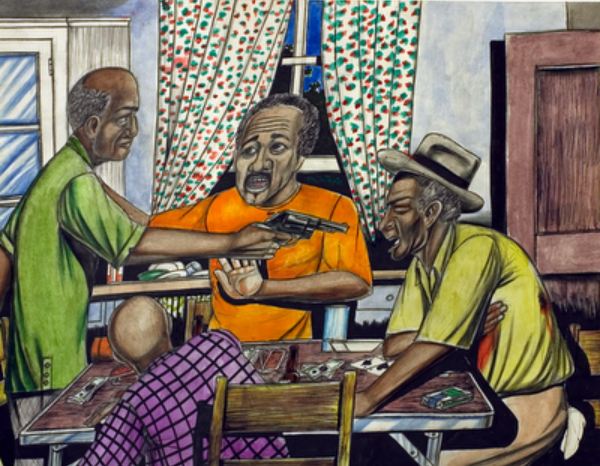
I was on a site that had a few images of some self-taught and outsider artists and saw one of the pieces from Roy Ferdinand.  In a lot of the work from outsiders artists there is often a child-like quality in the work, a feeling of naivete expressed in the rendering and brushwork.  Looking at Ferdinand’s work, there was a definite sophistication and stylization that really differentiated from the typical outsider.  It made me want to know more about this guy and, in my search, I came across the quote above calling him the Goya of the ghetto,  pretty high praise, I was really intrigued. 

Ferdinand was born in 1959 and hedied from a long battle with cancer in 2004 in New Orleans.  Though his work showed more sophistication, he did share much in common with other outsider artists.  Coming from a world of poverty, for example.  He depicted the hard world of the urban streets of New Orleans.  Often, there was implied violence and explicit sexuality in his work, with gangsters, drug dealers and junkies, pimps and whores often populating his images.  The pictures were gritty and tough snapshots of his time and place.

And while much of his work dealt with the harsher elements of his life, Ferdinand also painted the everyday gentler side of his world, providing a full view of his New Orleans.  I particularly love this piece, showing an older woman holding a piece of corrugated metal with a rough outsider-ish image painted on it.  I suspect it is her own painting she is holding from the gentle smile of pride on her strong face, which is rendered with tenderness, and the other piece of corrugated metal in the bottom corner with a simlilar painting on it.  Moreover, it’s just a lovely image and moment, far removed from the world he often painted. 

To my eye, his work has real eye appeal.  The colors work well together and there is a real harmony in the images as a whole.  The drama of many of his scenes only serves to make these images more compelling and probably will make them grow in stature through the years.  It would have been interesting to see what Roy Ferdinand would have painted in the aftermath of Katrina.  It would have been epic work for an artist so tied to the streets of New Orleans.  It’s a shame such a distinct and powerful voice wasn’t around to document it.

Read Full Post »

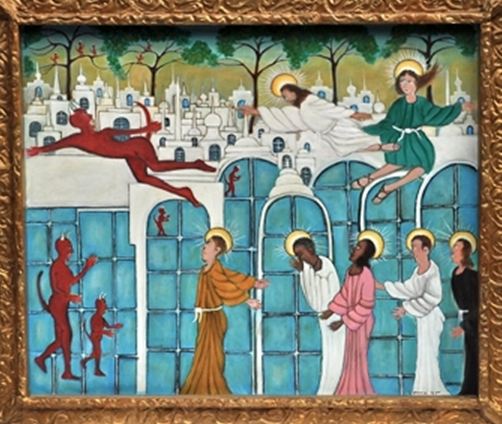
I often like to periodically check out sites that deal in folk art and one of my favorites is Candler Arts, an Atlanta based site that has an online gallery and blog.  I generally find something new and interesting, most often the result of self-taught artists.  This piece for sale there recently caught my eye.  It’s a painting of God expelling Lucifer from Paradise by Lorenzo Scott, a self taught visionary painter from the Atlanta area.  I was intrigued by the composition and decided to look up more on Mr. Scott.

Born in 1934 in Georgia, he moved in the 1960’s to New York City, where he noticed the numbers of people who who paint and sell their work outside the museums there.  He had maintained an interest in drawing since he was boy in school to the point of distraction from his studies but that was about the extent of his knowledge about art. Inspired by these other artists, he started going to the Metropolitan Museum and began studying the works of the Renaissance masters, examining closely how they painted the features of their subjects and the manner in which they composed their pictures.  In a way, he went through a Renaissance guild-like training as an artist without the benefit of a Master to fine tune and influence his talent. After several years in NY, Mr. Scott returned to Atlanta and continued his studies before the paintings of the High Museum there. 

 What emerged was a truly interesting mix of Renaissance-influenced imagery and the folk art hand, a unique interpretation that had classic themes and the raw immediacy of the self-taught visionary.  Vibrant.  His work caught the attention of collectors and curators and over the years he has been the subject of several museum shows and has placed his work in a number of museums, including two at the Smithsonian in Washington, DC.  In the 1990’s he began to include with his classical based compostions a bit of work with more contemporary and traditional folk art themes, many based on visions that, Mr. Scott has said, come to him while asleep. 

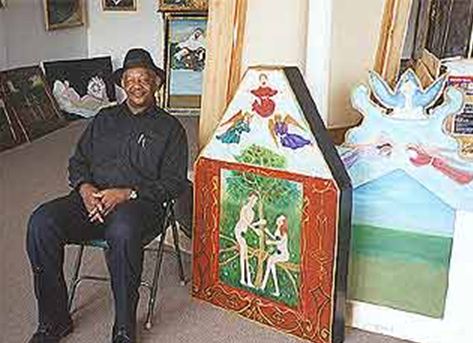
His framing is also unique.  They are generally self-made from from lumber topped with bondo, the autobody filler, then painted with gold paint.  They carry that same mix of classical and folk as the paintings and are a perfect companion for the work.

It’s great to see folks who find a way to tap into this inner pool of creativity, inspired by brushing against things far removed from themselves.  For Mr. Scott it was seeing the work of the masters and carrying their work forward in his own personal style.

Read Full Post »

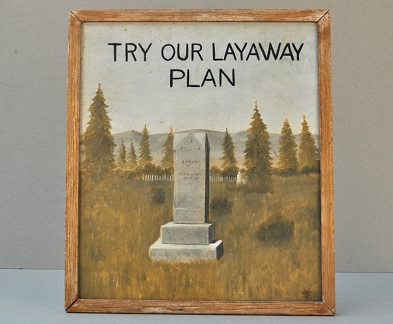
I came across this on  Candler Arts , website that features an eclectic collection of American folk art available for purchase.  I wrote a couple weeks ago about one of their paintings, a nativity scene from Jimmy Lee Sudduth painted with mud and housepaint.  When I saw this piece I gave a chuckle and thought about the reactions it would bring hanging in a shop or gallery. 

It is probably an advertising piece for a monument maker, probably in the first half of the 20th century, probably in a rural region.  Advertising pieces through the last century or so have provided us with some great folk art.  Think of the large cigar store figures.  Paul D’Ambrosio, who writes the vastly informative blog, American Folk Art @ Cooperstown, has written a number of times about the handmade signs and figures that once graced the counters of small shops and stores in earlier America.  Many are a bit rough, like this sign, but all are simply trying to communicate with their customers and did so with a sort of grace that we can still see in them today. 

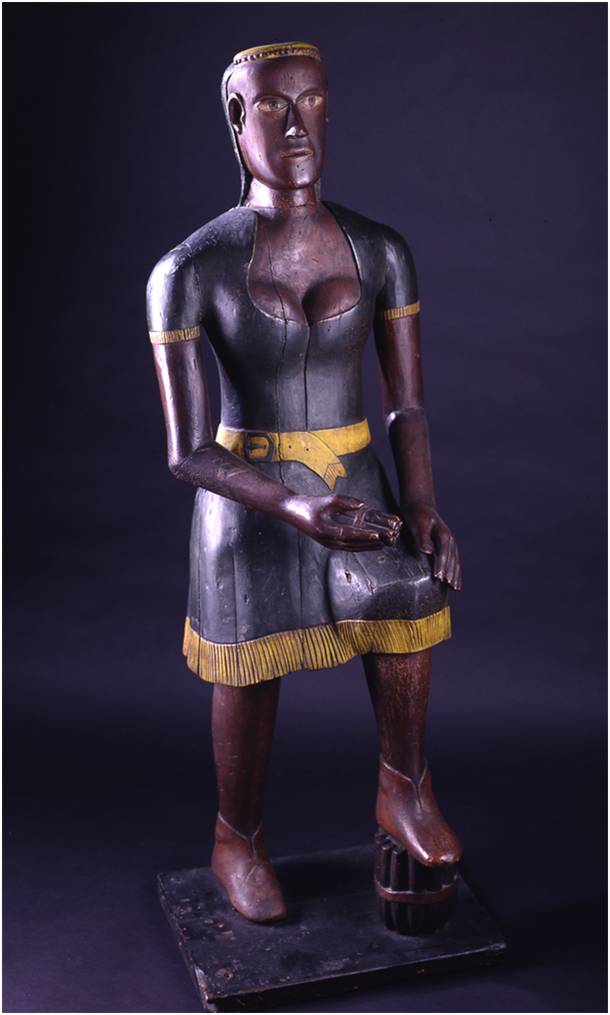
One of my favorites from Paul’s blog is a piece from the Fenimore Art Museum collection believed to be from a freed slave named Job from around 1825.  It is an African-American cigar store figure and is a sensitive depiction of such a figure for the time. A female figure holding out a bundle of cigars, it is not a harsh caricature one often would see at that time.  But is still an eye-catching figure which was the purpose of these pieces, to attract customers into the shops. 

 I would definitely stop and take a serious look today if I saw a carving like this outside a shop.  And maybe I would even ask about their layaway plan.

Read Full Post »

I saw this the other day on one of my favorite blogsAmerican Folk Art @ Cooperstown, which serves up great American folk art and the stories behind it on a regular basis.   Paul D’Ambrosio, who writes this blog and is an authority on folk art, featured this wonderful protrait from the early 1800’s, probably from eastern New York state where the painter  Ammi Phillips plied his trade. 

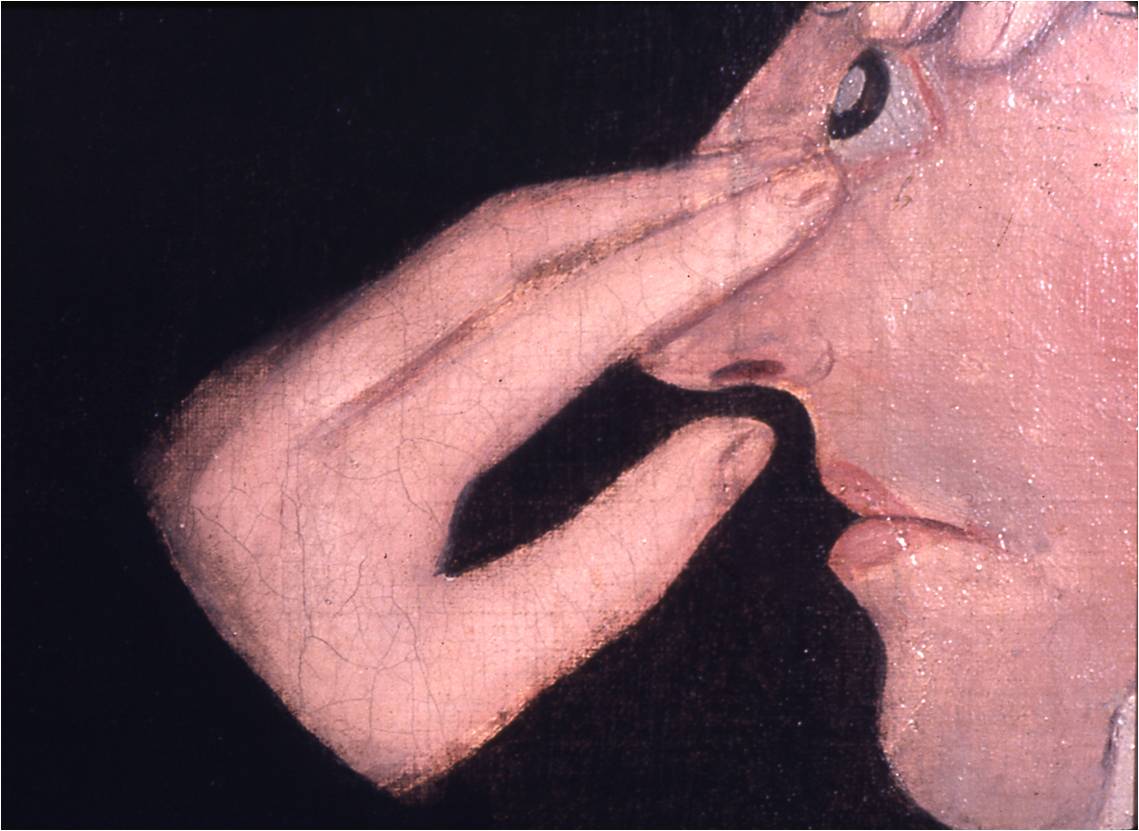
Having your portrait painted at that time was the only way that one’s image might ever be recorded and therefore took on a great importance, the sitter wanting to give a full accounting of who they were.  It was not unusual to display evidence of your trade, to show the tools that enabled the sitter to afford the luxury of such a painting.  But I doubt that many went quite as far as this man.

He is obviously a doctor.  Well, at least I hope he’s a doctor because I really wouldn’t be comfortable if I were the man whose eye is being held open if he were, say, a carpenter.  This appears to be a doctor about to perform cataract surgery.  You wouldn’t think so but this surgery, in different forms, has been around since well before the time of Christ, as early as the  6th century BC.  It’s one of those things thqat makes me very thankful for the time in which I live, for all its flaws.

It’s a  portrait that makes you wonder about the lives of the people in it, which I think  makes it a great portrait.  It has an oddball quality as well that transcends mere portraiture.  Just a wonderful and strange piece of Americana.  If you wish to know more about the world of American folk art, check in at the American Folk Art blog.  It is a treasure chest of information and stories,

Read Full Post »

Kid Stuff

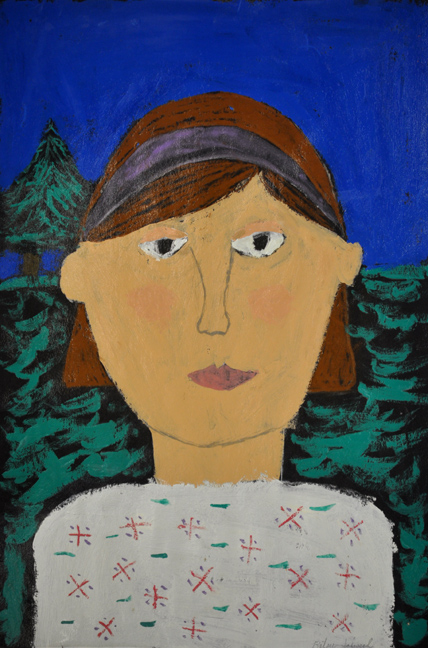
My sister asked me to frame this for  my nephew, Jeremy,  for Christmas.  It’s a self-portrait done by his longtime friend and now fiancee, Eliza, when she was 9 years old, which means it was done two years ago.  Just kidding.  It was a couple of decades back.

I just love this piece.  There is just something there, like a lot of kid’s art that I’ve been fortunate to see, that has a real sense of rightness.  There is an innocence in its expression and feeling with an innate and natural sophistication that goes beyond the nine years of experience Eliza had at the time.  By that, I mean that she is expressing things with this little painting in a natural way that older, much more experienced painters struggle to find in their own work, even with all their years of acquired knowledge and technical sophistication.

I think therein lies the beauty of folk art and kid’s art’s place in it: True self expression with what you know and how you view things without trying to represent the work or yourself as more sophisticated than you really are.  When the feeling behind the work is genuine, the level of sophistication becomes secondary.  I think we’ve all seen paintings done by highly skilled artists that are skillfully rendered but raise no feeling within us, seemingly devoid of emotion.  It’s like they are so concerned with technique that they lose the emotion of what they’re trying to portray, whereas kid’s art often is so much about being able to freely express themselves that the feeling is carried through the process and actually enhanced with each unsteady stroke of paint.

I’m sure many of you out there see a steady stream of kid’s work and brush off a lot of it.  Take an extra moment and look a little deeper and you’ll see some wonderful things from these little beings.  Fresh eyes…

Read Full Post »

« Newer Posts