Feeds:
Posts
Comments

Posts Tagged ‘Forestport NY’

A place belongs forever to whoever claims it hardest, remembers it most obsessively, wrenches it from itself, shapes it, renders it, loves it so radically that he remakes it in his own image.

–Joan Didion

***********

My friend Linda from Texas one day in her blog  brought this quote from Joan Didion to my attention and it has stuck in my mind for some time.  It seems to especially apply itself to those places and memories from our past that have long passed from the sight of the general public, places that I often run across when doing genealogical research.  Towns that have vibrant stories and a rich , interesting past but are nearly vacant now, the memories of that place now resigned to an existence in a few aging minds and a few timeworn photos.

My nephew and his wife recently went up through the Adirondacks and I told him to look for the village of Forestport where my grandmother’s family had a large presence in the late 1800’s and early 20th century.  Her father, my great-grandfather was a prominent member of the logging industry there, employing hundreds of loggers who harvested the timber of the Adirondack and sent it on barges down the Black River Canal to the Erie Canal and onward to build the booming cities of the east.  After his trip, he said that he had been through Forestport and there wasn’t much there.

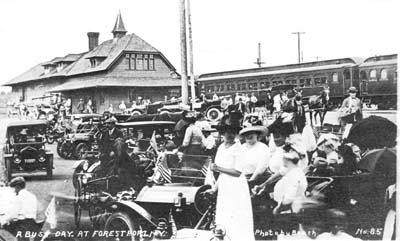
In my research, the town had taken on its own life.  There are many photos like the one above of the rail station where my grandmother used to come and go (she might even be in that crowd) give evidence of a bustling place full of life.  There are a few books that document the town at that time, talking about the many characters who built the village in the southern forest of the Adirondacks and rebuilt after it burned to the ground on several occasions.  Other books document its place on the Black River Canal, the barge builders who worked there and the men who kept the locks made the canal work.  All attest to a place full of life.

Yet now that is all nowhere to be seen.  That life is a mere reflection in a few minds who have any interest in such places.  Like me.

I wonder often how close the memory I have wrestled from reading and looking jibes with what actually was.  Have I added more life, more vibrancy than actually existed?  I suppose that’s where Didion’s words enter the equation.  Because I care for some reason, that past, that memory of place has become my possession somehow.  Remade in my image, as she said.

It’s an interesting concept and one that doesn’t necessarily just pertain to place alone.  It may work for all memory, all history– events and people, for instance.  History belongs to those who remake it in their own image, for better or worse.

Read Full Post »

This is the image I was searching for the other day when I was distracted by the portrait of Willie Nelson.  This is a scene from the very early 20th century at the railroad station in Forestport, NY, in the lower part of the Adirondacks.  It’s where my great-grandfather had his logging operations back then and maintained a home as well as a couple of other businesses.

As I’ve read about that area and that time I am struck by the contrast between then and now.  If you drive through the Adirondacks you encounter town after small town, all sleepy little affairs with hardly anyone around except for the seasonal tourists.  Forestport is one of those towns.  But back in the day, Forestport was a buzzing, vibrant town.  It had numerous mills, processing the trees coming from the Adirondack wilderness to supply the lumber to build the growing cities of the northeast.  There were huge numbers of loggers going into the forests every day — my gr-grandfather had 250 lumberjacks working for him at one time.  There were canal workers that transported the lumber with mules and horses down the Black River Canal to the Erie Canal.  There were boat-builders there who built the barges that traveled the canals and carriage builders to make wagons to haul logs and people.  These workers spawned a whole support network that created cheese factories, breweries, retail stores, restaurants and taverns, all employing numbers of other workers.

Everything was local, nearly everything produced nearby.  Ironically, the very canal and later highway system that allowed the town to ship out the resources that allowed it to grow were the beginning of the end, as new products from outside the local area were now easily shipped in on these transportation portals.  Products became more regional then national and most of the products consumed were no longer local in any sense of the word.

As the forests depleted from the voracious cutting, there were fewer and fewer loggers.  Fewer and fewer mills.  The canal was replaced by the railroad at first then the highway so the canal workers and boatbuilders became obsolete.  The newly popular car and truck replaced the local carriage builders.  And with the loss of these workers came the end of the need for the businesses that supplied and supported them.  The cheese factories closed.  The stores and restaurants were boarded up.  Slowly, the town dwindled until all that remained was sleepy little burgh that wouldn’t be recognizable to the residents from that time.

I’m not saying this time or that time was better or that it’s a crying shame that this place no longer is the same.  Things change.  For many reasons.  There are thousands of places like Forestport throughout the northeast and spreading through the midwest of this country, towns that are like little dying planets whose heyday has passed.

The interesting thing for me is that bustling, life-filled world is barely remembered, only existing in a few photos and a few writings.  Makes me wonder how what we view now as the centerpoints of our lives will change and if, a century from now, this time will exist only in memories and images that may be of little interest to the citizens of that time.

Of course, Ted Williams, Walt Disney and I will be there to remind the people then of this time, after they revive us from our cryogenically induced naps.

Read Full Post »

Logging near Forestport, NYThis is a scene from the Adirondack Mountains of New York near the town of Forestport, taken in the 1890’s.   There’s a possibility this is one of my great-grandfather’s crews.  I don’t really know.  Never knew much about  the man as I was growing up, didn’t even know his full name.  My family had little link to the past, few photos and very little oral history.  So little was known of our ancestors and their lives. Thanks to the access to old records and newspapers that is now available via the internet I have been able to find out much that would have been otherwise lost to our family.

For example, the great-grandfather I mentioned above was known to have ran a lumber camp in the Adirondacks, supposedly in the north near St. Regis Falls, where my father’s mother ( who died in 1979) was born and raised.  That was about the extent of our knowledge of the man.  I knew his last name was Perry and he ran a lumber camp.

A couple of years back, I did a quick Google search with what little info I had and much to my surprise an entry appeared.  There was a Gilbert Perry listed in a book from 1895 profiling the citizens of Oneida County, NY, in the southern part of the Adirondacks.  That didn’t seem to jive with what I knew but when I read the article it stated he was from St. Regis Falls and maintained a farm there as well.  His children were listed and I recognized one name as being a sister of my grandmother, who was not listed as she wasn’t yet born.

It was a thrill to finally find something on an ancestor, something that gave their life form.  I learned that he was a hard-working, ambitious entrepreneur who ran a number of lumbering enterprises as well as a couple of retail stores and his farms.  He was considered one of the pioneers of Adirondack logging, having several camps and crews of men numbering in the hundreds along with 50 or more teams of horses.  At the time, he was signed to bring in the largest contract of lumber in the Adirondacks.

After that I started doing more research and a whole new world  opened up to me when I came across the digitized newspapers from that time and region.  Local newspapers at that time were a true mirror of the area and people they covered, giving many details on their everyday lives and their travels.  I was able to piece together a full picture of the life my grandmother’s family lived in St. Regis Falls and Forestport.  I was even able to come across a full account of my grandmother’s wedding to my grandfather, something my dad and his siblings had never heard or seen.  It gave my memories of my grandmother a new depth.

I was even able to find numerous mentions of his lumber camps, including an account of a normal day in the camp, in a number of books outlining the history of the Adirondacks along with many stories of the men who worked for him.  One was a character named Atwell Martin, called the Hermit of North Creek, who is recalled in many stories and tall tales, including one where Paul Bunyan, having heard the tales of Martin’s exploits, traveled east to visit him.  They got along famously at first but ultimately ended up in a fight where trees were upended and used as clubs and the great Paul Bunyan ends up slain.  His body was buried in the headwaters of the Black River, the dam at North Lake.

I am still doing research but it’s an interesting and different world I keep uncovering, filled with great exploits and hard lives in a harsh environment.  It’s just been a thrill to find a link to a past of some sort…

Read Full Post »