Free men are aware of the imperfection inherent in human affairs, and they are willing to fight and die for that which is not perfect. They know that basic human problems can have no final solutions, that our freedom, justice, equality, etc. are far from absolute, and that the good life is compounded of half measures, compromises, lesser evils, and gropings toward the perfect. The rejection of approximations and the insistence on absolutes are the manifestation of a nihilism that loathes freedom, tolerance, and equity.
–Eric Hoffer, The Temper of Our Time (1967)
Several times I’ve shared the words of Eric Hoffer, the Longshoreman Philosopheras he was sometimes called who died in 1983 at the age 80. He had a way of stating complex idea in a straightforward manner. His 1951 book The True Believer, which sets out his theories on the rise of mass movements– most notably extreme political movements and cults– and the dangers they pose, is widely considered a classic of social psychology. You can read it and see many parallels to the
This particular passage spoke to me immediately when I came across it a few years back. It was something that seemed to be proving itself in real time with what we were and are experiencing here. It is a situation that might be described simply as a struggle between those who see things only in absolute terms and those who understand that there are few if any absolutes in an imperfect world such as ours.
A battle between unfounded certainty and founded uncertainty. True belief and true doubt.
Needless to say, Hoffer’s passage felt spot on for me, a creature who dwells in uncertainty. I could feel the truth in his words, particularly that last sentence: The rejection of approximations and the insistence on absolutes are the manifestation of a nihilism that loathes freedom, tolerance, and equity.
This one sentence might be the best description of the horror show we are experiencing first-hand.
Not sure why I am sharing this this morning. This passage has been sitting in my drafts file for a long time now and it just felt right this morning, a simple understanding of what we are witnessing, though I doubt any of you need to have it clarified for you.
Anyway, there it is. And here’s a song that speaks to uncertainty in equally simple terms. It’s What’s Happening?!?! by the Byrds from back in 1966, around the same time as Hoffer’s words. Nearly sixty years later and it is the same story. Nihilism then is nihilism now…
You ask me how I became a madman. It happened thus: One day, long before many gods were born, I woke from a deep sleep and found all my masks were stolen,–the seven masks I have fashioned and worn in seven lives,–I ran maskless through the crowded streets shouting, “Thieves, thieves, the cursed thieves.”
Men and women laughed at me and some ran to their houses in fear of me.
And when I reached the market place, a youth standing on a house-top cried, “He is a madman.” I looked up to behold him; the sun kissed my own naked face for the first time. For the first time the sun kissed my own naked face and my soul was inflamed with love for the sun, and I wanted my masks no more. And as if in a trance I cried, “Blessed, blessed are the thieves who stole my masks.”
Thus I became a madman.
And I have found both freedom of loneliness and the safety from being understood, for those who understand us enslave something in us.
But let me not be too proud of my safety. Even a Thief in a jail is safe from another thief.
–Kahlil Gibran, The Madman: His Parables and Poems (1918)
I was recently looking at some paintings from 8 or 9 years back from a series I call Icons. The subjects are people pulled from my ancestry that were done in a rough way like religious icon paintings. I stopped over this one at the top,Peter the Scoundrel. This one has been one of my least favorites from the series for a variety of reasons, some aesthetic, but mainly because the character it portrays, my 3rd great-grandfather, was such an enigma.
His name was Peter Bundy though it’s hard to tell if that was his real name or just one of the several aliases he assumed in his lifetime. I shared his story here back in 2016 and what a convoluted and confusing one it was. It had an abandoned family, two stints in the Union Army in our Civil War under different names one of which ended in desertion, capture and imprisonment in Andersonville, and a couple of other aliases that hid who-knows-what. My investigation into left me with the realization that the only thing I knew of him for sure was that he was buried in a small country cemetery in Caton. His stone there lists the unit of his second stint as a soldier and that he was born in Scotland. While I think he served in this unit under the name Peter Bundy, I have my doubts as to whether he was actually born in Scotland or born with the name Peter Bundy.
It was a frustrating look into his life, like trying to reveal the identity of someone behind a mask. Just when you thought you were going to see the truth of that person, you pull off the mask you see only to discover there is yet another mask beneath. And another beneath that one and maybe another beyond that.
It made me think of the masks many of us wear throughout our lives. Peter Bundy might be an extreme case but many of us have multiple faces we wear for different situations and people, often to the point where it becomes difficult to discern which face is real and which is a mask.
It is equally difficult to fully understand the reason for the mask we wear. Sometimes it is to deceive, plain and simple. Peter Bundy, for example. Sometimes we wear masks for protection against things we fear or to fit into situations where we feel uncomfortable. Sometimes we wear a mask simply because we don’t want to be who we are or to show our real self. There are many reasons and situations, some honest and some not, that cause us to don our masks.
I often wonder if there are those who never wear a mask and think that it must be a wonderful thing to be so comfortable in your own skin. I am sure they are out there, those people who feel so self-assured and real. But then I wonder if one would even be able to know for sure if that was not just a mask in itself.
That brings me to the parable at the top from Kahlil Gibran. I came across it the other day after sharing another short piece on a scarecrow that was from the same book of Gibran’s parables. It made me think of Peter Bundy’s masks as well as the many masks I have worn. But more than that, it made me think about the liberating feeling of shedding all your masks, to live with your naked face.
To live a life of transparency.
I realized that it’s something I aspire to through my work and this blog. I also realized that shedding every mask is not an easy thing. Some fit so well, feel so comfortable and protective, that they naturally just go back into place at certain times.
I have also found that trying to resist the temptation to wear these masks often leads one to a need for solitude and caring less, if at all, how others see you. This would be the freedom of loneliness and the safety from being understood as Gibran put it. I would quibble a bit with the use of loneliness in this translation as I seldom, if ever, feel lonely in my solitude. In fact, I often feel lonelier out in the public. That’s when I most want to pull on my mask.
I don’t know that I’ll ever be fully without a mask or two. Can any of us really make that claim? Is it even possible?
Who really knows?
Let’s finish up with a song that’s not really about masks. Well, the more I think about it, maybe it is. It is about madness of a sort. It’s some great early Rolling Stones–19th Nervous Breakdown.
The first method for estimating the intelligence of a ruler is to look at the men he has around him.
–Niccolò Machiavelli, The Prince (1513)
Have truer words ever been written about those who seek power?
It takes only a glimpse at the Rogues Gallery that surround our would-be king to understand that that this country is tottering on a tightrope today. Two words immediately jump to mind that I feel best describe our current government: kakistocracy and kleptocracy.
The first, kakistocracy, is a government run by the worst, least qualified, or most unscrupulous citizens. We got that in spades, folks.
The second, kleptocracy, is a government based on virtually unlimited grand corruption. one whose ruler– the thief-in-chief— grants almost absolute immunity to those he has authorized to loot on his behalf.
We are seeing textbook examples of both. Well, they would be textbook examples in a society ruled by a government that didn’t rewrite textbooks in their own image.
It leaves us up there on a shaky tightrope with little chance of keeping the balance needed to make it across with little to save us should we fall since we’re now working without a net since they dismantled it.
It is almost as though they want us to tumble off that rope.
I could be wrong, of course. I keep saying that, but they never seem to prove me wrong. And if I am wrong and this is truly the best and brightest that have been assembled to lead this country, we are in worse shape than any of us thought.
The kakistocracy and kleptocracy we are witnessing brings to mind another word– idiocracy. I have read many times that we are living in the most stupid of times and while it is terrifying, it also gives me hope that it cannot exist for too long.
The worst and the dumbest can only hold off the best and the brightest for so long. Only one can make it to the other side of that tightrope and my money– and effort– is against the worst and the dumbest.
Stay up there, folks.
Here’s a predictable song for this week’s Sunday Morning Music. It’s the late Leon Russell and his Tight Rope. I was surprised to see that I never shared this song here in the many years I’ve been doing this blog. Well, let’s fix that today, as well.
For the keynote of the law of Karma is equilibrium, and nature is always working to restore that equilibrium whenever through man’s acts it is disturbed.
–Christmas Humphreys, Karma and Rebirth (1948)
I came across the quote above from a book on Buddhism from a Brit named Christmas Humphreys. I had never heard the name but agreed the sentiment that nature is a continuously bringing the world into equilibrium despite our best efforts to disrupt and destroy its balance. Turns out that Christmas Humphreys was a famous British barrister as well as a judge at the Old Bailey later in his career.
But the more interesting part for me was that he was, in his lifetime from 1901 to 1983, one of the highest profiled Buddhists in Britain, having founded the London Buddhist Society and authoring a large number of books on the religion. After his death his home in St. John’s Wood became a Buddhist temple.
His involvement in a number of famous trials led to him being portrayed in several films, including a recent one (it’s on the streaming service BritBox now) concerning the Ruth Ellis trial, in which he was the prosecuting barrister. Ruth Ellis was convicted of murdering her abusive lover and was subsequently the last woman executed in the UK, hanged in 1955.
I guess that’s some sort of karma, right? Probably depends on your perspective.
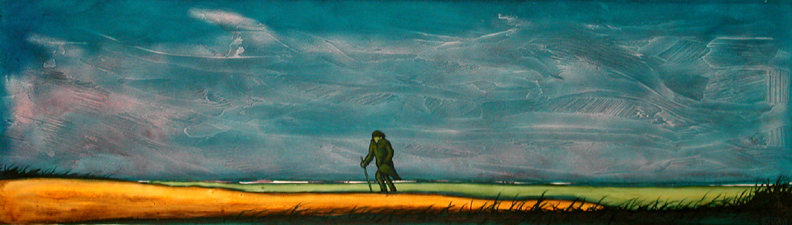
Humphreys was also mentioned with a line– “I went home and read my Christmas Humphreys book on Zen“– in the 1982 Van Morrison song, Cleaning Windows. I thought that make a good final addition to today’s triad alongside Humphreys’ quote and the 2002 painting at the top, Night Karma. which is one only a few pieces that remain with me from what I call my Dark Work, those pieces painted in the period of about 18 months immediately after 9/11. It’s been a longtime favorite of mine here in the studio.
Once I said to a scarecrow, “You must be tired of standing in this lonely field.”
And he said, “The joy of scaring is a deep and lasting one, and I never tire of it.”
Said I, after a minute of thought, “It is true; for I too have known that joy.”
Said he, “Only those who are stuffed with straw can know it.”
Then I left him, not knowing whether he had complimented or belittled me.
A year passed, during which the scarecrow turned philosopher.
And when I passed by him again I saw two crows building a nest under his hat.
–Kahlil Gibran, The Madman, His Parables and Poems (1918)
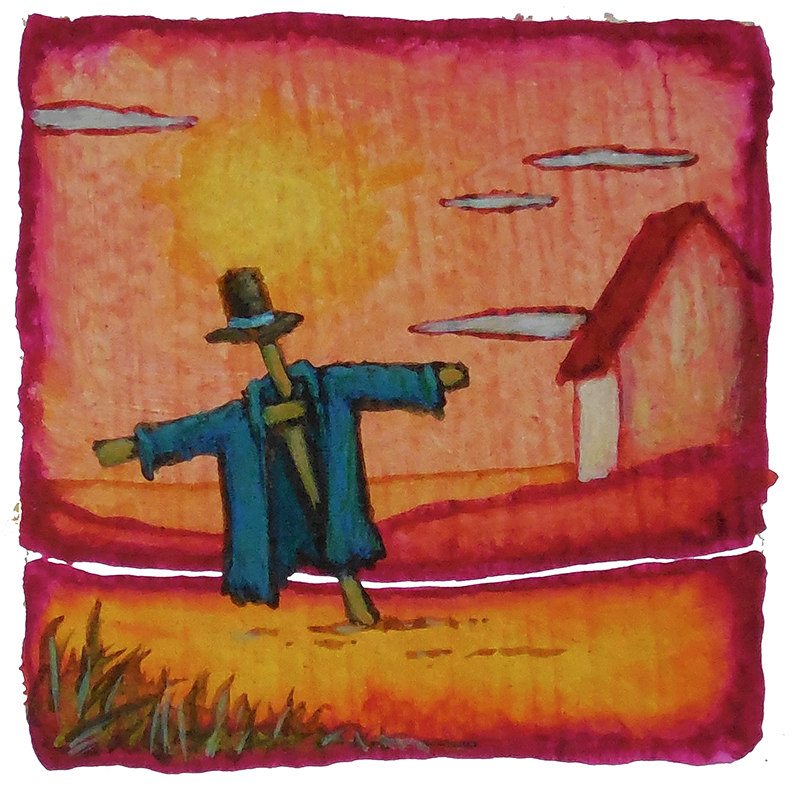
Looks like the theme for today is thescarecroweven though I have already spent too much time attempting to write something altogether different. The other and now discarded subject was just not coming together in any kind of cohesive way. But in a roundabout way it did lead me to the short parable above from Kahlil Gibran.
The answer from the scarecrow– “The joy of scaring is a deep and lasting one, and I never tire of it.” — struck my fancy.
I just stopped for a few moments after writing that to ponder what a strange phrase struck my fancy is. There may be a blog post in that phrase. Or not, which is probably for the better. Whatever strikes my fancy.
But the idea of that there can be joy in scaring is intriguing. I am not sure I ever felt scaring people was part of who or what I am. But taking joy in scaring those who richly deserve it might be within me. It probably should be within all of us just so that we keep the deserving aware of our presence and the power we possess over them.
That last sentence probably seems like pretty cryptic. Well, it probably is. Scarecrows are seldom what they seem so take it any way you wish.
Here’s a song, Scarecrow, from Beck just to round out today’s triad. Got to run– two crows are pecking around my hat…
What we, thanks to Jung, call “synchronicity” (coincidence on steroids), Buddhists have long known as “the interpenetration of realities.” Whether it’s a natural law of sorts or simply evidence of mathematical inevitability (an infinite number of monkeys locked up with an infinite number of typewriters eventually producing Hamlet, not to mention Tarzan of the Apes), it seems to be as real as it is eerie.
-Tom Robbins, The Syntax of Sorcery (2012)
I came across the passage from author Tom Robbins, who died in February at the age of 92, while doing some research. One phrase from it, “the interpenetration of realities,” really jumped out at me. I am not ready to tell you what I was researching or why the phrase struck me as it did. That will be forthcoming and self-evident in the coming weeks.
But I will say that, for some reason, it reminded me of a favorite song, That’s the Way the World Goes Round, from the late John Prine. I think it has something to do with the constancy of the inevitabilities of life– the sun coming up and the sun going down, the tide coming in and the tide going out, the joy and sorrow that comes with living and dying, and so on. They all come to us at some point while this old world just keeps turning round.
That doesn’t really answer anything about the interpenetration of realities, does it? All I’ll say is that it made me wonder if the rhythms of our life cycles are modulated by other dimensions or worlds of reality that we may never know. Do they serve as a sort of unseen natural force, much like gravity, that keeps on track?
I don’t know. But rereading that just now makes me wonder if there was a little something extra in my coffee this morning.
I think I’ll just leave it there for now and share the song with the promise that I will sometime soon explain how the interpenetration of realities comes into play. Well, that is if I don’t forget…
If you’re a painter, you are not alone. There’s no way to be alone. You think and you care and you’re with all the people who care. You think you care and you’re with all the people who care, including the young people who don’t know they do yet. Tomlin in his late paintings knew this, Jackson always knew it: that if you meant it enough when you did it, it will mean that much.
–Franz Kline, Evergreen Review interview, 1958
Just taking a moment to announce the dates for two upcoming events at the West End Gallery in Corning.
The first is for my annual solo exhibit at the gallery. I have normally had my solo show at the West End Gallery in July. This created a short turnaround between my annual June show at the Principle Gallery and the July show at the West End which was very stressful. It has become more and more difficult as I have aged and my processes evolve. By that, I mean it simply takes longer to complete each painting. As a result, we have moved this year’s West End Gallery show– my 24th solo effort there— to the autumn. The 2025 exhibit will open on Friday, October 17 and run until November 13. The date for the accompanying Gallery Talk will be announced later, closer to the show opening.
The second announced date is much sooner and for something I seldom do for a variety of reasons. However, after being asked for a number of years, I will be doing a painting demonstration at the West End Gallery in a little over two weeks, on Saturday, April 26. My demo begins at 10 AM and runs to about 12 noon or thereabouts.
This event is being held in conjunction with the Arts in Bloom Art Trail of Chemung and Steuben County which involves open tours of artists’ studios and events such as this in the area’s art galleries. Painter extraordinaire Trish Coonrod will also be giving a demonstration at the same time. We will both be in the Upstairs Gallery so if you’re interested it serves up a nice two-fer. A chance to witness two starkly different processes.
As I said, I seldom do these demos. However, I felt that it was important, with what looks to be a challenging year for the artists and galleries, to do all I could do to support the gallery that has been my home for 30 years now.
It’s definitely out of my comfort zone and I am more than a little self-conscious about painting in front of people. I think it’s partly because, being self-taught, I don’t necessarily paint in a traditional manner. It’s not always flashy and fast. I also worry that someone will be there only when the painting is in one of the flat and unflattering stages that almost all my paintings go through.
But despite my apprehensions, I am certain it will come off well. Things usually do okay when I am this nervous.
I know it’s early in the day, but if you’re interested, please stop in at the West End Gallery on Saturday, April 26 to watch and chat for a bit. It might be fun. No kibitzing though!
Here’s a time-lapse video from 2011 that shows the stages some of my work goes through on the way to being a painting.
I’m going to a town that has already been burnt down I’m going to a place that has already been disgraced I’m gonna see some folks who have already been let down I’m so tired of America
— Going to a Town, Rufus Wainwright
Much to do this morning so I am running short on time. But being a Sunday, I felt the obligation to share a song for my Sunday Morning Music. Checking my blog stats, I have noticed in the past few weeks that the post below from 2021 has been getting quite a bit of attention. I knew the song would be fitting for this moment in time, but went back to it to see if the writing might pertain as well.
It did. And it also reminded me of the shortness of our memories and how often we disregard history, having the hubris to think that we are beyond repeating the tragic mistakes of past eras.
But as often recently as I have felt like singing that chorus– I’m so tired of America— I still maintain the belief that we can and will get through to the other side, fire-tested and grateful for what we can hold on to.
I wasn’t going to display the lyrics above from the Rufus Wainwright song I am featuring here this morning. Saying that you’re tired of America isn’t a popular sentiment at any time and Wainwright says that this song, though one his more popular songs in concert, at times elicits strong response in the form of boos.
It was written in 2007 both as a relationship breakup song and as a protest against the Bush policies of that time, including an escalation of the war in Afghanistan, that Wainwright believed would lead to more and more damage here and abroad. America is symbolized here as being on fire and Wainwright is getting away by going to a city, a town, that has already gone through this experience, as the lyrics at the top point out.
That town is Berlin with its dark history from the Nazi era. A place that had already been burned down, filled with people who live in the long shadow of defeat and disgrace.
People who have stumbled through the inferno and came out the other side.
It’s an interesting song, one as much about rebirth as it is about the fire. It certainly has the feel of the bone-weariness that many folks here are experiencing now, as they can plainly see where things are headed. I know there are many days when I feel like saying that I am so tired of America and wish we could just move forward in time to the point where we are emerging from the fire.
But I won’t because we can’t. Just got to face the fire. Tired as we might be, someone has got to fight through the flames to that point when we start building once more.
Give a listen, if you are so inclined. It’s a lovely song. By the way, for those who don’t know, Rufus is the son of singer/songwriters Loudon Wainwright III and Kate Mc Garrigle and the brother of singer Martha Wainwright.
On the day I was born, Said my father, said he I’ve an elegant legacy waiting for ye. Tis a rhyme for your lips And a song for your heart To sing it whenever the world falls apart. Look, look, look to the rainbow Follow it over the hill and stream Look, look, look to the rainbow Follow the fellow who follows a dream.
—Yip Harburg, Look to the Rainbow from Finian’s Rainbow
I have a lot of faith in the ability of younger generations to see the horror show taking place in this country with clear eyes. That they will recognize the outright lies, the cruelty, the bullying, the hypocrisy, the corruption, and the stupidity that washes over us like a tidal wave every day.
But I have begun to question that belief in recent days.
I now finding myself worrying about what will come from the constant exposure to behaviors from our leaders that were once shameful and even disqualifying but have now become the accepted norm.
What is the legacy being created here? What kind of future world will it be when it becomes totally accepted to outright lie or cheat? Or when selfishness is viewed as strength and compassion as weakness? When intelligence and science is derided while ignorance and unfounded belief is held in the highest esteem? When accountability and responsibility is replaced with buck-passing and scapegoating? When generosity and true charity is set aside in favor of piggish greed?
How will a society whose citizens have been raised with these shameful behaviors function?
From where I sit, it seems like it would be a hellish landscape, ugly and violent. A dystopian nightmare of cruel and crude people.
Maybe I am dead wrong or overstating the case here. Maybe.
But how can we expect any different when every word and deed they now witness from those in power lacks traditional virtues of any kind and is considered acceptable?
I know there are counterarguments here. For example, there are still many empathetic, caring folks whose parental influence will outweigh societal pressures. And maybe that will hold off us falling completely into the abyss for a time. But if we can’t reign this in soon and reestablish what we see as out of the norm and unacceptable, I fear it will eventually overtake us.
I can’t believe that is the legacy we want to leave for our future generations.
I wish I had answers instead of questions. Perhaps it’s not for me to answer. Perhaps the best we can do is to try to serve in our own small way as examples of kindness and compassion.
Maybe by doing that we can serve as rainbows which others will follow. That would be a good start.
Here’s the song from which the lyrics at the top were taken. It’s Follow the Rainbow from the musical Finian’s Rainbow. The lyrics were written by Yip Harburg who also wrote the lyrics for many great songs– Over the Rainbow and all the other songs from The Wizard of Oz, Brother, Can You Spare a Dime?, April in Paris, Lydia the Tattooed Lady, and It’s Only a Paper Moon. There are a number of versions of this song out there, including one by Petula Clark from the film, but I prefer this version from the always great Dinah Washington.
Most people live in almost total darkness… people, millions of people whom you will never see, who don’t know you, never will know you, people who may try to kill you in the morning, live in a darkness which — if you have that funny terrible thing which every artist can recognize and no artist can define — you are responsible to those people to lighten, and it does not matter what happens to you. You are being used in the way a crab is useful, the way sand certainly has some function. It is impersonal. This force which you didn’t ask for, and this destiny which you must accept, is also your responsibility. And if you survive it, if you don’t cheat, if you don’t lie, it is not only, you know, your glory, your achievement, it is almost our only hope — because only an artist can tell, and only artists have told since we have heard of man, what it is like for anyone who gets to this planet to survive it. What it is like to die, or to have somebody die; what it is like to be glad. Hymns don’t do this, churches really cannot do it. The trouble is that although the artist can do it, the price that he has to pay himself and that you, the audience, must also pay, is a willingness to give up everything, to realize that although you spent twenty-seven years acquiring this house, this furniture, this position, although you spent forty years raising this child, these children, nothing, none of it belongs to you. You can only have it by letting it go. You can only take if you are prepared to give, and giving is not an investment. It is not a day at the bargain counter. It is a total risk of everything, of you and who you think you are, who you think you’d like to be, where you think you’d like to go — everything, and this forever, forever.
–James Baldwin, TheArtist’s Struggle for Integrity talk, 1962
Yesterday’s post was about art enduring times of strife and repression. Today, I am offering a snippet from a 1962 talk author James Baldwin gave at the Community Church in NYC in which he spoke of the responsibility of art and artists to humanity, one in which they were required to reveal and share the truth of our common experience as humans. This would serve as a clarifying light that would diminish the darkness that surrounds us.
I will note here that Baldwin’s talk took place at the height of the Cold War, only weeks after the Cuban Missile Crisis. The war in Viet Nam was ramping up and the struggle for Civil Rights was at a bitter juncture at that same time. It was a dark and scary point in time.
In the here and now, I think we can relate to that feeling of impending darkness.
It is a time in which art– and by art, I include all forms of art: literature and poetry, visual arts, music, dance, theater, etc. — is a necessity. Not as diversion or distraction. But for its ability to reflect the truth and gravity of the moment and cast a bright light against the darkness.
It is a light that allows us to see we have not been alone in the dark as we had feared. It also lets us clearly see the struggle ahead that will require action and sacrifice. And knowing these things focuses our attention which has a calming, centering effect.
It is then that blind fear is often replaced with clear-eyed courage.
Saul Bellow said a similar thing in a Paris Reviewinterview:
Art has something to do with the achievement of stillness in the midst of chaos. A stillness which characterizes prayer, too, in the eye of the storm… Art has something to do with an arrest of attention in the midst of distraction.
Like Baldwin’s talk, Bellow’s interview took place in 1962 when the world was in crisis. It was a time that made clear that art was a necessity. It illuminated the issues and brought a focus that, in many ways, swayed public opinion that in many ways shaped the future.
It was a floodlight in the dark.
Though it is a different time with different circumstances and a world much changed via technology, we’re at a similar point in history today. Art remains a necessity in bringing the light.
Art will bring the light, people.
Let us make sure we focus so that we may see and hear what it is saying.




 Redtree Times