Feeds:
Posts
Comments

Posts Tagged ‘GC Myers’

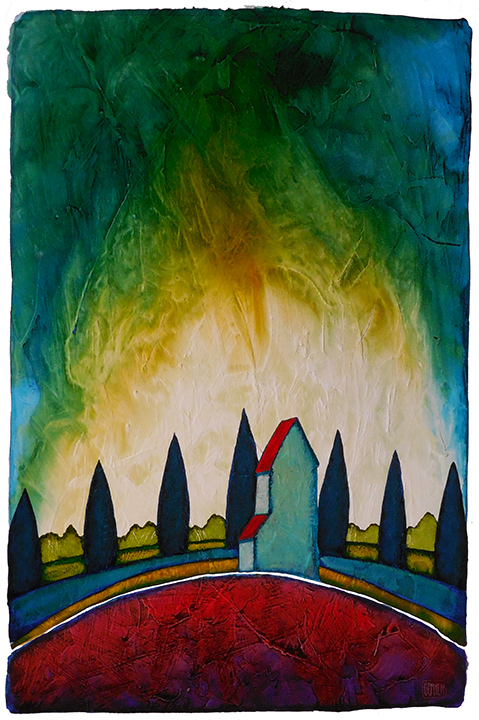
GC Myers- Lux Templi

Lux Templi-At the West End Gallery


Do you sometimes want to wake up to the singularity
we once were?

— Marie Howe, The Singularity


Yesterday, I came across a post from about four years ago of this short animation of a poem from poet Marie Howe. The post and the poem had slipped my mind, but I was moved upon reading it again.

Her poem is titled Singularity and refers to the theory from Stephen Hawking, and others as well. The accepted theory is that when a star dies it collapses into itself until it is finally a single tiny point of zero radius, infinite density, and infinite curvature of spacetime at the heart of the black hole formed from the star’s collapse. A single point of immense mass and energy This was referred to as a singularity. 

Hawking looked at this singularity and wondered since this was the end point of star’s death could it not also be the starting point for future new universes that might emerge if this singularity were to explode outward– the Big Bang Theory.

The underlying thought is that the universe and all that it is was once a single thing before the Big Bang created all that we know the universe to be now.

We were all part of one thing.

No, we were that one thing.

That is as simple as I can put it and still understand it. I am not even sure that simple explanation is correct. Probably off by a large fraction, like the final garbled message in the old Telephone Game, where something is whispered in one kid’s ear at a table. They then whisper it into the kid next to them and so on. By the time the message gets to the final kid, the message usually only contains a small part of the original message. I am probably that kid near the end of this process.

 Admittedly, and much like Howe explains to her audience, my own grasp of advanced physics and most other great scientific theoretical concepts is limited. But the idea that we were once one and that we may all at some point become one again is somehow appealing to something inside me. It makes me think that maybe a form of singularity is the goal of all art– both an inward reduction of totality into a single tiny point as well as an outward explosion of this same totality.

Expressions of mortality and rebirth.

I don’t know for sure. This is just what the kid next to me whispered in my ear. If I’m way off base here, blame it on him. 

 The entire Marie Howe poem is below the video. Take a look then get the heck out of here. I got plans to either collapse or explode this morning. Not sure which it will be. Probably a theory on that somewhere.


SINGULARITY
by Marie Howe

(after Stephen Hawking)

Do you sometimes want to wake up to the singularity
we once were?

so compact nobody
needed a bed, or food or money —

nobody hiding in the school bathroom
or home alone

pulling open the drawer
where the pills are kept.

For every atom belonging to me as good
Belongs to you.
   Remember?

There was no   Nature.    No
them.   No tests

to determine if the elephant
grieves her calf    or if

the coral reef feels pain.    Trashed
oceans don’t speak English or Farsi or French;

would that we could wake up   to what we were
— when we were ocean    and before that

to when sky was earth, and animal was energy, and rock was
liquid and stars were space and space was not

at all — nothing

before we came to believe humans were so important
before this awful loneliness.

Can molecules recall it?
what once was?    before anything happened?

No I, no We, no one. No was
No verb      no noun
only a tiny tiny dot brimming with

is is is is is

All   everything   home

Read Full Post »

GC Myers- Time Patterns 2024

Time Patterns– At West End Gallery


I can hardly understand the importance given to the word research in connection with modern painting. In my opinion to search means nothing in painting. To find is the thing. Nobody is interested in following a man who, with his eyes fixed on the ground, spends his life looking for the purse that fortune should put in his path. The one who finds something no matter what it might be, even if his intention were not to search for it, at least arouses our curiosity, if not our admiration.

Pablo Picasso, “Picasso Speaks,” 1923


To find is the thing…

I often write here about searching for something with my work. It’s usually something I can’t describe in any way that helps myself or the reader. It’s just something that pulls me forward.

Well, that’s what I thought, for the most part.

Reading the passage above from Picasso recently set me thinking that perhaps it was not a search at all, at least not in the way I had portrayed it.

Perhaps I was driven onward because I had found something and felt the need to express and share it. Or perhaps to keep that feeling of discovery, that eureka! moment, alive within myself– and within others who sensed whatever I had found for themselves when they viewed the work.

I can’t say for sure. I am still wrangling with this. But it makes some sense to me. A painting begins as an exploration, a search, but as it progresses it moves toward a revelation of some sort. The search is in the process, not in the resulting work.

At least, for the artist. It may differ for the viewer. They may see it as a way toward something they need and seek. Something they may not even realize is needed or sought. Perhaps they will find that same thing in the final work that that I had found, that same thing that seems to somehow answer vague, unasked questions.

Who knows for sure? But this idea that the work in not so much a search as it is a revealing of what has been found satisfies something in me.

Maybe that what was I was looking for in the first place?

Or maybe this is all one of those dreams where everything you wonder about suddenly seems to make perfect sense and there is that momentary feeling of elation that is then suddenly and completely gone once your eyes open.

Could it be that?

I don’t know but here’s an old song from Todd Rundgren that came to mind while I was finishing up. I haven’t heard this tune in many years and Todd Rundgren is one of those artists who was very popular in the 70’s but has faded somewhat from the front of the public mind the in the decades that followed, though he still is actively recording and performing. Just on a smaller stage as the musical outlets    became narrower and more niched. This is I Saw the Light.


Read Full Post »


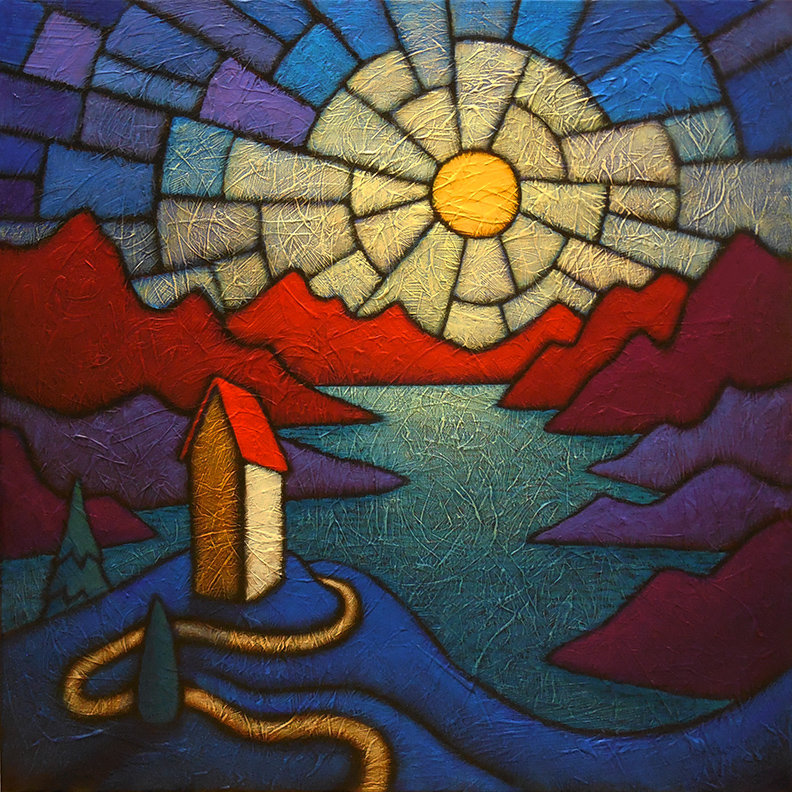
GC Myers- In the Light of Stillness 2024

In the Light of Stillness— At West End Gallery

If we had no winter, the spring would not be so pleasant: if we did not sometimes taste of adversity, prosperity would not be so welcome.

–Anne Bradstreet,  Meditations Divine and Moral (1664)


Cold here overnight. Single digit cold with a supper clear sky and a bright moon. The light reflected on the icy crystals that were created by the extreme cold, making it seem like there were shining diamonds scattered in the frosty grass.

It would have been an even more spectacular display if there had been snow on the ground. Even so, it was beautiful as it was.

Finding beauty in the harshness is somewhat akin to the words above of Anne Bradstreet, who was both the first North American writer and woman to have their work published in the 1600’s. Bradstreet (1612-1672) was born to Puritan parents in England and came to the Massachusetts Colony in 1630. To be honest, I don’t know much about her work, which was primarily poetry. But a quick look at her biography shows that while she was cultured and well-educated, she, like most of the early settlers who came here, endured extreme hardship, suffering from mutliple maladies and losses. 

She knew about finding beauty in harshness.

I am sharing a song this morning called Chilly Scenes of Winter. I was going to play Hazy Shade of Winter from Simon & Garfunkel but I somehow always confuse their title with Chilly Scenes of Winter which was a wonderful 1979 movie. It is a small quiet, quirky and funny in a bittersweet way film with a great cast. You can click here or on the title above to see it on YouTube.

That aside, when I searched for the song, Chilly Scenes of Winter, mistakenly thinking I was looking for Hazy Shade of Winter, I came across the song below with that title. It is from an early pioneer of country music, Cousin Emmy. Born in Kentucky in 1903, as Cynthia May Carver, she performed under the name Cousin Emmy from the 1930’s until her death in 1980. She was big country radio star from the 1930’s into the early 1950’s. She drifted into obscurity but found her career revitalized with the folk music movement of the 60’s and the bluegrass revival thereafter.

I don’t know much about Cousin Emmy or her music, but I like this song. Her voice has that kind of flat and plaintive tone to it that is indicative of the music of that part of Kentucky. And it is also a song about finding happiness after suffering loss. In the song she finds a new love after being slighted by her beau who himself is then slighted by his new love. 


Read Full Post »

GC Myers- An Orderly Life sm

An Orderly Life– At the West End Gallery


The man who believes that the secrets of the world are forever hidden lives in mystery and fear. Superstition will drag him down. The rain will erode the deeds of his life. But that man who sets himself the task of singling out the thread of order from the tapestry will by the decision alone have taken charge of the world and it is only by such taking charge that he will effect a way to dictate the terms of his own fate.

― Cormac McCarthy, Blood Meridian, or the Evening Redness in the West


I hesitated a bit about the use of the excerpt above from a book by author Cormac McCarthyBlood Meridian, that I read probably thirty years ago.

It’s considered by some as McCarthy’s magnus opus and one of the greatest of American novels. My memory of it is of its powerful imagery of the relentless chaotic violence that marked the tale, which is set in the Texas-Mexico borderlands in the late 1840’s. It’s a powerful told story that has the feel of the most lurid Hieronymus Bosch painting one could imagine.

It’s a book I would like to revisit but I keep putting off, especially in the context of America at this moment in time. It might be too disheartening to see parallels from that book in a contemporary reality.

Even so, the excerpt above describes what I see as the basis for much of my work, which is the need to seek some sort of order in the chaos, mystery, and seemingly senselessness which this world presents to us on a daily basis.

It might be a fool’s errand. I’ve said that many times before. But to not seek some sense of order in the swirl of chaos, some light in the dark, is unimaginable. Unacceptable.

To seek order means that we have not ceded control over our lives and fates to superstition and fear. That we have chosen to think and reflect on those mysteries of life.

And maybe if we can somehow pull one single thread of order from that vast tapestry of mystery and chaos, we will count ourselves among the fortunate ones who live outside the realm of chaos and fear.

Just one thread…


This post ran a few years back but I thought I’d share it because it included the painting at the top, An Orderly Life, which has been at the West End Gallery for several years now. It’s one of those pieces that really resonate for me personally and every time I come across it in the gallery I feel a pang for it. It’s a mixture of wanting it back for myself– as I said, it holds personal meaning for me– and sorrow that it hasn’t spoken to anyone else in the same way. The sorrow is always more pronounced for those pieces that I feel hold something special or that really strike a chord within me. I think this piece will soon come back to me and I will accept it with that same mix of happiness and sorrow. It actually makes the piece feel more alive to me in that we humans experience that same sort of acceptance and rejection throughout our lives, often going unrecognized for whatever their special purpose might be. In a way, the painting is just living a normal life.

And that is okay.

Here’s a 2009 song from Yusuf Islam, formerly known as Cat Stevens. This is titled To Be What You Must.


Read Full Post »

GC Myers- Moonlight Quartet, 2023

Moonlight Quartet–At West End Gallery


In the moonlight which is always sad, as the light of the sun itself is—as the light called human life is—at its coming and its going.

Charles Dickens, Dombey and Son 


This line from Dickens always makes me wonder about a lot of things– about the emotional feel of moonlight and sunlight, about how each serve as a witness to our existence, about our affinity for light as humans, and how we react to light.

This wondering brings up lots of questions. Is our life in the light, be it sunlight or moonlight, even real? Or are we mere ghosts, manifestations of formless souls, that only exist and find form in dimensions of light?

I sure don’t know. But I do like wondering, especially about those questions that can’t be answered. Sometimes it seems like those are the only questions that matter.

I see that the light is breaking in gray through the trees. Time for this ghost to get moving.

Here’s a song from Joni Mitchell from her jazz-tinged work of the early 1980’s. This is Moon at the Window.


Read Full Post »

GC Myers- Greenie's Barn circa 1994

Greenie’s Barn, 1994– Now at West End Gallery


There is surely no greater wisdom than well to time the beginnings and endings of things.

–Francis Bacon, Of Delays, 1625


I came across the post below from a couple of years back this morning and thought I would use it to accompany the painting shown above. It’s a small watercolor from 1994 called Greenie’s Barn. It represents for me a beginning as it was painted in that period where I was discovering an artistic voice, at a point coming after what I feel was the major breakthrough in my development. Everything was fresh and exciting, with new discoveries coming with every session of painting. I look at this painting and that jumps out at me because I can remember how thrilled with what I was seeing in this small piece at the time. I loved it the colors at its edges, the ragged nature of its form, its quietude and contrast of light and dark. All things I desired in my work. It felt like it was signaling a direction for me to follow, as though it were a weathervane on that barn.

The barn itself reminded me of the old barns in this area. Many that I knew as a youth have long fallen to the ground from neglect as the farmers who built and used them for generations died out or moved into other forms of work. I see some now, teetering and ready to fall, sections of their roofing peeled back, exposing their roofbeams, and I feel a sadness for them. They were such important structures in their time, often maintaining an almost regal presence in their landscape, and now their kingdom was gone.

So, for me, this small painting of a barn represents both beginnings and endings. I don’t know why I named it Greenie’s Barn. It just felt right at the time and I remember referring to barns by their owners’ names as a kid. It has been with me for 30 years now and I never wanted to offer it in a gallery, but I felt now was the time. It’s at the West End Gallery now as part of their holiday show.

The post below from a few years back deals with beginnings and endings as well. It ends with this week’s Sunday Morning Music selection.


I tromped up through the woods yesterday. The snow wasn’t deep and it was cold enough to freeze up some of the boggier parts of the hillside so that I could wander through. It was something I hadn’t done for some time. Too long. Even though it’s only less than a quarter mile up in the woods, it seems like a world removed from the home and studio down below, which themselves often feel far removed from the world at the end of our long driveway.

It’s quieter than down below, the trees and the terrain muffling sound. The crunch of the snow underfoot is clean and clear. It’s a good sound.

With the snow on the ground and the leaves now gone, I could see deeper into the woods. I was able to better see the individual trunks and crowns of the trees. Some were like anonymous people in a crowd scene in a film, not really standing. While I could still appreciate their individual beauty, they didn’t stop my eye.

It was the bigger trees that jumped out at me, the beech and maples and the now dying ash trees that have been ravaged by the borer beetles. It made me think how loggers must look through the woods, their eyes measuring and taking in the shape of each tree until one large tree sets off their inner alarms. It made me wonder how my great-grandfather, who at the age of 17 first set out into the Adirondack forests in 1872 leading his own crew of loggers, would look through these woods. Would he simply see the trees as a form of income or would he look upon them as companions? After all, this was man who spent much of about 60 or so years in the deep woods in all sorts of weather conditions, most of the time coming before the use of tractors and chainsaws.

It’s one of those times when you wish you had a way to spend a few minutes speaking with an ancestor.

As is always the case in nature, the forest reminds you of the beginnings and endings. The floor of the forest is littered with dead trees that have tumbled over in wetter and windier times or, in the case of the mighty ashes that have died from the damage of the beetles, rot then fall in large chunks until all that is left is the lower trunk of the tree. The remnant ash trunks are sometime twenty plus feet tall.

I am always a bit sad when seeing these dead trees who by virtue of location and environment didn’t last as long as they might have in other places. But even so, among their bony remains on the forest floor new saplings and young trees abound, all straining upward trying to push their faces to the light.

It’s a reminder of the inborn desire to struggle and survive that is present in all species. We all desire to exist, to feel our faces in the sunlight of this world. But, as the forest points out, we all have beginnings and endings.

And that’s as it should be. How would we be able to appreciate this world, to see it as the gift it is, if we knew our time here was without end?

I don’t know the purpose of this essay. I simply started and this is what it ended up as. A beginning and an ending…

Here’s a song that is about beginnings. Not a holiday song. You most likely will get your fill of those everywhere else. Not to say I won’t play one or two in coming days but today let’s go with From the Beginning from Emerson, Lake & Palmer.


Read Full Post »

GC Myers- And Dusk Dissolves sm

And Dusk Dissolves – At the West End Gallery


It was that hour that turns seafarers’ longings homeward- the hour that makes their hearts grow tender upon the day they bid sweet friends farewell…

― Dante Alighieri, Purgatorio


Dante had it right– dusk is that hour of recollection, some warm and some less so. As I age, I see this more clearly, most likely as a result of simply having more to look back on than look forward to at this stage in my life.

Don’t jump too hardly on that last line. I feel there is still a tremendous amount of living ahead for me and others my age or older. It’s just math– the ratio of time lived to the expected or hoped for time left in one’s life– says that the greater part of our life is behind us for people of my age and older.

And I believe dusk does often remind us of this fact. It’s a time when we sometimes pause to look back on the day, to reckon what we have done and not done during that time and to measure what lies ahead for the next day.

And sometimes this recollection extends back further than the day that just passed due to the moment in which it takes place. Maybe it’s the warmth and color of the sunset. Maybe it’s the way the landscape around us changes in the setting light, as colors deepen and contrast to the narrowing light. Whatever it might be in that moment, something triggers flashes of distant memories.

Words spoken and unspoken. Maybe just a glance from a face you remember or the most innocuous detail from some moment that didn’t seem important when you saw it so long ago.

Sometimes these moments are full and make sense. Sometimes they are fragments that seem insignificant. Yet they remain in place in our memory.

And as that moment of recollection passes and we move to settling in for the night and looking ahead to the coming day, these recalled moments dissolve, much like the setting sunlight melts into darkness.

There’s a wealth of recollections to pull from as one ages and maybe I see that in the depth and richness of the colors here. Maybe every stroke of color in that sky is a fleeting and flashing moment from my memory. I don’t know.

It makes me think of when my dad was in his final years suffering from dementia. His memory was spotty at best and often large segments of it were absent. I remember one instance when he was disturbed and asked me with great seriousness to tell him who his mother was. I went to a photo of her from her college yearbook (Potsdam 1918!) that was on a bulletin board we had put up in his room. I pointed her out and explained in great detail her history. He listened to me more intently than any other time I can remember in my life, like he needed to know this and wanted to inscribe it deep into memory.

Looking back on that moment now, I can only imagine him as the Red Tree looking back and, instead of the richness of individual colors in that sky of memory, he is seeing a hazy grayness with occasional peeks of color. A recognizable tree or hillside whose color has faded to a duller shade, almost gray. And the distant deeply colored mountain that might have been his mother was not even visible.

Makes me appreciate every moment, every fleck of color, every drop of light, every insignificant recollection that remains with the hope that my dusk never fully dissolves.


This post ran a few years back. I came across the image of the painting at the top, And Dusk Dissolves, and remembered that this painting was still at the West End Gallery. I had forgotten that it was there. It’s a very large piece, 30″ by 48″, so it is often difficult to find space for it on the gallery walls. But it remains a favorite of mine. Seeing it and reading the post reminded me of my parents, who I have been thinking about in recent weeks.

Here’s a song about looking back, a version of a favorite Beatles song, In My Life, from 1965‘s Rubber Soul album. Hard to believe this song is almost 60 years old. This version is from the American recordings of Johnny Cash, done in the final months of his life. n a long and storied career, I’ve always felt it was among his most impactful work. His age and ailments changed his delivery and imbued the songs with real heart-felt emotion and purity. A powerful group of music. This version of the Beatles’ song is not so different stylistically, but it it is filled with his own personal meaning which, n a way, makes it his own.


Read Full Post »

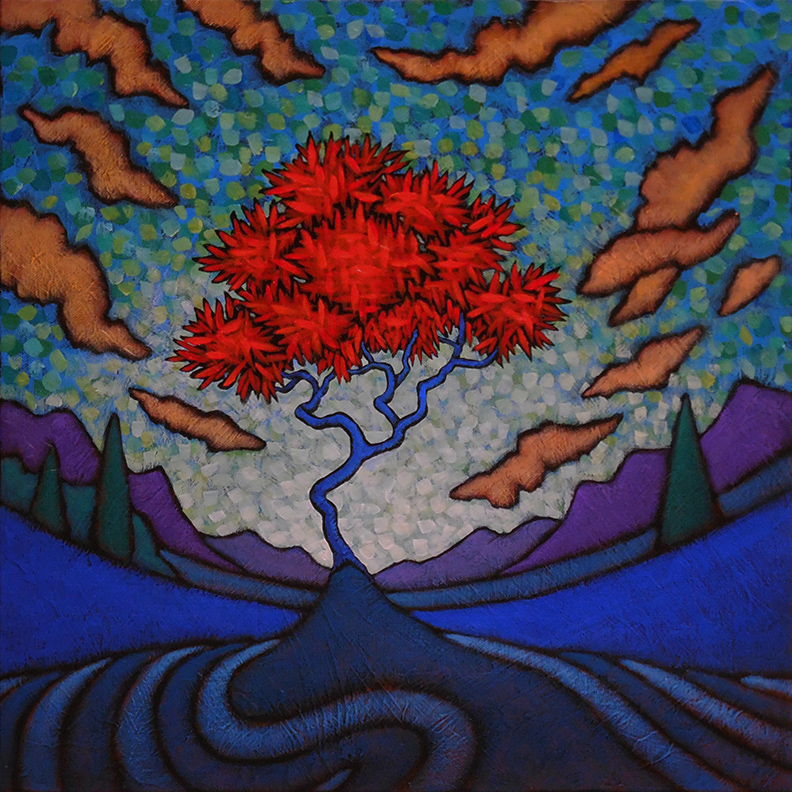
GC Myers- On the Blue Side  2024

On the Blue Side— At the West End Gallery


Poetic power is great, strong as a primitive instinct; it has its own unyielding rhythms in itself and breaks out as out of mountains.

–Rainer Maria Rilke, Letters toa Young Poet


The line above from Rilke has been translated a couple of different ways. This is an abridged version that omits any reference to the subject, a German poet, who Rilke was describing in his letter. This version becomes only about poetic power. This is the version you will mainly see quoted today.

The original version was a direct reference to Richard Dehmel, a German poet who died in 1920 from injuries sustained in WW I. Dehmel was an influential poet in Germany in the pre-war years, his verse considered very rhythmic. It was a favorite among popular composers of that era– Richard Strauss, Carl Orff, and Kurt Weill, for examples–who regularly set his poetry to their music. He is best known for his work that was strongly sexual in nature, so much so that he faced obscenity charges several times.

The original line is at the end of a paragraph where Rilke writes about his admiration for the beauty of Dehmel’s work as well as his concern that he sometimes went beyond the prevailing accepted levels of decency of that era. The original line:

His poetic strength is great and as powerful as primal instinct; it has its own relentless rhythms within, and explodes from him like a volcano.

It wasn’t changed that much actually, mainly keeping a direct reference to Dehmel and using the explosive nature of a volcano instead of breaks out as out of mountains.

I know this is not of much interest to anyone, but I only mention it because the original made me think of the Red Tree in some of my paintings as a sort of small volcanic explosion. I had never thought of them in this way and it intrigued me. It gave them a new dimension.

I can definitely see this in the painting at the top, On the Blue Side, which is at the West End Gallery. The Red Tree here has a feel of released energy, as though it is exploding from the earth. Maybe trees and everything springing from the earth is a small volcano, a bursting eruption of energy? I don’t know but I like the idea.

Hmm….

Here’s a song that is about mountains in a way. This is Remember the Mountain Bed, another favorite from Mermaid Avenue, the Wilco/Billy Bragg collaboration where they composed music for the unpublished Woody Guthrie lyrics. Good stuff.


Read Full Post »


GC Myers- Monde Parfait

Monde Parfait— At West End Gallery

Art is not a handicraft, it is the transmission of feeling the artist has experienced.

-Leo Tolstoy, What is Art? (1897)


When I first shared the quote above, I wasn’t sure if it was accurate or even from Tolstoy. I have found the source in the six of so years since it appeared here, and it was both from Tolstoy and accurate, appearing in an 1897 book titled What is Art? The book decried the elitist nature of art at the time when it was predominantly the domain of the powerful — the rulers, the ultrawealthy, the academies of higher learning, and the church– as well as the wealthy art dealers who chose what was suitable for these elite few.

The artists who thrived at that time catered solely to these few and were often richly rewarded for their efforts. They themselves became the elite.

In the chapter that contained the sentence at the top, Tolstoy foresaw a future where art would break free from such constraints and speak to all people, from most the common person to the most powerful among us. It was a peek forward at what the 20th century soon was to deliver us as it broke free from the entrenched traditions of art.

Art would become less academic, less constrained by rules. It would become a way of expressing emotions and feelings that sometimes were stifled in prior generations. Artists would no longer cater solely to the whims of the powerful but would aim to connect with the many. It would be art that would more accurately reflect the state of all people.

As the rest of the paragraph containing the sentence above states:

But art is not a handicraft; it is the transmission of feeling the artist has experienced. And sound feeling can only be engendered in a man when he is living on all its sides the life natural and proper to mankind. And therefore security of maintenance is a condition most harmful to an artist’s true productiveness, since it removes him from the condition natural to all men,—that of struggle with nature for the maintenance of both his own life and that of others,—and thus deprives him of opportunity and possibility to experience the most important and natural feelings of man. There is no position more injurious to an artist’s productiveness than that position of complete security and luxury in which artists usually live in our society.

Art must come from human beings with common human experiences and emotions. It must be a living thing derived from the richness of life as most people know.

In the blog post from several years back where I first shared Tolstoy’s words above, without knowing the full context, I wrote the following, which I think still applies:

Craftsmanship– handicraft– definitely has a part to play but that alone cannot transport the viewer to that inner spring from which their emotions flow. Something might be beautifully crafted but unless it is constructed from the empathy, the love, the awe, the wonder and the wide assortment of feelings that define our humanity, it remains just a lovely object.  Beautiful but coolly devoid of feeling.

And there is nothing wrong with that.

But the aim of the artist, at least to my mind, should be to speak from their own emotions and experiences so that they can enmesh with the emotions of the viewer– or listener or reader, whatever their medium might be. To transmit and create a sort of communion of feeling between the artist and the recipient.

Can this be taught? I don’t know. I try to tell students to read, to look, to listen, to practice a sense of empathy in their daily lives. Widen their view and become a fuller person. I think art comes from an equal blend of one’s handicraft and their sense of humanity.

That’s just my opinion and it may be as flawed an idea as the mind that thinks it. But I can stand behind that thought and hope, in some small way, to achieve that blend in my own work.


Of course, the future that Tolstoy foresaw was already on the move. For example, by the time Tolstoy wrote What is Art? Vincent van Gogh whose life and work very much represented what Tolstoy saw ahead., had been dead for several years. His influence and that of many other artists from that era had yet to change the art world — and the world in general. It was coming though. Here’s Don McLean‘s lovely paean to Vincent van Gogh, Vincent.


Read Full Post »


GC Myers-- Follow the River sm

Follow the River— At Principle Gallery

Me, my thoughts are flower strewn
With ocean storm, bayberry moon
I have got to leave to find my way
Watch the road and memorize
This life that pass before my eyes
And nothing is going my way
The ocean is the river’s goal
A need to leave the water knows
We’re closer now than light years to go

–R.E.M., Find the River, 1992


Sunday morning. Cold and dark. Tired. Maybe that’s the wrong word. More like fatigued, if there is any actual difference. Just feel all out of rhythm in a lot of ways. One of those periods where everything mechanical or electronic that I touch seems to react erratically to me. Just inserting the verse above from the R.E.M. song that I am going to pay for this week’s Sunday Morning Music took about fifteen minutes as the site would freeze up and then wouldn’t format properly.

The fatigue, the frustration, the lack of rhythm– it all builds up and you feel as though you’ve strayed off your path a bit. A little disoriented and feeling somewhat lost. You look for something that gets you back on that path, some landmark or something you can follow that you know will cross your intended path somewhere down the line. Maybe a stream or river.

Something that moves, flows. Something with a rhythm. It might not be yours but maybe it will lead you to yours once again.

I’ve followed it before and found my way back. Many times. It gets harder as I age, as though the wear and tear of this process of recovering my path saps a little more each time. But even as I feel a bit more tired and achy, just knowing the drill, understanding that there is a way through, is sustaining.

So, I tell myself that today is the day I break through, the day I put my feet back on that path from which I had strayed. And maybe today really is the day in which I am not deceiving myself again.

I hope so.

I know that if it is the day, this funk will dissipate in a poof! and even the memory of it will quickly fade. One of the benefits of having experienced this before is that there’s a mechanism that washes away much of the memory of being lost. Oh, I remember but, having found the river once again, its flow has quickly carried me far downstream away from it. It remains in the rearview.

Give a listen to R.E.M. and their song Find the River from their 1992 album Automatic for the People.

Me? I have to run. I just know that that river is just ahead for me. Let yourself out, okay?


Read Full Post »

« Newer Posts - Older Posts »