Feeds:
Posts
Comments

Posts Tagged ‘GC Myers’

Trio: Three Squares – 2002


Summertime, and the livin’ is easy
Fish are jumpin’
and the cotton is high
Oh, your daddy’s rich
and your ma is good-lookin’
So hush, little baby, don’t you cry

One of these mornings
you’re gonna rise up singing
And you’ll spread your wings
and you’ll take to the sky
But till that morning
there ain’t nothin’ can harm you
With daddy and mammy standin’ by

–Summertime, from Porgy and Bess, Dubose Heyward, George & Ira Gershwin (1934)


I am not so sure about the livin’ is easy part of summertime. Summer has often felt more like steel cage death match for me. Or a grim and gritty fever dream. You might ascertain that it is not my favorite season by a long stretch.

But that doesn’t take anything away from my appreciation of the great aria from Porgy and Bess. Like so many great songs, it’s melody and lyrics are so beautifully composed that it’s hard to find a performance that doesn’t resonate. There have been many, many great versions of this classic and there’s hardly a lemon among them. The Ella Fitzgerald version is perhaps the gold standard though that might be debatable. I am sharing a live performance by Janis Joplin from 1969 in Amsterdam.  I probably like this version because it has the grit and tone of my summers.

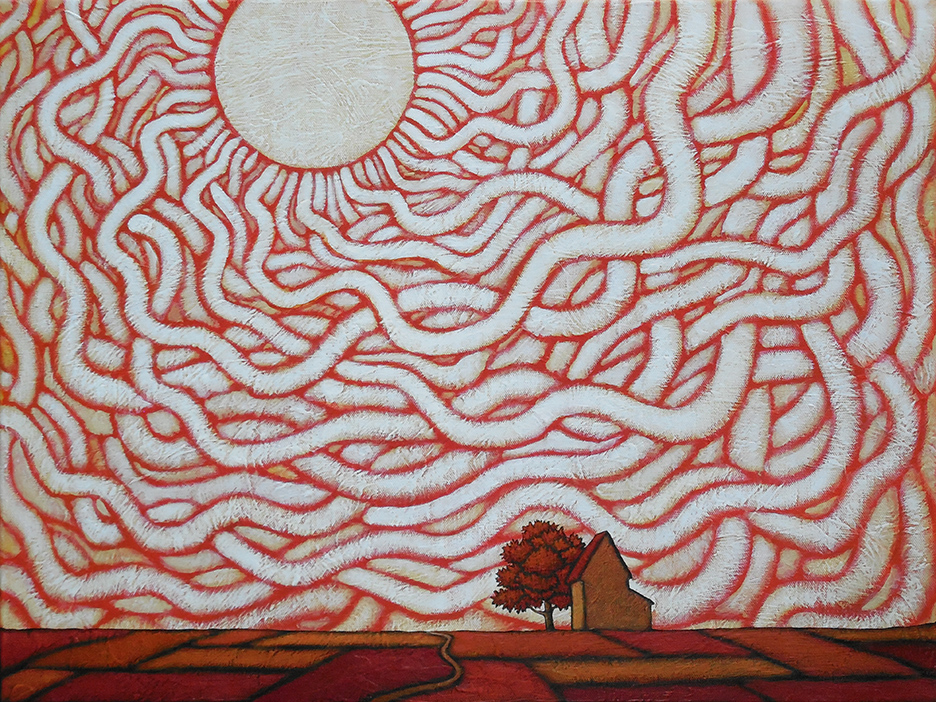
The image at the top is a small triptych from 2002 that hangs in my studio. It has long been a favorite and still gives me a rush when I look up at it, like I did just this moment. I see it as a link between my earliest work of the mid and late 1990’s that focused on sparsely detailed blocks of color and the subsequent work.

Here’s Janis…


Read Full Post »

Moment Revealed — At West End Gallery


We have five senses in which we glory and which we recognize and celebrate, senses that constitute the sensible world for us. But there are other senses – secret senses, sixth senses, if you will – equally vital, but unrecognized, and unlauded… unconscious, automatic.

–Oliver Sacks, The Man Who Mistook His Wife for a Hat


Maybe that’s the purpose of art, to prompt us to some sort of sixth sense, one that otherwise goes unnoticed and underutilized in our usual five-sense lives. It is something that we don’t even know that we have been needing and missing until we are awakened to it.

This sixth sense enables us to detect the many dimensions which exist between and beyond that which we observe with our five senses, adding depth and richness to our sense-limited world. 

And art does just that, serving as the activating agent for this sixth sense and beyond that, acting as the connecting link between the known and the unknown. I believe that is what is taking place when one is moved by art in any form.

It transports you into dimensions beyond the five senses. 

And that’s where the good stuff is…

Here’s a song this morning about one type of sixth sense from Irish singer/songwriter Imelda May. With a style that covers many genres of music including jazz and rockabilly, she wasn’t on my radar until just a couple of years ago. I stumbled across a video of Robert Plant and her performing a rockabilly-Big Band rave-up of Led Zep‘s Rock and Roll that I very much enjoyed. I’ll throw that on below as well.


Read Full Post »

House of Blues – At Principle Gallery


‘Cause I have all of life’s treasures and they’re fine and they’re goodThey remind me that houses are just made of woodWhat makes a house grand, oh, it ain’t the roof or the doorsIf there’s love in a house, it’s a palace for sureBut without love it ain’t nothin’ but a houseA house where nobody lives

–Tom Waits, The House Where Nobody Lives (1999)


It feels like America in the year 2025– a house without love or joy. Or happiness. Or grace, vision, or humor.

Any of those things that make a house feel lived in.

Those things that make a house a palace of love.

We instead build endless chain-link cages to fill with our hatred and bigotry.

That’s all I will say this morning.

You might not agree. Fine.

Just calling ’em like I see ’em, as the ump behind the plate would say. Just hoping your individual houses are filled with love and laughter.

Here’s the Tom Waits song that made me think this with the full lyrics below.


There’s a house on my block that’s abandoned and cold
The folks moved out of it a long time ago
And they took all their things and they never came back
It looks like it’s haunted with the windows all cracked
Everyone calls it the house
The house where nobody lives

Once it held laughterOnce it held dreams, did they throw it away, did they know what it means?Did someone’s heart breakOr did someone do somebody wrong?

Well, the paint is all cracked, it was peeled off of the woodThe papers were stacked on the porch where I stoodAnd the weeds had grown up just as high as the doorThere were birds in the chimney and an old chest of drawersLooks like no one will ever come backTo the house where nobody lives

Oh, and once it held laughterOnce it held dreams, did they throw it away, did they know what it means?Did someone’s heart breakOr did someone do somebody wrong?

So if you find someoneSomeone to have, someone to hold, don’t trade it for silverOh, don’t trade it for gold‘Cause I have all of life’s treasures and they’re fine and they’re goodThey remind me that houses are just made of woodWhat makes a house grand, oh, it ain’t the roof or the doorsIf there’s love in a house, it’s a palace for sureBut without love it ain’t nothin’ but a houseA house where nobody livesBut without loveIt ain’t nothin’ but a house, a house where nobody lives

–Tom Waits, The House Where Nobody Lives (1999)


Read Full Post »

The Entanglement— Now at Principle Gallery


The force that through the green fuse drives the flower
Drives my green age; that blasts the roots of trees
Is my destroyer.
And I am dumb to tell the crooked rose
My youth is bent by the same wintry fever.

The force that drives the water through the rocks
Drives my red blood; that dries the mouthing streams
Turns mine to wax.
And I am dumb to mouth unto my veins
How at the mountain spring the same mouth sucks.

The hand that whirls the water in the pool
Stirs the quicksand; that ropes the blowing wind
Hauls my shroud sail.
And I am dumb to tell the hanging man
How of my clay is made the hangman’s lime.

The lips of time leech to the fountain head;
Love drips and gathers, but the fallen blood
Shall calm her sores.
And I am dumb to tell a weather’s wind
How time has ticked a heaven round the stars.

And I am dumb to tell the lover’s tomb
How at my sheet goes the same crooked worm.

–Dylan Thomas (1933)


This is considered the poem that more or less brought Dylan Thomas to fame as a poet. I read it again recently and was surprised at how well it aligns with the theme of my show, Entanglement, at the Principle Gallery. It basically describes how our timed existence here on this world is simply part of the timeless driving force of the universe. How that in this place made of time, the very force allowed us for our short stay here, the life force that energizes us, ultimately destroys then leaves us to regather with its timeless source.

Not sure that it is something that is easily explained and I am not sure if I was able to adequately convey that message with this show. But since the show ends today, I felt it was worth sharing this morning along with a splendid reading from Thomas’ fellow Welshman Richard Burton. And for good measure, I added a favorite song from a favorite guitarist, Martin Simpson. Last shared here a couple of years back, it’s titled She Slips Away, and was written about the death of his mother, as she moved from time to timelessness.

As does my Entanglement show which ends today. So, if you want to see it, today is your last opportunity to see it in its entirety before it moves into the realm of the timeless.


Read Full Post »

To the Main Road– At Principle Gallery


I knew that I had ample room in which to wander, since science has calculated the diameter of space to be eighty-four thousand million light years, which, when one reflects that light travels at the rate of one hundred eighty-six thousand miles a second, should satisfy the wanderlust of the most inveterate roamer.

–Edgar Rice Burroughs, Pirates of Venus (1932)


Still feeling a bit off kilter and definitely not feeling celebratory in any way for the Fourth of July tomorrow. In fact, I am a little crotchety this morning. Writing that makes me wonder about the origins of the word crotchety. One of the numerous benefits of the instant information of the InterWebs– we won’t go into its equally numerous pitfalls — is that one can answer questions like this within seconds. No more finding and dragging out the dictionary or encyclopedia or whatever reference book you have stacked on your shelves. I accumulated a bunch of compendiums of knowledge, both general and odd facts, over the years that sometimes answered such queries. Not always which meant writing it on a list to be looked up the next time I went to the library. Information moved much slower then and usually by the time I got an answer I had lost interest.

FYI, crotchety is derived from the word crochet which refers to the craft and hook used in it. The term came to represent someone who was hooked by peculiar thoughts, resulting in a brusque, rude attitude towards others.

Yeah, I fall into that category this morning. Crotchety old man shaking my fist at the sky.

Anyway, the theme today is wanderlust. Maybe by the description of searching for info that should be changed to wonderlust. Is that even a word? I guess I will have to take to the InterWebs once more.

While I am doing that, here’s a tune called Wanderlust from the immortal Duke Ellington and sax legend Coleman Hawkins. This came up on my playlist earlier setting this whole fiasco in motion.

Now, either listen or get out. I got things to do. Like I said, I am crotchety this morning and wonderlust  calls…


Read Full Post »

Betwixt and Between— At Principle Gallery


Don’t think. Thinking is the enemy of creativity. It’s self-conscious, and anything self-conscious is lousy. You can’t try to do things. You simply must do things. 

— Ray Bradbury


I ran a post featuring a Ray Bradbury quote the other day which reminded me of another of his quotes and a favorite blog entry from the past that employed the above quote. It’s a refinement of a quote from a 1962 essay, The Queen’s Own Evaders, in which Bradbury wrote about his time in Ireland writing the screenplay for the 1956 John Huston film, Moby Dick.

Never wanting to be a screenwriter, Bradbury adapted only his work for movies or television but made an exception when offered the chance to adapt the Melville classic. He struggled for months and months trying to adapt the novel then one day realized he was being too self-conscious, overthinking every word and element. He began anew and, at the end of an epic eight-hour writing session, finished the script.

The original quote was:

Self-consciousness is the enemy of all art, be it acting, writing, painting, or living itself, which is the greatest art of all. 

Ridding one of self-consciousness was a subject that popped up in many of his essays and interviews over the next 20 years or so as he refined the message. I well understand his view since I feel that I am least self-conscious when I am painting. My paintings are my world much like Bradbury’s world was that of Mars or the October Country or the strange, animated skin of the Illustrated Man.

Bradbury also stated over the years that an artist should not attempt to explain an artwork while it is being created. That’s how I feel about painting, as well. You do it. Then you think about it. As a result, that is why I seldom even begin to think about what the painting is about or what it might be called until it is done or at least well into its process.

Bradbury’s words on creativity are worthwhile for anyone, not just writers or artists. As he said, living is the greatest art of all. Here’s that earlier blog post, last shared here in 2018:


I came across this quote from famed sci-fi writer Ray Bradbury on an online site with quotes on creativity. This struck close to the bone for me as I have proudly not thought for years now. I have long maintained that thinking usually inhibits my work, making it less fluid and rhythmic.

It’s a hard thing to get across because just in the process of doing anything there is a certain amount of thought required, with preliminary ideas and decisions to be made. I think that the lack of thought I am talking about, as I also believe Bradbury refers, is once the process of creating begins. At that point you have to try to free yourself of the conscious and let intuition and reaction take over, those qualities that operate on an instantaneous emotional level.

I can tell instantly when I have let my conscious push its way into my work and have over-thought the whole thing. There’s a clunkiness and dullness in every aspect of it. No flow. No rhythm. No brightness or lightness. Emotionally vacant and awkward. Bradbury’s choice in using the term self-conscious is perfect because I have often been self-conscious in my life and that same uncomfortable awkwardness that comes in those instances translates well to what I see in this over-thought work.

So, what’s the answer? How do you let go of thought, to be less self-conscious?

I think Bradbury hits the nail on the head– you must simply do things. This means trusting your subconscious to find a way through, to give the controls over to instinct.

And how do you do that? I can’t speak for others but for myself it’s a matter of staying in my routine. Painting every day even when it feels like a struggle. Loading a brush with paint and making a mark even when I have no momentum or idea or at hand. Just doing things and not waiting for inspiration.

You don’t wait for inspiration– you create it.

So, stop thinking right now and just start doing things.

Read Full Post »

Finis Terrae (Land’s End) — “Entanglement” Ends July 7,2025


Man is least himself when he talks in his own person. Give him a mask, and he will tell you the truth.

-Oscar Wilde, The Happy Prince & Other Tales


I basically believe these words from Wilde. To a point. There is a certain class of folks however who wear a mask to hide behind, to prevent them from telling truth. Usually for duplicitous reasons, to benefit themselves or to avoid responsibility. Certainly not to spare the feelings of others.

But then again, maybe wearing that mask reveals their truth, after all. It exposes their weakness and greed, their contempt for the truth as well as their lack of compassion and unwillingness to even attempt to feel empathy.

You can probably think of somebody like that. Or a whole bunch of them.

Don’t make me put a label on this group this morning. I am still reeling a bit from whatever has ailed me for the past several days and don’t want to get any more aggravated than I am feeling at the moment.

On the broader subject of Wilde’s quote, I have often wondered which is the mask I wear — my actual self or my painting? Which is more likely to tell the truth? Which is real? Or are they now one and the same? I say now because they were once two distinctly different entities, one being decidedly more truthful than the other.

I won’t say which was the more honest being.

If I did, it might well be a lie.

I do hope they’re one and the same.

And I am not just saying that. Cross my heart and hope to die.

Let me finish with song and a reminder that this is the final week to see my Entanglement exhibit at the Principle Gallery in Alexandria, as it comes down July 7. If this work is my mask, I am proud to wear it.

I think it tells truth, for both me and the work.

Here’s John Lennon and Gimme Some Truth.


Read Full Post »

The Passing Parade— Now at the Principle Gallery


It’s akin to style, what I’m talking about, but it isn’t style alone. It is the writer’s particular and unmistakable signature on everything he writes. It is his world and no other. This is one of the things that distinguishes one writer from another. Not talent. There’s plenty of that around. But a writer who has some special way of looking at things and who gives artistic expression to that way of looking: that writer may be around for a time.

–Raymond Carver, A Storyteller’s Shoptalk,  New York Times (1981)


I am in the midst of a deep funk, a depressive event that comes on the heels of every show or gallery talk. Every show or talk–good, bad, or indifferent. It’s just the way it is. I think it’s a blend of several things.

One is simply being worn down with the effort of both creation and promotion. The promoting part– this blog, for example– becomes difficult and depleting just before and after each event.

Another is in creating unrealistic expectations for the event. This is especially true when I have stronger than normal feelings about the work.

Some of it comes in questioning my own efforts. Did I do enough? Did I break new ground? Or the simple but deadly– Am I good enough? 

Some of it comes from second-guessing my interactions with people. In her diary, author Anaïs Nin described very much what I go through after any event:

I have never described, even in the diary, the act of self-murder which takes place after my being with people. A sense of shame for the most trivial defect, lack, slip, error, for every statement made, or for my silence, for being too gay or too serious, for not being earthy enough, or for being too passionate, for not being free, or being too impulsive, for not being myself or being too much so.

You add in the deadline for the show being met which means that an endpoint, a destination, has been reached. It seems as though it should be a time to feel free but for a short time after each event, I feel unmoored, without direction, until a new destination is put in place.

These post-show depressions usually find me questioning what I do and the choices I have made. The questions that usually satisfies and begins to put me back on course comes by asking myself if I am painting the paintings I want or need to see. Am I doing work that is mine alone?

For the answer to those questions, I am going to continue here with a blog entry that has ran a couple of times here, the last time being in early 2020. The painting at the top of the original post  has been switched out for one, The Passing Parade, from my current Entanglement exhibit at the Principle Gallerystill promoting!— which satisfies now what I wrote then. I have also added the passage at the top from the late Raymond Carver. It’s another one of those quotes about writing where one can easily substitute artist for writer. It very much ties into the idea of painting the paintings you want to see for me. Or to create the world in which you wish to live, to put it another way.

Here’s that earlier blog post:


This painting really captivates me on a personal level and reminds me of a thought that once drove me forward as a younger painter. It’s a thought that I often pass along as a bit of advice to aspiring artists:

Paint the paintings you want to see.

Sounds too simple to be of any help, doesn’t it? But that simplicity is the beauty and strength of it.

For me, I wasn’t seeing the paintings out there that satisfied an inner desire I had to see certain deep colors that were being used in a manner that was both abstract and representative. If I had seen something that fulfilled these desires, I most likely would not have went ahead as a painter. I wouldn’t have felt the need to keep pushing.

It was this simple thought that marked the change in my evolution as a painter. Before it, I was still trying to paint the paintings that I was seeing in the outer world, attempting to emulate those pieces and styles that already existed as created by other artists. But it was unsatisfying, still echoing the work of others, forever judged in comparison to these others.

But after the realization that I should simply paint what I wanted to see, my work changed, and I went from a bondage to that which existed to the freedom of what could be found in creating something new. For me, that meant finding certain colors such as the deep reds and oranges tinged with dark edges that mark this piece. It meant trying to simplify the forms of world I was portraying so that the colors and shapes collectively took on the same meditative quality that I was seeing in each of them.

In my case this seems to be the advice I needed. But I think it’s advice that works for nearly anything you might attempt.

Paint the paintings you want to see.

Write the book you want to read. Toni Morrison said this very thing at one point.

Play the music you want to hear. Make the film you want to see. Cook the food you want to eat. Make the clothes you want to wear.

Make the world in which you want to live.

Simple.

Now go do it.


It was good advice then and it still is now. Time for me to claw my way out of this hole. Paint toward the light…

Read Full Post »

The Wisdom Beyond Words– At Principle Gallery


The hero adventures out of the land we know into darkness; there he accomplishes his adventure or again is simply lost to us, imprisoned, or in danger; and his return is described as a coming back out of that yonder. Nevertheless—and here is a great key to the understanding of myth and symbol—the two kingdoms are actually one. The realm of the gods is a forgotten dimension of the world we know. And the exploration of that dimension, either willingly or unwillingly, is the whole sense of the deed of the hero.

-Joseph Campbell, The Hero With A Thousand Faces


“The realm of the gods is a forgotten dimension of the world we know.”  

This sentence from the late Joseph Campbell could well summarize what the work from my current solo show at the Principle Gallery, Entanglement, is trying to convey. It is a show about those forgotten, hidden, and unrecognized dimensions that surround us every minute of every day during our time in this physical plane.

They are dimensions made up of energy and rhythm woven into deeply entangled patterns. Some of these patterns manifest themselves in this physical plane, resulting in a template or pattern of mythic behaviors that have been manifested and recalled with reverence in the stories of every culture throughout history.

Patterns of mythic action that exist in every time and place.

Here and now.

In my eyes, this work is a representation of the psychic unity of mankind, a theory to which Joseph Campbell’s work adhered.  It basically states that all people in this world share patterns of thought and behavior. Patterns that replicate those that exist in the dimensions beyond our recognition or understanding that these paintings represent.

If you’re familiar with Campbell’s work, you know that the great myths, such as Homer’s Odyssey, are not the sole province of the hero’s journey. Most people, in every time and place, at some time in their lives recreate the hero’s journey. It may be on a smaller, more intimate scale. They surely will not see it as being mythic or heroic. But it is woven from the same cloth and in the same patterns of the great myths, those same patterns that I see in these paintings.

 I could go on and on but that’s all I want to say this morning. I have things that need to be done. 

Heroic things?

Probably not. But then again, who knows?

Here’s an all-time favorite song of mine, one that I have probably share a little more here than I should. It’s Heroes from David Bowie. The line from the song that repeats and resonates- We can be heroes, just for one day— pretty much sums up this post. 

We can be heroes…


Read Full Post »

In the Free World-– Now at Principle Gallery, Alexandria


Every artist dips his brush in his own soul, and paints his own nature into his pictures.

–Henry Ward Beecher, Proverbs from Plymouth Pulpit (1887)


As an artist, if you will allow to call myself that, I believe these words the famous 19th century preacher Henry Ward Beecher are true. I know that I feel closest to my work when it most reflects a feeling and tone that I recognize deep within myself. You just hope that this aspect of your nature is equally reflected outward, that people see that same aspect in you as a person.

Sometimes they do and sometimes they do not. It is not always an easy transition when trying to bring anything from the inner to the outer world. I guess the best one can do as an artist is to be sincere, to represent those aspects which truly are part of your true nature.

To try to do otherwise produces insincere work. And while it can exist and even prosper in the short term, it eventually reveals its insincerity.

I don’t know, maybe I am just spinning my wheels this morning. I often do that in the aftermath of a show opening. It’s a matter of finding something to hold on to before I fully fall into the abyss of funk that I seem to encounter after every show. In this year’s case, I am holding on to the fact that I know the work I produced is indeed sincere and represents what I believe is my true nature.

Well, most of my true nature. You know, the good parts. The aspirational. The inspirational. But in reality, even the darker aspects of my true nature show up in what I consider my best work. I think it is that tension between the dark and light aspects of an artist’s nature that produce meaningful art.

Sincere art. Art of the soul.

Okay, a little more info on Henry Ward Beecher, for those of you not familiar with the name. He was one of the biggest celebrities of the late 19th century, on an equal footing with the actors, musicians, and writers of the era. At one point, he was referred to as the Most Famous Man in America. He was even on popular trading cards and had his own sex scandal that culminated in one of the most celebrated trials of the time. He was also a great social reformer as an abolitionist and advocate for women’s suffrage. He was the brother of Harriet Beecher Stowe of Uncle Tom’s Cabin fame, as well as the brother of Thomas K. Beecher. I throw in Thomas because of his local connection to my hometown. He was the big fish in our small pond at the time, a preacher who drew huge congregations as well as a civic leader. He was a good pal of Mark Twain and buddied around with him, playing pool and such, during Twain’s many summer stays here in Elmira. Beecher also presided over Twain’s wedding to local girl Olivia Langdon.

Okay, enough extra info. Let’s have a song. Since we’re discussing the nature of the soul, here’s Soul Time from Shirley Ellis. You might know her from her fun big hits The Name Game and The Nitty Gritty. A video for The Nitty Gritty with some exuberant dancer, highlighted by the wild moves of well-known dancer/choreographer Bobby Banas, became a viral hit. Lots of fun.


Read Full Post »

« Newer Posts - Older Posts »