Feeds:
Posts
Comments

Posts Tagged ‘Labor Day’

Since it is Labor Day, I thought I would rerun a post from several years back that is one of my favorites that very much has to do with one of the symbols of labor–the hands of the worker:

working-hands-photo-by-tony-smallman-2008I have always regarded manual labour as creative and looked with respect – and, yes, wonder – at people who work with their hands. It seems to me that their creativity is no less than that of a violinist or painter.

-Pablo Casals

******************

I came across this shot of working hands and it made me think of how I’ve viewed hands through my life.  I’ve always looked at people’s hands since I was a child.  The liver spotted hands of my grandmother had thin ivory fingers that seemed like translucent china, for instance.

The hands of our landlord Art, an old farmer, were thick and strong and missing at least one digit down to the knuckle on several fingers, the result of an impatient personality and old farm machinery.  Not a great match.  I saw quite a few farmers with missing fingers.

Fat Jack, who I wrote about here a ways back, had hands whose nails were longer than you might expect and permanently rimmed with the black from the oil and grease of the machines on which he was always working.  His hands were round and plump, like Jack himself, but surprisingly soft and nimble, good for manipulating the small nuts and bolts of his world.

There was a manager when I was in the world of automobiles who was a great guy but had extremely soft and damp hands.  It was like handling a cool dead fish when you shook hands.  A mushy, damp, boneless fish.

I admired working hands.  They reflected their use so perfectly, the scars and callouses  serving as badges of honor and the thick muscularity of the fingers attesting to the time spent at labor.  They seemed honest with nothing to hide.  They were direct indicators of that person’s life and world.

My own hands have changed over the years.  They were once more like working hands, calloused and thickening from many hours spent with a shovel.  There are a number of small scars from screwdrivers that jumped from the screwhead and into the flesh time and time again and another on the end of my middle finger from when I cut the very end of it off while trying to cut a leather strap with a hunting knife.  Not a great idea.

I always felt confident when my hands were harder and stronger.  Now, I have lost some of that thickness of strength and the fingers are thinner and a bit softer from doing less manual labor.  I look at them now and wonder how I would have judged them when I was younger, when I measured a man by his hands, something that  I don’t do  now.  I now know there are better ways to measure a life, that the work of the mind is now a possibility– something that seemed a million miles away then.  But when I come across working hands, strong and hard, I find myself admiring them still.
Read Full Post »

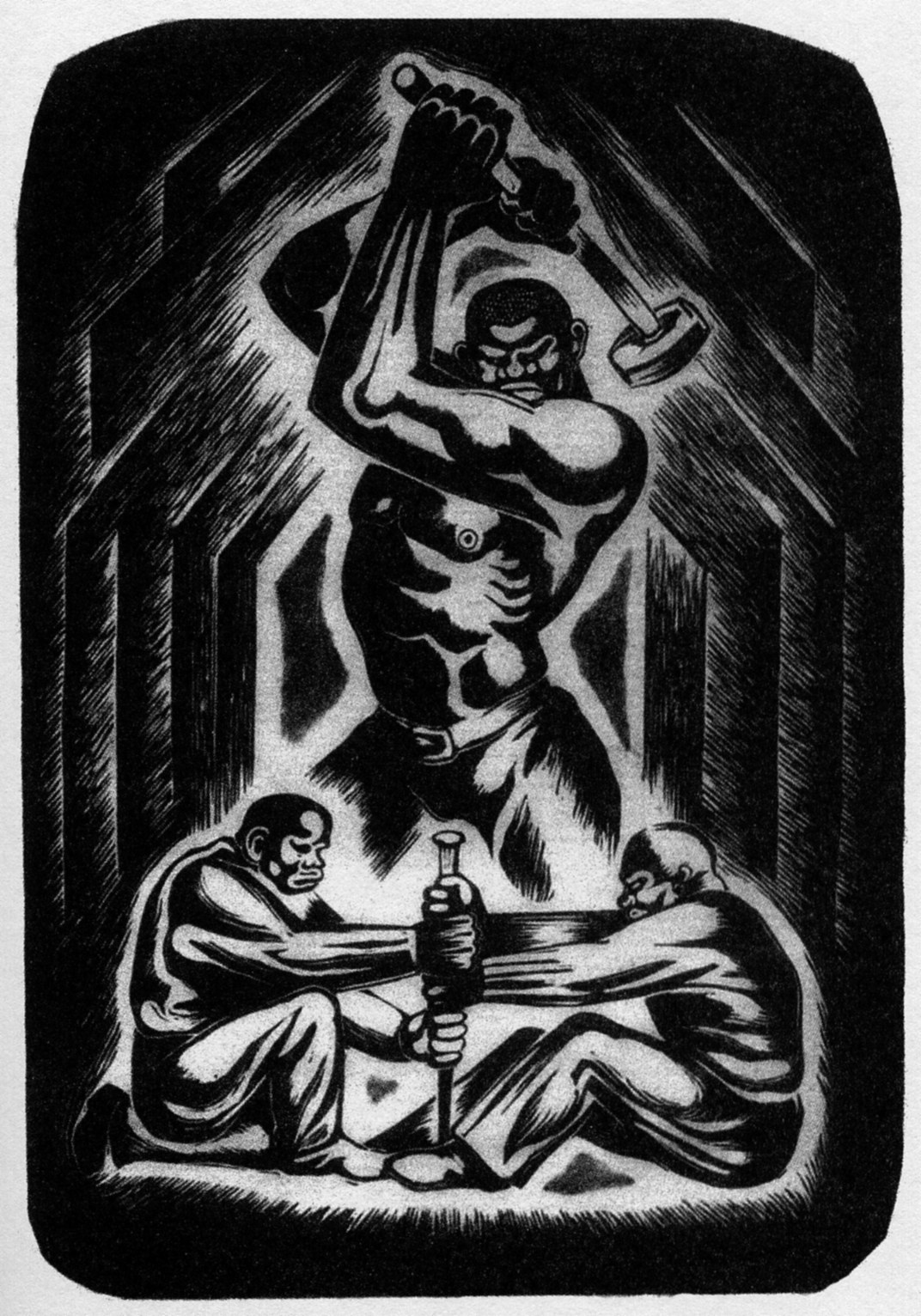
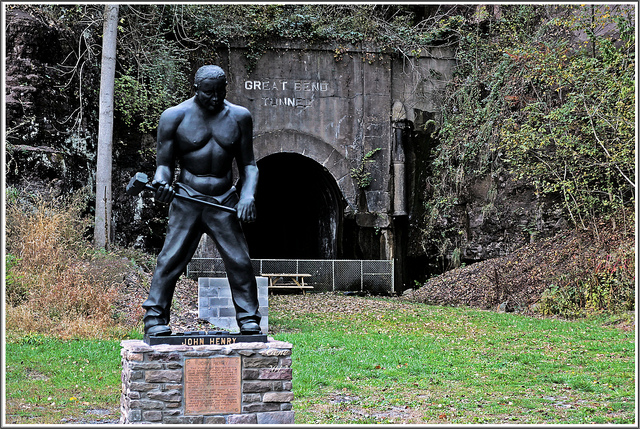
John-Henry-statueAnother Labor Day weekend.

I usually focus on the labor aspect of this holiday when writing about it, trying to point out how much our country was shaped by both the toil of the workers as well as the labor unions who fought for and won many of the rights that we now take for granted.  But this year I thought I would focus on a folk song that addresses the role and importance of labor in our lives:

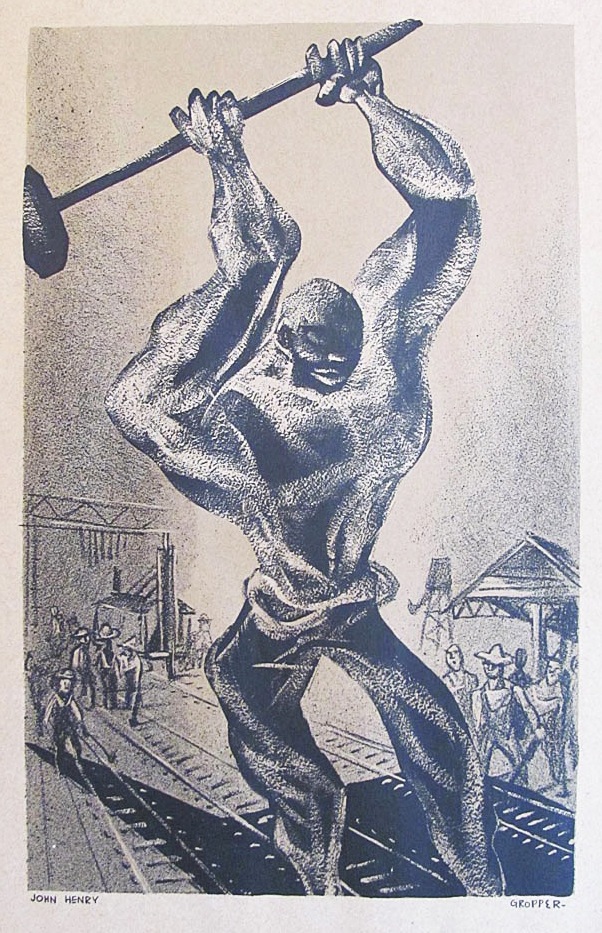
John Henry–  that steel driving man who faced off in an epic battle of man against machine, defeating the steam drill that threatened to take away his job.  Well, sort of defeating it.  I guess a victory is still a victory even if you die in the wake of your triumph.

john_henry_by_fw_long_dehtUnfortunately, John Henry’s great efforts ultimately didn’t save the jobs of the workers who would be displaced by the steam drill.  But it did illustrate the importance of  labor and the purpose it adds in our lives.  Labor has always been that thing by which we have provided for ourselves and our families, from the time we were primarily hunter/gatherers and farmers (which was not that long ago) to the present day.  To take away that ability to provide is to strip away one’s pride and definition as a human.

In that aspect, John Henry’s victory  was more than a triumph of blood and bone over steel and gears.  It was a triumph of the human spirit, a crying out of our need to be necessary in some way, to be undiminished.  And despite John Henry paying the ultimate price for his victory, I think that is why this song still strikes a strong chord with us.

So for this Sunday’s music I will play one of my favorite versions (among many) of John Henry.  It’s from Johnny Cash from his 1963 album, Blood, Sweat and Tears, an album which focused on labor.  I think it captures that idea of purpose really well.

Have a great Labor Day weekend but try to remember the idea behind the holiday.

John Henry William Gropper
 

Read Full Post »

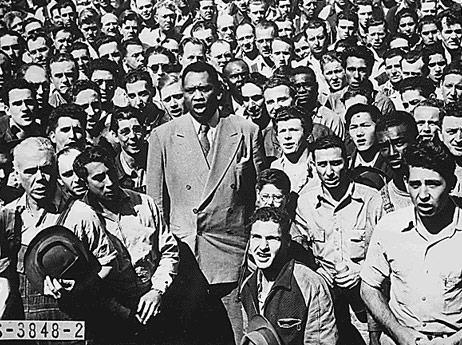
Paul Robeson and Shipyard Workers singing "The Star Spangled Banner" 1942

Paul Robeson and Shipyard Workers singing “The Star Spangled Banner” 1942

It’s a Sunday morning which means a bit of music here on the blog.  I try to have something fitting the day and since we’re in the midst of the Labor Day weekend, I thought I would have something labor related.  It is a holiday celebrating the working classes after all, something we often forget as we rush to get in that last weekend of the summer.  I’ve talked here before about the labor movement and how it transformed the American life.  Almost every right we now take for granted in the workplace was fought for– and I mean fought for— by workers and organizers who banded together to demand better working conditions and higher wages.

There were some important names in the labor movement of the early 20th century but maybe none so polarizing as that of Joe Hill, a Swedish immigrant who came to America in 1902 and soon after, as an itinerant laborer,  became involved with the labor movement.  He joined the Industrial Workers of the World — the Wobblies— and wrote  some of the most memorable labor songs of the time, songs which are still played today– The Preacher and the Slave (Pie in the Sky) and There Is Power In a Union.

Hill was working in the silver mine areas of Utah when he was accused of a double murder.  Many believe that Hill was innocent , that the evidence cited did  not line up with the facts of the case, yet he was found guilty.   Many believed that his labor connections were the deciding factor in the guilty verdict.  He was executed by firing squad in 1915.

Hill did little to help himself, remaining silent about a wound that the prosecution claimed was inflicted on him during the murder.  Hill’s fiance later stated that Hill had wrote her from prison, saying that her former lover had shot him.  But Hill seemed to sense that he meant more to the movement as a martyr.

And that is exactly what he became.  He was cremated and his ashes divided into 600 small packets which were distributed around the world by the Wobblies to be cast to the winds.  He has been celebrated in word and song.  The name Joe Hill when spoken still draws the attention of those who know their history.

This is a song , I Dreamed I Saw Joe Hill Last Night, written in the 1930’s by Earl Robinson and Alfred Hayes.   It is performed by the great Paul Robeson, one of the most interesting people of the last century.  Robeson was a star athlete, a lead actor and  headlining singer– the bright light in any sky he entered.    But more than that, Robeson was a ceaseless champion of the labor and civil rights movements.  If you don’t know much about Robeson, please look him up.

This is a subject that needs more space and time than I have to give today and for that, I apologize.  But please take a listen to the operatic voice of Paul Robeson as he sing about Joe Hill.  And remember what this holiday really means.


Read Full Post »

GC Myers- The Task Met smallIf a man is called to be a street sweeper, he should sweep streets even as Michelangelo painted, or Beethoven composed music, or Shakespeare wrote poetry. He should sweep streets so well that all the hosts of heaven and earth will pause to say, here lived a great street sweeper who did his job well.

–Martin Luther King, Jr.

**********************

Another Labor Day is here.  On this blog in the past I have bemoaned how the general public has forgot how much it owes to the labor movement, how the middle class that was the pride of this country during the middle of the last century was a direct result of hard fought gains from workers who banded together and stood against social injustice.  But today I just want to speak briefly about taking pride in one’s job, the same sentiment reflected in the quote above from Martin Luther King, Jr.

When I was a waiter in a pancake house, even after I had started showing my work in several galleries, I was always a waiter first when I was at my job.  Never a painter-slash-waiter, a title which served no purpose.  Circumstances had put me in this place at this time and I had determined that if I had to be there I would give it my complete attention and effort.  I would make it my own.  If I disliked it so much that it made me miserable, I would do something about changing my job when my day there was done and the task before me was complete.

 But while I was there, I treated it as though it were my destiny because, who knew, maybe it was.  I took great pride in being good at that job and some other jobs that I’ve done that could be classified as menial.  What was the cost in doing this?  If I had to be there then I would rather be recognized for my excellence rather than my misery.

Simply put, take pride in the task before you, however menial you see it.  Treat it as your destiny because in that very moment, it is.

Have a great Labor Day and remember what the day stands for.

Read Full Post »

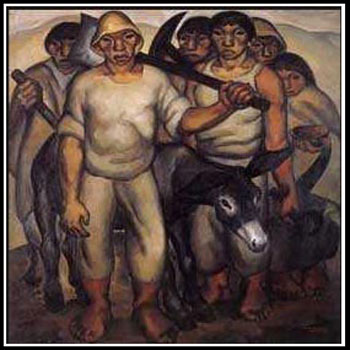
It’s another Labor Day here in America.  Just another holiday for most, one that marks the end of summer and the transition into autumn.  That’s what it was to me in my younger days.  But it began as a way of honoring the contributions of the working class to our country’s growth and progress.  From the fields and factories to the shipyards and mines, labor has been the backbone that held this country up.  The idea of labor has taken on added meaning for me as I became more and more aware of the importance of it in our history as well as its relevance to my own well-being and identity.

You see, I consider myself a working man, probably before I consider myself an artist.  I learned in my early days working in a factory and toiling as a laborer in other jobs the value of  being able to put my head down and focus on the task at hand.   I learned that effort was the one variable I could control and that effort often overcame my deficiencies.  I might not be as strong or smart or as talented as the next guy but I firmly believed that I could always outwork  him.    Effort brought out the most in whatever limited attributes I might possess.  I believe that any success I have achieved as an artist can be directly tied to these lessons learned with a shovel in hand and the sweat running down.

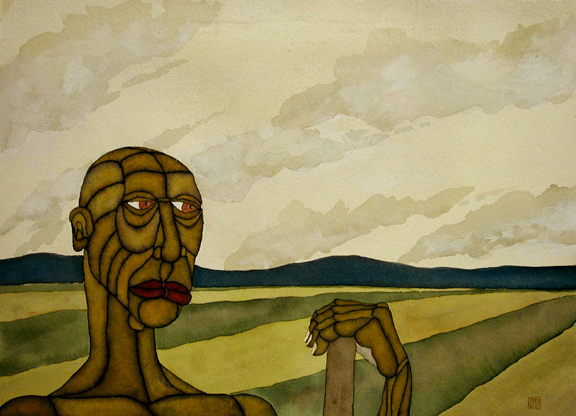
This value of labor is often portrayed in my work, most often in the form of rows of fields.  This   piece above, from my early Exiles series, always reminds me of the tenant farmers in the Dust Bowl-era photos of Walker Evans in the famous James Agee book, Let Us Now Praise Famous Men.  Labor and effort was all they knew.

I could go on and on here about the value of the labor movement in America and the great debt we owe to those ancestors who fought and died for the rights and protective  regulations which we take for granted today.  Too many of us don’t realize how difficult the battle was for these rights and how quickly they could erode without continued effort and vigilance.   So, enjoy your holiday but remember what it means.

Read Full Post »

Another Labor Day

Just another Labor Day, the annual holiday here that marks the end of the summer.  Most of us don’t even think for a moment about what the name of this holiday anymore, don’t realize that this holiday was meant to honor the trade and labor unions that have been so demonized in recent years. I know that I’m aware of the history of this holiday and even I forget it most of the time.  And that is a shame because we all could use a reminder of how the working class of this country has truly built the great wealth of the nation.

I guess I’m a labor guy.  My first real job was in a grocery store, a Loblaw’s, and we were unionized.  My next two jobs were also unionized and for a couple of years I was  a Teamsters’ union steward for my department  when I was working in the A&P Food Processing Plant.  I learned a lot from that experience, things that shaped how I still view the world today, thirty years later. 

There were some good guys who were supervisors at the plant. Bosses.  Management.  I could  see how people would say there’s no need for all the labor regulations and the protections of unions when I worked for these select few.  They were fair and pragmatic in their approach to dealing with the workers and most of us worked harder than hell for these guys. 

 But many were not fair-minded and used their position of authority as a hammer to try to pound everyone under them as though they were nails.  They continually tried to circumvent every rule and regulation and were constantly at odds with their workers.  These guys were the face for me of why there was a need for labor unions in many places.  I can still see many of their faces so vividly in my memories of that time.  They were the first layer of management, the least trained and most ill-equipped, and they would do anything to meet the demands that the layer of management above that had placed on them, even if it meant abusing the rights of the workers under their supervision.

It’s not that they were bad guys.  They had goals set for them that had to be met and they were simply not very skilled at dealing with people, specifically their workers.  So they would try to bully and punish.  Probably in the same way that they had been dealt with most of their lives.  As a union steward, I could see that the behavior of these abusive bosses made the need for protecting the workers imperative even though there were other fair and just bosses out there.  There would always be some bad bosses, especially at the lowest and middle levels, and they were the ones who dealt primarily with the labor force.

We were built with our labor force and we have prospered most as a nation when the labor force shares equitably in the wealth being created.  On this labor day, we should remember that and be thankful for the sacrifices made by those workers and unions before us in creating protections against the bad bosses of this world.


Read Full Post »

Labor Day

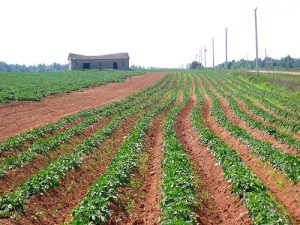
pei-potato-farmAnother Labor Day has come. Most folks have forgotten that this holiday was first celebrated back in 1894, signed in as a federal holiday as an effort to bring an air of reconciliation to the nation which had just endured the widespread and violent Pullman Strike. It is meant to honor the Labor Movement and the workers it represents.

For me, the day reminds me of the first time I worked outside of our home for someone else as a child, a memory that was recently reawakened at a wedding of an old friend near the fields where I first used my hands and back for labor. There was an old potato farmer on the road where I grew up and a friend of mine would periodically go down there and work, most of the time picking or bagging potatoes. One day he asked if I wanted to come along as the farmer was going to lay irrigation pipe that day and could use some extra help. Being eleven years old and wanting to make some extra cash and having no idea what I was getting myself into, I agreed.

It was hot and dusty work. The long pipes weren’t heavy but were awkward and each time they began to dip towards the ground as you carried them brought a gruff yell from the crusty old farmer, was not one to wear out his smile from use. He certainly did a lot of yelling and cursing at us that day.

We had just a short break to eat the sandwich each of us had brought with us and after about eight hours in the fields, I was exhausted and covered with alternating layers of sweat and gray, grimy dust. It was the first real day of work I had experienced. It had been a tough for an untested eleven year old but now I would be rewarded.

As my friend and I prepared to mount our bicycles and head tiredly home, the farmer stood before us in his dusty bib overalls, unsmiling, of course.

“Suppose you want to get paid?”

It came out of his mouth not so much like a question but more like a complaint. We silently nodded, eager in our anticipation of our sweet reward. He stuck his thick, strong farmer hand into a pocket and pulled out a handful of change. He counted out three dollars in quarters to each of us and said, “Okay?”

Again, not really a question. More of a dismissal, more like okay, we’re done here, now go.

We were just kids but we knew we had been taken advantage of that day. But we were eleven years old and afraid to death to talk back to the surly old man, to say that this was unfair. We never worked another day for him and I found out later that this was his modus operandi, working the hell out of kids then underpaying them. If they didn’t come back, so what? There were always kids looking  to make some money.

It was a small incident but it shaped how I viewed labor and the way many people are exploited. It was a clear object lesson, in microcosm, on the value of the labor movement in this country as a unifying force for those of us most susceptible to being exploited.

The labor movement is underappreciated now. Our memories are short and we lose sight of the abuse and exploitation of workers that have taken place over the ages. We take for granted many of the rights, rules and protections in the workplace, thinking they have always been in place. But they are there only because people in the labor movement stood up against this exploitation and abuse. These folks willing to stand against injustice deserve our gratitude on this day. We could use a hell of a lot more of them now.

So, as you spend your holiday in a hopefully happy and relaxing manner, remember those who made this day possible. Happy Labor Day.

Read Full Post »

« Newer Posts