Feeds:
Posts
Comments

Posts Tagged ‘Little Gems’


Daytripper– At West End Gallery

The best kept secret in America today is that people would rather work hard for something they believe in than live a life of aimless diversion.

–John W. Gardner, Living, Leading, and the American Dream, 2003


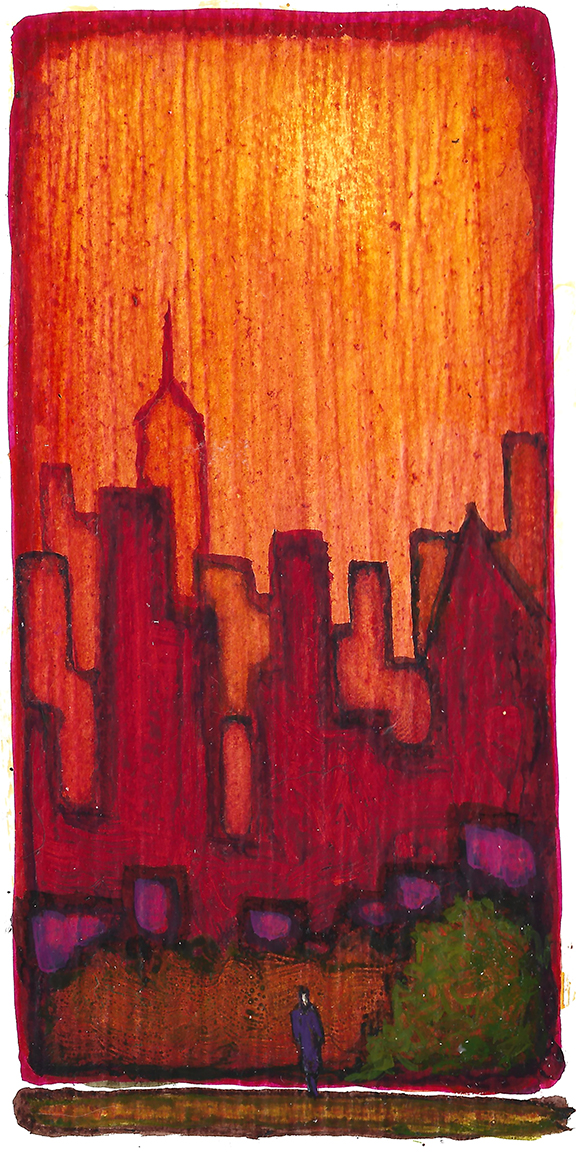
This is another new Little Gem that is now at the West End Gallery for their annual exhibit of small works. This piece really hit me in a visceral way when it was done. It exuded a lot of different things that all hit the mark for me. The color was right on with its mood, tone, and temperature harmonizing perfectly. The shapes and forms felt right in relation to each another and the small figure in the foreground added great depth to the scene.

There was a lot packed into this very small painting. Yet, I struggled with what it was saying to me. The wildfires in LA were burning at the time and I thought that with its extra warm coloration it might be saying something about fleeing the heat and flames.

But that didn’t feel right. The nature of the tiny figure was a nagging question for me. Was it fleeing the city’s hustle and bustle? Or was it returning from the city to its home in a cooler, calmer remote place? I couldn’t answer that definitively, but I loved the ambiguity. It didn’t really matter whether the figure was  seeking diversion in the heat of the city or in the cool of the country. The point I saw was that it was seeking something different, if only to provide a contrast to what it experienced every other day.

The daytripper, of course. 

I looked for a short quote or passage that somewhat summed up what I was seeing here and came across this short passage from a posthumously published book the late John W. Gardner (1912-2002) who had served as the U.S. Secretary of Heath, Education, and Welfare under LBJ. I wasn’t sure it spoke directly to this painting, but it spoke to something that had been on my mind, something that seemed to manifest itself in recent times.

It was this idea that we have become a country that leans into constant diversion, that we seek easy, instant, and short-lived gratification in lieu of working or sacrificing for something that would more deeply satisfy our needs and desires. Something that would benefit us in a lasting manner. It’s a tendency that has been exploited by the powerful and influential for their own benefit

It is a hard offer to resist. We all want things to come easy., with little thought or effort. on pour part. And after being exposed to easy diversion for so long, we expect and demand it. We no longer value the day trip– we expect it each and every day.

It’s all an illusion. And a dangerous one at that. We have lost that muscle memory of the need for work and sacrifice for something greater, something more lasting.  We have exchanged that ability for shiny trinkets. 

I know that sounds much like the rants of an old codger at the local diner crowing about how things were so much better back in the day. To be honest, it wasn’t any better. We still wanted everything to be easy and thoughtless. That desire just wasn’t being as fully exploited as it is now. 

I’m going to stop now because I can’t fully link that thought to the painting outside of saying that we need diversion and the occasional day trip. But it should remain that– a day trip. Not a life filled with diversion that keeps us from attending to the real needs of ourselves and others. We need to pay attention, to look away from the shiny and easy a little more often. 

Divert ourselves not with the meaningless, but with things that feel our souls. 

And I think John W. Gardner was correct in believing that most people today would be willing to shuck constant diversion in order to have something worth working or fighting for. 

Maybe that tiny figure is turning its back on the diversions presented to it in order to seek its purpose? Or maybe the painting itself is a diversion?

I don’t know.

But like I wrote earlier, this little painting has a lot of things packed into it. 

Here’s the song that gave the title to this little guy, Daytripper. I am sharing both the Beatles’ original along with a wonderful version from fingerpicking wiz Tommy Emmanuelle that also includes Lady Madonna from the Beatles. If you like watching a master guitarist play, this is a must see.

A little diversion, yes, but it feeds the soul. Or so I think.


Read Full Post »

The Resistance– At West End Gallery


We have been silent witnesses of evil deeds: we have been drenched by many storms; we have learnt the arts of equivocation and pretense; experience has made us suspicious of others and kept us from being truthful and open; intolerable conflicts have worn us down and even made us cynical. Are we still of any use? What we shall need is not geniuses, or cynics, or misanthropes, or clever tacticians, but plain, honest, straightforward men. Will our inward power of resistance be strong enough, and our honesty with ourselves remorseless enough, for us to find our way back to simplicity and straightforwardness?

–Dietrich Bonhoeffer, Letters and Papers from Prison


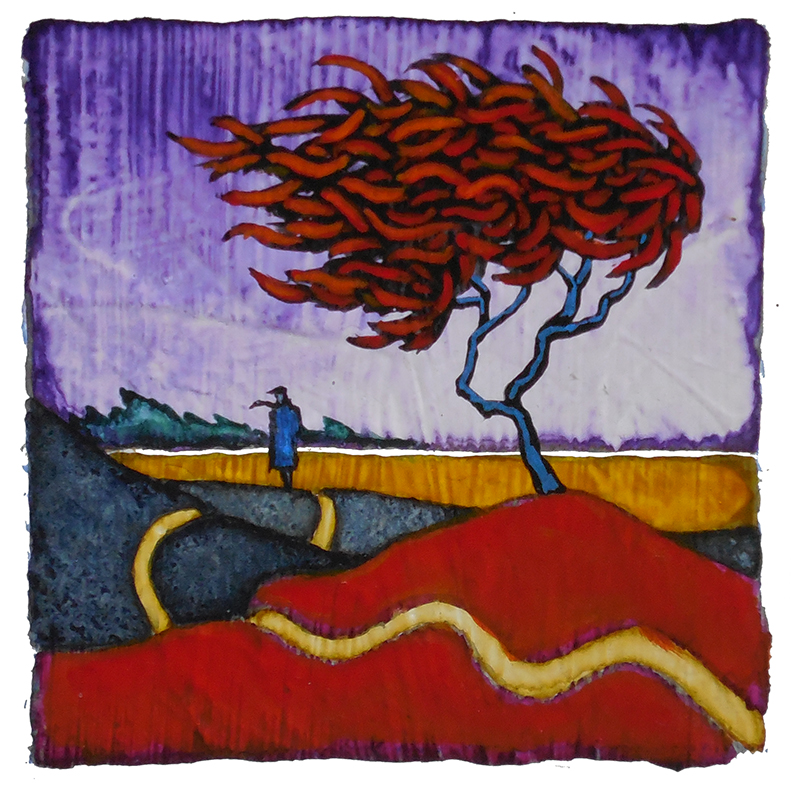
I see this new painting, The Resistance, as being about the willingness to stand one’s ground when the prevailing winds bellow against, trying to force you in a direction in which you do not want to go. You can read that interpretation as being political, topical, or merely symbolic of one holding tight to their principles. It’s a painting, ostensibly a piece of art, so that’s up to you.

Whatever the case, it’s a little piece that speaks loudly for me which is why I had not hesitation in coupling it with the words at the top from Dietrich Boenhoeffer. He and his writings, especially his posthumous Letter and Papers from Prison, are the subject of what has easily been my most popular blog post, On Stupidity.

Dietrich Boenhoeffer (1906-1945) was a German pastor and theological writer who stood in direct opposition to the Nazi regime and spoke out against its programs of eugenics, euthanasia, and genocide. He fled Germany and had an opportunity to stay in the US in the late 1930’s, safe from the reach of the Nazis. But after only two weeks in NYC, he insisted on returning, believing that if he were to rebuild the German church in the war’s aftermath, he must endure the conflict with its people.  In June of 1939, he returned and joined the German resistance to Hitler and Naziism.

He was imprisoned in a German prison in 1943 and later transferred to a concentration camp. He was implicated in a plot to assassinate Hitler in April of 1945 and was sentenced to death after a court martial trial in which there were no witnesses, evidence or any form of defense provided for him. He was hanged in the final days of the war. The legacy of his courage and the strength of his resistance are still celebrated around the free world today.

As I said, this painting may represent that sort of resistance for you. You might well just see it as simply being about a strong wind blowing against a person and a tree. Or you might be a bit of a contrarian (as I am) and see it as a symbol of not being swayed by popular opinion as symbolized by the wind’s effect here. Or you might expand that reading of this painting and see it in an existential sense. Again, that decision is your privilege and responsibility.

However you see it, I hope you see something for and of yourself in it.

This small painting, The Resistance, is 3″ by 3″ on paper, and is now at the West End Gallery for their annual Little Gems exhibit. The show is hung in the gallery for viewing now and the opening reception is next Friday, February 7.

Here’s a song from Bob Seger and the Silver Bullet Band to go with this all. Maybe it’s a little too on the nose but the song is Against the Wind. For some unknown reason, I have never shared anything from Bob Seger here even though I was big fan of his work, especially in the 70’s and 80’s. I think it’s just a case of holding on to some things and losing track of others. But it’s almost always solid stuff.


Read Full Post »

Cloud Flyer– At West End Gallery


In a time of sceptic moths and cynic rusts,
And fattened lives that of their sweetness tire
In a world of flying loves and fading lusts,
It is something to be sure of a desire.

Lo, blessed are our ears for they have heard;
Yea, blessed are our eyes for they have seen:
Let the thunder break on man and beast and bird
And the lightning. It is something to have been.


–G. K. Chesterton, The Great Minimum (1917)


The new small painting at the top is titled Cloud Flyer and is now at the West End Gallery as part of their annual Little Gems exhibit. I showed my work for the first time ever at their first Little Gems show back in 1995. The show has proven to be one of their most popular shows every year since. I know it’s one of mine, both in painting for it and seeing the small work of the other artists.

It seems to go against logic but there seems to be something freeing in painting on a small scale. Maybe it’s because it feels less daunting facing a small unintimidating surface than being confronted with the broad blankness of a large canvas.

Or maybe because of the size there is only one take, to use a movie term. There are no preliminary sketches or studies. I know many artists who work in a 3-step process of first creating a small loose study then transfer it to a slightly larger version that is a bit tighter in its painting. They then attempt to transfer everything they have gleaned from the first two studies to a large and totally finished final painting. With few exceptions, when I get to see all the stages of a painting done in this way, the first sketch is generally the most alive of the three. It is fresh and free and, unlike the later stages, not trying to recapture something that may have been unintended when it emerged. The final painting often ends up feeling like a copy of something else other than what it is.

I don’t work that way. My belief has been that every painting ends up being a rehearsal for the next. Therefore, you should strive to paint each piece, no matter its size or significance, in the same manner. I think it creates consistency in the quality of the work, something that transcends its size. I feel that every small piece I have done for all the Little Gems shows over the years is a work unto its own.

That’s certainly how I feel about this small painting. It has things in it that I know I would be hard-pressed to recreate it on a larger scale and still maintain the original unique feel of this one. An angle here or there would be off, the composition and colors would be altered in some way, and it might feel a little stilted. Contrived. It wouldn’t be the same. And for me, that’s the way it should be.

This piece has its own life and a sense of freshness. This was one of the first pieces I worked on for this show and I can’t tell you how much I springboarded off the energy this little guy provided. It was like a little jolt of lightning hitting me at a time when I needed it.

That’s the reason I chose the section from the G.K. Chesterton poem, The Great Minimum, at the top. That final line– And the lightning. It is something to have been. — just kills me. The rest of the poem, as I read it, is about the small joys of being alive, how each small thing brings value to this world, and nothing is insignificant.

Little things mean a lot.

Of course, I could be wrong. We all read things differently with our own set of filters and desires for what we want to see and hear. 

For me, it fits this painting. And this exhibit.

Below is a version of the poem performed as a song by the Nicole Ensing Band. I liked this better than some of the dryer straight recitals of it. They do a nice job with it. Below that is the whole poem if you would like to read along.


The Great Minimum

It is something to have wept as we have wept,
It is something to have done as we have done,
It is something to have watched when all men slept,
And seen the stars which never see the sun.

It is something to have smelt the mystic rose,
Although it break and leave the thorny rods,
It is something to have hungered once as those
Must hunger who have ate the bread of gods.

To have seen you and your unforgotten face,
Brave as a blast of trumpets for the fray,
Pure as white lilies in a watery space,
It were something, though you went from me today.

To have known the things that from the weak are furled,
Perilous ancient passions, strange and high;
It is something to be wiser than the world,
It is something to be older than the sky.

In a time of sceptic moths and cynic rusts,
And fatted lives that of their sweetness tire,
In a world of flying loves and fading lusts,
It is something to be sure of a desire.

Lo, blessed are our ears for they have heard;
Yea, blessed are our eyes for they have seen:
Let thunder break on man and beast and bird
And the lightning. It is something to have been.

— G.K. Chesterton


Read Full Post »

A Secret Sun— At West End Gallery


And they’re only going to change this place
By killing everybody in the human race
They would kill me for a cigarette
But I don’t even wanna die just yet

There has to be an invisible sun
It gives its heat to everyone
There has to be an invisible sun
That gives us hope when the whole day’s done

–Invisible Sun, The Police, 1981


After finishing this new small painting, it reminded me of something but I couldn’t figure out what. I wanted to find the connection so that it might help me find a title for this piece. That’s how I often title my work, from subtle — and some not so subtle– nudges coming from the work that spark loose connections in my mind.

Was it something I saw or read? Was it because of the red sun? It bugged me for a while but I finally let it go and just worked from what I was seeing.

The red of the sun here made me think that it was not normal, that it had a significant difference for those that saw it. The way it was partially obscured by the trees made me think it was trying to remain unseen, as though it were not for everyone’s eyes.

A secret sun? That’s pretty much how the title to this small painting, A Secret Sun, came about.

But that first reminder of something I couldn’t put my finger on still vexed me. I carry bunches of these vexing little questions around in my head– names, faces, movies, songs, books, and so on that I can’t quite remember. Every so often I will be painting or doing something else, maybe making my way through the woods to the studio in the morning, and suddenly the answer to one of these questions pops into my head.

The initial question and everything around it seems suddenly clear. I sometimes yell out, “That’s it!” like I’m Charlie Brown after the psychiatrist Lucy asks if might be suffering from pantophobia, the fear of everything.

Just remembering the answer one simple and sometimes stupid questions that naggingly lingers in my mind is as satisfying a thing as I can’t think of at the moment. I will probably think of something else later and will be equally pleased then.

Just the other day, the connection that couldn’t recall to this little painting, suddenly came to mind. It was an old Police song, from their 1981 Synchronicity album. It was a favorite album back in the day but one that I hadn’t heard fully in many years. The song was Invisible Sun. which was about a sun we couldn’t see but gave us warmth and hope.

It fit perfectly with what I was seeing in this painting. It seems today that we almost need a secret sun to keep us warm and hopeful as the one that we all can see now gives us heat but not much hope.

And maybe that secret sun is not even a sun. Maybe it is something else that fills us with hope but goes unnoticed by many others?

I don’t know. That question will nag at me, no doubt. But I feel pretty good about getting the one about A Secret Sun out of my head.

Here’s the original Police song, Invisible Sun.

A Secret Sun is 3″by 5″ on paper and is now hanging with the Little Gems exhibit at the West End Gallery. The show opens with a reception on Friday, February 7 but the work is up and available for previews and presales.


Read Full Post »

Blue Flow– At West End Gallery


“To overcome the anxieties and depressions of contemporary life, individuals must become independent of the social environment to the degree that they no longer respond exclusively in terms of its rewards and punishments. To achieve such autonomy, a person has to learn to provide rewards to herself. She has to develop the ability to find enjoyment and purpose regardless of external circumstances.”

― Mihaly Csikszentmihalyi, Flow: The Psychology of Optimal Experience


This is another new small painting now at the West End Gallery in Corning, NY. It is titled Blue Flow and is a tidy 2.5″ by 2.5″ on paper. It is right on the mark for the annual Little Gems show at the gallery which opens on February 7.

I chose the passage above from late psychologist Mihaly Csikszentmihalyi to go along with this painting today. Csikszentmihalyi first introduced the concept of flow in 1975 and his 1990 book, Flow: The Psychology of Optimal Experience, which I have discussed here in the past, became a classic in the field of positive psychology.

Flow is basically being in the zone in a creative sense, shutting out all external noise and distraction to deeply focus on the task at hand. It is described as being at that point of balance found when one’s skill level meets its highest challenge. Flow has become a well-worn term for musicians of the highest skill level. You now often hear the word used to describe the soaring solos of guitarists like Jimi Hendrix or Stevie Ray Vaughan.

I often use the term rhythm in describing that hyper focused state of creating. It also involves doing whatever is being done for the sole purpose of doing it. It doesn’t depend on the approval or consent of anyone other than its creator.

It’s a letting go of that which is outside– fears and doubts– and just going with the flow.

There’s a lot more involved in his book on the subject but for my purposes today I am going with the simplest form of flow and how it symbolically relates to this little piece. I see the blue stream as being the flow of creativity and the distant sun as its endpoint. Everything around it is in tones of gray and black, their colors lost in the act of focusing on the flow of creation.

It’s a simple reading of it, of course. But sometimes the best pieces find their power in that simplicity. I think that’s the case here.

I came across a song from an artist who was not on my radar. His name is Shawn James and the song is fittingly called Flow. I liked the song a lot, both in sound and meaning, and have enjoyed listening to his other music this morning. Solid stuff. Look forward to hearing more. Here’s a taste:

So you think you got it all figured out?
All this money in the bank and the women all about
Well, now what you gonna do when your ship starts to sink?
Caught in a monstrous sea and you won’t be able to think
Yeah, and it’s there you’ll learn what I know
That all of this world will fade
You gotta learn to let it all go, oh
And flow like the river


Read Full Post »


Nations, like stars, are entitled to eclipse. All is well, provided the light returns and the eclipse does not become endless night. Dawn and resurrection are synonymous. The reappearance of the light is the same as the survival of the soul.

–Victor Hugo, Les Misérables (1862)


Eclipse– At West End Gallery

Perhaps all people sometimes live through periods of eclipse, times when the light on which we depend seems to go away. Science tells us now that the light will soon return but to those who lived in the earlier ages of man, the sudden departure of light must have felt apocalyptic. I can only imagine the fearful panic and worry that must have filled them, not knowing if the light would ever return. Wondering if their lives, their futures, would be forever changed. How would they survive?

Maybe I don’t have to imagine. Maybe we are now in the time of a great eclipse.

I don’t know. But those feelings that our distant ancestors must have felt when the last bit of light they saw was obscured seem closer to the surface now, not lost in the mire of our long dormant DNA memories.

I want to believe that like the natural type of eclipse, the darkness of this cultural eclipse will soon give way to a reappearance of light. And I think it will.

The question is how long will this eclipse linger? Will our desire to see the light once more hasten its return? Or will we learn to dwell in a state of constant darkness, forgetting all that the light once gave to us?

Again, I don’t know. Not sure than anyone out there has a credible answer, one way or the other. All we can do is bide our time, lighting candles and torches against the darkness. Keeping light alive somehow.

After I finished this small painting, Eclipse, I knew that I liked it on a surface level. I liked it simplicity, forms, and colors. It seemed to work, to have a life energy. But I also felt that it was offering a message beyond its surface appeal.

This symbolic idea of an eclipse was the first thing that entered my mind at that point. I often attach symbolic meanings to my work that might only apply to my own interpretation. You might not see it that way at all. After all, we all perceive the world around us in different ways with different preferences and prejudices.

You might think that an eclipse is just an eclipse, and a cigar is just a cigar. That’s okay. We all take what we want and need from art. In this case, I see the bigger symbolism of this little piece and find myself waiting for, as Hugo put it, dawn and resurrection.

For this week’s Sunday Morning Music, here’s a song that I have shared a few times over the years. It’s alive version of Darkness on the Face of the Earth from Willie Nelson with Emmylou Harris sitting in. He wrote the song in 1962 and it was originally released that year by Hawkshaw Hawkins, who was a big country star at the time. He died in the same plane crash in 1963 that killed Patsy Cline. Nelson released the version on which this performance is based on his 1998 album, Teatro. Great album.

Eclipse is a 2″ by 4″ piece on paper that is now at the West End Gallery for their annual Little Gems show, opening February 7.


Read Full Post »

King of the Night Forest — At West End Gallery


The clearest way into the Universe is through a forest wilderness.

–John Muir, July 1890


I have mentioned that one of the things I like best about doing work for the annual Little Gems exhibit at the West End Gallery is that I get to work on new themes and directions. The smaller format is ideal for exploring new things– different color combinations, compositions, elements, etc. Over the 31 editions of  this show, some once new things have become regular visitors to my work where others have been limited to their one and only appearance.

This year’s show has one distinctly different entry– actually, two paintings of the same sort– to the body of my work. I very much enjoyed working on these and found myself looking at them constantly after they were done. If that means they will become part of my regular rotation for years to come or are simply a one-time entry for this time remains to be seen.

Some of my favorite themes had limited lifespans within the body of my work. Of course, I always reserve the right to revisit these themes in the future so they may not be really finished within the body of my work. Just paused. For example, my popular Archaeology series flourished for a year or two then moved to a place within my body of work where it shows itself every few years. And even then, it only appears in a handful of new pieces, maybe only two or three.

Sometimes, it simply depends on what I need to see in the work for myself. This work starts off as being explicitly for myself. While I might be pleased if others take to them, it doesn’t really matter to me so long as they spark some sort of excitement within me that can I carry with me into my other work.

There are two distinct pieces from this show that fall into this category. I don’t know where they fit yet or if they will become regular visitors. Or maybe they will become regulars that will never be shown outside my studio. Work for me alone.

The jury is still out on this new work. I like these new pieces a lot. They excite me, both in the process and in the way they carry their own different story and mythology. Maybe I need that new mythos right now in order to make sense of the bizarreness of what I see unfolding here recently. It leaves me feeling me more alone than ever and even more unmoored, as though the past I thought I knew and relied on was no more. 

Kind of like that feeling of which George Orwell wrote in 1984:

He felt as though he were wandering in the forests of the sea bottom, lost in a monstrous world where he himself was the monster. He was alone. The past was dead, the future was unimaginable.

Maybe I simply needed to see something different, something with its own reality, its own history and mythology. This work seems to fit that bill. Whether it remains it another question. I could see them effectively translated as much larger work– 4′ by 4′, for example. It would make for a dramatic and bold statement. But whether I go that route is unknown right now.

The first of these paintings is shown above. It is a little over 6″ by 6″ on paper and I call it King of the Night Forest. The title came from when I used to walk in the dark down to my home from my first studio that was up in the woods. I often did that walk without a flashlight or without any visible lights to guide me and found that the forest took on a whole different character in that darkness. Every sensation, every sound, every smell was magnified as I felt my way down the hill with my feet. Where I could peer deep into the forest during the day, I was now met with a deep blanket of opaque blackness.

The imagination could run wild. Maybe there were eyes watching from just beyond that wall of darkness? Maybe some being I didn’t recognize who only came out when the dimension of blackness. Maybe a whole civilization that lived in a dimension just a shade beyond our own, so near that in those dark moments when I found myself rubbing up against their dimension they could observe me. Maybe they were wondering what sort of strange beast was moving their space.

Perhaps one of those times it was the King of the Night Forest watching me slowly make my way in the blackness. 

I began these faces because they allow me to use pattern and color in their making. It really doesn’t feel much different to me than the process I often use in creating some of my landscapes that incorporate more colors, shapes, and patterns than is typical for my work. It is only the form and the narrative that emerges that is different. 

Where it goes from here, I don’t know. For now, it satisfies something with me that was in need of something new.

This painting, King of the Night Forest, and the other which I will show here in the coming days are available at the West End Gallery as part of this year’s Little Gems exhibit. The show officially opens Friday, February 7 but the work is now in the gallery and available for previews. 

I didn’t have a song in mind for this painting but right now, I feel like hearing Patti Smith and her 1978 collaboration with Bruce Springsteen, Because the Night.

Maybe it fits. If not here, maybe in the Night Forest.


Read Full Post »

Sea of the Six Moons– At West End Gallery


But the principal failing occurred in the sailing,
And the Bellman, perplexed and distressed,
Said he had hoped, at least, when the wind blew due East,
That the ship would not travel due West!

–Lewis Carroll, The Hunting of the Snark (1876)


I think the takeaway from this new small painting for me is that we sometimes find ourselves sailing on seas that don’t make sense.

The bearings that once guided our navigation have changed in ways that confuse us. The winds blow and the waves break in ways we have never seen before and don’t quite understand. Where there was one moon and recognizable constellations by which we could set a course, we find ourselves under a starless sky with six moons, some rising, some falling, some moving sideways.

And a familiar shoreline is nowhere to be found. And the only map we have is like the Bellman’s map in Lewis Carroll’s The Hunting of the Snark— a blank sheet of paper!

Lost sailors on strange seas with the only things we have at hand are ourselves, our imagination, a bit of courage, and the willpower to survive.

A dire situation, indeed. But we are still afloat and our sails intact. That is job one. We can do this.

Now that is my reading of this piece this morning at this particular moment in history. I have looked at this piece many times since I completed it a few weeks ago and saw it in more whimsical terms.  Less ominous and less fraught with peril. But either way, as a frightening allegory or as a flight of fancy, it satisfies me greatly. And that’s all I can ask of my work.

This piece is 8″ by 8′ on panel and is now at the West End Gallery in Corning. It will be included in their 31st annual Little Gems exhibit that opens February 7. The show is going up on the walls beginning today if you would like to stop in for a preview.

Here’s a song that leans heavily to the whimsical interpretation of this painting. It’s a version of a favorite Little Feat song, Sailin’ Shoes, performed by mandolinist Sam Bush, who is a big kahuna in the world of progressive bluegrass. Always good stuff and a good take on this song.

Now, to which moon do I set my course? There’s a snark out there somewhere to be found, for sure.


Read Full Post »

The Beat Goes On— Soon at West End Gallery


The first vows exchanged by two beings of flesh and blood was at the foot of a rock that was crumbling into dust; they took as witness for their constancy a sky that is not the same for a single instant; everything changed in them and around them, and they believed their hearts free of vicissitudes. O children! always children!

–Denis Diderot, Jacques le Fataliste (1796)


This is a new piece from a group of small paintings that are headed to the West End Gallery for its annual Little Gems exhibit of small works. It was one of the first pieces I worked on for this new group. I wanted to play with color and form and silhouette.

I add silhouette because it is a big part of perception. That really becomes apparent the longer I live in the woods. Looking through the trees of the forest, especially this time of the year (winter– -4° this morning!) when the underbrush has died back, the fallen trees create strange dark silhouettes that sometimes make me stop in my tracks. There is a kind of primal response as, for a few moments, my imagination sees them as lurking dark creatures.

But all the time my brain is weighing out things and I quickly deduce from gained knowledge the reality of what I am seeing. It is too big or small or the line that would be the creature’s back is somehow not right. The primal response retreats and I am left to relish that momentary burst of imagined perception. It also makes me wonder how many reports of Bigfoots (or is it Bigfeet?) and other strange creatures have been of something far different than what those witnesses have claimed they were.

As I say, our response to silhouette is an important aspect of how we interpret things. I think that’s why I am drawn to the silhouettes of city skylines. They tell a story of growth and change. Or during wartime, of destruction and change.

We often see skylines as constants, being able to identify cities by landmark buildings. But around these few identifiable silhouettes, it is anything but constant. It is always changing as new building arise and old one come down. For example, the skylines of NYC from 1985, 2005, and 2025 are not the same.

Change is the only constancy.

That can be said for almost everything, not just skylines. The rates of change may vary but everything changes over time. Some things evolve for the better and we want them to be eternally that way. Some devolve for the worse and we can’t wait for even more change to come soon. Either way, it is our responsibility to adapt to these changes, good or bad, as they come.

Because changes will keep coming.

Like the old Sonny & Cher song from 1967 says, the beat goes on. That’s where I got the title for this Little Gem. There was also something both warm and cool in the colors that reminded me of the song’s famous bassline, suggested and played brilliantly by Carol Kaye. She was part of the famed Wrecking Crew, a group of L.A. session musicians who played on many of the hits of the 1960’s. Leon Russell and Glen Campbell, among many others, were alumni of the Wrecking Crew.

It is reported that Carol Kaye has played bass on an estimated 10,000 recordings in a career that spanned 65 years. I find that incredible. The beat truly does go on.

There’s more I could write about this Little Gem.  But I am just going to leave it here with the Sonny & Cher tune.

And the beat goes on…


Read Full Post »


I do not know whether I was then a man dreaming I was a butterfly, or whether I am now a butterfly dreaming I am a man.

–Zhuang Zhou


I love this famous anecdote above from the great Daoist philosopher Zhuang Zhou, who was born sometime in the 4th century BCE. Like most things worth thinking about, it has no answers for us, only questions. In this case, the question being how we discern what is reality and what is a dream.

I am not going to get into a philosophical argument here this morning on that question. I only mention it because it reminded me of the painting above and the feeling I take away from it.

It is an early piece of mine from thirty years ago, back in 1995, that I call Summerdream. I’ve been looking at it a lot recently as I prep it to be part of the upcoming annual Little Gems show at the West End Gallery.

It’s a small piece that has always resonated with me. I love its forms and simplicity. But more than that, it has a sense of solidity in the way it is painted with deep saturated watercolor while still giving me a dreamy, ethereal sense of floating. I like this dichotomy, its appearance of earthly solidity alongside a diaphanous airiness in its felt atmosphere.

Like Zhuang Zhou, I find myself asking which is real and which is the dream here.

I don’t know for sure. Perhaps I am actually a butterfly dreaming that I am a man wondering such a thing? Or maybe both I and my butterfly alter ego are just a tiny part of a dream dreamt by a tiny being that dwells forty dimensions of time and space from where I sit? 

Maybe or maybe not. We will most likely never know and that, in itself, might be the only correct answer. We deal with the reality in which we find ourselves at any given moment.

Right now, I am a guy sitting in the dark of a winter morning. That’s my reality right now. But later, I might look at this painting and find myself as a floating butterfly.

And that will be an acceptable reality then.

Here’s a well-worn song, from the Cranberries and the late Dolores O’Riordan, Dreams.


Summer dream is a 5″ by 7″ watercolor on paper, framed at 11″ by 14″. It will be available at the West End Gallery as part of their annual Little Gems show, which opens February 7. This painting and a group of new small paintings will arrive at the gallery later this week. The gallery is currently on a short winter break and will reopen this coming Tuesday, January 21.


Read Full Post »

« Newer Posts - Older Posts »