The worst sin that can be committed against the artist is to take him at his word, to see in his work a fulfillment instead of a horizon.
–Henry Miller, The Cosmological Eye (1939)
Love these words from Henry Miller. I think most people, artists included, look at a piece of art and see it as an endpoint rather than a jumping off point. I would like to think that my work serves both as an invitation and starting point for the viewer. My hope is that my little world as I present it is welcoming enough that they easily enter and feel comfortable. Once there, my wish is that they begin to explore both the space in which they are and the self they see in it. To start an inner journey of some sort, one that might last only for a few moments or for a lifetime.
That’s asking a lot, I know. And it’s not fully in my mind when I am at work because at that point I am fully engaged in my own inner journey. It’s only after I step back and try to view a piece with a more dispassionate eye that I begin to recognize if a piece has that potential in it.
A horizon to pursue.
A starting point of a journey.
Some do. Some don’t. And maybe some that I think do, don’t. And vice versa.
One never knows for sure. And that is the beauty of art. Some see totality and some see endless potentiality.
That’s all the time I have this morning. I see a horizon forming and need to get moving towards it.
Here’s a song from Michael Nesmith, best known as one of the Monkees. This is his take on Beyond the Blue Horizon, a song that was first performed by Jeanette MacDonald in 1930. It’s quirky but still works for me this morning.
Skip the Light Fandango–At Principle Gallery June 13, 2025
We skipped the light fandango Turned some cartwheels across the floor I was feeling kind of seasick When the crowd called out for more The room was humming harder And the ceiling flew away
—A Whiter Shade of Pale, Procul Harum
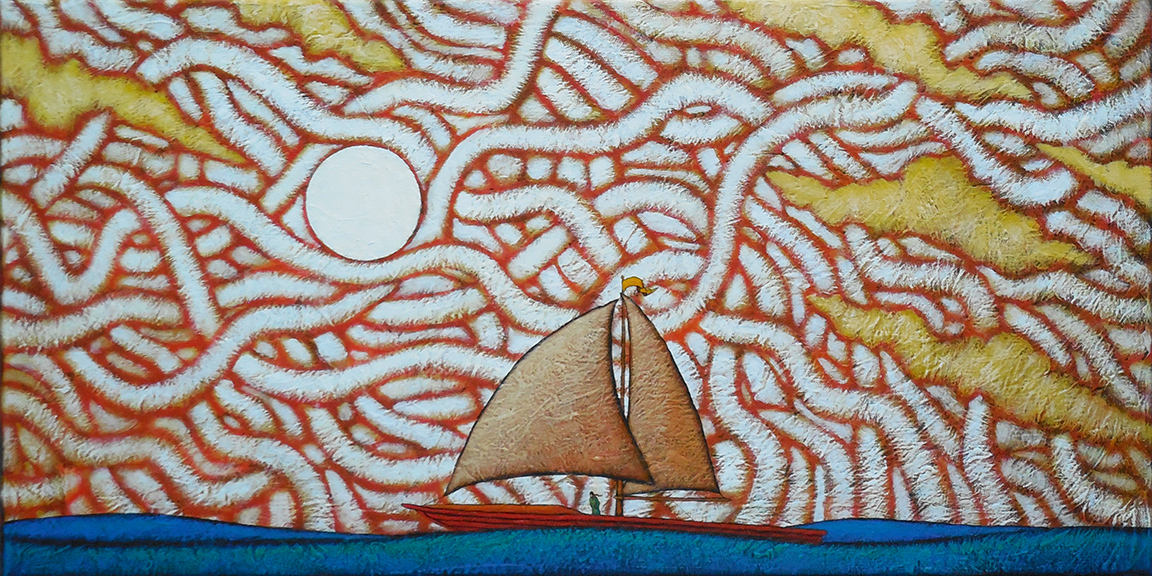
I can’t exactly say why the opening line from the old Procul Harum song came to mind when I was putting the finishing touches on this new painting. It really doesn’t have much to do with the song itself but since that moment that line seems glued to this painting in my mind.
I think it may have to do with the sky here, with the rolls crossing it reminding me both of pinwheels and cartwheels. There’s also something in the tone of this painting that feels a bit like that of the song to me. Unlike some of the other paintings from this show that employ this pinwheel/cartwheel sky, this piece carries more darker undertones. It shows a bit in the image above but is more evident when seen in person.
Even with the reference to the song, this is a painting that very much fits in with the theme of my upcoming Entanglement show at the Principle Gallery that opens two weeks from today, on Friday, June 13. I see the Red Tree here recognizing its relationship with the greater patterns of energy that make up all, understanding that it has descended from it and will eventually ascend back to it.
I’ve spent quite a bit of time glancing at this painting over the past several months. It has the ability to pull me in and hold my attention while creating a deep emotional response within me, a trait I find appealing in any piece of art.
Whether this applies to others as far as this painting is concerned, I cannot say. You can never tell for sure. That’s the beauty and mystery of art.
Now let us listen to that Procul Harum song that inspired this piece’s title. This is A Whiter Shade of Pale from 1967. If you’re of a certain age, you know that this song was radio staple throughout the late 60’s and 70’s and was played at every high school prom in that era. I can’t say for sure, but I think it was required by law.
Give a listen then let yourself out– I have tons to do this morning and need to get to it pronto.
Skip the Light Fandango is 15″ by 30″ on canvas and is included in my exhibit of new work, Entanglement, that opens two weeks from today, on Friday, June 13 at the Principle Gallery with an Opening Reception from 6-8:30 PM. I will also be giving a Painting Demonstration at the gallery on the following day, Saturday, June 14, from 11 AM until 1 PM.
I was raised outta steel Here in the swamps of Jersey Some misty years ago Through the mud and the beer The blood and the cheers I’ve seen champions come and go So if you’ve got the guts, mister Yeah, if you got the balls If you think it’s your time Then step to the line And bring on your wrecking ball
—Wrecking Ball, Bruce Springsteen
Running a little late but wanted to share some Sunday Morning Music. Thought that some Springsteen would be appropriate since he had a bit of a run-in with the creature who now occupies the People’s House. At a show in England, Bruce opened his show by saying that though we were now under the thumb of a corrupt, incompetent, and treasonous administration the America of which he wrote for the better part of the past six decades was still there. His is an America of hard working, hardscrabble, hard luck folks who are decent and caring and are just trying to make their way through this world unscathed.
El Presidente Grande Naranja took umbrage at these remarks and basically threatened Bruce with all the power of the highest office in this land for Bruce exercising his First Amendment rights in his criticism of the administration.
I am not going to get into the whole affair this morning except to say those who threaten our basic rights such as free speech and due process and the institutions that have kept democracy afloat for 250 years are not acting in the best interests of America. A virtual wrecking ball is being smashed into every corner of the American edifice.
And the only response to such an attack is with an even bigger wrecking ball, one of accountability and justice.
That’s all I am going to say. Here’s Wrecking Ballfrom Bruce Springsteen. Some good advice in here: Hold tight to your anger/And don’t fall to your fears.
What we, thanks to Jung, call “synchronicity” (coincidence on steroids), Buddhists have long known as “the interpenetration of realities.” Whether it’s a natural law of sorts or simply evidence of mathematical inevitability (an infinite number of monkeys locked up with an infinite number of typewriters eventually producing Hamlet, not to mention Tarzan of the Apes), it seems to be as real as it is eerie.
-Tom Robbins, The Syntax of Sorcery (2012)
I came across the passage from author Tom Robbins, who died in February at the age of 92, while doing some research. One phrase from it, “the interpenetration of realities,” really jumped out at me. I am not ready to tell you what I was researching or why the phrase struck me as it did. That will be forthcoming and self-evident in the coming weeks.
But I will say that, for some reason, it reminded me of a favorite song, That’s the Way the World Goes Round, from the late John Prine. I think it has something to do with the constancy of the inevitabilities of life– the sun coming up and the sun going down, the tide coming in and the tide going out, the joy and sorrow that comes with living and dying, and so on. They all come to us at some point while this old world just keeps turning round.
That doesn’t really answer anything about the interpenetration of realities, does it? All I’ll say is that it made me wonder if the rhythms of our life cycles are modulated by other dimensions or worlds of reality that we may never know. Do they serve as a sort of unseen natural force, much like gravity, that keeps on track?
I don’t know. But rereading that just now makes me wonder if there was a little something extra in my coffee this morning.
I think I’ll just leave it there for now and share the song with the promise that I will sometime soon explain how the interpenetration of realities comes into play. Well, that is if I don’t forget…
We cast a shadow on something wherever we stand, and it is no good moving from place to place to save things; because the shadow always follows. Choose a place where you won’t do harm – yes, choose a place where you won’t do very much harm, and stand in it for all you are worth, facing the sunshine.
–E.M. Forster, A Room With a View
Choose a place where you won’t do harm…
Man, that sounds like advice coming to us from a distant time and place. So much so that it seems almost quaint, almost to the point where many of us do exactly the opposite, choosing places where we can do nothing but harm.
I know this is nothing new. There has always been a streak of malice and vindictiveness within our character. We would often rather sacrifice to harm others rather than to help them.
That’s part of the dark shadow that follows us, obscuring what little remains of our empathy. Not sure why I am writing this this morning, outside of the utter disappointment I sometimes feel in the choice many make to turn away from the sunshine of compassion and live in the deep shadows that are devoid of it.
Actually, this all started when I came across an old blog post that had a Johnny Cash performance of a Loudon Wainwright song, The Man Who Couldn’t Cry. Simply put, it’s a song about a man who lived a life without feeling. This performance is from a time when Johnny Cash was just beginning to reinvent himself, having become irrelevant, seen as a relic of country music’s past. He couldn’t get airplay for his music. He decided to make music that was out of the box.
It is written that though he was a legendary performer, he was terrified for this show as it was one of the first times he had played alone on stage without a backing band. Just a man and his guitar. I like that story, that this man who headlined around the world and had throngs of adoring fans felt the need to move ahead with deeply personal work that was meaningful and often raw. That it meant so much to him that he felt exposed, that he was nervous and afraid.
He chose a place where he wouldn’t do very much harm, and stood in it for all he was worth, facing the sunshine.
A bitter wind blows through the country A hard rain falls on the sea If terror comes without a warning There must be something we don’t see What fire begets this fire? Like torches thrown into the straw If no one asks, then no one answers That’s how every empire falls.
— R.B. Morris, That’s How Every Empire Falls
I had a post here about eight years ago featuring a song performed by John Prine, That’s How Every Empire Falls. In recent days, that particular post has garnered quite a few views. I sometimes find it interesting how the number of views for certain posts from the past jump upward with what is taking place in the world at any given moment.
For example, a post from 2011 titled Then Who Do We Shoot? which was about the film The Grapes of Wrath has spiked upward in recent weeks. The title of that post referred to a question in the film asked by the sharecropper Muley to the bank’s henchmen who were evicting him from his family farm. Muley wanted to know who could be held responsible and the bank guys gave him the big runaround, saying that nobody was to blame, that all the people involved were just obeying orders and doing their jobs.
It seemed pertinent to this moment in time. As does the post with That’s How Every Empire Falls. Written in the early 2000’s by singer/songwriter R.B. Morris, it is a song that feels prophetic now, nearly 25 years later.
It is a simple but elegant song consisting of five stanzas, the first four describing some sort of moral compromise or failing. The first is man who is fleeing his past and the decisions he made that went against what he knew to be right. The second describes how religion is twisted in ways by men to serve their own purposes. The third is about alienation and estrangement within families and how love is often withheld. The fourth is about a man whose job requires him to do things that are morally wrong even though they may be legally correct, using the I’m Just Obeying Orders defense as justification for his actions.
The fifth and final stanza brings it all together though in the current environment it might be viewed as additional moral failing, as an indictment of the media’s failures in holding people’s feet to fire, opening the door for a growing normalization and acceptance of corrupt and criminal behavior across government and society. As the final lines say:
If no one asks, then no one answers That’s how every empire falls.
It’s a powerful yet delicate song. Our democracy might also be viewed in the same way. It’s held together with little more than shared belief, so much so that accepting even a little moral sloppiness can allow it to come apart. When we ignore or shrug off the moral and ethical bankruptcy that is unveiling before us, we have all but thrown in the towel on our democracy.
That’s how every empire falls.
Below is the song in its original form performed by R.B. Morris. I think its starkness is its power. The lyrics are below if you want to read along.
Caught a train from Alexandria Just a broken man in flight Running scared with his devils Saying prayers all through the night Oh but mercy can’t find him Not in the shadows where he calls Forsaking all his better angels That’s how every empire falls
The bells ring out on Sunday morning Like echoes from another time All our innocence and yearning and sense of wonder left behind Oh gentle hearts remember What was that story? Is it lost? For when religion loses vision That’s how every empire falls.
He toasts his wife and all his family The providence he brought to bear They raise their glasses in his honor Although this union they don’t share A man who lives among them Was still a stranger to them all For when the heart is never open That’s how every empire falls
Padlock the door and board the windows Put the people in the street “It’s just my job,” he says “I’m sorry.” And draws a check, goes home to eat But at night he tells his woman “I know I hide behind the laws.” She says, “You’re only taking orders.” That’s how every empire falls.
A bitter wind blows through the country A hard rain falls on the sea If terror comes without a warning There must be something we don’t see What fire begets this fire? Like torches thrown into the straw If no one asks, then no one answers That’s how every empire falls.
And they’re only going to change this place By killing everybody in the human race They would kill me for a cigarette But I don’t even wanna die just yet
There has to be an invisible sun It gives its heat to everyone There has to be an invisible sun That gives us hope when the whole day’s done
–Invisible Sun, The Police, 1981
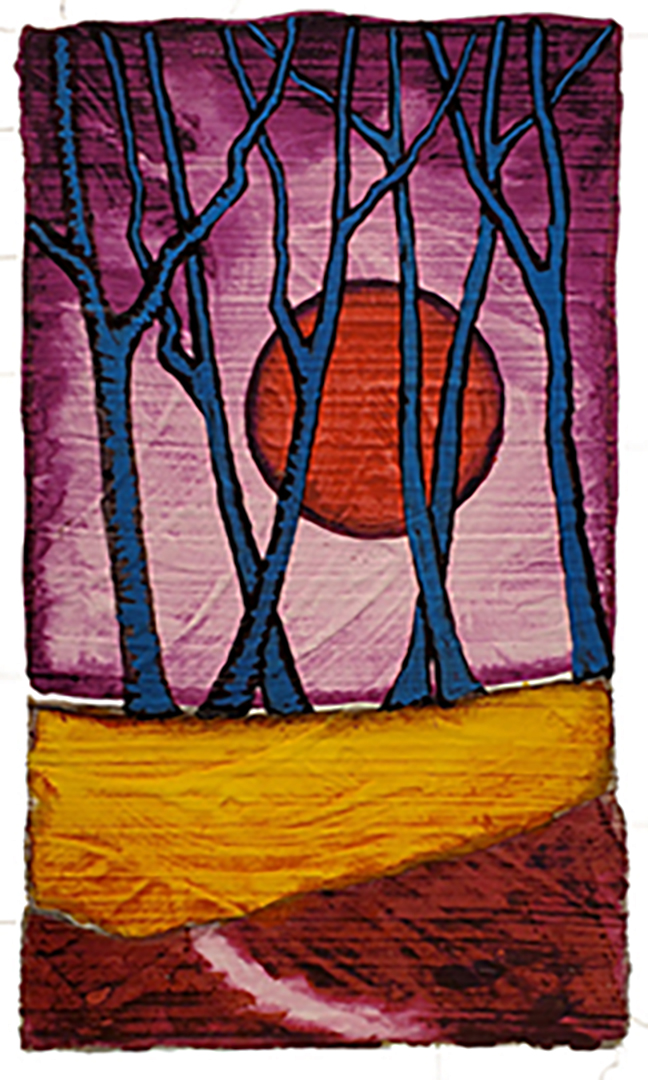
After finishing this new small painting, it reminded me of something but I couldn’t figure out what. I wanted to find the connection so that it might help me find a title for this piece. That’s how I often title my work, from subtle — and some not so subtle– nudges coming from the work that spark loose connections in my mind.
Was it something I saw or read? Was it because of the red sun? It bugged me for a while but I finally let it go and just worked from what I was seeing.
The red of the sun here made me think that it was not normal, that it had a significant difference for those that saw it. The way it was partially obscured by the trees made me think it was trying to remain unseen, as though it were not for everyone’s eyes.
A secret sun? That’s pretty much how the title to this small painting, A Secret Sun, came about.
But that first reminder of something I couldn’t put my finger on still vexed me. I carry bunches of these vexing little questions around in my head– names, faces, movies, songs, books, and so on that I can’t quite remember. Every so often I will be painting or doing something else, maybe making my way through the woods to the studio in the morning, and suddenly the answer to one of these questions pops into my head.
The initial question and everything around it seems suddenly clear. I sometimes yell out, “That’s it!” like I’m Charlie Brown after the psychiatrist Lucy asks if might be suffering from pantophobia, the fear of everything.
Just remembering the answer one simple and sometimes stupid questions that naggingly lingers in my mind is as satisfying a thing as I can’t think of at the moment. I will probably think of something else later and will be equally pleased then.
Just the other day, the connection that couldn’t recall to this little painting, suddenly came to mind. It was an old Police song, from their 1981 Synchronicity album. It was a favorite album back in the day but one that I hadn’t heard fully in many years. The song was Invisible Sun. which was about a sun we couldn’t see but gave us warmth and hope.
It fit perfectly with what I was seeing in this painting. It seems today that we almost need a secret sun to keep us warm and hopeful as the one that we all can see now gives us heat but not much hope.
And maybe that secret sun is not even a sun. Maybe it is something else that fills us with hope but goes unnoticed by many others?
I don’t know. That question will nag at me, no doubt. But I feel pretty good about getting the one about A Secret Sun out of my head.
Here’s the original Police song, Invisible Sun.
A Secret Sun is 3″by 5″ on paper and is now hanging with the Little Gems exhibit at the West End Gallery. The show opens with a reception on Friday, February 7 but the work is up and available for previews and presales.
Me, my thoughts are flower strewn With ocean storm, bayberry moon I have got to leave to find my way Watch the road and memorize This life that pass before my eyes And nothing is going my way The ocean is the river’s goal A need to leave the water knows We’re closer now than light years to go
–R.E.M., Find the River, 1992
Sunday morning. Cold and dark. Tired. Maybe that’s the wrong word. More like fatigued, if there is any actual difference. Just feel all out of rhythm in a lot of ways. One of those periods where everything mechanical or electronic that I touch seems to react erratically to me. Just inserting the verse above from the R.E.M. song that I am going to pay for this week’s Sunday Morning Music took about fifteen minutes as the site would freeze up and then wouldn’t format properly.
The fatigue, the frustration, the lack of rhythm– it all builds up and you feel as though you’ve strayed off your path a bit. A little disoriented and feeling somewhat lost. You look for something that gets you back on that path, some landmark or something you can follow that you know will cross your intended path somewhere down the line. Maybe a stream or river.
Something that moves, flows. Something with a rhythm. It might not be yours but maybe it will lead you to yours once again.
I’ve followed it before and found my way back. Many times. It gets harder as I age, as though the wear and tear of this process of recovering my path saps a little more each time. But even as I feel a bit more tired and achy, just knowing the drill, understanding that there is a way through, is sustaining.
So, I tell myself that today is the day I break through, the day I put my feet back on that path from which I had strayed. And maybe today really is the day in which I am not deceiving myself again.
I hope so.
I know that if it is the day, this funk will dissipate in a poof! and even the memory of it will quickly fade. One of the benefits of having experienced this before is that there’s a mechanism that washes away much of the memory of being lost. Oh, I remember but, having found the river once again, its flow has quickly carried me far downstream away from it. It remains in the rearview.
Give a listen to R.E.M. and their song Find the River from their 1992 album Automatic for the People.
Me? I have to run. I just know that that river is just ahead for me. Let yourself out, okay?
Our American character is marked by a more than average delight in accurate perception, which is shown by the currency of the byword, “No mistake.” But the discomfort of unpunctuality, of confusion of thought about facts, of inattention to the wants of to-morrow, is of no nation. The beautiful laws of time and space, once dislocated by our inaptitude, are holes and dens. If the hive be disturbed by rash and stupid hands, instead of honey, it will yield us bees.
–Ralph Waldo Emerson, Prudence (1841)
Just going to share the words of Emerson, the image of a recent painting, and a song that will serve as this week’s Sunday Morning Music. It’s a song that I was surprised to learn was last shared here over ten years ago. I always think that I just recently shared it. Maybe because it so often feels appropriate to the time.
The song is What’s Going Onfrom Marvin Gaye. It is from his 1971 album of the same title that is considered by many as one of the greatest albums of all time. This is a poignant and elegant song of protest that was written by a member of The Four Tops, Renaldo “Obie” Benson, who witnessed a violent confrontation between police and anti-war protesters in Berkeley in April of 1969, while on the band’s tour bus. He couldn’t understand what he was seeing, why the police were brutally beating on those kids, kids much like those being sent every day to fight in Viet Nam. It made no sense to him, and he ended up writing this song based on what he witnessed with Motown songwriter Al Cleveland.
His bandmates vetoed recording the song, saying that they didn’t want to record a protest song. Benson later spoke of his response, saying, “My partners told me it was a protest song. I said ‘No, man, it’s a love song, about love and understanding. I’m not protesting. I want to know what’s going on.’“
It’s a great song, mixing great emotional impact with a cool, rational detachment that seeks a calm response to the question, “Why?”
What is wild cannot be bought or sold, borrowed or copied. It is. Unmistakeable, unforgettable, unshamable, elemental as earth and ice, water, fire and air, a quintessence, pure spirit, resolving into no constituents. Don’t waste your wildness: it is precious and necessary.
–Jay Griffiths, Savage Grace: A Journey in Wildness
I had a procedure at a doctor’s office this past week. As I sat there waiting for him to come in, there was music playing. It was modern country music. There wasn’t much to focus on, so I listened more intently than I might have done otherwise. The doctor was running behind schedule and I ended up listening to four songs. I am not saying it was bad or anything like that. It was just nothing. The sound was pleasing but bland. Unmemorable. The lyrics said little if anything. The first two I heard could have been the same song in many ways. It all reminded me of some awful AI concoction.
I was still a bit prickly from the events of last week and the music began to grind on my nerves. I could feel my blood pressure rising. After the fourth song, his assistant came in to let me know he was behind schedule and asked if I wanted to listen to something different.
I said that I did. When she asked what, I said immediately Nina Simone. She instructed the Alexa there to play Nina Simone and when the first notes from her piano slowly began asked if that was right. I assured that it was correct and she left me alone to listen.
The song was Wild is the Wind. I couldn’t have asked for a better song in that moment in that sterile doctor’s office at the end of a perfectly awful week. It captured my mood perfectly. I could feel an easing within me as I sat there. A heavy sigh came forth.
The contrast between that song and the stuff I had heard before was stark. This song had a rawness of emotion and a uniqueness and human touch that the other songs seemed to be lacking. As I said, the others felt to me as though they were created by AI.
Contrasted against the dullness of their conformity, Nina’s song felt like a rebellion of the spirit. Though it is not upbeat and has a sense of loss to it, it did feel wild and free in that moment. The other music, on the other hand, felt boxed in and constrained. No wildness, no freedom.
There seemed to be an analogy there to what I sensed has been happening here in this country. The sense of loss is for that wildness of spirit that seems to be leaking away, being rejected and replaced by uniformity of belief, thought, and action.
Maybe there is no analogy to be had. But for a moment I felt inspired at a moment that was uninspiring in every other way.
Maybe that is the purpose of art — if there is any at all.
Something to think about this morning. Here’s Nina Simone and her version of Wild is the Wind.






 Redtree Times