As I thought of these things, I drew aside the curtains and looked out into the darkness, and it seemed to my troubled fancy that all those little points of light filling the sky were the furnaces of innumerable divine alchemists, who labour continually, turning lead into gold, weariness into ecstasy, bodies into souls, the darkness into God; and at their perfect labour my mortality grew heavy, and I cried out, as so many dreamers and men of letters in our age have cried, for the birth of that elaborate spiritual beauty which could alone uplift souls weighted with so many dreams.
—William Butler Yeats, Rosa Alchemica
In this passage from the beginning of Rosa Alchemica, Yeats describes the driving force behind his search for that driving force of alchemy that has not only the purported ability to transform lead into gold but can also in the same manner transform and elevate the human spirit above that of the ordinary and mortal. A search for the essence of the spirit. The alchemy within ourselves.
Though humans have searched diligently for such a thing since ancient times, I don’t know that such an ability truly exists. But as Yeats’ words indicate, one long look into the night sky makes it easy to see why one would want to believe that such a thing is possible.
With the sky filled with a universe of wonder and the promise from distant stars and worlds, why wouldn’t we think we had the ability to transform and elevate ourselves and our lives? Or our world?
Maybe that’s the driving force behind the creative arts, an attempt at some crude alchemical transformation of the ordinary into something more, something greatly enriched with the essence of the human spirit.
Maybe. I look out the window at the morning light beginning to filter through the trees and think to myself: Why not?
It’s time to get to work on my own small attempts to achieve an alchemy of some sort. Perhaps today is the day that unlocks the secret?
Who knows? Why not?
This morning, I am sharing a video of an acoustic instrumental cover of I’d Love to Change the World, originally from Alvin Lee and Ten Years After. This is from a musician, Johnny Thompson, busking with his guitar on the street in Costa Rica. His YouTube channel has covers as well as his own originals. Though there are a few spots of wind noise, I like this performance very much.
Doubt is not a pleasant condition, but certainty is an absurd one.
–-Voltaire, letter to Frederick II of Prussia in 1767
It’s one of those mornings. I am filled with uncertainty and the idea of focusing on writing something seems like an unbearable burden. I would rather get to a painting I am working on that will be included in my annual June solo exhibit at the Principle Gallery. That’s where the uncertainty sets in.
I am in the midst of a group of new work that is really hitting the mark for me on all levels. Oddly enough, that’s where the problem begins. My strong positive reactions are triggering equally strong feelings of doubt. It sounds crazy, I know, but the idea of certainty– my own or others– almost always raises my anxiety levels, especially when it comes to my work.
Trying to balance these two polar opposites– doubt and certainty–results in times when one prevails. This morning, doubt wins the day. After I begin to work, certainty will make a mighty comeback. And after my painting day is done, the two will wrestle until I drift off to dreamland.
All in all, it’s often an uncomfortable existence bouncing between the unpleasant and the absurd conditions, as Voltaire called them.
I sometimes wish for absolute certainty. It seems like it would be satisfying to believe that your every word, action, opinion, and belief were absolutely correct. But we’ve seen where the extreme nature of that kind of certainty has taken us. I sometimes think the great divide between people is one of those who sometimes feel doubt and those who always feel absolute certainty.
Well, for someone who didn’t want to write this morning, I seem to have done quite a bit when all I wanted to do was write few words to share the post below that first ran here in 2014. FYI, I am not ready to share my new work yet but will start showing it in the coming weeks–on a day when I am more certain of things.
Much of my work seemingly has a journey or a quest as its central theme. But the odd thing is that I don’t have a solid idea of what the object is that I am seeking in this work. I have thought it was many things over the years, things like wisdom and knowledge and inner peace and so on. But it comes down to a more fundamental level or at least I think so this morning. It may change by this afternoon.
I think I am looking for an end to doubt or at least coming to an acceptance of my own lack of answers for the questions that have often hung over us all.
I would say the search is for certainty but as Voltaire points out above, certainty is an absurd condition. That has been my view for some time as well. Whenever I feel certainty coming on in me in anything I am filled with an overriding anxiety.
I do not trust certainty.
I look at it as fool’s gold and when I see someone speak of anything with absolute certainty–particularly politicians and televangelists– I react with a certain degree of mistrust, probably because I see this absolutism leading to an extremism that has been the basis for many of the worst misdeeds throughout history. Wars and holocausts, slavery and genocide–they all arose from some the beliefs held by one party in absolute certainty.
So maybe the real quest is for a time and place where uncertainty is the order of the day, where certainty is vanquished. A place where no person can say with any authority that they are above anyone else, that anyone else can be subjugated to their certainty.
To say that we might be better off in a time with such uncertainty sounds absurd but perhaps to live in a time filled with absolute certainty is even more so.
The sole art that suits me is that which, rising from unrest, tends toward serenity.
–André Gide, journal entry, November 23, 1940
The journal entry above from Nobel Prize-winning author André Gide very much speaks to me. Though it serves many purposes for me, I tend to view my work as a means of absorbing and acknowledging the anxieties and pressures that this world often presses upon us, dampening their effects, and then moving, to use Gide’s term, toward serenity.
The darker aspects of the world are still there, an underlying presence that creates a contrasting tension, a counterpoint that serves as a starting point from which serenity and other aspects of light can build.
I am talking about the emotional tone of the work here, but it also roughly describes my actual painting process. Much of my work starts with a dark surface on which light and brightness is built.
Even my work with transparent inks that is more watercolor-ish in nature employs a process where a darker layer of ink is first applied. almost as a dark puddle on a light– usually white and prepped with layers of gesso– surface. This layer, this puddle of ink, is then little by little removed, each deduction revealing more and more light from the underlying surface.
From darkness comes light…
Let’s have a tune this morning. The song is I See a Darkness. It’s one I have played a couple of times over the years, once by Will Oldham (aka Bonnie “Prince” Billy) who wrote and originally recorded it and the other as covered by Johnny Cash, from the American Recordingsperiod late in his life. His work from this time, when his scarred voice carried his age and emotion so eloquently, is potent stuff.
Light coming from darkness…
I think this part of its chorus fittingly applies to today’s post and to life in general:
Oh, no, I see a darkness. Did you know how much I love you? Is a hope that somehow you, Can save me from this darkness.
Madness is a special form of the spirit and clings to all teachings and philosophies, but even more to daily life, since life itself is full of craziness and at bottom utterly illogical. Man strives toward reason only so that he can make rules for himself. Life itself has no rules. That is its mystery and its unknown law. What you call knowledge is an attempt to impose something comprehensible on life.
–Carl Jung, Liber Novus
An attempt to impose something comprehensible on life…
That sounds like a pretty tall task, given the sheer lack of logic and reason it so often displays. It also sounds like the way artists and writers often describe what they are trying to find in their work– an understanding of what is and isn’t. A revealing of the possibility of that which we cannot see and a new perspective on that which we can.
And in doing so, make their own rules while discarding others. Whatever it takes to make sense of the insensible. Using the illogical to find some sort of logic.
That makes sense in a world that seldom moves in a straight line.
Where that takes us, I don’t know. As an artist– if that is what I am– following that twisting and turning line to some sort of end is the mystery and the thrill of it.
Pretzel logic.
And like a pretzel, following its line always brings us back to where we began. Do we know any more at that point?
Who knows?
Maybe that’s the whole point, to let us know that we can’t know what we can’t know. That we must embrace the mystery.
Sounds good. But, of course, that is the result of some pretzel logic.
Okay, that was a long way around the pretzel to get to this week’s Sunday Morning Music. Here is Steely Dan and Pretzel Logic.
But, of course, you knew that, right? Can’t fool you guys…
A great wind is blowing, and that gives you either imagination or a headache.
–Catherine the Great (1762-1796), Letter to Baron Friedrich von Grimm (29 Apr 1775)
Doing a quick search this morning, I couldn’t find the entirety of the letter from Catherine the Great that contained the quote above, so I don’t know the exact context. I don’t know what was that wind to which she referred. It might have been the stirrings of the American Revolution or, more likely, the spread of the progressive ideas of the Enlightenment that she was trying to introduce to the Russian people.
Whatever the case, when the great winds of change come, one can choose to see the new possibilities that lay beyond and navigate toward this new horizon of opportunity. That’s the imagination part, I dare say.
Or one can just see one’s resistance to the winds be pummeled into acceptance. To finally let the wind blow you wherever it wants to take you and do whatever it will regardless of one’s desires. Hopeless and powerless, to end up as flotsam on the never-ending waves.
I would venture that this might be the headache. It sounds like a headache to me.
That’s all I am going to say this morning. Just liked that quote from the Empress Cathy and thought it might fit with the painting at the top. Or maybe not. Does it matter?
The painting by the way, Sea of the Six Moons, is currently hanging at the West End Gallery as part of their annual Little Gemsexhibit. The show ends tomorrow, Thursday, March 13, so if you want to catch this always wonderful show, please get in today or tomorrow.
Here’s a song that may or may not fit alongside today’s painting and quote. I played it here four years back and it just hit a chord with me this morning. It’s The Dolphinsfrom Fred Neil, who was best known for writing Everybody’s Talkin’that was made popular by Harry Nilsson and its prominent connection to the film, Midnight Cowboy. I was going to play one of the covers of it that have been made, such as those by Linda Ronstadt, Tim Buckley, or Harry Belafonte, but I find that Neil’s original suits me best.
The first progressive step for a mind overwhelmed by the strangeness of things is to realize that this feeling of strangeness is shared with all men and that human reality, in its entirety, suffers from the distance which separates it from the rest of the universe.
–Albert Camus, The Rebel: An Essay on Man in Revolt (1951)
I live a pretty isolated existence so I can’t speak for everyone, but it seems like a lot of people are feeling alienated by the jumbled strangeness that is taking place. It’s an overwhelming sense that the landscape around you as well as the people within it and their customs are foreign to you, that you somehow don’t fit in.
It’s a sense of feeling like a stranger in a strange land, to use that term that descended to us from Moses in the book of Exodus and its later use as the title for the sci-fi classic from Robert Heinlein. It’s a term I’ve employed a number of times through the years to describe the sense of alienation with which I have sometimes struggled.
I have to admit that this feeling is in air around me in recent times. However, this sense that many others may well be experiencing that same sense of estrangement from an existence that once felt naturally homelike makes me believe, like the words at the top from Camus, that there is a progressive step, a way forward from this, at least for us as a group.
Though it overwhelms our minds now, we have to understand that the reality that we observe in this moment does not have to last forever. And because there are so many of us feeling this new sense of strangeness, it will not.
That’s just my feeling this morning. There may not be anything instructive in it. But it perhaps it can provide some comfort, as strangers in this strange land, knowing that beyond the now alien emptiness around us there are others who are looking up at those same seven moons, wondering as I do how they came to be and if they will always be there.
Here’s song that sprang to mind just now. Actually, the lines from the chorus:
Nobody told me there’d be days like these Strange days indeed Most peculiar, mama
It’s Nobody Told Me from John Lennon, recorded near the end of his life and released several years after his murder.
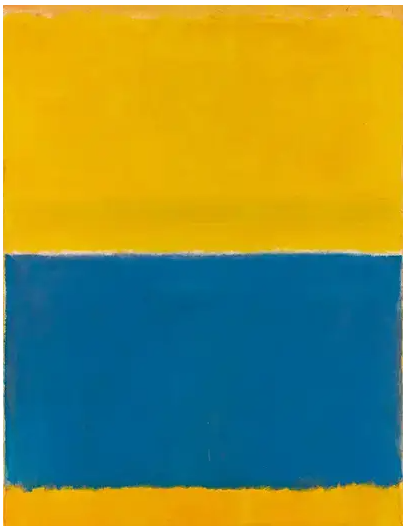
“You might as well get one thing straight. I’m not an abstractionist… I’m not interested in the relationships of color or form or anything else. I’m interested only in expressing basic human emotions—tragedy, ecstasy, doom and so on. And the fact that a lot of people break down and cry when confronted with my pictures show that I communicate those basic human emotions… The people who weep before my pictures are having the same religious experience I had when I painted them. And if you, as you say, are moved only by their color relationships then you miss the point.”
― Mark Rothko, 1956 Interview with Selden Rodman
I used a representation yesterday of the colors of the flag of the Ukraine that was actually a detail, shown above, taken from the large Mark Rothko painting shown at the top. I had used this detail before in a post around this time in 2022, one which drew a lot of attention yesterday. Enough so that I went back to check out that post which I am sharing again today as the quotes in that post from Rothko speak so clearly to a lot of things that I have been focusing on recently, on both this blog and in my work.
And since it is Sunday, I am also sharing some Sunday Morning Music at the bottom. In light of what is taking place in this country, the calming effect of Gnossienne No. 1 from Erik Satie seems like the right choice to accompany Rothko as Satie’s work followed similar paths of deep expression and silences. The version I am sharing is a mesmerizing performance from celebrated Finnish guitarist Otto Tolonen.
Busy morning ahead with painting and plowing from what I hope is the last snowfall of this winter. But I thought I would share a Mark Rothko painting (the image at the top is only a detail of its lower section- the whole painting is shown here on the left) and a video on it from Sotheby’s auction house (where it sold for $46.5 million in 2015) along with several Rothko quotes.
Rothko (1903 -1970) was a big influence on my early work. The idea of expressing the big human emotions through simplified forms and color really spoke to me because I never looked at painting as a craft but more as a means to express those forms of emotion that well up inside because they are sometimes too difficult to express in words and voices.
Another aspect that attracts me to Rothko is that he, like Kandinsky, was often eloquent in speaking about his work and art in general. And in those words I found that my own already developed perspectives often largely meshed with and echoed both of these artists’ words and views.
For example, in the quote below the idea that a picture lives by companionship is one that is central to my work.
“A picture lives by companionship, expanding and quickening in the eyes of the sensitive observer. It dies by the same token. It is therefore risky to send it out into the world. How often it must be impaired by the eyes of the unfeeling and the cruelty of the impotent.”
Here a few more that also speak to me, things I have often written about here, about the need of emotional expression in art and of the searching for silence.
“It is the poet and philosopher who provide the community of objectives in which the artist participates. Their chief preoccupation, like the artist, is the expression in concrete form of their notions of reality. Like him, they deal with the verities of time and space, life and death, and the heights of exaltation as well as the depths of despair. The preoccupation with these eternal problems creates a common ground which transcends the disparity in the means used to achieve them.”
“When I was a younger man, art was a lonely thing. No galleries, no collectors, no critics, no money. Yet, it was a golden age, for we all had nothing to lose and a vision to gain. Today it is not quite the same. It is a time of tons of verbiage, activity, consumption. Which condition is better for the world at large I shall not venture to discuss. But I do know, that many of those who are driven to this life are desperately searching for those pockets of silence where we can root and grow. We must all hope we find them.”
The aim of every artist is to arrest motion, which is life, by artificial means and hold it fixed so that a hundred years later, when a stranger looks at it, it moves again since it is life. Since man is mortal, the only immortality possible for him is to leave something behind him that is immortal since it will always move. This is the artist’s way of scribbling “Kilroy was here” on the wall of the final and irrevocable oblivion through which he must someday pass.
–William Faulkner, Paris Review interview (1958)
Faulkner perfectly captures something I have been writing about here for years, the urge to leave something behind as evidence of your onetime existence in this world. It’s the driving force behind creation of all sorts, from human procreation to multiple forms of artistic expression, from the caves of Lascaux to the Sistine Chapel to the simplistic image of Kilroy left all over the world by American soldiers in WW II. Graffiti, which might be the purest form of saying I was here, has been around as long as mankind.
For the artist, it is an act of faith that your work will somehow survive into the future. You can never know with any degree of certainty. Oh, it may well make its way into museums or collections that span generations. It might well exist.
But will it be truly seen? Will it stay relevant, will its voice clearly speak in the future? Will it still maintain its movement, its life?
This idea of relevance– or rather irrelevance– is not a concern that only applies to the future for the artist. As an artist, after decades of creating work, I often question the relevance of my work at any given moment. Is it alive in this present, let alone the future?
I don’t know that you can fully know the answer to that question for anyone but yourself. Your relevance, now or a hundred years in the future, is not something you have a lot of say in.
The best you can do is to focus only on creating something that feels alive now. If it captures the motion, the feeling, the voice, and the humanity of our existence, it might well escape oblivion and might make its presence known in the future.
If it does, great. If not, you at least created something for this moment in time. And that’s great in its own right.
I chose the painting at the top, The Resistance— currently part of the West End Gallery’s Little Gems show– not only because of the obvious motion of it but because so much of what we do as humans is comprised of acts of resistance, of fighting to be heard or not relegated to some form of oblivion, one where we have no control over who and what we are.
I guess that could be applied to creating unique work, as well. Here’s a performance that I shared here several years ago. It is Ukrainian guitarist Nadia Kossinskaja performing an Asor Piazzolla composition, Oblivion. Felt like it went well this painting this morning.
What if culture itself is nothing but a halt, a break, a respite, in the pursuit of barbarity?
–Slavoj Žižek, Living in the End Times
This is another new small painting (only 2″ by 4″!) that is included in the Little Gems show now hanging at the West End Gallery. It’s called On the Lake Road. The first thing that came to mind for me was that it reminded me of the feel of the some of the roads that run around the edges of the lakes here in the Finger Lakes region of NY, especially in the summer when the roads are filled with summer residents and vacationers all seeking a pastoral break from their regular lives. There’s an almost palpable feeling of ease as you drive on those roads with the lake right there with you amid the quaint summer cottages.
I saw that feeling in this piece and named it accordingly.
While looking for a literary bit to pair with it, I came across this quote from Slovenian philosopher Slavoj Žižek and it stopped me in my tracks. It made me wonder if our natural instinct as a species was one of barbarity and if art was one of the few things that kept from fully following that instinct.
Were all forms of art just a means to stifle our barbaric impulse? Is it meant to remind us that we have another option beyond our inborn tendency toward cruelty, selfishness, and tribalism? Does it exist to let us know that, though it is naturally within us, we have ability to reject that instinct and instead choose compassionate kindness?
I don’t know. I am sure there all sorts of examples and differing definitions of art that contradict this but sitting in the dark in the computer screens glow at 5 AM, it sounds plausible. After all, so much great art in all forms has come from times when we were battling our own barbarity, often offering us another vision of what might be. And I believe we might find that the barbarians among us, those who are without empathy and compassion, also have no room in their life for art.
I might expand the old saying musichas charms to sooth the savage breast (which, by the way, goes back to the first line from the 1697 play The Mourning Bride by William Congreve) to include all forms of art.
Can even a small painting like On the Lake Roadserve as a levee against our potential floods of barbarity?
Maybe. I would like to think so.
Here’s a song I’ve loved for many years now from the legendary bluegrass duo of Flatt & Scruggs. This is their cover of a Bob Dylan song, Down in the Flood.
In a time of sceptic moths and cynic rusts, And fattened lives that of their sweetness tire In a world of flying loves and fading lusts, It is something to be sure of a desire.
Lo, blessed are our ears for they have heard; Yea, blessed are our eyes for they have seen: Let the thunder break on man and beast and bird And the lightning. It is something to have been.
–G. K. Chesterton, The Great Minimum (1917)
The new small painting at the top is titled Cloud Flyer and is now at the West End Gallery as part of their annual Little Gems exhibit. I showed my work for the first time ever at their first Little Gems show back in 1995. The show has proven to be one of their most popular shows every year since. I know it’s one of mine, both in painting for it and seeing the small work of the other artists.
It seems to go against logic but there seems to be something freeing in painting on a small scale. Maybe it’s because it feels less daunting facing a small unintimidating surface than being confronted with the broad blankness of a large canvas.
Or maybe because of the size there is only one take, to use a movie term. There are no preliminary sketches or studies. I know many artists who work in a 3-step process of first creating a small loose study then transfer it to a slightly larger version that is a bit tighter in its painting. They then attempt to transfer everything they have gleaned from the first two studies to a large and totally finished final painting. With few exceptions, when I get to see all the stages of a painting done in this way, the first sketch is generally the most alive of the three. It is fresh and free and, unlike the later stages, not trying to recapture something that may have been unintended when it emerged. The final painting often ends up feeling like a copy of something else other than what it is.
I don’t work that way. My belief has been that every painting ends up being a rehearsal for the next. Therefore, you should strive to paint each piece, no matter its size or significance, in the same manner. I think it creates consistency in the quality of the work, something that transcends its size. I feel that every small piece I have done for all the Little Gems shows over the years is a work unto its own.
That’s certainly how I feel about this small painting. It has things in it that I know I would be hard-pressed to recreate it on a larger scale and still maintain the original unique feel of this one. An angle here or there would be off, the composition and colors would be altered in some way, and it might feel a little stilted. Contrived. It wouldn’t be the same. And for me, that’s the way it should be.
This piece has its own life and a sense of freshness. This was one of the first pieces I worked on for this show and I can’t tell you how much I springboarded off the energy this little guy provided. It was like a little jolt of lightning hitting me at a time when I needed it.
That’s the reason I chose the section from the G.K. Chesterton poem, The Great Minimum, at the top. That final line– And the lightning. It is something to have been. — just kills me. The rest of the poem, as I read it, is about the small joys of being alive, how each small thing brings value to this world, and nothing is insignificant.
Little things mean a lot.
Of course, I could be wrong. We all read things differently with our own set of filters and desires for what we want to see and hear.
For me, it fits this painting. And this exhibit.
Below is a version of the poem performed as a song by the Nicole Ensing Band. I liked this better than some of the dryer straight recitals of it. They do a nice job with it. Below that is the whole poem if you would like to read along.
The Great Minimum
It is something to have wept as we have wept, It is something to have done as we have done, It is something to have watched when all men slept, And seen the stars which never see the sun.
It is something to have smelt the mystic rose, Although it break and leave the thorny rods, It is something to have hungered once as those Must hunger who have ate the bread of gods.
To have seen you and your unforgotten face, Brave as a blast of trumpets for the fray, Pure as white lilies in a watery space, It were something, though you went from me today.
To have known the things that from the weak are furled, Perilous ancient passions, strange and high; It is something to be wiser than the world, It is something to be older than the sky.
In a time of sceptic moths and cynic rusts, And fatted lives that of their sweetness tire, In a world of flying loves and fading lusts, It is something to be sure of a desire.
Lo, blessed are our ears for they have heard; Yea, blessed are our eyes for they have seen: Let thunder break on man and beast and bird And the lightning. It is something to have been.





 Redtree Times