Feeds:
Posts
Comments

Posts Tagged ‘Painting’

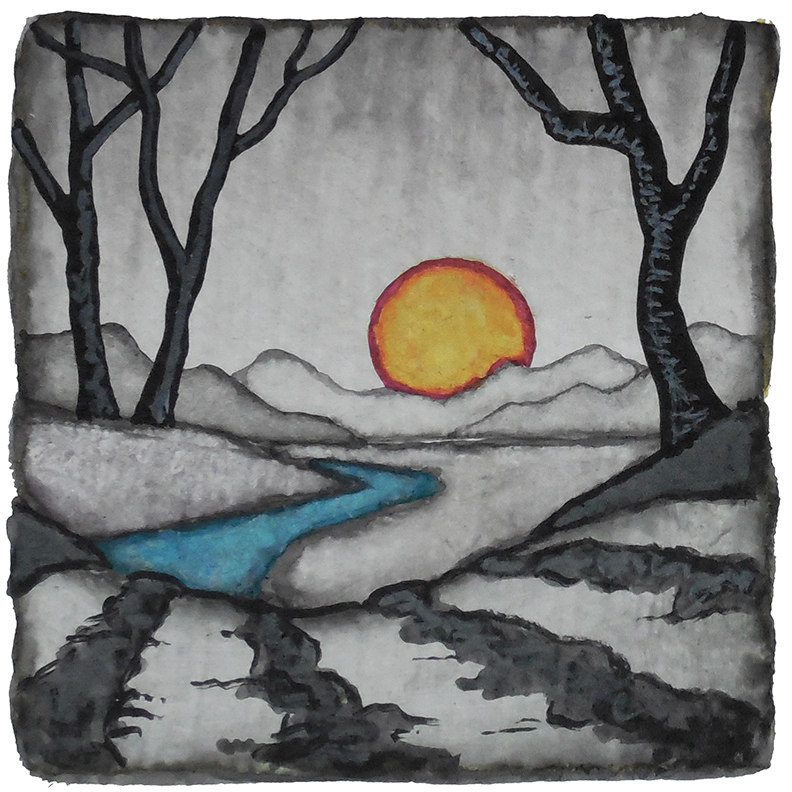
Blue Flow– At West End Gallery


“To overcome the anxieties and depressions of contemporary life, individuals must become independent of the social environment to the degree that they no longer respond exclusively in terms of its rewards and punishments. To achieve such autonomy, a person has to learn to provide rewards to herself. She has to develop the ability to find enjoyment and purpose regardless of external circumstances.”

― Mihaly Csikszentmihalyi, Flow: The Psychology of Optimal Experience


This is another new small painting now at the West End Gallery in Corning, NY. It is titled Blue Flow and is a tidy 2.5″ by 2.5″ on paper. It is right on the mark for the annual Little Gems show at the gallery which opens on February 7.

I chose the passage above from late psychologist Mihaly Csikszentmihalyi to go along with this painting today. Csikszentmihalyi first introduced the concept of flow in 1975 and his 1990 book, Flow: The Psychology of Optimal Experience, which I have discussed here in the past, became a classic in the field of positive psychology.

Flow is basically being in the zone in a creative sense, shutting out all external noise and distraction to deeply focus on the task at hand. It is described as being at that point of balance found when one’s skill level meets its highest challenge. Flow has become a well-worn term for musicians of the highest skill level. You now often hear the word used to describe the soaring solos of guitarists like Jimi Hendrix or Stevie Ray Vaughan.

I often use the term rhythm in describing that hyper focused state of creating. It also involves doing whatever is being done for the sole purpose of doing it. It doesn’t depend on the approval or consent of anyone other than its creator.

It’s a letting go of that which is outside– fears and doubts– and just going with the flow.

There’s a lot more involved in his book on the subject but for my purposes today I am going with the simplest form of flow and how it symbolically relates to this little piece. I see the blue stream as being the flow of creativity and the distant sun as its endpoint. Everything around it is in tones of gray and black, their colors lost in the act of focusing on the flow of creation.

It’s a simple reading of it, of course. But sometimes the best pieces find their power in that simplicity. I think that’s the case here.

I came across a song from an artist who was not on my radar. His name is Shawn James and the song is fittingly called Flow. I liked the song a lot, both in sound and meaning, and have enjoyed listening to his other music this morning. Solid stuff. Look forward to hearing more. Here’s a taste:

So you think you got it all figured out?
All this money in the bank and the women all about
Well, now what you gonna do when your ship starts to sink?
Caught in a monstrous sea and you won’t be able to think
Yeah, and it’s there you’ll learn what I know
That all of this world will fade
You gotta learn to let it all go, oh
And flow like the river


Read Full Post »

Andrew Wyeth-That Gentleman


It’s all in how you arrange the thing… the careful balance of the design is the motion.

-Andrew Wyeth


I am running a bit late this morning but wanted to share the post below from several years ago, to feature the paintings of Andrew Wyeth but to also highlight the importance of balance in any work of art. I have lately been trying to reconcile the desire to have large fields of color within my work that will have instant visual impact with the need to also have balance and a sense of motion for the eye within the piece, even in pieces that depict stark stillness. It’s one of those esoteric conundrums in every piece of work with an answer that is only known after the fact– you don’t know what it is until you see it and even then, you don’t know how you got there. 

It’s something I can’t easily explain, if at all. But for this morning it serves as an excuse to look at some wonderful Wyeth pieces.


I recently read this quote from the late Andrew Wyeth then looked over a large group of his work, examining each piece with these words in mind. I could really see the importance of the placement of the elements in his work, how it was the characteristic that truly defined his work. It was this that gave his work a poetic feel.

His use of negative space is masterful, the empty areas taking on an important role in the overall feel of the work. Placing the central character, the focal point of the picture, in any in any other spot would change the whole piece, would make it feel less.

It would feel off balance, at least in the form that Wyeth defined it. That balance is his signature.

And I think that is true for many artists. This idea of balance and motion makes up the artist’s eye. Every artist has a slightly different way of seeing things which creates their own unique visual voice.

Myself, when I feel stuck or blocked or feel that I have painted myself into a creative dead end, I look back at older work. It is often the balance and motion with the composition that affect me the most. It serves as a reminder to not lose sight of this idea of balance, to not focus too  much on other parts of the painting that, while important, may not have as much effect on the overall impact of the piece.

Balance in the design creates motion. Good advice from Mr. Wyeth.


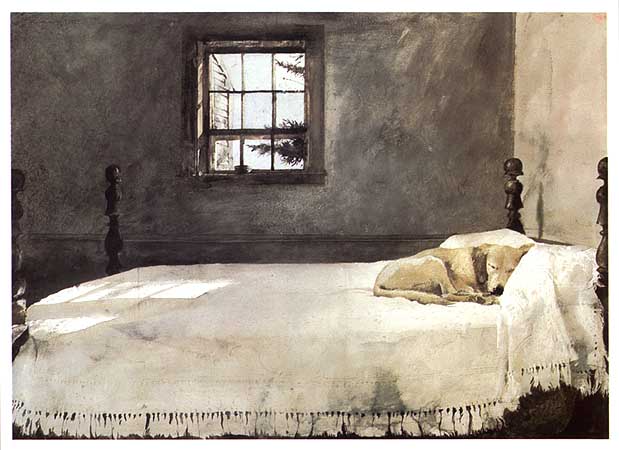
Andrew Wyeth– Spring Fed,1967

Read Full Post »

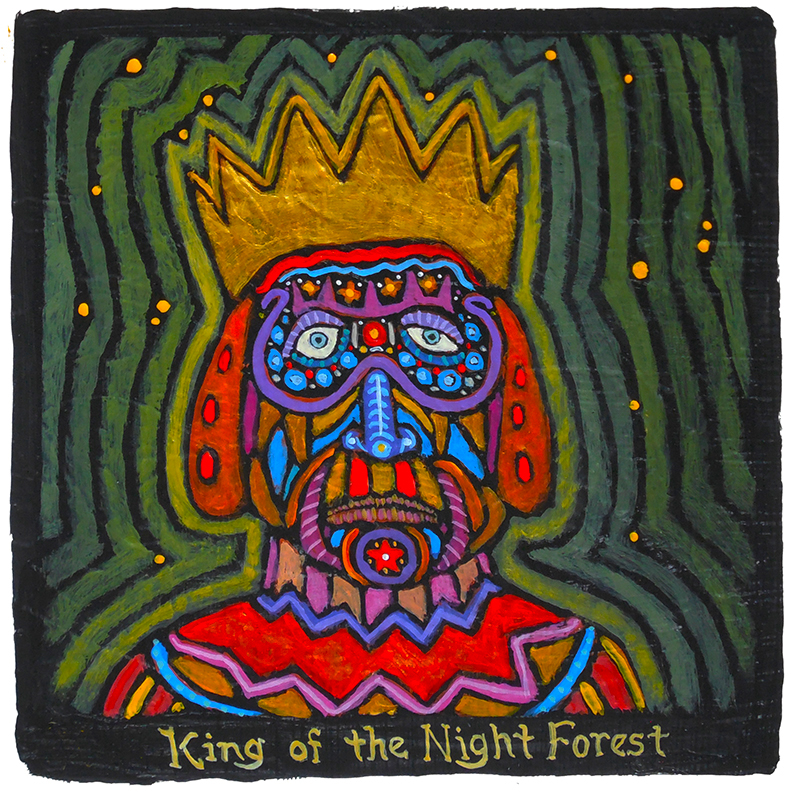
King of the Night Forest — At West End Gallery


The clearest way into the Universe is through a forest wilderness.

–John Muir, July 1890


I have mentioned that one of the things I like best about doing work for the annual Little Gems exhibit at the West End Gallery is that I get to work on new themes and directions. The smaller format is ideal for exploring new things– different color combinations, compositions, elements, etc. Over the 31 editions of  this show, some once new things have become regular visitors to my work where others have been limited to their one and only appearance.

This year’s show has one distinctly different entry– actually, two paintings of the same sort– to the body of my work. I very much enjoyed working on these and found myself looking at them constantly after they were done. If that means they will become part of my regular rotation for years to come or are simply a one-time entry for this time remains to be seen.

Some of my favorite themes had limited lifespans within the body of my work. Of course, I always reserve the right to revisit these themes in the future so they may not be really finished within the body of my work. Just paused. For example, my popular Archaeology series flourished for a year or two then moved to a place within my body of work where it shows itself every few years. And even then, it only appears in a handful of new pieces, maybe only two or three.

Sometimes, it simply depends on what I need to see in the work for myself. This work starts off as being explicitly for myself. While I might be pleased if others take to them, it doesn’t really matter to me so long as they spark some sort of excitement within me that can I carry with me into my other work.

There are two distinct pieces from this show that fall into this category. I don’t know where they fit yet or if they will become regular visitors. Or maybe they will become regulars that will never be shown outside my studio. Work for me alone.

The jury is still out on this new work. I like these new pieces a lot. They excite me, both in the process and in the way they carry their own different story and mythology. Maybe I need that new mythos right now in order to make sense of the bizarreness of what I see unfolding here recently. It leaves me feeling me more alone than ever and even more unmoored, as though the past I thought I knew and relied on was no more. 

Kind of like that feeling of which George Orwell wrote in 1984:

He felt as though he were wandering in the forests of the sea bottom, lost in a monstrous world where he himself was the monster. He was alone. The past was dead, the future was unimaginable.

Maybe I simply needed to see something different, something with its own reality, its own history and mythology. This work seems to fit that bill. Whether it remains it another question. I could see them effectively translated as much larger work– 4′ by 4′, for example. It would make for a dramatic and bold statement. But whether I go that route is unknown right now.

The first of these paintings is shown above. It is a little over 6″ by 6″ on paper and I call it King of the Night Forest. The title came from when I used to walk in the dark down to my home from my first studio that was up in the woods. I often did that walk without a flashlight or without any visible lights to guide me and found that the forest took on a whole different character in that darkness. Every sensation, every sound, every smell was magnified as I felt my way down the hill with my feet. Where I could peer deep into the forest during the day, I was now met with a deep blanket of opaque blackness.

The imagination could run wild. Maybe there were eyes watching from just beyond that wall of darkness? Maybe some being I didn’t recognize who only came out when the dimension of blackness. Maybe a whole civilization that lived in a dimension just a shade beyond our own, so near that in those dark moments when I found myself rubbing up against their dimension they could observe me. Maybe they were wondering what sort of strange beast was moving their space.

Perhaps one of those times it was the King of the Night Forest watching me slowly make my way in the blackness. 

I began these faces because they allow me to use pattern and color in their making. It really doesn’t feel much different to me than the process I often use in creating some of my landscapes that incorporate more colors, shapes, and patterns than is typical for my work. It is only the form and the narrative that emerges that is different. 

Where it goes from here, I don’t know. For now, it satisfies something with me that was in need of something new.

This painting, King of the Night Forest, and the other which I will show here in the coming days are available at the West End Gallery as part of this year’s Little Gems exhibit. The show officially opens Friday, February 7 but the work is now in the gallery and available for previews. 

I didn’t have a song in mind for this painting but right now, I feel like hearing Patti Smith and her 1978 collaboration with Bruce Springsteen, Because the Night.

Maybe it fits. If not here, maybe in the Night Forest.


Read Full Post »


I do not know whether I was then a man dreaming I was a butterfly, or whether I am now a butterfly dreaming I am a man.

–Zhuang Zhou


I love this famous anecdote above from the great Daoist philosopher Zhuang Zhou, who was born sometime in the 4th century BCE. Like most things worth thinking about, it has no answers for us, only questions. In this case, the question being how we discern what is reality and what is a dream.

I am not going to get into a philosophical argument here this morning on that question. I only mention it because it reminded me of the painting above and the feeling I take away from it.

It is an early piece of mine from thirty years ago, back in 1995, that I call Summerdream. I’ve been looking at it a lot recently as I prep it to be part of the upcoming annual Little Gems show at the West End Gallery.

It’s a small piece that has always resonated with me. I love its forms and simplicity. But more than that, it has a sense of solidity in the way it is painted with deep saturated watercolor while still giving me a dreamy, ethereal sense of floating. I like this dichotomy, its appearance of earthly solidity alongside a diaphanous airiness in its felt atmosphere.

Like Zhuang Zhou, I find myself asking which is real and which is the dream here.

I don’t know for sure. Perhaps I am actually a butterfly dreaming that I am a man wondering such a thing? Or maybe both I and my butterfly alter ego are just a tiny part of a dream dreamt by a tiny being that dwells forty dimensions of time and space from where I sit? 

Maybe or maybe not. We will most likely never know and that, in itself, might be the only correct answer. We deal with the reality in which we find ourselves at any given moment.

Right now, I am a guy sitting in the dark of a winter morning. That’s my reality right now. But later, I might look at this painting and find myself as a floating butterfly.

And that will be an acceptable reality then.

Here’s a well-worn song, from the Cranberries and the late Dolores O’Riordan, Dreams.


Summer dream is a 5″ by 7″ watercolor on paper, framed at 11″ by 14″. It will be available at the West End Gallery as part of their annual Little Gems show, which opens February 7. This painting and a group of new small paintings will arrive at the gallery later this week. The gallery is currently on a short winter break and will reopen this coming Tuesday, January 21.


Read Full Post »

GC Myers- Greenie's Barn circa 1994

Greenie’s Barn, 1994– Now at West End Gallery


There is surely no greater wisdom than well to time the beginnings and endings of things.

–Francis Bacon, Of Delays, 1625


I came across the post below from a couple of years back this morning and thought I would use it to accompany the painting shown above. It’s a small watercolor from 1994 called Greenie’s Barn. It represents for me a beginning as it was painted in that period where I was discovering an artistic voice, at a point coming after what I feel was the major breakthrough in my development. Everything was fresh and exciting, with new discoveries coming with every session of painting. I look at this painting and that jumps out at me because I can remember how thrilled with what I was seeing in this small piece at the time. I loved it the colors at its edges, the ragged nature of its form, its quietude and contrast of light and dark. All things I desired in my work. It felt like it was signaling a direction for me to follow, as though it were a weathervane on that barn.

The barn itself reminded me of the old barns in this area. Many that I knew as a youth have long fallen to the ground from neglect as the farmers who built and used them for generations died out or moved into other forms of work. I see some now, teetering and ready to fall, sections of their roofing peeled back, exposing their roofbeams, and I feel a sadness for them. They were such important structures in their time, often maintaining an almost regal presence in their landscape, and now their kingdom was gone.

So, for me, this small painting of a barn represents both beginnings and endings. I don’t know why I named it Greenie’s Barn. It just felt right at the time and I remember referring to barns by their owners’ names as a kid. It has been with me for 30 years now and I never wanted to offer it in a gallery, but I felt now was the time. It’s at the West End Gallery now as part of their holiday show.

The post below from a few years back deals with beginnings and endings as well. It ends with this week’s Sunday Morning Music selection.


I tromped up through the woods yesterday. The snow wasn’t deep and it was cold enough to freeze up some of the boggier parts of the hillside so that I could wander through. It was something I hadn’t done for some time. Too long. Even though it’s only less than a quarter mile up in the woods, it seems like a world removed from the home and studio down below, which themselves often feel far removed from the world at the end of our long driveway.

It’s quieter than down below, the trees and the terrain muffling sound. The crunch of the snow underfoot is clean and clear. It’s a good sound.

With the snow on the ground and the leaves now gone, I could see deeper into the woods. I was able to better see the individual trunks and crowns of the trees. Some were like anonymous people in a crowd scene in a film, not really standing. While I could still appreciate their individual beauty, they didn’t stop my eye.

It was the bigger trees that jumped out at me, the beech and maples and the now dying ash trees that have been ravaged by the borer beetles. It made me think how loggers must look through the woods, their eyes measuring and taking in the shape of each tree until one large tree sets off their inner alarms. It made me wonder how my great-grandfather, who at the age of 17 first set out into the Adirondack forests in 1872 leading his own crew of loggers, would look through these woods. Would he simply see the trees as a form of income or would he look upon them as companions? After all, this was man who spent much of about 60 or so years in the deep woods in all sorts of weather conditions, most of the time coming before the use of tractors and chainsaws.

It’s one of those times when you wish you had a way to spend a few minutes speaking with an ancestor.

As is always the case in nature, the forest reminds you of the beginnings and endings. The floor of the forest is littered with dead trees that have tumbled over in wetter and windier times or, in the case of the mighty ashes that have died from the damage of the beetles, rot then fall in large chunks until all that is left is the lower trunk of the tree. The remnant ash trunks are sometime twenty plus feet tall.

I am always a bit sad when seeing these dead trees who by virtue of location and environment didn’t last as long as they might have in other places. But even so, among their bony remains on the forest floor new saplings and young trees abound, all straining upward trying to push their faces to the light.

It’s a reminder of the inborn desire to struggle and survive that is present in all species. We all desire to exist, to feel our faces in the sunlight of this world. But, as the forest points out, we all have beginnings and endings.

And that’s as it should be. How would we be able to appreciate this world, to see it as the gift it is, if we knew our time here was without end?

I don’t know the purpose of this essay. I simply started and this is what it ended up as. A beginning and an ending…

Here’s a song that is about beginnings. Not a holiday song. You most likely will get your fill of those everywhere else. Not to say I won’t play one or two in coming days but today let’s go with From the Beginning from Emerson, Lake & Palmer.


Read Full Post »

Brueghel_the_Elder_-_Netherlandish Proverbs

Pieter Bruegel the Elder- Netherlandish Proverbs, 1559


I was following the pack, all swallowed in their coats
With scarves of red tied ’round their throats
To keep their little heads from falling in the snow
And I turned ’round and there you go
And Michael, you would fall and turn the white snow red
As strawberries in the summertime

White Winter Hymnal, The Fleet Foxes


I felt like hearing the song White Winter Hymnal though it is still technically not yet winter. But it is cold and there is a light covering of snow on the ground in these parts. I checked to see when I had last played it here and saw that it was in 2018 along with the post below. Since it was a favorite Bruegel painting, one that never fails to grab my attention, I decided to run it again.


I was listening to some music early this morning and came across this song, one that I hadn’t heard in a number of years. Thought it might be a good one to share if only to show the painting that adorned the album cover from which it came.

The painting is from Pieter Bruegel the Elder from 1559. It has come to be known as Netherlandish Proverbs though its original title was The Blue Cloak or The Folly of the World. It has also been known as The Topsy Turvy World which I personally like.

Like any Bruegel painting, it is a pleasure for the viewer with their gorgeous warm colors and dense compositions that make it feel like there is always something more to see. The painting certainly lives up to that feeling, containing depictions of over 120 proverbs or idioms used by the Dutch at the time.

Many are comical, pointing out the absurdity of the world, and some are still in use, such as “Banging your head against a brick wall which you can see in the bottom left-hand corner. Others have faded from usage, like Having one’s roof tiled with tarts” which indicates that one is very wealthy. Some are surprisingly scatological, such as “He who eats fire, craps sparks,” which is about the same as our current “If you mess with fire expect to get burnt.”

If you go to the Wikipedia page for the painting there is a complete list of the proverbs along with the imagery for each. I am enjoying it as I work my way through the list. Even without the list, looking closely at a Bruegel painting is always a great pleasure, as I pointed out above.

The painting was used on the cover of the Seattle based Fleet Foxes‘ self-titled 2008 first album. The song is White Winter Hymnal which works well for this time of the season. The lyrics are actually kind of nonsensical (the verse at the top is basically the whole song) but the song with its ringing harmonies is lovely and the video is interesting. The song has also been covered by the acapella group Pentatonix.

So, take some time to really look at the painting and use the list to see if what can identify what Bruegel was saying.


Read Full Post »

Ad Marginem C 1930 Painting by Paul Klee; Ad Marginem C 1930 Art Print for sale

Paul Klee– Ad Marginem, ca 1930


First, he does not attach such intense importance to natural form as do so many realist critics, because, for him, these final forms are not the real stuff of the process of natural creation. For he places more value on the powers which do the forming than on the final forms themselves.

He is, perhaps unintentionally, a philosopher, and if he does not, with the optimists, hold this world to be the best of all possible worlds, nor to be so bad that it is unfit to serve as a model, yet he says:

‘In its present shape it is not the only possible world.’

Thus he surveys with penetrating eye the finished forms which nature places before him.

The deeper he looks, the more readily he can extend his view from the present to the past, the more deeply he is impressed by the one essential image of creation itself, as Genesis, rather than by the image of nature, the finished product.

— Paul Klee, On Modern Art


This excerpt from On Modern Art, the 1924 treatise from the great Swiss artist Paul Klee.

For me, he was a big influence not only for his distinctive works but for his attitude and his views on art that he expressed so well in his writings. His use of color also influenced me. I always think of his work in terms of the color– sometimes muted yet intense and always having a melodic harmony to it.

It always feels like music to me. Like Klee, I often equate the visual with music.

I like his idea that the world is in the process of creation, of Genesis, and that it is not a final form. It allows for visionary work, for imagining other present worlds that extend beyond our perception because, as he writes, In its present shape it is not the only possible world.

And to me, that is an exciting proposition.


This is a reworked version of a post that originally ran in 2015. I needed a little kick of Klee this morning.


Paul_Klee,_Swiss_-_Fish_Magic_ 2

Paul Klee- Fish Magic 1925


blossoms-in-the-night-paul-klee

Paul Klee,, Blossoms in the Night

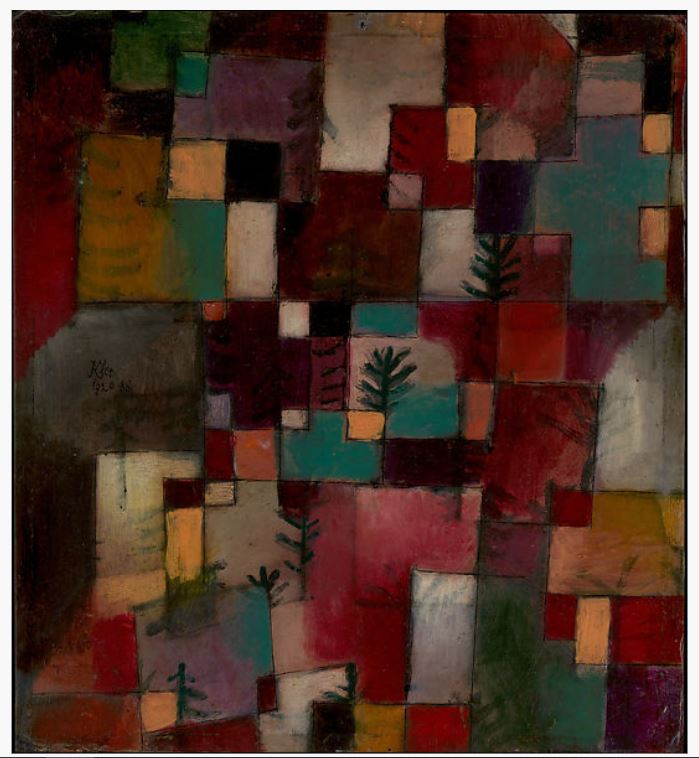
Paul Klee- Redgreen and Violets-Yellow Rhythms 1920

Paul Klee- Redgreen and Violets-Yellow Rhythms 1920

Paul Klee Bird Garden 1924

Paul Klee Bird Garden 1924

klee_southern-gardens

Southern Gardens- Paul Klee

Read Full Post »

Natural Anthem sm

Natural Anthem– At Principle Gallery, Alexandria VA


To Mercy, Pity, Peace, and Love
All pray in their distress;
And to these virtues of delight
Return their thankfulness.

–William Blake, Songs of Innocence (1789–1790)


Speaking of thankfulness in this week of thanks, I might add silence or quietude to those virtues of delight that Blake listed above, though that probably falls under his definition of Peace. I know that I am always thankful when I am gifted with silence or quiet when I am in the midst of some sort of distress. It stills the waters, in a manner of speaking.

There are others that I might add, as well. Understanding and compassion for example. Again, you might classify them under Blake’s Mercy and Love, respectively.

I guess it doesn’t matter how you classify them. Receiving any of these virtues of delight are gifts of the highest order, gifts of the soul that inspire thankfulness in most of us. Unfortunately, there are some who don’t recognize these gifts when given and are stingy in offering these gifts to others. I feel bad in a way for such people. There seems to be an incompleteness to them, a void of virtues that should be filled with gratitude. As the Roman orator Cicero stated: Gratitude is not only the greatest of the virtues, but the parent of all of the others.

Anyway, that’s my spiel for this morning. Thank you for reading.

Here’s a piece of music for which I am very much thankful. It’s the first movement, Ludus: Con moto, from Tabula Rasa. a 1977 work from Estonian composer Arvo Pärt.  I picked up this album back in 1999 and listened to it over and over during my early years as a full-time painter. The feel of this music and its themes of love, empty space, and silence seemed to fit well with my work at that time. Hope it still does. This features violinist Gil Shaham along with the Gothenburg Symphony Orchestra.

Still hits me hard. And I am thankful for that…


Read Full Post »

GC Myers- Someway Somehow

Someway Somehow — At West End Gallery


…Perhaps
The truth depends on a walk around a lake, A composing as the body tires, a stop
To see hepatica, a stop to watch
A definition growing certain and A wait within that certainty, a rest
In the swags of pine-trees bordering the lake.
Perhaps there are times of inherent excellence

–Wallace Stevens, Notes Toward a Supreme Fiction (1942)


This new small painting, Someway Somehow, now showing at the West End Gallery as part of their Deck the Walls holiday exhibit, might well represent finding beauty and color amidst the ashes of the everyday. Much like the lines from Wallace Stevens above.

For me, it has the feel of dreaming for me. Maybe it would be better to say dreams set against reality.

Maybe that’s the same thing as what I derived from Stevens’ lines. Not sure this morning.

The lower part of the image is in tones of gray that symbolize the sometimes grayness and monotony of our everyday existence, that workaday part of our lives when we set aside our hopes and dreams to focus on tasks and responsibilities. The upper part is set in colors that represent for me the rare times we find in order to return to those hopes and dreams.

We often find ourselves living in that area that straddles both gray and color, with the hope that we can find a way to live in the color of our dreams. Getting to that place is sometimes a hard road to follow and too many people give up early on. But those who continue do so withe thought echoing in their mind that someday somehow they will reach that place.

The dream of the dream.

Here’s a tune to go along with it. It’s Follow That Dream from Bruce Springsteen. It’s often referred to as a cover of the Elvis Presley song from his 1962 movie of the same name. Springsteen has often referred to the Elvis song as a favorite and covered it a number of times in early concerts.  I had a bootleg version of his cover that I can’t locate much to my dismay as it was a wonderful performance. The version of Follow My Dream from Springsteen that people might know is a reinvention of the song with altered melody, pace, and lyrics that he began performing in the early 1980’s. Not really the same song except for a few lines and its message.

But still effective. I think it fits well with this painting.

As I noted above, Someway Somehow is at the Deck the Walls show at the West End Gallery that opens today, Friday, November 22, with an opening reception that runs from 5-7 PM.


Read Full Post »

GC Myers-- Moment of Pride 2023

Moment of Pride— At West End Gallery


Pictures must be miraculous: the instant one is completed, the intimacy between the creation and the creator is ended.

Mark Rothko


I came across the words above from the late painter Mark Rothko and found myself relating very much to their meaning. The process of creating a picture is ideally a period of intimacy, one where the maker ideally opens their inner self and exposes their totality to the surface. There is a transference of energy and thought in that moment that forms the new life taking place on that surface.

Each move, each change to the surface pulls bits from the inner stores of the creator and alters the new reality being formed. For a rare moment, the two entities– the maker and the surface–are locked together.

They are one.

But as the picture takes shape and form, beginning to express its own life force, it moves away from the maker. At completion, the painting takes on its own being and at that point is beyond the reach and influence of the maker.

As a maker of pictures, I can say that this moment is both wistfully sad and exhilarating. When that moment of completion is at hand, I immediately miss that time of transference when the air is still filled with excitement and possibility. But seeing the new picture, self-contained and speaking for itself, brings a kind of parental pride. I know that I will never be as close to that picture as I was in that moment. But that moment binds us forever, even if it will be always as a faint memory when I glimpse its image in the future.

I chose the piece at the top for this post- fittingly titled Moment of Pride because it sums up the feeling felt when that transference has taken place and the piece stands apart, living and breathing on its own. I certainly felt the feeling depicted when completing this piece.

There was a definite moment of transference when this painting made the leap from being me to being it. It had its own story to tell that was then beyond me, speaking with its own voice, its own meaning that it will someday make known to someone other than me.

And they will hopefully experience their own rare moment….


This is a reworked post from 2016. It seemed to perfectly fit the painting at the top, Moment of Pride, which is now at the West End Gallery as part of their Deck the Walls exhibit, opening tomorrow. I’ve been adding songs to most every post lately and I’ll keep that going today.

Don’t think this song fits the painting here but it has a wistful feel much like that feeling felt when you realize that you’ve lost a closeness with someone or something that you will never be able to recapture, so it might. Whether it does or not, it’s a song that like a lot from an album that I like a lot and that’s good enough for me. It’s the title track from the Anodyne 1993 album, the last album from Uncle Tupelo before splitting up the next year as its members moved on separately to form the bands Son Volt and Wilco.

The tune and lyrics have a weary, disenchanted feel that seems to fit my own lately and probably a lot of others out there:

You threw out the past
When you threw out what was mine
Throughout the years
It was hard to make it last

Anodyne, anodyne

No sign of reconciliation
It’s a quarter past the end
Full moon from on high
Across the board, we lose again

Give a listen if you are so inclined. And don’t slam the door when you leave, okay?


Read Full Post »

« Newer Posts - Older Posts »