Feeds:
Posts
Comments

Posts Tagged ‘Painting’

I thought I  would show a bit more of the large canvas I’m working on at the moment.  As I’ve described in previous posts, it’s a 54″ tall by 84″ wide canvas that has been biding its time for nearly 10 months in my studio, waiting for me to finally give it some life.  Well, it’s beginning to take shape and I can see better its final stages, if things work out as I hope.

I’m always a little hesitant to show these pieces in progress because sometimes they lack the life that the final stages of the process bring.  But even though there is still a lot of depth to be added, this piece is gaining animation quickly.  It’s been interesting seeing how the colors of the fields have changed as other colors are added in the process, some of the reds and oranges that seemed to jump off the canvas modulated in intensity by adding varied shades of green and yellows.

I’ve brought the sky to a certain point where it creates enough ambiance that I can be influenced by it  but is not yet at its final intensity.  I see a certain blue in my mind that will be a challenge to pull off here but at least it is there now, pulling at my mind. 

The same goes for the great black void that is a lake in the center of the canvas.  I see a certain color and depth ahead for this critical part of the composition,  which is the focal point for the whole thing, everything else revolving around and reacting to it.  The overall strength of this painting  is dependent on my ability to recreate the color that I see in my mind for this section.  If I don’t reach that visualized color, what could be a very good painting could become a ho-hum piece.  As a result, my mind is always running through methods of achieving that color even while I am at work on other parts of the painting.

Today should be a pivotal day for the bigger part of the composition, as I finish up this layer of color on the landscape and begin adding what may be the final layer for some parts of it.  The composition should really come together at this point,  just waiting for that color in the lake.

We shall see.

Read Full Post »

There are only two mistakes one can make along the road to truth; not going all the way, and not starting.
—Buddha

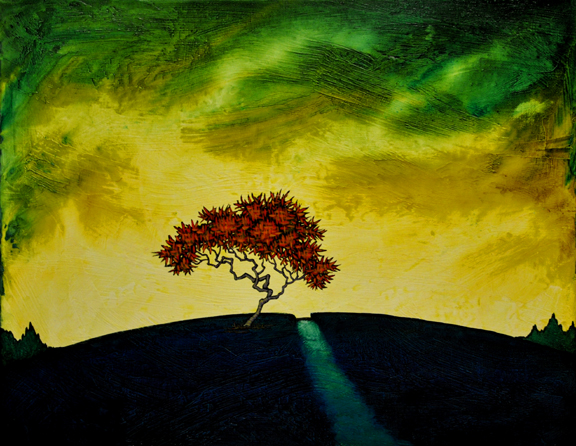
This is a new painting that recently went to Watts Fine Arts in Zionsville, outside of Indianapolis.  It’s a large canvas, 20″ tall by 60″ wide, that is called Where the Road Ends
 
I often use a pathway or road leading into my work, the idea being that it serves as an invitation for the viewer to enter the scene.  Sometimes the path simply cuts through the landscape and runs to a horizon, a symbol of  the continuity of the journey.  But sometimes the path seemingly ends and I find myself at these times asking myself what that means, both in the context of the painting and in my mind.  Is it the reaching of a goal, such as the truth to which Buddha alludes above?  Or is it merely a road that comes to an end?   
 
Probably both are correct.  In the process of painting I don’t go forward with this final image in mind.  The road neither ends nor goes on when I am in the midst of painting.  It’s just there.  But at a certain point, the composition demands that a decision be made, to either continue with it or to let if disappear behind a knoll.  The easier decision is always to continue, to let the path represent  the continuum of time.  It is natural and something we can all relate to in some way.  We understand theconcept of the journey.
 
But to terminate the road means that there is some sort of finality, an endpoint.  Be it wisdom, truth, death or some other sort of epiphany, this terminus presents a great opportunity for symbolism.  Enter the single Red Tree.  Set against the end of the path and the  landscape that opens to lines of distant hills, it becomes an icon for that for which we strive. 
 
 Perhaps it is a symbol for our wiser self in the here and now, enlightenment found.  Perhaps for some it represents an afterlife, the step beyond our earthly journey.  Or it could be any number of other readings.  But however it is read, the Red Tree here, sitting away the end of the road, demands engagement from the viewer, demands that they consider its meaning to them.
 
And I like that.
 

Read Full Post »

Omega Rise

I finished this piece yesterday and it may well be the last painting I finish this year and if that’s the case, I am happy with this piece having that designation.  I always hope that paintings that end or start my years have something in them that makes them mark their time in a memorable fashion, that they will have something that will make them stand out.  That being the case, I’ve titled this 16″ by 20″ canvas Omega Rise. 

Omega is the last letter of the Greek alphabet and is often used to designate an end or a finish, which fits in with the idea of it being the last piece of 2011.  But there is also an ominous, serious quality in  the sky that portends that the omega may mean more than that.  Perhaps this last little uphill rise is the final part of a journey but not necessarily in an end of life sort of way.  Perhaps the dark blue of the rise signifies a past of some sort and the rise lifts the viewer  out of that darkness and into the brightness of some new enlightenment.  The tree seems to be near a cusp between the contrast of dark and light, close to the discovery of what is over this rise.  There is definitely some sort of epiphany beyond it.

Please remember, I’m just thinking off the top of my head at 7 AM and in a few days, or even a few hours, I may see this in a completely different way.  But I know there’s something in this piece that if it remains the omega painting for 2011, I will always remember it as that.

Read Full Post »

I’ve been reviewing past work over the last few weeks for a variety of reasons.  Sometimes I am looking for an idea or motif that has not been in use for some time.  A new lead to re-examine and follow anew.  Sometimes, it’s pure nostalgia, looking at the work as group with a small bit of pride, like a parent looking at photos of their kids. And I sometimes go back through my files because they serve as a form of memory for me.  While I may have the details of most of my work stored somewhere in the folds of my brain, I can’t always pull them forward.  Seeing the images brings back everything in a torrent.

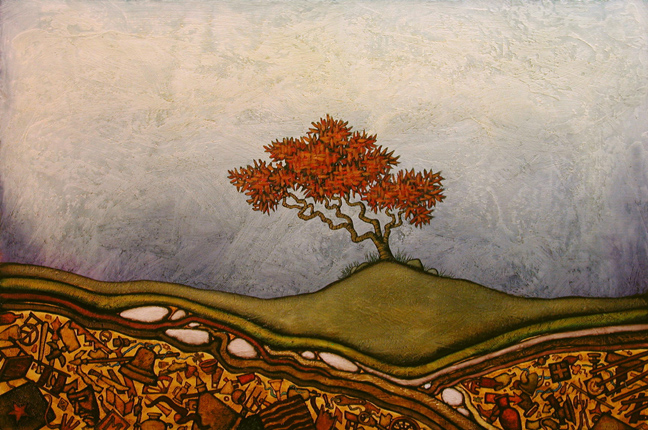
The painting above is a good example of this rush of detail.  Titled Archaeology: The Story Told, it’s a 20″ by 30″ canvas from  the 2008 Archaeology series.  Although I don’t like to publucly state that there are pieces that are favorites, this painting was one of my favorites from this group. 

There is so much I like about this painting from the moody duskiness of the sky with its purples that grade downward to the way the underground boulders create a visually rhythmic counterpoint.  But the thing that always stuck out for me was how the underground debris came together to form a narrative, which is where the title originated.  There was no intent in painting this.  All of the debris was painted in a freestyle manner, with each piece being painted independently from one another outside of possible relationships in size and shape.  It wasn’t until it was done that I began to see a stroyline running through the heap of items.

For me, it was the story of this country starting with  the obvious prompting of what looks to be an American flag at the center of the bottom.  There was a bell that reminded me instantly of the Liberty Bell to represent our Revolution and a Viking helmet that told of the earliest European explorers here.  There was a cowboy boot that symbolized our westward movement and what appeared to be a lance for the weapons that the native Americans used in their defense of their land.  There is a pitchfork for the agriculture that sustained and help the nation expand.  There  is an electric light to represent the inventors like Edison who transformed our country and machine parts for the industrialization.  There is a baseball bat for our national pasttime.  A peace symbol for both its inherent meaning as well as for its use as symbol of protest and our right to speak freely.

It’s all loosely associated and many may not even see them in a unified way but for me it all came together in a single glance and that was how I immediately read the painting.  It’s unlike any of the other paintings in this series in that way and that makes it special for me. 

Gary T., I hope you don’t mind me showing your painting!

Read Full Post »

Taking Off the Mask

Man is least himself when he talks in his own person. Give him a mask, and he will tell you the truth.

—–Oscar Wilde

I read this quote from Oscar Wilde and it made me think about painting serving as a mask for some artists, allowing them to say things in paint that they see as their truth that they might not be able to express otherwise.  I might fall into that category in some regards.  I certainly hope my work reflects some sort of inner truth.  Or, at least, reflects an aspiration for what I desire for my own truth.

For instance, my work often is placid and calm while I often do not reflect that same attitude personally.  I aspire to be calm and placid and sometimes I do find it for short periods of time.  Maybe the aspiration to be this way will eventually become an ultimate truth.  Maybe this sort of personal  truth can be created, like the face behind the mask beginning to take the shape of the mask.

I don’t know.  Maybe it’s something that we shouldn’t dwell on for too long.  I thought of this quote when I was finishing this recent painting, titled True Self, a 7″ by 15″ piece on paper.  I wondered if this image on the sheet before me was any part of my own truth.  I know that I wanted it to be such but there was part of me that felt unsure, sensing that the reality didn’t yet meet the aspiration.  But it felt like there was at least a small bit of my truth in there somewhere. 

Perhaps when I finally take off the mask I will find it was not a mask but a mold.


Read Full Post »

Seeking Rhythm

This is a new piece, a small painting about 7″ by 11″ on paper.  I still have no name for it.  I’ve been spending the last several days trying to refind my normal painting rhythm.  I use the term rhythm quite often in describing what I do and always struggle when trying to descrribe exactly what I mean when using it.  But this time it means the actual ebb and flow of the act of painting, the tempo of the creative process as an idea forms and takes shape before me on the surface. I normally fall easily into a pattern where one action of painting inspires another and so on, almost self-perpuating.  Color begets color and line begets line, each sparking a new idea, a new thought.  It’s a rhythm that I have depended on for most of the time I have painted.

When I’m away from painting as I have been lately, doing needed projects around the home and studio, I fall out of this rhythm.  I can tell during the day, an uneasy knot forming in my gut.  This rhythmic pattern has become vital to my well-being  and when it’s disrupted, I get antsy and out of sorts.  Usually, I am back into it within a day or two with little loss of momentum and this unease fades quickly into the paint and routine.  Some times, as is the case at the moment, it becomes more of a struggle to regain that rhythm, to find that groove in which to take hold.  Nothing starts nor finishes easily.  Color doesn’t sing on the surface, laying there with an uninspired flatness.  Lines are listless and forms dull.  One piece does not inspire the next.  In fact, it brings dread to the next piece.

 I find myself trashing piece after piece,  something I seldom do.  I normally can find something that I want to keep in a piece even if it is only for the lesson learned from its deficiencies.  But these failures seem dismal and dull.  Their very existence bothers me and they go in the trash.

But time has taught me not to panic when I am struggling to find footing.  I became more determined and go back to basics, working on small blocks of color, trying to find life and visual excitement in each little block.  At first, even this was a chore, like slogging in ankle deep creative mud.  But eventually, something broke loose and I find myself finding a stirring of life in the colors and forms and soon I am excited by what I am seeing.  The next move has been inspired and soon my mind is filled with possibilities and potentialities for several new pieces.  Rhythm seems almost at hand and the knot in my gut begins to subside, my mind settling into a familiar hum.  Like that red tree in the image above, looking out over its domain and feeling that, for the time being, all is right with that world.


Read Full Post »

Failure

In response to yesterday’s post concerning a very large blank canvas that is waiting patiently for me, I received several very interesting questions from my friend, Tom Seltz, concerning the role that failure and the fear of failure plays in my work.  He posed a number of great questions, some pragmatic and some esoteric,  that I’ll try to address.

On the pragmatic side, he asked if there is a financial risk when I take on large projects like the  4 1/2″ by 7′ canvas of which I wrote.  Actually, it’s not something I think about much because every piece, even the smallest,  has a certain cost in producing it that, after these many years, I don’t stop to consider.  But a project such as this is costlier as a larger canvas is more expensive right from the beginning simply due to the sheer size of it.  The canvas is heavier and more expensive and there is more used.  I use a lot more gesso and paint.  And while the cost of materials is a larger cost the biggest financial risk comes in the time spent on such a project.  It takes longer to prepare such a large canvas, longer to paint and, if it works out, longer to finish and frame.  This is time not spent on other projects.  Wasted time is by far the biggest risk in facing such a project and that is something I have to take into consideration before embarking on large projects.

He also asked whether I can reuse the materials if I don’t like what I’ve painted.  Sure, for the most part.  Especially canvasses.  Actually, the piece shown here was such a piece.  I had a concept in my head that floated around for months and I finally started putting it down on this 30″ square canvas.  I spent probably a day’s worth of time and got quite far into it before I realized that it was a flawed concept, that I was down a path that was way off the route I had envisioned.  It was dull and lifeless, even at an early stage.  It was crap and I knew that there was no hope for it.  I immediately painted it over, mainly to keep me from wasting even more time by trying to resuscitate it,  and this piece emerged, happily for me.

Tom also asked if I ever “crashed and burned” on a piece or if the worst sort of failure was that a piece was simply mediocre.  Well, I guess the last paragraph says a bit about the “crashed and burned” aspect, although that is a rarer event than one might suspect.  The beauty of painting is that it’s results are always subjective.  There is never total failure.  It’s not like sky-diving and if your parachute doesn’t open you die.  At least, that hasn’t been my experience. 

Mediocrity is a different story.  That is the one thing I probably fear most for my work and would consider a piece a failure if I judged it to be mediocre.  I have any  number of examples I could show you in the nooks and crannies of my studio but I won’t.  They have a purpose and some have remaining promise.  The purpose is in the lessons learned from painting them.  I usually glean something from  each painting, even something tiny but useful for the future.  But most times,  the mediocre pieces teach me what I don’t want to repeat in the future.  A wrong line here.  A flatness of color there.  Just simple dullness everywhere.

But, being art, there are few total failures, and many of these somewhat mediocre pieces sit unfinished because there are still stirs of promise in them.  I can’t tell you how many times I’ve come to what I felt was a dead end for a painting, feeling that it was dull and lifeless, and set it aside.  Months and months might pass and one day I might pick it up and suddenly see something new in it.  A new way to move in it that brings it new life.  These paintings often bring the greatest satisfaction when they leave the gallery with a new owner.  Sometimes failure is simply a momentary perception that requires a new perspective.

Okay, that’s it for now.  I’m sure I have more to say about failure but it will have to wait until a later date.  I’ve got work waiting for me that doesn’t know the meaning of the word failure and I don’t want to risk that it might learn it.

Tom, thanks again for the great questions.  I’m always eager for good questions so keep it up!

Read Full Post »

I first painted one these faces back in 1995 when they became what I call my Exile series.  They were painted in very much the way I paint some of my landscapes, starting with one block of color and letting that block dictate what the next will be.  I had no reference points to work from, just letting the image grow on its own and for much of the time when I was painting these I had no idea how the face would emerge.  Often, they completely surprised me.

This 12″ square canvas was my first new Exile piece since that time and it took a while to reengage.  The originals were painted from a very emotional personal standpoint and  I am in a different emotional place now, sixteen years later.  But after I haltingly began there came a point where it began to take hold and pull out its own emotion, with which I began to empathetically identify.

Call it an existential melancholy.

I see some of these figures in that way, alienated from their past and haunted by memories.  They are, in a way, prisoners of their own experience, trapped in a moment long gone and never to be seen again.  Not all of them, but many, fall into this category.

I’ve been wanting to restart the Exiles series for some time.  To what end, I can’t say.  I don’t know if I will show these anywhere but here.  I don’t know if they would want to venture from the safe haven I offer them here. 

We’ll see.

Read Full Post »

Glory Run

I talked the other day about painting in series and that brought ot mind a few themes that I have painted over the years that were part of a loose series, not necessarily painted near each other in time but connected through subject and composition.  One such series were a group of paintings done over a number of years that contained a single sail boat riding out the waves.  They were simple compositions, with basic elements that emphasized the motion of the craft yet maintained an almost abstract quality. 

 The piece shown here, Glory Run, is one of my favorites from that series and has that abstraction with the round sun and the crescent sail playing off one another.  The rounded arcs of the waves and the oblong clouds add more geometry to the composition and make it a piece that I can look at without even realizing the subject.  On the other hand, I can sometimes look at this piece and focus solely on the shape of the craft and the sailor at its stern.

Near this same time I also did this piece, Lone Running, working off the same basic theme.  This might be that same sailor.  I’m not really sure.  This piece, to me, plays even more off the way the shapes interact, giving it a very abstract feel.  The crescent sail comes rhythmically off the curve of the wave and creates a nice symetry with the sun.  This painting really works for me in this manner.

Now, as I write about how I see these and what I think makes them work, I have to point out that none of those thoughts about symetry, abstraction or interaction of the elements come to mind when I’m painting.  Oh, they may be there, hidden in the thoughts of simply obtaining a sense of rightness in the piece, which is first and foremost.  They probably do have a say in the back of my mind.  But as I approach the table or easel, they are secondary to the idea of conveying emotion.  After a painting is done it’s then easy to see how these qualities have played a part in bringing out the emotion I was seeking. 

I haven’t painted a boat piece in a few years, haven’t had whatever urge it was that created these pieces.  But I always stop over these pieces and gaze at them for a while.  There’s something there for me that goes beyond breaking down the elements and composition.  Maybe I should soon continue the series…

Read Full Post »

Growing a Painting

Above is the tentatively finished version of the painting I started earlier this week, a 24″ by 48″ canvas that I am considering calling Escape Route. I showed the first few steps of the painting process on this blog two days ago, ending with the sky being near finished and the composition blocked in.  I’m not going to go into all the steps and decisions that went into completing this piece.  Instead, I put together a short film that shows the painting evolving to the finished product.

I will say that the final version is much different in many ways than I first envisioned with the first strokes of red oxide that went on the canvas.  Each subsequent bit of color, each line that appeared, altered the vision in my head just a bit, evolving the piece constantly until the very end of the process.  Even the last part, where I inserted the treeline that appears on the farthest ridge, was not seen in my mind until just before the decision to proceed with them was made.  I decided to go with this treeline to create a final barrier for the road to break past on its way upward toward the sky.  A final moment of escape.

This painting has given me a great sense of satisfaction after finishing it.  I spent much of the late afternoon yesterday just looking at it and taking it in.  I don’t know if it will translate as well on the computer screen but this piece has substantial size at 24″ by 48″ which gives great weight to the blocks of color from the buildings and the light from the sky.  There is a sense of completeness here that I could  only struggle to explain, but as I said, brings me great satisfaction.  I feel as though the evolved painting has exceeded what I imagined when I first started this piece.   While I can’t fully explain that, it is all I can hope for from my work.

I will spend some more time over the next several weeks looking at this painting, determining if anything should be tweaked or altered.  A highlight added here, a line crispened there.  But as it stands, I think it has taken on its own life and I will probably leave it alone as it is.

Here is the short film, Growing a Painting:

Read Full Post »

« Newer Posts - Older Posts »