Feeds:
Posts
Comments

Posts Tagged ‘Painting’

GC Myers 2009 Buildiing UpI’m at a point with this work in progress, a 42″ by 60″ canvas, where I have basically finished the underpainting which is the process of blocking in the composition.  The next step for me is to start building up color throughout the piece, developing more depth from all the elements.  In this case, I start by using a light application, again almost drybrush, of a yellowish paint.  for this piece I’m using a yellow oxide.

The thinly applied yellow allows me to see dimension yet still lets the darkness of the base’s black and the red of the underpainting show through.  This is something that I feel is crucial to the feeling I’m trying to achieve.  Again, I could easily go through and simply paint each structure with one pure color and save a ton of time but it would lose the effect I desire.  Besides, it gives me more time to consider each subsequent move.

Now comes some red.  I start with a few cross-strokes of a crimson in the sky then start applying some yellow strokes as well, just to start to give light the sky.  I also start to lighten the path in all parts of the painting just to give some more depth.  At this point, I’m also pondering if I should start working a bit on the waterway as it is such a large and crucial element in the lower half of the painting and it’s darkness at this point might alter how I proceed with other elements.  After some thought, I decide against working on the waterway and move on to the roofs of the structures.

GC Myers 2009 Adding the Red RoofsAgain, I use a crimson red that is a bit darker which gives me a bit of leeway so that I can lighten roofs later as I see the need.  I’m beginning to see more and more light in the piece at this point and can see areas where I want to concentrate in some of the next steps in the process.  For instance, sides of the houses that will be a sort of focal points through the piece.  I’m reminded also at this juncture of how the roofs of the village act as little pointers or arrows that move the eye upward in the picture.  I do this with other elements as well, in may of  my paintings, everything pushing the eye toward the center of the painting.  It didn’t start as a conscious effort but I became aware that I was doing this years ago and have been doing this subconsciously, albeit with an awareness,  for years.

I was a little apprehensive in showing how I paint in this style, afraid that it might take away some of the mystique of the final paintings, make it seem that  the work was a pure product of process.  But taking the time to write down how I proceed makes me realize that while there is a process it is the decisions that are made during the process that make it either work or not work.  Intuition and a constant visual weighing of elements play huge roles in this decision making, which makes each piece unique beyond the process.  These are things that I take for granted in my day to day existence in the studio, parts of the process that are below the surface and operating on a subconscious level but are perhaps the most important aspects of the process.

So, I’m on to the next step.  Stay tuned…

Read Full Post »

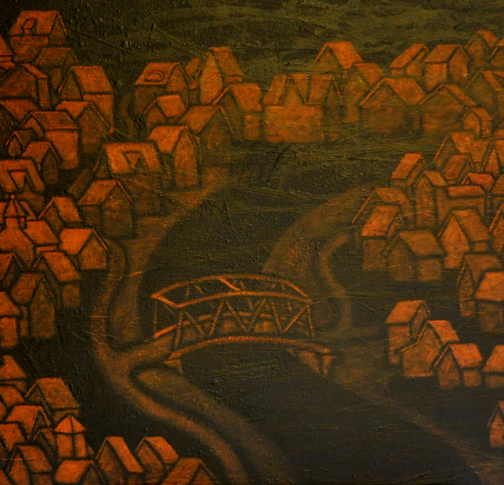
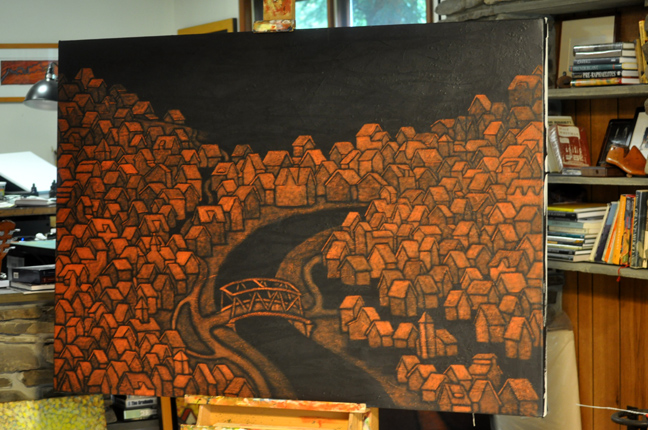
GC Myers 2009 UnderpaintingSo I’ve been working on this large painting, a 42″ by 60″ canvas, as I noted in Saturday’s post.  When I last wrote I had just blocked in the lower parts of both sides and had the bridge just sort of sitting alone in the middle.  Since then I have continued with the underpainting in the red oxide that I prefer to use.  Most of this is applied in an almost dry brush way, where I put my brush into paint then swab a lot of it off before applying it to the canvas.  It leaves a lighter layer of paint, allowing the black underneath come through.  It takes a bit longer but it suits the way I see the thing building and growing.

It also takes a lot more time than one might suspect in growing the village from the start, especially in a way that makes it feel organic and not just thrown together.  Each new element informs the next and there is a bit of time spent just looking at each piece to make sure that it plays off the form below and beside it.  This is even more crucial in such a large canvas because I’m trying to maintain a continuity of form throughout the whole piece so elements in different areas of the canvas still relate to one another.

As the village grows upward I begin to try to decide how I want it to transition into either a background or sky or if I want to simply have the structure fill the entire picture plane.  I decide here that I want to have sky so I start to think of how I will have the structures end near the top of the canvas.  As I’ve been looking here I have chosen to have the village move into a somewhat empty landscape and that  into the sky.  I want to create a saddle-like structure with the landscape so that the light I create in the sky will be cradled by the landscape below.  I often do this in my work and I think it has to do with this cradling effect holding the light in a way that brings the eye to the lowest point, creating a focal point off of which the rest of the painting plays.  It’s a funny feeling writing about this because when I’m making these decisions, it’s very seldom near the front of my mind.  They’re just done in stride, instinctually,  as I’m taking in what I’m seeing.

GC Myers Underpainting DetailI’m also at a point in the canvas where I have a bit of space at the lower center of the piece, around the bridge and banks of the waterway.  I start to fill in this area, adding detail although it’s not real fine detail.  I want this space to have interest and detail but not so much that it becomes the sole focus of the work.  I see the light that I will create where the sky meets the landscape in this painting as the more important area of focus, conveying more of the feeling that I’m hoping will emerge.

So I keep working upward and as I near where I feel I want to stop the structures I begin to start get a feel for how the landscape itself will continue.  Here’s where I am at this point and where I’ll leave it for now.

GC Myers 2009 Underpainting

Read Full Post »

The New LabyrinthThis is a piece from early last year, titled The New Labyrinth.  I do several pieces of this nature every year and always count them among my favorites to perform.  They are done in a very free-form fashion, usually starting in one corner and allowed to build into the picture frame on its own accord, until I get the sense that I should stop.  As each new building is painted it creates new parameters for the next, new prompts for my eye.  As a result, the piece has a very organic feel for me. as though there has been a natural growth in the painting.

I particularly like this painting for this feel but maybe more so because of the use of similar, muted colors in the buildings.  There is almost a monochromatic feel to the piece that I find appealing especially in the context of the subject.  It harkens back to the days when I first started painting and would do exercises where I would paint scenes using only one color, only varying the shades of it to create depth and texture.  It was probably one of the most important lessons I learned and one that I urge all novice painters to try at least a few times.  Knowing how to create harmony within the confines of a single color is necessary if you ever hope to control a larger palette.

There is also a really nice natural rhythm that runs through this piece, giving me a sense of my normal landscapes.  This probably occurs because of the way I described how the painting is allowed to grow in an organic way.

It’s a piece that has visual interest in every bit of it which is something I strive for in all my work.  I would like to think that you could take a random fragment of any of my paintings and find something that catches your eye in it.

I keep a photo of The New Labyrinth on a bulletin board I keep in my studio and I look at it quite often, thinking that I really should paint in that way again soon.

Maybe I will…

Read Full Post »

Simple GloryI am asked this question at every opening:  How long does it takes to finish a painting?  

This is a question that I’ve answered a thousand times and I still have to stop and think about my answer. 

You see, there are so many variables in my painting technique at different times that sometimes the actual process can be much longer or shorter.  Sometimes I can toil over a piece, every bit of  the process requiring time and thought.  There may be much time spent just looking at the piece trying to figure out where the next line or stroke goes, trying to weigh each move.  Then there are times when the painting drops out effortlessly and I’ll look up after a very short time and realize that it’s almost complete. Any more moves from me and the piece would be diminished.

I often cite an example from a number of years ago.  I had been working on a series of paintings, working with a particular color and compositional form.  Over the course of a month, I did several very similar paintings in several different sizes from very small up to a fairly large version.  Each had a very distinct and unique appearance and feel but the technique and color was done in very much the same way.

One morning at the end of this monthlong period, I got up early and was in the studio at 5 AM.  I had a very large panel prepared  and pulled it.  Immediately,  I started on the panel.  Every move, every decision was the result of the previous versions of this painting I had executed over the past month.  I was painting solely on muscle memory and not on a conscious decision making thought process.  I was painting very fast, with total focus, and I remember it as being a total whirl.  The piece always seemed near to disaster.  On an edge.  But having done this for a month I trusted every move and forced through potential problems.

Suddenly, it was done.  I looked over at the clock and realized it had only been two hours.  Surely, there must be so much more to do.  

But it was done.  It was fully realized and full of feeling and great rhythm.  I framed the piece and a few weeks later I took it to the Principle Gallery in Alexandria, VA. where I had shown my work for many years.  It sold within hours of arriving at the gallery.

I realized at that point that every version of that painting was a separate performance, a virtual rehearsal for that particular painting.  I had choreographed  every move in advance and it was just a matter of finding the right moment when plan and performance converge.

 It had taken a mere two hours but it was really painted over the course of hundreds of hours.

I hope you can see why I always have to think about this question…

Read Full Post »

Elvis in the WildernessThis is a small oddity titled Elvis in the Wilderness from a series that I called Outlaws, first shown in 2006 and a series I will address more in future posts.  They were all fairly small pieces, usually 4 to 6″ square and were all much darker in nature and in appearance than my normal work.  They were, however, an extension of the faces that I would draw in my high school years so for me they were not a drastic change.  They were all part of me.  For many longtime viewers they were a sharp turn away from the style and light of my representative work.  Many approached me at the show at the Principle Gallery that year asking if this was a new direction and would it mark the end of the landscapes.  I explained that this was just another aspect of one person, that while I do show myself through my work I am only showing small facets of my whole at any given time.  Snapshots, if you will.

My paintings often represent who I am at any given point in time but sometimes they are more aspiration than reality.  I long for calmness and peace, in the world and in myself.  I desire a strong and brave outlook, to have the wisdom of the ages.  I want to shed my fears aside and live boldly.  Unfortunately, these wishes sometimes remain just that– wishes.

But so long as these aspirations remain, there is hope for more light  and less darkness.  Like Elvis in the Wilderness, sometimes one struggles to find a way to the light.

Read Full Post »

scan0081

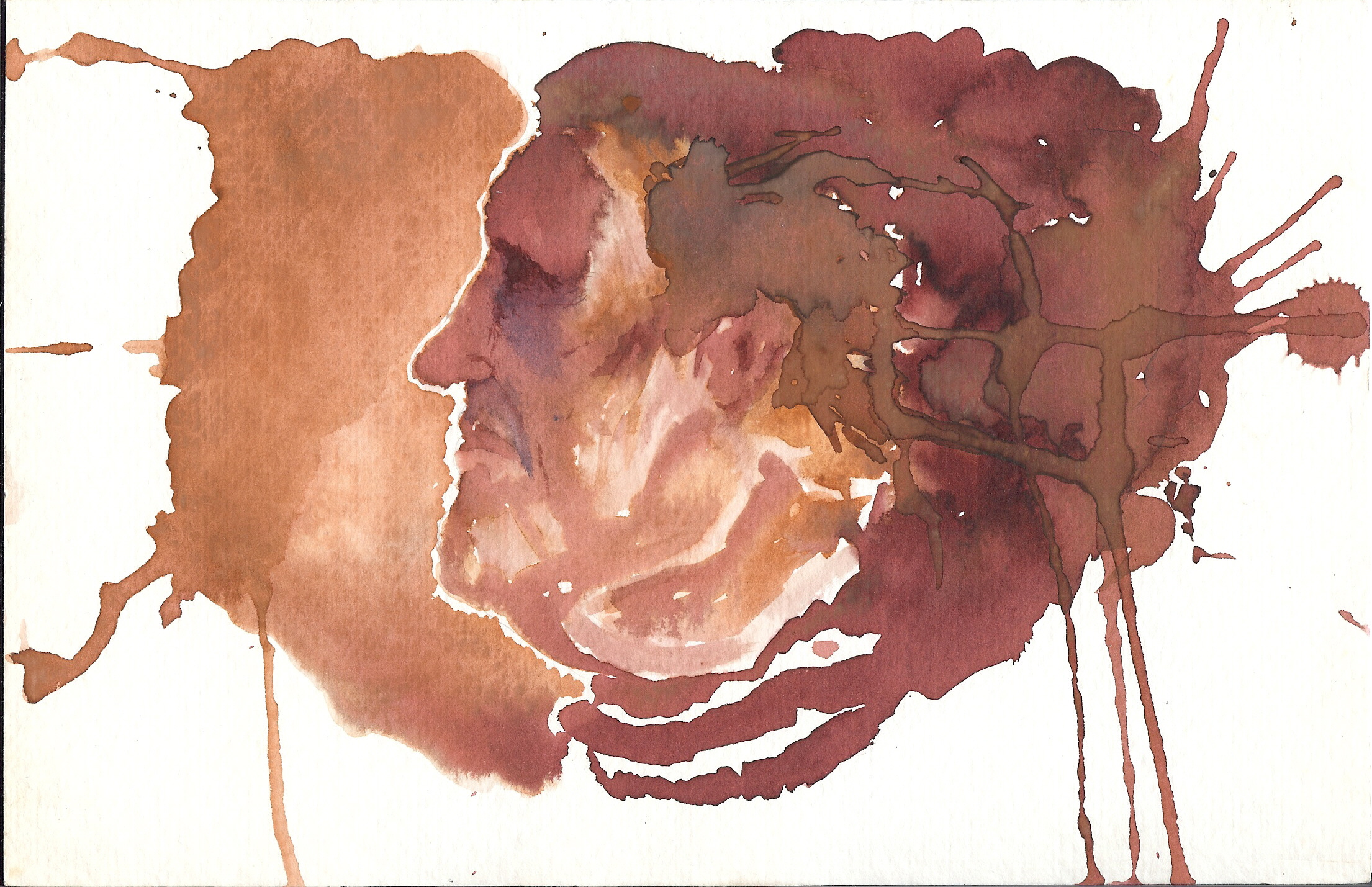
Painting for me has always been more like reading tea leaves than faithfully representing something sitting before me.  I have always found that the excitement in painting was in not knowing exactly what would emerge from the blank sheet of paper or canvas, having to deeply look into the surface trying to discern what movement or stroke might be next.  Trying to make out the outline of something, anything, in the first puddles of paint that might become something tangible.  Much like seeing things in the clouds except with this, the clouds are controllable, to a certain point.

It’s something I’ve done since I was a kid.  I remember laying on the living room floor in the old house on Wilawanna Road, looking up at the white curtains my mom had over every window.  At the edge they frilled out a bit and in that edge I could see faces- peering eyes, flaring nostrils and gaping mouths.  It filled a lot of time during my pre-teen years when I was often alone.

The piece above was one of the first things I did when I first picked up painting after my accident many years back.  It was done with airbrush paints that had been lying around for years.  It started with a large puddle of colors on the right and I simply started dragging paint from the puddle, forming the brow.  I didn’t know it was a brow but it began to look like one to me and that led downward to the nose.  That shape led to another and to another and soon an image emerged, something tangible that had its own power, its own life and story.  Like reading tea leaves…

That is pretty much how I still paint to this day, with variations in the technique.  I find it an exciting and always enlightening way to work.  Always the potential for something new and different, which keeps life in the studio interesting.

Read Full Post »

Visible HopeThe show for the Haen Gallery is complete and now I begin to think of what I might say at the gallery about what I do, about the process and about the work in general.  It has become much more difficult to do so as the years have passed.  When I first began to do this it was easy.  I was still in contact with the public in my regular job and everything about creating my work was still forming and being thought out, still fresh in my brain.  But as time passed and my way of working became ingrained, less thought out and more instinctual,  words to express what I do and I feel about it became increasingly hard to find.  When I’m alone in the studio there is no need for words.  It’s all instinct and intuition.  Quite honestly, I usually don’t even begin to try to read anything into a painting until it is done.

But I do want to be able to talk about the work because I think it is primarily about communication, about expressing an emotion to the world.  Reaching out. 

So I try to come up with words that describe this.  But ideally, the words are moot and the work speaks for itself and people make their own connections to the paintings and see something in them that is more than I could have ever intended.  Their own hopes and dreams and lives.  To me, this is miraculous and perhaps the best part of what I do as an artist.

So I will be prepared to say a few words but hopefully the work will do all the talking.

And All Is Revealed

The show is title Now… and will be opening at the Haen Gallery in downtown Asheville, NC on November 22.  The show opens with a brief gallery talk at 5 PM and runs until 8:30 PM. 


Read Full Post »

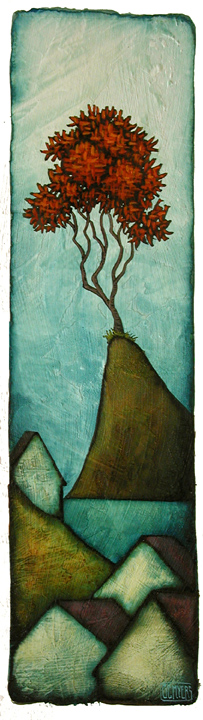
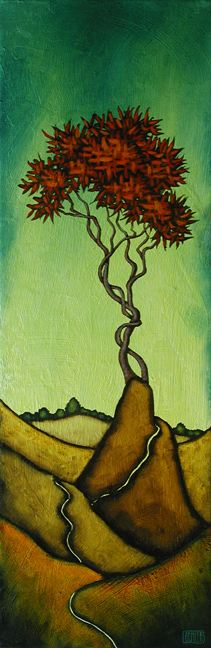
One Destiny This is a piece titled One Destiny which is a new painting that is 8″ wide x 24″ high and is on canvas.  It is part of my show, Now…, which opens November 22 at the Haen Gallery in downtown Asheville, NC.

The use of intertwined trees growing together into what seems a single crown of leaves is a recurring icon in my work.  The way trees sometimes grow and adapt to one another has always intrigued me.  There is a grace and natural rightness in the way they move upward, almost a dance.  The symbolism of the two trees coming together as a marriage or partnership of sorts is also unavoidable.

For me this piece comes back to the natural grace of the tree form.  This is something I’m searching for in each piece.  To me, this is more important than the reality of the representation because if it’s there the painting makes sense, even though though some details may seem illogical when you take the time to consider them.  I think this piece is a prime example of this.  The fact that there is a strange red tree (or trees) perilously perched on this strange little peak should seem odd and out of place in most cases but for me, and in my mind, the flow and rightness of the elements makes me see the scene as perfectly logical and natural.  

I don’t know if this fully explains what I mean.  I do know that One Destiny  meets my criteria for this definition and translates beyond logic.

Read Full Post »

Foundation

My head’s been swirling lately with things I thought I would never have to know, things that I never could imagine would impact my life-  derivatives, Credit Default Swaps, leveraging and deleveraging, etc.  There seems to be a huge disconnect between how the media generally portrays what this financial crisis really entails and how the people who are embroiled in it lay it out.  The story from the guys who know is much scarier than what the media or politicos feed us.  We’ve been living in a house of cards for much too long and there will be a change coming.  A return to building and living on a real foundation…

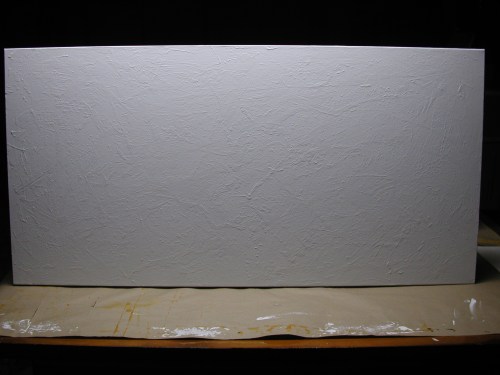
That being said, I thought I would talk briefly how I prepare my surfaces for paint, how I build my foundation.  Whether I am using paper, masonite or canvas ( the canvas above is 24″ X 48″), I start in the same way by laying down layers of gesso.  I splatter, trowel, brush, knife and push with my fingers, anything to create a deep and interesting texture.  The whole idea behind this is to create a surface that has an interesting and abstractly sculptural feel.  Basically, it has visual interest before I even lay down my first brush of paint.  I find that this forms a textural depth in the painting, one that may not register immediately but ultimately gives the piece life .

I also find that this textured surface works best when completely chaotic and undirected.  Trying to create a pattern underneath that drives the piece above more often than not comes off as contrived and clumsy.  It becomes too much a product of thought, losing all sense of natural grace, which is what I think the surface prep adds to a painting.

I will show how the canvas shown turns out in the next month or so…

Read Full Post »

« Newer Posts