Feeds:
Posts
Comments

Posts Tagged ‘Photography’

Cameron_Julia_Margaret_Iago_Study_from_an_ItalianA few months ago, I posted one of my favorite photos, Sadness, from the  British Victorian era photographer Julia Margaret Cameron.  I was struck by the contemporary feel and presence of the photo taken of the actress Ellen Terry in 1864.  It had a naturalness that was unlike much of the photography that we think of from that era, making me feel that it could be a photo from any time.

I recently came across another of Cameron’s photos that hit me in very much the same way.  It is an 1867 study of a young Italian man,  Angelo Colarossi, portraying Iago, the betrayer of Shakespeare’s Othello.  With downcast eyes, his unshaven face fills the frame and you don’t see any props to give away his character.  It may be betrayal that fills his face but for me it is more along the lines of Judas than Iago.  There seems to be remorse and even a bit of Christlike genuflection in his downward gaze.

Like Cameron’s Sadness, this piece has a freshness that makes it feel out of time.   It is a document of emotion that crosses time.  Cameron had a real knack for capturing the universal and eternal in her work, when all others were capturing stiff, glassy-eyed portraits in her own time.  For me, I use Cameron’s work as reminder of the quality that I want in my own work, that universal and timeless appeal, even though our methods and materials and eras are so different.

Just a great photo.

Read Full Post »

henri-cartier-bresson-leningrad neva riverI wrote the other day about the decisive moment  and mentioned the French photographer, Henri Cartier-Bresson,  who made great use of the term and concept in his work.  I am a fan of his work.  It would be hard to not find something in his work that draws you in.  Many are simply great images  with superb composition and an artistic rhythm running through them, showing the influence of his early training as a painter.  Some are mysterious and enigmatic, making you stop and just wonder what exactly was the story behind the photo, such as the image shown above of a sun bather along the Neva River in 1973 Leningrad .  And many capture defining moments in the 20th century, moments of history and change.

Decisive moments.

henri cartier-bresson_gestapo_informer_1945Cartier-Bresson was born in 1908 and witnessed nearly a century of such moments, his death coming in 2004.  He lived through both World Wars in Europe.  He fought in the second war and was a POW for nearly three years until he escaped and continued the war serving with the French underground resistance.   The photo here on the left is from 1945 showing a Gestapo collaborator being confronted in the aftermath of the war.  He traveled around the world at important moments, capturing the people on the street as change was taking place.  His photo of henri-cartier-bresson China 1949people in 1948 China in a crushing line to get gold allotted to them by the government as it teetered on the brink before finally falling to Communism.  Ten people were killed in the crush of this line.  In that same year, 1948, Cartier-Bresson also met Mahatma Gandhi.  He was one of the last people to meet Gandhi and his photos, taken a mere hour before he was shot and killed, are the last photos of him while alive.  Again,decisive moments.

As I said, there’s a lot in his body of work, something for everyone.  He is considered the grandfather of modern photojournalism, making the move from clumsy large  format cameras to the more portable 35mm  that allowed greater spontaneity and mobility.  It brought the immediacy of the moment on the street to film.

Something I find interesting about his grand life is that  he hung up his camera almost thirty years before his death and spent his final decades at his first love, drawing and painting.  Just an amazing life, a witness to a world at the most decisive moments of the time.

henri-cartier-bresson Aquila degli Abruzzi 1952henri cartier-bresson istanbul 1964


Read Full Post »

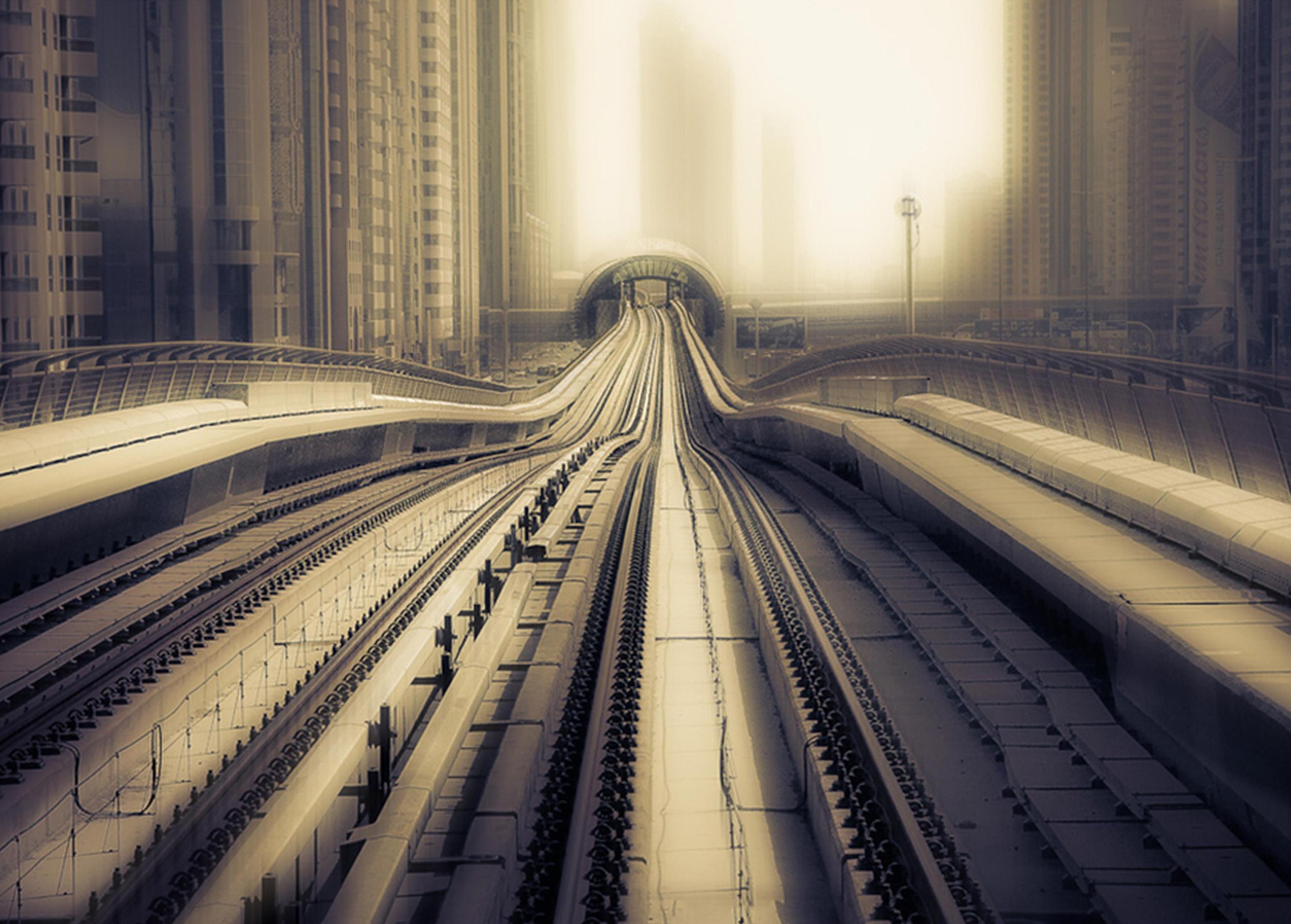
I wasn’t going to post anything today but there was this photo on a site  to which I subscribe, PhotoBotos.com, from photographer Nima Moghim.  It was of the tracks of the metro line in Dubai.  It is  an image of converging lines and stark tones that is at once both wonderful and terrifying.  It has a feeling that is devoid of anything natural besides the beautiful curve of the lines as they race towards each other in the distance.

Moghim’s own description of the photo only enhances the dark, dystopian nature of the image:

I took this photo in Dubai metro in late spring of this year. When I am on the metro train and pass all of these modern life indices which have been arranged like the children logo in this new city, I asked myself where the end of this luxurious life is and whether we don’t get closer to the Apocalypse with progress. The following sentences are my statement to the “Apocalypse now “and my declaration for this photo: 

“Apocalypse now….the words which hear frequency at these days and we almost fear. But who takes us toward the Apocalypse ? Who melts the Antarctic ices? Who makes a frightful weapon such as HAARP instead of music? Who throws bomb on his head? Who pours oil in the dark depth of ground in the clear waters? Who leaves his kin at the bottom of well for gaining power? Who prepare the blood baths for the naïve people on the pretext of freedom? Who focus the best trade in the world on the weapon? Who ridicules his fellow citizen on the pretext of inspection? And who transgresses all ethical virtues on the pretext of modernization? All people on the modernity express train are directed to a great explosion and we don’t know where the end is, 2012 or the next thousands of years? God is very patient …..”

Sorry for such an unsettling photo on a Sumday morning in the summer but it was too intriguing to not pass along.  Awful beauty…

PS– The HAARP mentioned in his declaration stands for High Frequency Active Auroral Research Program, which is a US Military research project that deals with the ionosphere and has been called the Moby Dick of conspiracy theorists who claim it is responsible for all sorts of recent natural disasters.  It was new to me but you can read a bit by clicking the link above.

Read Full Post »

I know that I just had a post on vintage photos the other day  and I don’t usually like to have similar posts too close to one another but I found these photos too interesting to not mention here.   They are called Hidden Mother photos and come from the Victorian era of studio photography.  They are photos of small children taken with their mother holding them while she is under a drape of some sort.  The photo is then matted with a window that crops out the mother so that the drape appears as a backdrop for the child.  In present times,  these  photos, now without their mats to expose the whole photo, have become very collectible.  What was intended to be a sweet image of a toddler now has a ghostly figure cradling a child, giving it a strange and slightly creepy feel that appeals to collectors.  Some are a little creepier than others.  Just found these interesting…

Read Full Post »

Last week I had a post that featured a photo of a French boy with cigarette and rooster that I found interesting.  It was from Luminous Lint, one of my favorite sites that features great and historic photography.  But I also love looking at some other photo sites that feature vernacular photography.  Everyday stuff.  Posing around the Christmas tree or day at the beach family photos that  often have an unusual quality that I’m sure  that the people who originally took the photos never expected or even noticed.  Probably the latter since most of these sites pick up most of their photos from flea markets.  Not all of the photos have any artistry at all but there is often humor, humanity or have an air of mystery around them that conjures up all sorts of possible stories about them in one’s mind.

One such site is The Boat Lullabies which is ran by the person behind Square America, a downed site that was amazing and one that I documented here several times over the years.   Then there is Accidental Mysteries from the collection of John and Teenuh  Foster which features found photos that really do have a mysterious quality about them.  Time Tales is a  neat Dutch site that features photos from around the world that are categorized into time frames.  And there’s Big Happy Funhouse  which offers found photos and free pie and GargantuaPhotos which has vintage photos for sale, including the photo below of Rivets, the terrier whose photo lists him as being the mascot of the USS Nitro in 1945.


These are all great sites where you could spend way too much time so be careful.  But do give them a minute to at least let your mind take in some of the imagery and let your imagination off of its leash for a bit.  I guarantee you will find at least one thing that will make you smile or at least feel as though you might somehow know these people or have worn that same goofy Halloween costume.

Have a great day…

Read Full Post »

I check one of my favorite sites, Luminous Lint, periodically to see what is new .  It’s a treasure trove of great and historical photography and there is always something interesting in the new images that are seemingly added daily.

The photo shown here immediately caught my eye and made me chuckle.  It’s titled Portrait of Henri Groulx and a Rooster and is from a Parisian photo studio from around 1920.  In these all so politically correct times, it’s kind of refreshing to see this French kid with his cigarette dangling.  That world-weary look on his face and the confidence  of his stance as he sits with legs crossed say that he’s six years old and he’s seen it all.  Probably waiting for the next cockfight with his superchicken.

Another interesting photo is this one from 1847 taken by Boston area photographers Southworth and Hawes.  It documents an operation at Massachusetts General that features one of the earliest uses of ether as an anesthetic.  I’m not sure if the man credited with introducing ether as an anesthetic, William T.G. Morton, is in this photo but he was known to have demonstrated ether in this use in the Boston area at that time.  I just find this photo a remarkable historical image which makes me really appreciate modern medicine, especially modern anesthesia.

With that in mind, I must get to work.  My health insurance won’t pay for itself…

Read Full Post »

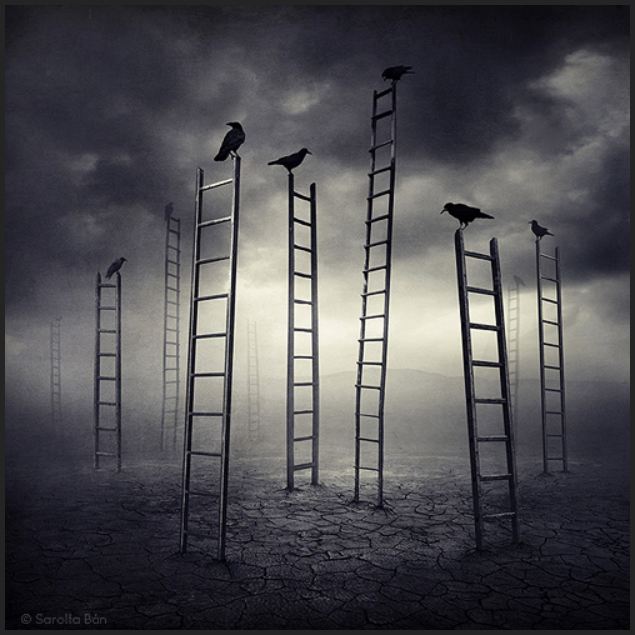
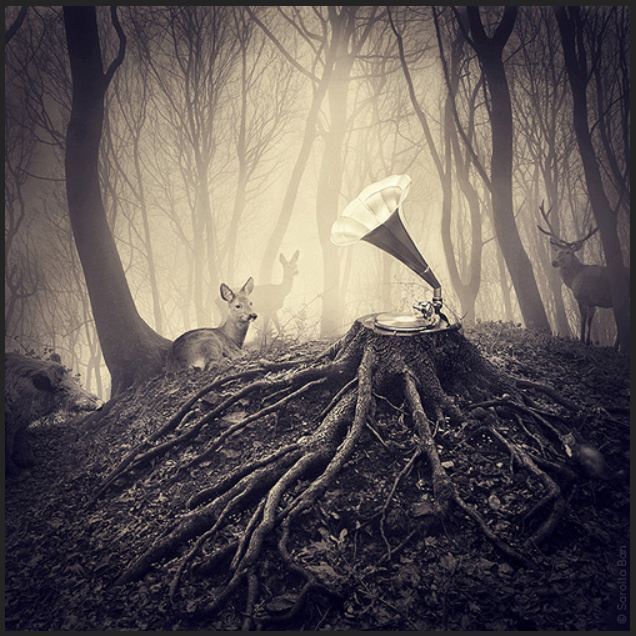
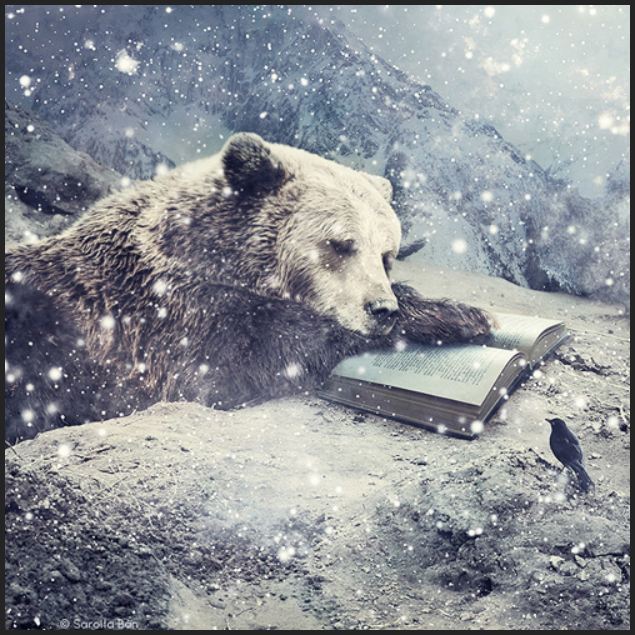
I came across some very interesting allegorical  photos  on the PhotoBotos.com site.  They are the work of a young  photographer from Budapest, Hungary by the name of Sarolta Ban, who digitally manipulates images of basically everyday items into thought-provoking scenes.  Her work reminds me very much, in tone and substance, to that of  Robert and Shana ParkeHarrison, who created the fantastic photos of the book The Architect’s Brother, which I featured here on the blog this past year. 

 The primary difference is that the ParkeHarrison work is not digitally manipulated.  They instead physically create the scenes and photograph them.  For some, especially photography purists, this is an important distinction.  But I am definitely willing to look past that and simply admire Ban’s beautiful work.  For me, it comes down to how her imagery affects me and makes me react.  And for me, her work has a dreamlike quality, filled with a quiet magic.  Peaceful but ponderous.  Just good stuff.

Read Full Post »

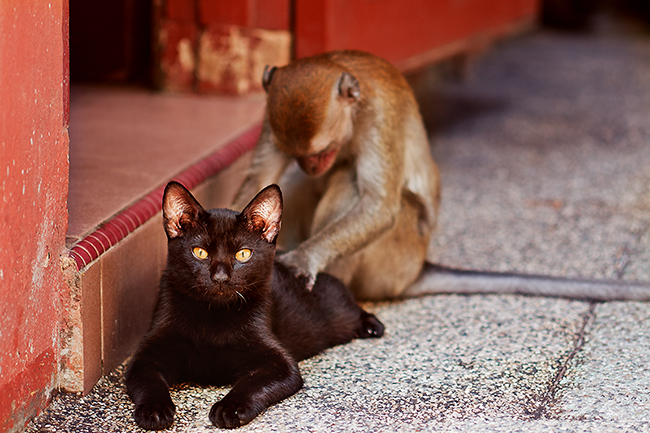
One of the blogs that I subscribe to is Photobotos.com which promises to deliver one amzing photo per day from photographers around the globe.  It pretty much keeps this promise consistently.  The photo shown here definitely falls in that category and was posted yesterday and really caught my eye.  It was a great  shot,  composed beautifully with  deep color and expressiveness.  It was shot by photographer Romain Mattei while traveling in Malaysia.  Mattei’s story, below,  of how the shot came about really adds something to this photo.  He writes:

I was spending the day in Kuala Lumpur without any plan of what to visit or to see. I was just going straight with only a map not to be lost. I make an amazing encounter purely by luck in a place where there were no tourists at all. A monkey and two cats were chilling on a chair in a patio. The two cats appeared to be pets but I wasn’t sure about the monkey. They were slipping and then playing together before the playful monkey pushed one of two sleeping cats out of the chair for fun. The cat lied down in order to keep on with its nap and this is when the monkey started to massage him. 

To me, it was a massage because he was really focused on doing it well on the back and the tail but of course if he would find a flea, he wouldn’t refuse a little snack. The cat was really enjoying and I was shooting the scene with my 100mm f/2.8 macro lens, which allowed me to be quite close to the scene. The two animals were not shy at all, the monkey was doing his job and the cat was even posing for the pictures. 

I took a whole series of pictures, it was too unique not to burn my Memory Card. I shot this one wide open in order to get the monkey a bit blurry but not too much so that the massage scene would be very recognizable. Like this, the focus point would be on the cat and the shot would be more eye-catching stressing the cat’s eyes looking right at me. 

Also, I didn’t want to center the cat’s face in order to strengthen the composition and I chose to place the cat on the picture following the thirds rule. The monkey was more or less in the center, but being blurry it didn’t affect the composition, not catching the attention that much. 

I left the right side empty, apart from the monkey’s tail in order not to overload the whole composition. 

I felt extremely lucky to witness this scene. After the monkey finished his massage/skin care, he went away and while I was shooting the cat completely relaxed, he came from a side and stole two bills in my pocket. I couldn’t believe it, I chased him to get my money back (maybe I should have left it to him as a reward for such a photographic moment) and while I was about to take my bills back from his hand, he put his hand behind his back like a little child!! He only wanted to play and then he gave the bills back to me himself. An extraordinary animal, so smart!


Read Full Post »

There’s a wonderful site to which I  subscribe , PhotoBotos.com, which blogs a remarkable photo each day.  From all parts of the world, most are spectacular shots and I always look forward to seeing what each new day’s offering will be.  Today’s was not a disappointment.  Called Soulside Journey, it is a shot of epic feel taken in the Cerce Valley of the French Alps by photographer Alexandre Deschaumes.  Just an amazing sight.

It made me want to see more of Deschaumes’ work and to learn a bit more about him.  Doing just a bit of research, I discover that he is a self-taught photographer who has been gaining acclaim in recent years for his stunning and emotionally charged shots of natural landscapes.  There is a nice online interview on the site Photography Office  that has Mr. Deschaumes stating: I find my inspiration in my hope and fears, through a simple mix of elegant curves , line and color harmony

I could very much sum up my own artistic philosophy in this simple sentence.  It makes me empathize very much with Mr. Deschaumes artistic vision and journey.  Going to his own site , which is filled with a vast number of his imagery, it’s easy to find many that speak to some of those same deep inner emotions that I seek in my own work.  Just plain good stuff.

I also found the lovely high-def film shown below from filmmaker Mathieu Le Lay that shows Deschaumes at work in the wild, trotting among some beautifully shot settings.  Gorgeous color.  Worth a look on a Sunday morning…

Alexandre Deschaumes – The Quest for Inspiration | Demo 2011 from Mathieu Le Lay on Vimeo.

Read Full Post »

There’s an exhibition currently hanging at  one of my favorite museums, the  extremely comfortable Phillips Collection in Washington, DC, called Snapshot: Painters and Photography, Bonnard to Vuillard.  It bascially shows how the advent of personal photography in the late 1800’s, with the invention of the Kodak handheld camera, changed how many artists worked.  The camera allowed artists to capture moments without their easel as well as permitted them to ponder an image long after the moment had passed.  This exhibit focuses mainly on the effect fo the camera on the Post-Impressionists, such as George Hendrik Breitner, whose photo of a girl in a kimono and the resulting painting is shown here.

I have seldom used photos as a pure reference source but, as this blog will attest, have been influenced by many of the photographed images I have come across through the years.  I think this exhibit would be a wonderful insight into how the photographed image is used to translate the artistic vision.   It runs at the Phillips until May 6 of this year

Read Full Post »

« Newer Posts - Older Posts »