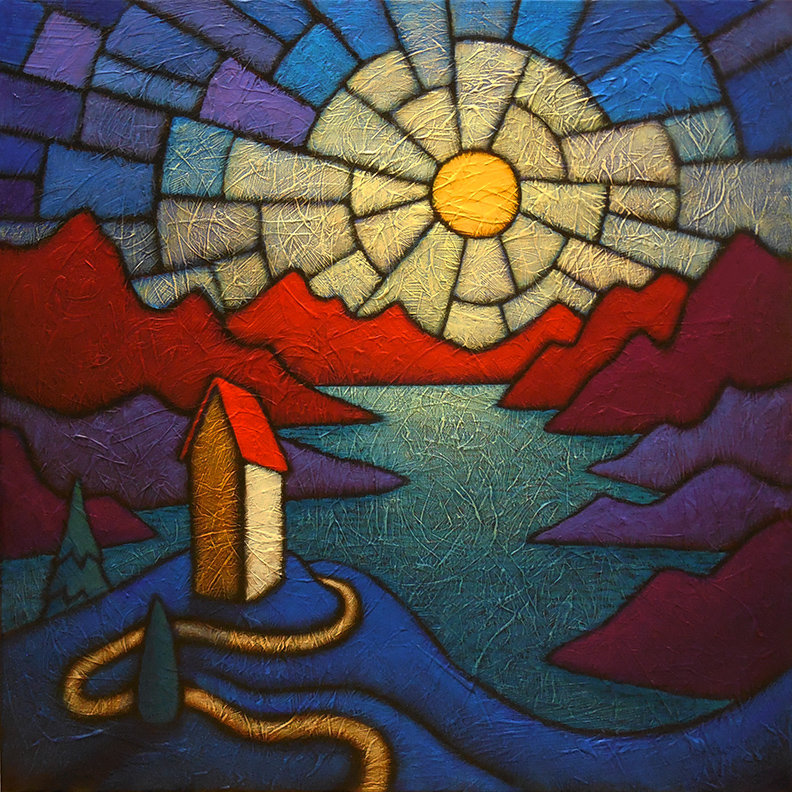
Lux Templi-At the West End Gallery
Do you sometimes want to wake up to the singularity
we once were?
— Marie Howe, The Singularity
Yesterday, I came across a post from about four years ago of this short animation of a poem from poet Marie Howe. The post and the poem had slipped my mind, but I was moved upon reading it again.
Her poem is titled Singularity and refers to the theory from Stephen Hawking, and others as well. The accepted theory is that when a star dies it collapses into itself until it is finally a single tiny point of zero radius, infinite density, and infinite curvature of spacetime at the heart of the black hole formed from the star’s collapse. A single point of immense mass and energy This was referred to as a singularity.
Hawking looked at this singularity and wondered since this was the end point of star’s death could it not also be the starting point for future new universes that might emerge if this singularity were to explode outward– the Big Bang Theory.
The underlying thought is that the universe and all that it is was once a single thing before the Big Bang created all that we know the universe to be now.
We were all part of one thing.
No, we were that one thing.
That is as simple as I can put it and still understand it. I am not even sure that simple explanation is correct. Probably off by a large fraction, like the final garbled message in the old Telephone Game, where something is whispered in one kid’s ear at a table. They then whisper it into the kid next to them and so on. By the time the message gets to the final kid, the message usually only contains a small part of the original message. I am probably that kid near the end of this process.
Admittedly, and much like Howe explains to her audience, my own grasp of advanced physics and most other great scientific theoretical concepts is limited. But the idea that we were once one and that we may all at some point become one again is somehow appealing to something inside me. It makes me think that maybe a form of singularity is the goal of all art– both an inward reduction of totality into a single tiny point as well as an outward explosion of this same totality.
Expressions of mortality and rebirth.
I don’t know for sure. This is just what the kid next to me whispered in my ear. If I’m way off base here, blame it on him.
The entire Marie Howe poem is below the video. Take a look then get the heck out of here. I got plans to either collapse or explode this morning. Not sure which it will be. Probably a theory on that somewhere.
SINGULARITY
by Marie Howe
(after Stephen Hawking)
Do you sometimes want to wake up to the singularity
we once were?
so compact nobody
needed a bed, or food or money —
nobody hiding in the school bathroom
or home alone
pulling open the drawer
where the pills are kept.
For every atom belonging to me as good
Belongs to you. Remember?
There was no Nature. No
them. No tests
to determine if the elephant
grieves her calf or if
the coral reef feels pain. Trashed
oceans don’t speak English or Farsi or French;
would that we could wake up to what we were
— when we were ocean and before that
to when sky was earth, and animal was energy, and rock was
liquid and stars were space and space was not
at all — nothing
before we came to believe humans were so important
before this awful loneliness.
Can molecules recall it?
what once was? before anything happened?
No I, no We, no one. No was
No verb no noun
only a tiny tiny dot brimming with
is is is is is
All everything home

 Redtree Times