Feeds:
Posts
Comments

Posts Tagged ‘poems’

Archaeology: The Silence of the World— Coming to Principle Gallery


I can imagine the silence when the world
will have stilled itself—no more poems tossed
off the tongue, no more screams
of raven lugging entrails of porcupine,
no more tales of the Navajo, or Louisiana black man,
or old-time Vermonter,
no more breathing in the ear of last lover…

The Silence of the World, Galway Kinnell


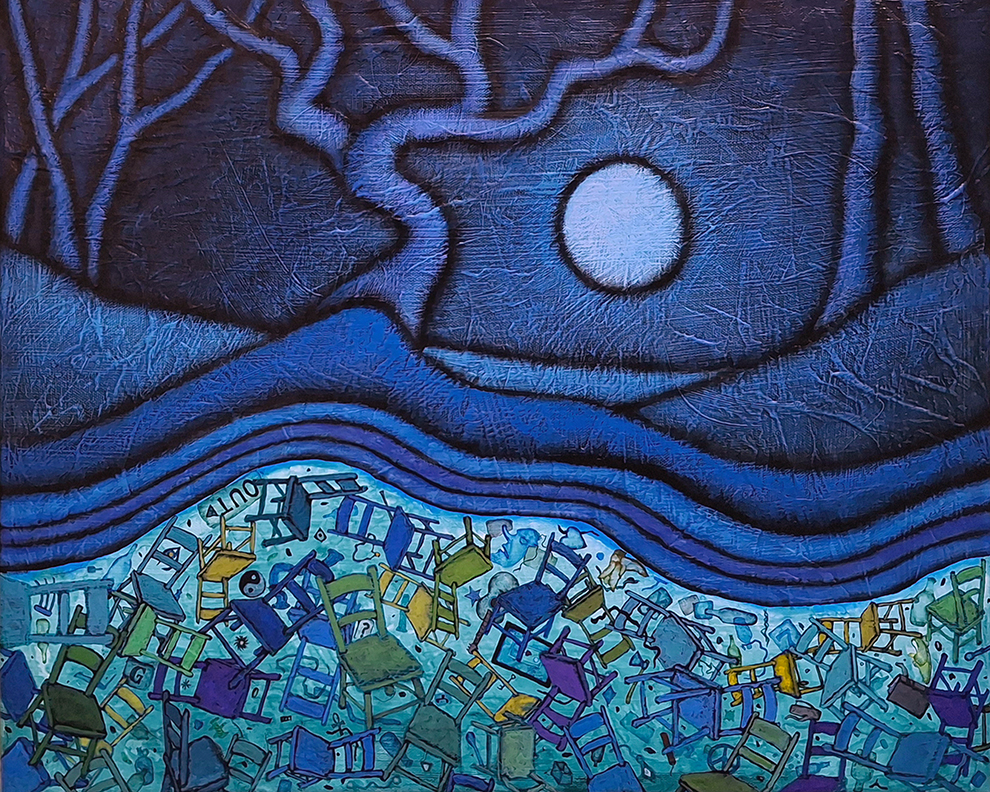
These are the opening lines from the first poem I encountered from Galway Kinnell, who I briefly wrote about t a few days ago. That idea of the world being without the hive activity of humans, forever cast in silence, stuck in my mind. It was just kind of hovering there for several weeks but came back to the surface in the past week as I worked on the new painting shown above.

It’s from my ongoing Archaeology series which first came about in 2008, after I returned to an exercise from a 5th grade art class when I was feeling deeply blocked creatively. I have only painted a handful of these Archaeology pieces in recent years, despite the fact that I do enjoy the process of painting them and that they have always been well received, both here and abroad.

Why that is, I don’t know. I suppose it’s as simple as the heart and spirit having to be in just the right place. Recently, I found that working on this piece and another in the same series have forced me to focus on the small moves that create the artifact fields in both. I needed to bring my mind back into the work and this really seemed to serve that purpose.

As I was working on this particular painting, that Kinnell poem–and its title specifically– began to haunt my thoughts. While many of the Archaeology paintings deal with the world beyond the time of man and how our existence will be reduced to buried artifacts, this piece brought other thoughts and questions to mind.

The primary question was: When humans are no more, does that mean that heaven no longer exists? Are heaven and hell attached to humans and will therefore cease to exist when the last human returns to dust?

I wasn’t bothered by either a yes or no answer to these questions. It will be what it will be without my opinion, fears, or hopes. Just wondering.

Yes or no, it will be a quieter world, filled with more silences. And that pleases me somehow. Humans seem to have a need to fill every empty space with sound and noise. And I think– without any evidence, of course– that this somehow throws the world out of equilibrium. That it seeks more silence.

And that is what I see in this painting. I chose to fill the artifact field mainly with chairs that represent the passing of man. For some unknown reason, I resisted making them Red Chairs. The upper part is painted in shades of blue that have a unifying silence in them. No noise from the contrast of colors or lightness.

Just a placid blueness.

And the tree in the foreground might be expressing in its twists the slightest delight in finally regaining the silence the world desired.

It’s a piece that fills me with a variety of feelings. I am saddened to see in it the end of our time and all that the human mind has produced that is good. Music, art, poetry, literature, and so on. But the idea of a reign of real silence along with the world returning to a greater equilibrium somehow satisfies me.

Don’t ask me why.

It’s given me a lot to both focus on and think about in here the studio. And I am grateful for that.

We all need things that make us think about things other than the things we think about. If you followed that, you’ve got a quicker mind than me.

Of course, I borrowed the title for this painting, Archaeology: The Silence of the World, from Kinnell’s poem which I have included below in its entirety.  I am also including a wonderful piece of music from composer Samuel Barber, his Adagio for Strings. This is performed here by the Berliner Philharmoniker conducted by Simon Rattle. The composition is built around beautiful silences that I feel reflect well on the painting.

Lovely music for a quiet Saturday morning, even if those damn humans are still out there making noise.


I can imagine the silence when the world
will have stilled itself—no more poems tossed
off the tongue, no more screams
of raven lugging entrails of porcupine,
no more tales of the Navajo, or Louisiana black man,
or old-time Vermonter,
no more breathing in the ear of last lover,
no more angelic beings left to be kissed
into the claustrophobia of flesh,
no more temples giving light
from open doors into bitter winter nights, no more
curious weasel who leaves
her black ring frozen in the air,
no more tooth that gnaws through gum and bones into
the cathedral of the mouth.
No more splat when singer spits
mouthwash into the washbasin after the concert,
no more “Quit yer bawlin!”
from punk principal to slob schoolboy
when sore mother hauls
small boy into classroom by sore ear.
No more young woman in large hat in profile
in afternoon light saying, “So what, darling?
I don’t hate you. I love you. So what?”
No more flutesman trudging through snow
on 125th Street on the last Sunday morning of his jeopardy.
No more husband saying, “Snack bar’s the other way.”
No more wife replying, “You aren’t going to eat again, are you?”
No more husband replying, “I don’t want to eat,
I was just telling you where the snack bar is.”
No more wife replying, “For Chrissake! I know where it is.”
No more caesura or else everything one endless caesura,
no more feminine rhyme such as “lattice” and “thereat is,”
no more parallelismus membrorum panting in one ear,
no more Neruda’s slowly deepening voice saying,
“Federico, te acuerdas, debajo de la tierra . . .”
From across the valley the thud of an axe
arrives later than its strike
and the call of goodbye slowly separates itself
little by little from the vocal chords of everything.

The Silence of the World, Galway Kinnell, The New Yorker, May 13, 2013
Read Full Post »

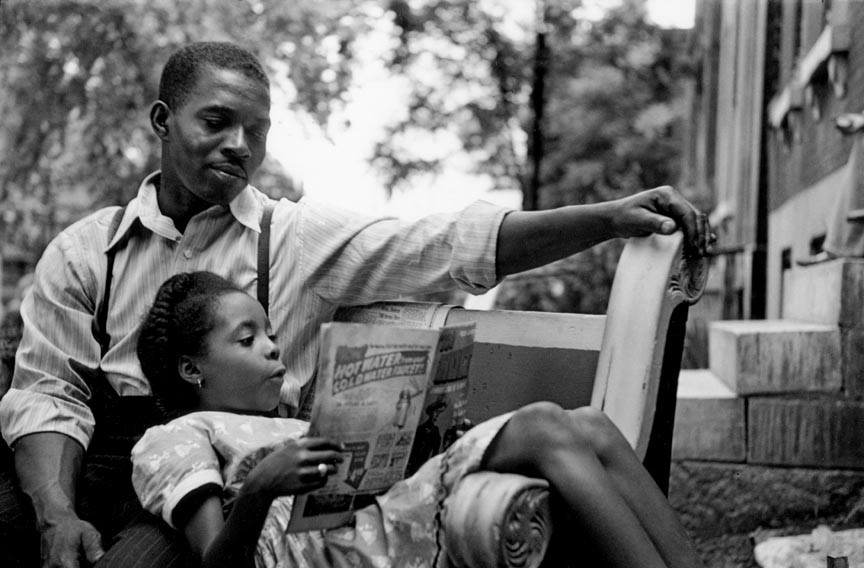
Gordon Parks- Father /Daughter, St. Louis, 1950


The post below is from a couple of years ago and has been by far my most viewed post in recent days.  In light of the poorly veiled political and cowardly cancellation of Stephen Cobert’s Late Night show, I thought it might well be worth revisiting. I have added another chapter from the Robert Hayden poem on which the post is based.


One of my favorite parts of writing this blog is the stream of consciousness part of it where I encounter something new. That part where I begin to research and one thing leads to another and another, wild tangent  to wild tangent. The result is that I end up learning of someone of whom I was previously unaware or some new concept or fact.

It often starts innocently. For example, this morning I stumbled across a short video from last night’s The Late Show with Stephen Colbert where the singer Dua Lipa turned the tables and asked Colbert about whether his comedy and his faith ever intersected. His answer was thoughtful and complete. I urge you to watch the clip at the bottom.

But in it, he invoked lines from the late poet Robert Hayden , from his 1970 book of poetry titled Words in the Mourning Time, that were very powerful and to the moment:

We must not be frightened nor cajoled
into accepting evil as deliverance from evil.
We must go on struggling to be human,
though monsters of abstraction
police and threaten us.

Words powerful enough that I immediately began looking up Hayden. I was a little embarrassed and ashamed that I didn’t know the name. His credits and the poems that I read were staggeringly impressive.

Hayden was an African-American born in Detroit in 1913 and died in 1980. He was the first African-American to hold the post Consultant in Poetry to the Library of Congress, which is now known as Poet Laureate.

Inspired by the poetry of W.H. Auden  and Stephen Vincent Benet, Hayden’s work often outlined the experience of the African-American throughout our history. But even so, Hayden rejected the idea of being called a black poet, referring to simply be recognized as a poet. This small distinction put him somewhat out of favor during the 1960’s with the black community though in essence his desire to be recognized without reference to his race represented one of the desired goals of the civil rights movement.

In fact, the whole of the verse from which Colbert quoted made just that point:

We must not be frightened nor cajoled
into accepting evil as deliverance from evil.
We must go on struggling to be human,
though monsters of abstraction
police and threaten us.

Reclaim now, now renew the vision of
a human world where godliness
is possible and man
is neither gook nigger honkey wop nor kike

but man

permitted to be man.

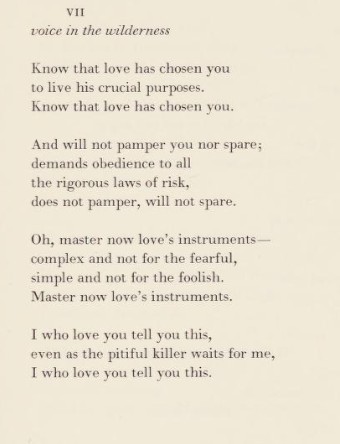
Words in the Mourning Time is a longer poem comprised of ten separate chapters that explores and mourns the world in the time period in the era of the Malcolm X/ RFK/MLK assassinations, and the horrors of the Viet Nam War. It speaks equally to the time in which we now find ourselves in 2025. Below is another chapter from the poem, voice in the wilderness, that really struck a chord with me:

I am including a couple of his other poems below. One is Those Winter Sundays which movingly speaks of the simple duties of love carried out by parents that are often overlooked by their children. Powerful. The other is Frederick Douglass.

As I read this poem, I wondered as I have many time before how nobody had yet made a big biographical film about the life of Douglass, who I consider one of the most fascinating, impressive, and influential characters in our history. This led me to looking this up and it turns out that the production company formed by Barack and Michelle Obama have one currently in production based on the Pulitzer Prize winning biography, Frederick Douglass: Prophet of Freedom, from historian David Blight. Hope it brings his power and eloquence to the attention of a wider swath of Americans.

Glad I watched the video below and found out more about Robert Hayden. I feel a bit more complete now. And that’s always a good thing.


Those Winter Sundays

Sundays too my father got up early
and put his clothes on in the blueblack cold,
then with cracked hands that ached
from labor in the weekday weather made
banked fires blaze. No one ever thanked him.

I’d wake and hear the cold splintering, breaking.
When the rooms were warm, he’d call,
and slowly I would rise and dress,
fearing the chronic angers of that house,

Speaking indifferently to him,
who had driven out the cold
and polished my good shoes as well.
What did I know, what did I know
of love’s austere and lonely offices?


Frederick Douglass

When it is finally ours, this freedom, this liberty, this beautiful
and terrible thing, needful to man as air,
usable as earth; when it belongs at last to all,
when it is truly instinct, brain matter, diastole, systole,
reflex action; when it is finally won; when it is more
than the gaudy mumbo jumbo of politicians:
this man, this Douglass, this former slave, this Negro
beaten to his knees, exiled, visioning a world
where none is lonely, none hunted, alien,
this man, superb in love and logic, this man
shall be remembered. Oh, not with statues’ rhetoric,
not with legends and poems and wreaths of bronze alone,
but with the lives grown out of his life, the lives
fleshing his dream of the beautiful, needful thing.


Read Full Post »

All of Time-At West End Gallery


My delight and thy delight
Walking, like two angels white,
In the gardens of the night:

My desire and thy desire
Twining to a tongue of fire,
Leaping live, and laughing higher:

Thro’ the everlasting strife
In the mystery of life.

Love, from whom the world begun,
Hath the secret of the sun.

Love can tell, and love alone,
Whence the million stars were strewn,
Why each atom knows its own,
How, in spite of woe and death,
Gay is life, and sweet is breath:

This he taught us, this we knew,
Happy in his science true,
Hand in hand as we stood
‘Neath the shadows of the wood,
Heart to heart as we lay
In the dawning of the day.

— Robert Bridges, My Delight and Thy Delight (1899)


I have things to attend to this morning, so I am sharing a simple trio that deals with something other than the state of the world or even the creative process. The trio today has more to do with love. I guess you could argue that love– or the lack of it– plays a vital part in both the state of the world and the creative process. So, maybe it is pertinent?

I don’t know. I just like this group and felt they all interwove well with each other, all dealing in a way with the theme of two angels. The poem above is from Robert Seymour Bridges (1844-1930) who was a British poet and the Poet Laureate of Britain from 1913 -1930. I was going to include just the first verse but the poem is not that long.

The song, Two Angels, is a longtime favorite from Peter Case. The painting at the top, All of Time, is at the West End Gallery. It’s one of those pieces that stick in my mind, maybe because its creation didn’t come easily. I began it then set it aside for a long time, often looking at what was there and wondering what the next step would be. It was a bit of an enigma. I was finally able to complete it so that it both pleased me deeply and found its own voice. That’s always satisfying.

The hard-fought ones often leave the deepest impressions—in painting as well in love and in life.


Read Full Post »