Feeds:
Posts
Comments

Posts Tagged ‘Principle Gallery’


The Answering Light— At Principle Gallery,

make a poem that does not disturb
the silence from which it came.

Wendell Berry


I run the post below every five years or so. Since I’m busy this morning (trying to not disturb the silence) and it’s been five years, thought today would be as good a time as any to replay it.

Regardless of what we do, we all need a reminder now and then to heed the silence.


I came across this poem a while ago from poet/author Wendell Berry on Maria Popova‘s wonderful site, Brain Pickings. It’s a lovely rumination that could apply to any creative endeavor or to simply being a human being.

I particularly identified with the final verse that begins with the line: Accept what comes from silence and ends with the lines above. I’ve always thought there was great wisdom and power in silence, a source of self-revelation and creative energy. Perhaps that self-revelation is why so many of us shun the silence, fearing that it might reveal our true self to be something other than what we see in the mirror.

Berry’s words very much sum up how I attempt to tap into silence with my work, to find those little words that cone out of the silence, like prayers, and to find inner spaces to paint that are sacred to me and not yet desecrated by the din of the outside world.

At the bottom is a recording of Wendell Berry reading the poem which gives it even a little more depth, hearing his words in that rural Kentucky voice. It’s fairly short so please take a moment and give a listen.


HOW TO BE A POET
(to remind myself)

Make a place to sit down.
Sit down. Be quiet.
You must depend upon
affection, reading, knowledge,
skill — more of each
than you have — inspiration,
work, growing older, patience,
for patience joins time
to eternity. Any readers
who like your poems,
doubt their judgment.

Breathe with unconditional breath
the unconditioned air.
Shun electric wire.
Communicate slowly. Live
a three-dimensioned life;
stay away from screens.
Stay away from anything
that obscures the place it is in.
There are no unsacred places;
there are only sacred places
and desecrated places.

Accept what comes from silence.
Make the best you can of it.
Of the little words that come
out of the silence, like prayers
prayed back to the one who prays,
make a poem that does not disturb
the silence from which it came.

Wendell Berry


Read Full Post »

Betwixt and Between— At Principle Gallery


The universe is full of magical things patiently waiting for our wits to grow sharper.

― Eden Phillpotts, A Shadow Passes (1919)


Running very late today. Overslept for a change. But I wanted to share the quote above from British author/poet/dramatist Eden Phillpotts who lived a life, 1862 to 1960, that spanned a time period marked by huge changes in society, culture, and technology.

It was an amazing time period to be alive. But, as Dickens wrote in regard to a different era, it was both the best and worst of times.  It was a time that saw huge advancements in science and medicine that brought relief to many who suffered. It was beginning of the Industrial Revolution with the huge technological shifts that advances brought such as the rise of the automobile, the airplane, radio, television along with the beginnings of space exploration and computerization. I am not always sure if the rise of the computer should go in the best or worst category. For this discussion, we will put it in the best.

But there were also two World Wars and multiple civil wars. Holocausts and ethnic cleansings. The rise of fascism and Nazism. The nuclear bomb was developed.

I am just spit-balling here off the top of my head and not even going into the cultural and societal shifts that occurred during that period. In short, it was an amazing time period.

But in that time period did our intelligence expand along with the knowledge that spawned such great change? Did our wits sharpen in any way to make us sense those magical things that surround us?

I can’t say. I doubt it. There is certainly little evidence of it taking place. Maybe that is why the bests and worsts of that era and our own run to the extremes. Maybe our wits are not yet developed enough to fully utilize the changes we have experienced as well as the magic that always surrounds us.

Hmm. That’s a lot to think about for a guy who just rolled out of bed and hasn’t even combed his hair or washed his face. Maybe I won’t even bother today. Maybe I will just focus on sharpening those wits. Mine have been dulled down lately and do need a touch up.

The painting at the top, Betwixt and Between, very much relates to the words of Phillpotts and the song below from Dave Brubeck. It is Sixth Sense from his 1964 album, Jazz Impressions of New York.


Read Full Post »

The Wakening Light— At Principle Gallery


Strange as it may seem today to say, the aim of life is to live, and to live means to be aware, joyously, drunkenly, serenely, divinely aware. In this state of god-like awareness one sings; in this realm the world exists as poem. No why or wherefore, no direction, no goal, no striving, no evolving. Like the enigmatic Chinaman, one is rapt by the everchanging spectacle of passing phenomena. This is the sublime, the a-moral state of the artist, he who lives only in the moment, the visionary moment of utter, far-seeing lucidity. Such clear icy sanity that it seems like madness. By the force and power of the artist’s vision the static, synthetic whole which is called the world is destroyed. The artist gives back to us a vital, singing universe, alive in all is parts.

In a way the artist is always acting against the time-destiny movement. He is always a-historical. He accepts Time absolutely, as Whitman says, in the sense that any way he rolls (with tail in mouth) is direction; in the sense that any moment, every moment, may be the all; for the artist there is nothing but the present, the eternal here and now, the expanding infinite moment which is flame and song. And when he succeeds in establishing this criterion of passionate experience (which is what Lawrence meant by ‘obeying the Holy Ghost’) then, and only then, is he asserting his humanness. Then only does he live out his pattern as Man. Obedient to every urge — without distinction of morality, ethics, law, custom, etc.

— Henry Miller, The Wisdom of the Heart, 1941


I’ve had this passage from Henry Miller sitting in a draft file for a long time now. Maybe it was his use of the dated stereotype of the enigmatic Chinaman that kept me from using it. It sounds cringey, yes. Definitely not the preferred nomenclature today, as Walter from The Big Lebowski would be quick to point out.

But I understand that his reference is not a slur as he was referring to the wise and stoic sages such as Confucius and Lao Tzu. It was about artists acquiring a similar Zenlike state in their work one that transports them to the eternal here and now, as Miller put it.

The expanding infinite moment which is flame and song…

That is what struck me about this passage. It is something I understand and maybe the main reason I am a painter today. More so than any reasons based on practicality or talent.

It is that moment that comes while working on a painting when I am no longer in the studio on that particular day but instead find myself in the place and time of the painting on which I am working–the eternal here and now

 A different reality has taken hold then and its feeling is palpable. It is both liberating from and unifying with the world in which I live. Liberating in that the world outside my studio with its lies, hatred, corruption, and stupidity seems like a distant planet in that time and place. Unifying in that this act of creation, this other time and place, allows me to express a connection with humanity that I sometimes struggle to find on the outer world. Asserting my humanness, as Miller wrote.

Of course, this does not happen here in the studio every time I stand before my easel. No, it is a rare gem that is buried deep and has to be excavated. The world impinges further into the studio on some days and in recent weeks I have lacked the energy and mental clarity to be transported fully to that other place and time– the eternal here and now— for any extended visits.

But it’s getting better every day. Yesterday I was able to once again find that place and time for a spell and it was like a trip to a spa for me. As free and easy a day in the studio as I have had in well over a month. It didn’t last long but it felt good for the time I was there and not here.

I hope to find that place and time again today. And to stay a little longer. 

Read Full Post »

Finis Terrae (Land’s End) — At Principle Gallery


Solitude is the profoundest fact of the human condition. Man is the only being who knows he is alone, and the only one who seeks out another. His nature – if that word can be used in reference to man, who has ‘invented’ himself by saying ‘no’ to nature – consists in his longing to realize himself in another. Man is nostalgia and a search for communion. Therefore, when he is aware of himself he is aware of his lack of another, that is, of his solitude.

-Octavio Paz, The Labyrinth of Solitude (1950)


I employed this passage from Octavio Paz a few years back but felt that it conveyed the search for communion that I see in this painting, Finis Terrae (Land’s End)Currently at the Principle Gallery, it is one of those pieces that haunts me, lingering with me in a way that is always close at hand.

It was that way while I was painting it and in the short time I spent with it in the studio before made its way to the gallery. I couldn’t stop looking at it. It seemed to represent a search for something beyond that which one could experience with the five senses.

I struggled to identify what that thing might be and realized that the thing being sought was a sense of communion, a uniting with all from which we are comprised.

In this realization, I recognized that it presented a duality.  I could see in this painting the ache that comes in the search, the desire to know that which is unknowable, while at the same time feeling a sense of peace.

That comes from understanding that the search is both a question asked in futility and its own answer.

It’s this duality that keeps me coming back to this painting in my mind.

It is both question and answer. And neither. A communion of both.

Don’t know if that will make sense to anyone but me this morning. Can’t tell if this is evidence of my mind getting sharper in response the antibiotics or evidence that it is still a bit lost in the fog.

Here’s a bit of music that I shared along with the words from Paz in that earlier post. It is a short classical violin piece from contemporary composer John Harbison. This is Song 2 from his 1985 work, Songs of Solitude. It seems to work for me as I look once more at this painting.

A needed communion…


Read Full Post »

The Pacifying Light– At Principle Gallery


A man’s work is nothing but this slow trek to rediscover through the detours of art those two or three great and simple images in whose presence his heart first opened.

-Albert Camus


These lines above are from an early essay, Between Yes and No, written by the French Nobel Prize-winning writer Albert Camus. It basically states, in sometimes grim detail, his belief that art “exalts and denies simultaneously.” In short, truth is generally somewhere in the middle, never absolutely in yes or no.

Yes or no is generally an oversimplified view, the extreme ends of the pendulum’s arc on which we swing.

While I may not fully understand all the subtleties of Camus’ essay, I do fully agree with the premise as I see it in my own simplified way. I think that art communicates best when it contains both the yes and the no— those polar oppositions that create a tension to which we react on an emotional level. For example, I think my best work has come when it contains opposing elements such as the light of hope or optimism tinged with the darkness of fear or remorse.

The Yes and The No of things. The certainty and uncertainty of all things.

Beyond that, I find this line about the artist’s effort to rediscover those few simple images that somehow first stirred something within their heart and soul intriguing. I certainly recognize it within my own work. I had no idea what I was trying to find when I first began to paint those many years ago. But the idea that there were some inner images that needed to be expressed nagged at me, even though I wasn’t fully aware of what those images were. They were slowly revealed to me and though I often didn’t fully understand their meaning, they somehow made sense and began to fill an emptiness.

That continues to this day. It is, as Camus, says, a slow trek. I still don’t know what to expect when I begin to paint and still have the nagging feeling that there is still an image out there– or in there– that eludes me. But I have some small degree of certainty, for whatever that is worth, that it is there waiting to be discovered. I just have to keep moving towards it.

Here’s a favorite song from a favorite artist, Rhiannon Giddens.  The song is the folk classic Wayfaring Stranger. It’s one of those songs that has been covered by a multitude of singers and is such a strong tune that every incarnation is equally wonderful.


Read Full Post »

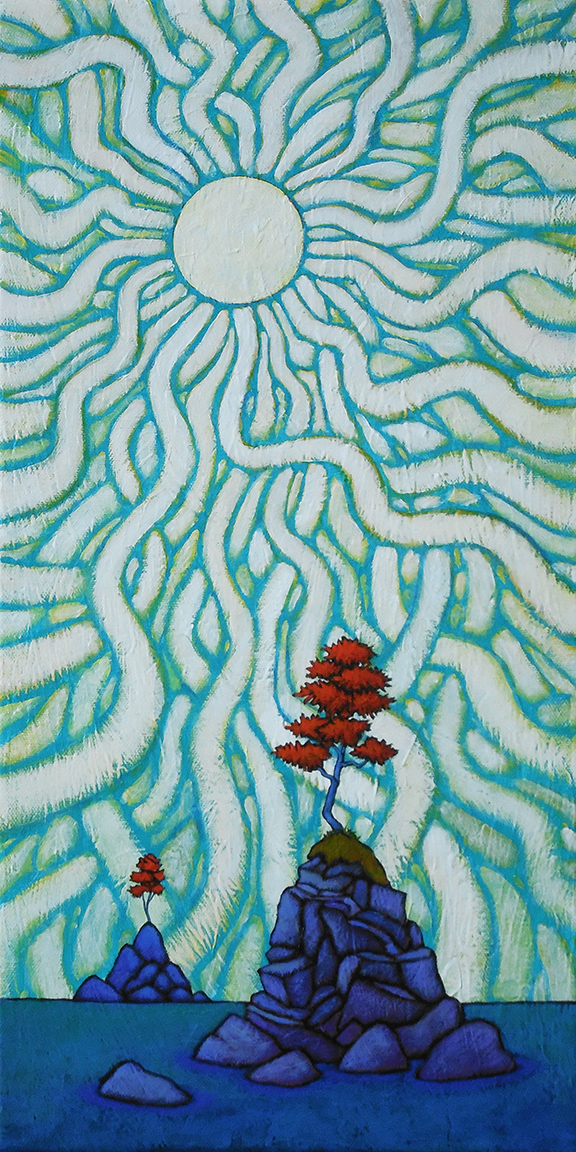
Wherever the Wind Takes Me – At Principle Gallery


All journeys have secret destinations of which the traveler is unaware.

–Martin Buber, The Legend of the Baal-Shem (1955)


Wasn’t planning on posting anything today but a song popped into mind and I thought I would share it. Not sure that it fully lines up with the painting or the words of Martin Buber at the top, which do mesh well together. The idea of secret destinations, of arriving at a point that is unexpected, is the basis for the story of many life journeys, after all.

How many of us can say our lives ended up exactly where we thought they would be when we first set out? And for those who did arrive exactly where they intended, I don’t know whether to envy or pity them. There’s something to be said for the security of sticking precisely to your set course. On the other hand, that insinuates that will travel unchanged throughout your long journey, that your desires and values won’t be shaken up and reorganized by things encountered along the way. That you won’t at some point realize that where you thought you wanted to arrive then was not the same as it is now.

For myself, it’s pretty obvious that I never had a real plan, a true set course to any destination. And though at times it’s been hard, and that even now, though my journey is much closer to its end than its beginning, I still am not sure where it will ultimately take me, I wouldn’t have it any other way.

Here’s that song. It’s another gem from that perfect coupling of artist and composer, Dionne Warwick and Burt Bacharach. From 1966, this is Trains and Boats and Planes.


Read Full Post »

The Entangling– At Principle Gallery


Centuries of husbandry, decades of diligent culling, the work of numerous hearts and hands, have gone into the hackling, sorting, and spinning of this tightly twisted yarn. Furthermore, we have not even to risk the adventure alone; for the heroes of all time have gone before us; the labyrinth is thoroughly known; we have only to follow the thread of the hero-path. And where we had thought to find an abomination, we shall find a god; where we had thought to slay another, we shall slay ourselves; where we had thought to travel outward, we shall come to the center of our own existence; and where we had thought to be alone, we shall be with all the world.

–Joseph Campbell, The Hero with a Thousand Faces (1949)


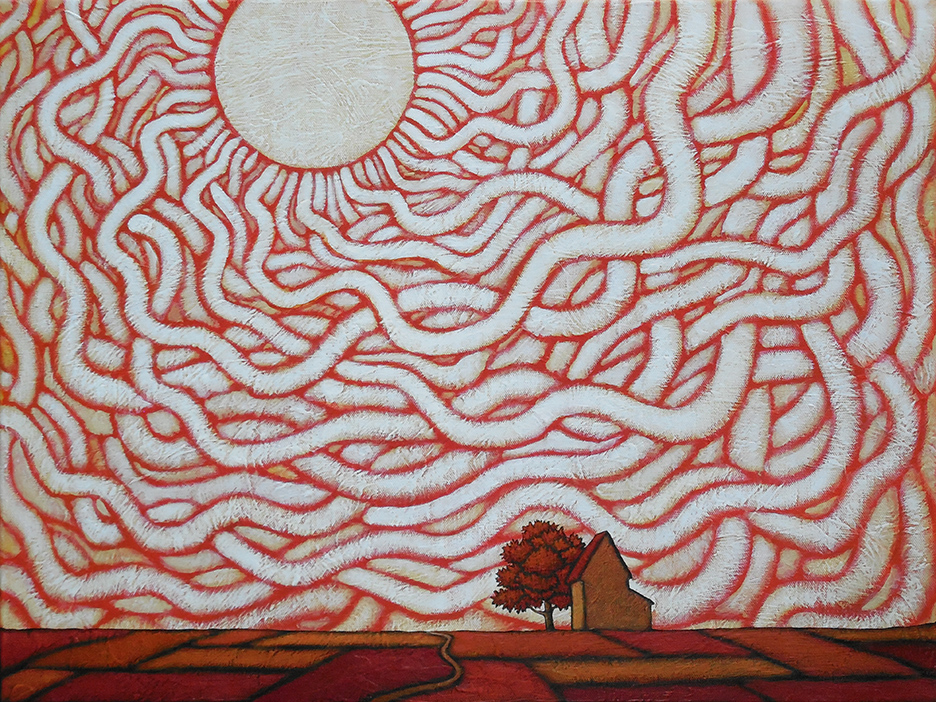
Was reading some Joseph Campbell and came across this passage and it immediately struck me as another way of looking at the Entanglement paintings from my recent Principle Gallery show.  Perhaps the twisting bands of ethereal energy as I see them are also representative of the twists and turns of the hero’s journey. It’s the story of human’s existence, one that takes them through a winding and often dark labyrinth filled with dead ends and numerous paths that seem to be leading to one’s desired destination only to be found to have led the traveler even further away.

And then when we are exhausted and filled with fear, all hope drained away, we take a turn on the twisting path and we find ourselves facing the light that gives us hope, the light that energizes and illuminates all that is behind and before us, showing us the unity of all things.

Hmm. Got to think about this a bit more.

Here’s this week’s Sunday Morning Music. Not sure it exactly fits the theme. I think it might. but it doesn’t really matter since I like this song and wanted to hear it this morning. It’s from one of my many favorites, Neko Case. This is Hold On, Hold On.


Read Full Post »


The artist must train not only his eye but also his soul, so that it can weigh colours in its own scale and thus become a determinant in artistic creation.

–Wassily Kandinsky, Concerning the Spiritual in Art (1912)


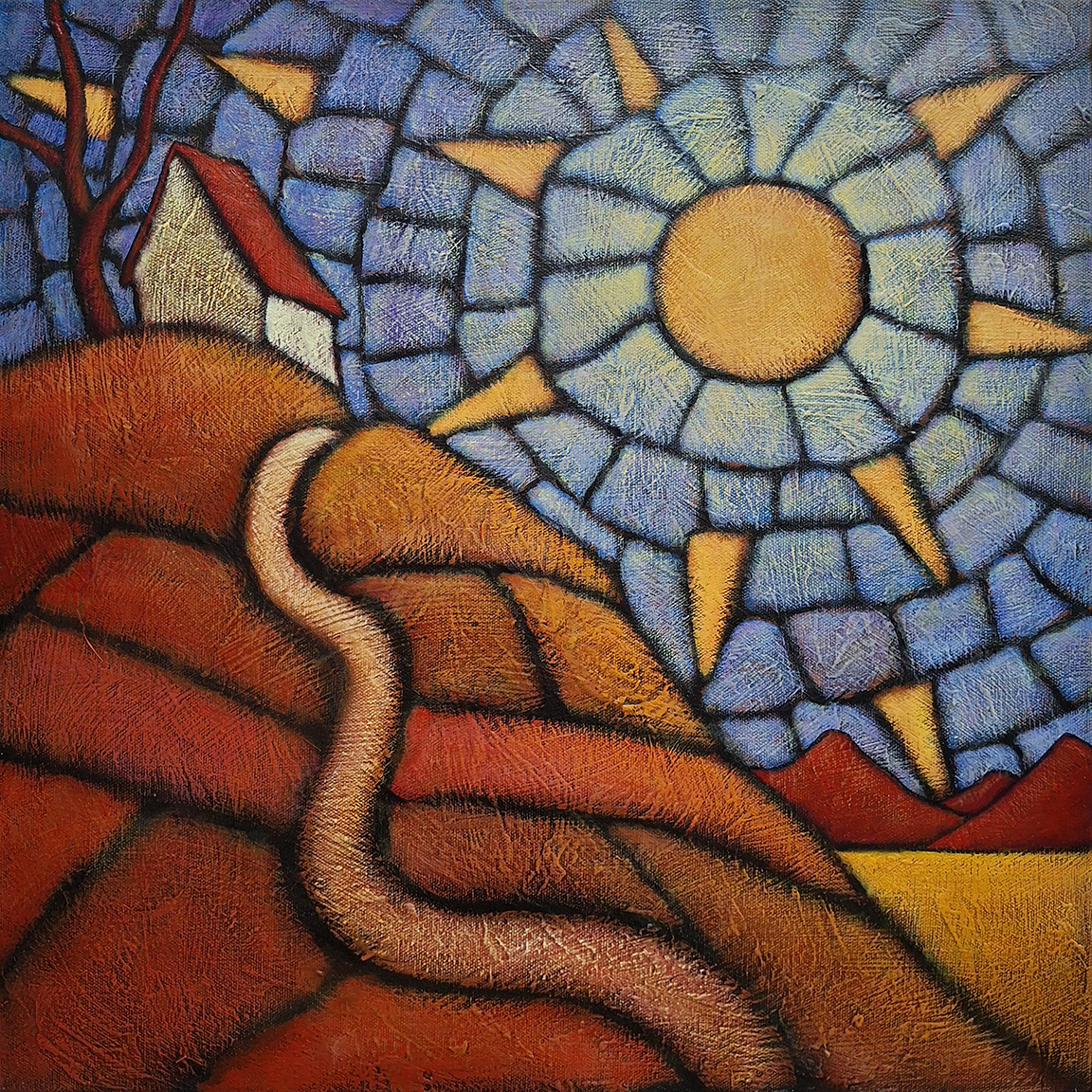
It’s been about a month since I gave a painting demonstration at the Principle Gallery. In the days after, I shared an image of the progress that had been made on the demo painting at the end of the session. I was fairly pleased with how it had emerged but could immediately see that there were changes– additions, subtractions and alterations– that needed to be made before it would truly come into form, at least to my eyes. There were a number of small adjustments and a couple of major changes.

Among the larger changes was altering the shape and color of the distant mountains in the lower right quarter. I simply wasn’t satisfied with the original. There was something in them– or not in them– that just didn’t sit right with me. 

I also changed the shape of the Red Roof house in the upper left. Again, the original just didn’t feel right to me. I depend on my ability to sense rightness in my work, and it was not meeting the mark.

I changed the angle of the roof and extended it a tiny bit, which allowed me to clean up some messiness in the sky behind it. It’s not that I mind a little messiness. The late biophysicist Max Delbruck (1906-1981) had a theory that he called the Principle of Limited Sloppiness. which stated that too much sloppiness was unacceptable in scientific research but allowing a little sloppiness sometimes revealed startling, unexpected results that could then be cleaned up. 

I guess you could say I adhere to Delbruck’s theory. A little sloppiness is fine and sometimes revelatory. However, in my work it’s a problem when the messiness is out of the rhythm of the painting and becomes a distraction, pulling focus from the whole of the painting.

Cleaning up that bit of messiness really honed the feel of the painting for me as did the fine tuning of the colors throughout. The rising road was lightened and a bit of darkness added to the left side of the hill, away from the sun, which, along with its light arrows, was brightened a bit.

It may not seem to the casual observer that the painting was greatly changed but to my eyes it emerged in a much different form., one that truly reaches that sense of rightness that I mentioned. Looking at it now here in the studio, it doesn’t feel like a hurried demo piece. It has its own feel and life now– an extension of the inner world I try to show in my work. It feels like it is truly part of that world now.

I used a Kandinsky quote at the top about an artist needing to train both their eye and their soul. I think of all the hours I have spent alone working in my studio have honed whatever skill I possess– the eye that Kandinsky mentions– as well as the sense of rightness which might well translate as the Kandinsky’s soul. I don’t really know that can express what I am trying to say but I like the idea that an artist is seeking their own soul in their work.

I am pleased I was able to share a little of what seeking looks like with the folks who made it to the demonstration a month ago. Many thanks again to everyone who made it possible.

I have yet to title this piece. A reader suggested the title of an old Cat Stevens song, Road to Find Out, as a title. That might work but I am open to suggestions. Let me know what you think.

Let’s listen to that Cat Stevens song. There’s larger image of the completed painting below. That is, if it is truly completed. Like people, art sometimes needs to change…


Read Full Post »

The Entanglement— Now at Principle Gallery


The force that through the green fuse drives the flower
Drives my green age; that blasts the roots of trees
Is my destroyer.
And I am dumb to tell the crooked rose
My youth is bent by the same wintry fever.

The force that drives the water through the rocks
Drives my red blood; that dries the mouthing streams
Turns mine to wax.
And I am dumb to mouth unto my veins
How at the mountain spring the same mouth sucks.

The hand that whirls the water in the pool
Stirs the quicksand; that ropes the blowing wind
Hauls my shroud sail.
And I am dumb to tell the hanging man
How of my clay is made the hangman’s lime.

The lips of time leech to the fountain head;
Love drips and gathers, but the fallen blood
Shall calm her sores.
And I am dumb to tell a weather’s wind
How time has ticked a heaven round the stars.

And I am dumb to tell the lover’s tomb
How at my sheet goes the same crooked worm.

–Dylan Thomas (1933)


This is considered the poem that more or less brought Dylan Thomas to fame as a poet. I read it again recently and was surprised at how well it aligns with the theme of my show, Entanglement, at the Principle Gallery. It basically describes how our timed existence here on this world is simply part of the timeless driving force of the universe. How that in this place made of time, the very force allowed us for our short stay here, the life force that energizes us, ultimately destroys then leaves us to regather with its timeless source.

Not sure that it is something that is easily explained and I am not sure if I was able to adequately convey that message with this show. But since the show ends today, I felt it was worth sharing this morning along with a splendid reading from Thomas’ fellow Welshman Richard Burton. And for good measure, I added a favorite song from a favorite guitarist, Martin Simpson. Last shared here a couple of years back, it’s titled She Slips Away, and was written about the death of his mother, as she moved from time to timelessness.

As does my Entanglement show which ends today. So, if you want to see it, today is your last opportunity to see it in its entirety before it moves into the realm of the timeless.


Read Full Post »

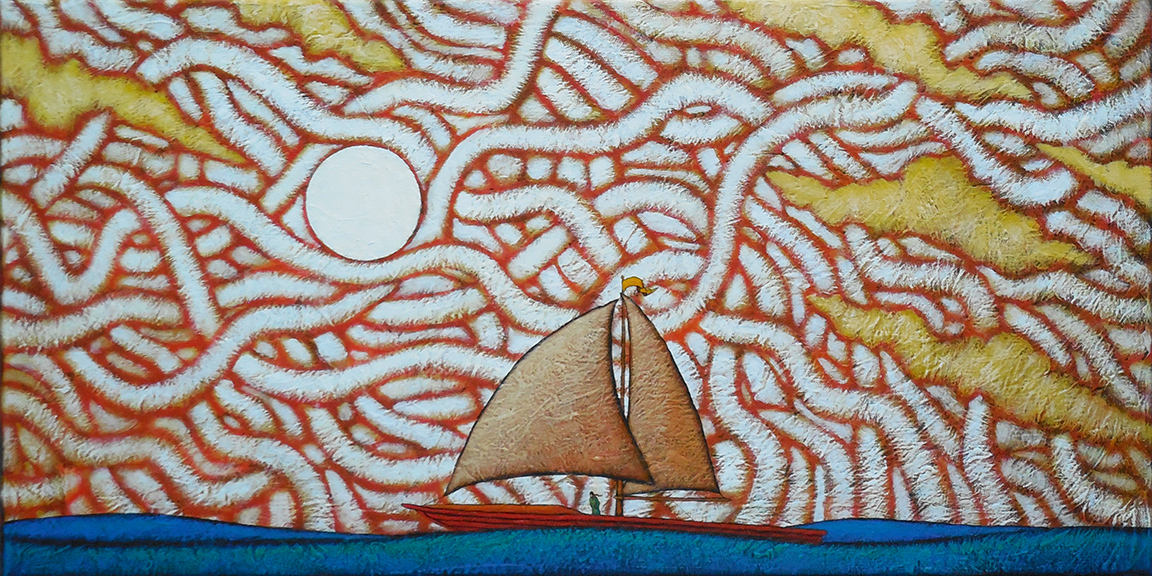
Betwixt and Between— At Principle Gallery


Don’t think. Thinking is the enemy of creativity. It’s self-conscious, and anything self-conscious is lousy. You can’t try to do things. You simply must do things. 

— Ray Bradbury


I ran a post featuring a Ray Bradbury quote the other day which reminded me of another of his quotes and a favorite blog entry from the past that employed the above quote. It’s a refinement of a quote from a 1962 essay, The Queen’s Own Evaders, in which Bradbury wrote about his time in Ireland writing the screenplay for the 1956 John Huston film, Moby Dick.

Never wanting to be a screenwriter, Bradbury adapted only his work for movies or television but made an exception when offered the chance to adapt the Melville classic. He struggled for months and months trying to adapt the novel then one day realized he was being too self-conscious, overthinking every word and element. He began anew and, at the end of an epic eight-hour writing session, finished the script.

The original quote was:

Self-consciousness is the enemy of all art, be it acting, writing, painting, or living itself, which is the greatest art of all. 

Ridding one of self-consciousness was a subject that popped up in many of his essays and interviews over the next 20 years or so as he refined the message. I well understand his view since I feel that I am least self-conscious when I am painting. My paintings are my world much like Bradbury’s world was that of Mars or the October Country or the strange, animated skin of the Illustrated Man.

Bradbury also stated over the years that an artist should not attempt to explain an artwork while it is being created. That’s how I feel about painting, as well. You do it. Then you think about it. As a result, that is why I seldom even begin to think about what the painting is about or what it might be called until it is done or at least well into its process.

Bradbury’s words on creativity are worthwhile for anyone, not just writers or artists. As he said, living is the greatest art of all. Here’s that earlier blog post, last shared here in 2018:


I came across this quote from famed sci-fi writer Ray Bradbury on an online site with quotes on creativity. This struck close to the bone for me as I have proudly not thought for years now. I have long maintained that thinking usually inhibits my work, making it less fluid and rhythmic.

It’s a hard thing to get across because just in the process of doing anything there is a certain amount of thought required, with preliminary ideas and decisions to be made. I think that the lack of thought I am talking about, as I also believe Bradbury refers, is once the process of creating begins. At that point you have to try to free yourself of the conscious and let intuition and reaction take over, those qualities that operate on an instantaneous emotional level.

I can tell instantly when I have let my conscious push its way into my work and have over-thought the whole thing. There’s a clunkiness and dullness in every aspect of it. No flow. No rhythm. No brightness or lightness. Emotionally vacant and awkward. Bradbury’s choice in using the term self-conscious is perfect because I have often been self-conscious in my life and that same uncomfortable awkwardness that comes in those instances translates well to what I see in this over-thought work.

So, what’s the answer? How do you let go of thought, to be less self-conscious?

I think Bradbury hits the nail on the head– you must simply do things. This means trusting your subconscious to find a way through, to give the controls over to instinct.

And how do you do that? I can’t speak for others but for myself it’s a matter of staying in my routine. Painting every day even when it feels like a struggle. Loading a brush with paint and making a mark even when I have no momentum or idea or at hand. Just doing things and not waiting for inspiration.

You don’t wait for inspiration– you create it.

So, stop thinking right now and just start doing things.

Read Full Post »

« Newer Posts - Older Posts »