Feeds:
Posts
Comments

Posts Tagged ‘Quotes’


Night, the beloved. Night, when words fade and things come alive. When the destructive analysis of day is done, and all that is truly important becomes whole and sound again. When man reassembles his fragmentary self and grows with the calm of a tree.
–Antoine de Saint-Exupery


This is a new painting, Nightheart, that is headed west to my friends at the Just Looking Gallery in San Luis Obispo.  It’s about 11″ by 34″ in size and has a most cam and contemplative aura around it.  This morning, when I came across the words above from  Antoine de Saint-Exupery , the French author of The Little Prince and a real man of action as well, I immediately thought of this painting.

When man reassembles his fragmentary self and grows with the calm of a tree.   That line may say more about what I want for and see in  my work  than anything  I have ever said myself.  In fact, reading his words right now leaves me speechless.  And calm, like that tree.

I will simply let that line above stand on its own alongside this painting.

Please take a moment  to click on the link above and read a bit on the life of Antoine de Saint-Exupery.   A full but short life…

Read Full Post »

The man who insists upon seeing with perfect clearness before he decides, never decides. Accept life, and you must accept regret.

****************

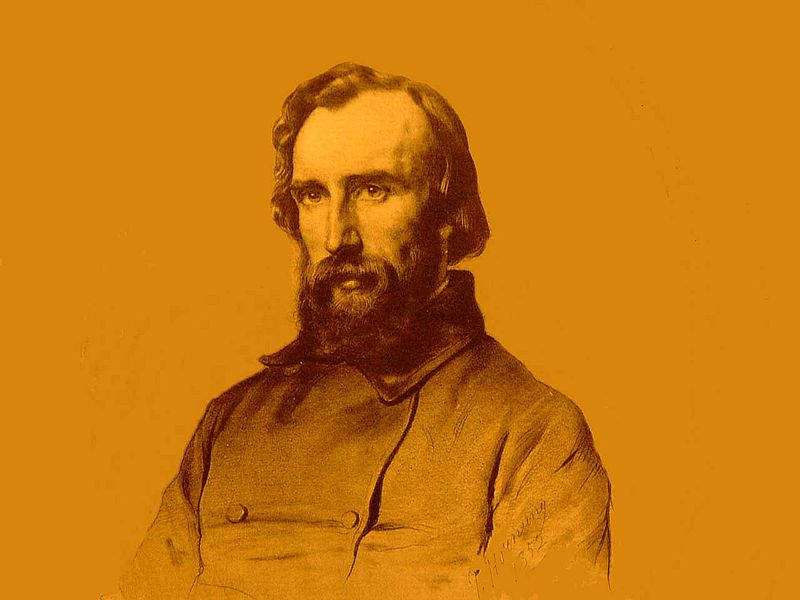
One of the great things about the cyberworld is the ability to find the work, either in image or words, of those people that might easily go unnoticed in the past.  You can now come across a few words or images that intrigue  you and within moments have access to a world of information about the writer or artist.  Such was the case recently when I stumbled upon a few quotes from the writer of the words above and  shown in the portrait above, Henri-Frederic Amiel

Born in 1821, Amiel was a Swiss professor, poet and writer who died in 1881, leaving no major marks on the world before his death.  Although esteemed, his poetry was not celebrated and he made no major breakthroughs as a professor of moral philosophy in his time.  It was after his death that Amiel began to live on in the form of a personal journal that he kept from the 1840’s until the time of his death.  Called the Journal Intime, it is a wondeful inner exploration of the man, exposing a depth of thought apllied to universal truths.  His words, written over 150 years ago in many cases, seem as fresh and as true today as then, a fact that made the Journal Intime a timeless classic  in much the same manner as the essays of Ralph Waldo Emerson

However, despite its acclaim after it posthumous publishing, the book has faded from the modern consciousness  and may not grace the shelves of many libraries.  But thanks to the online world, it is a book that is now readily available to those wishing to read these thoughtful words.  It is available on most book sites and is available free at a number of sites including Project Gutenberg.

So many of the quotes that have been pulled from the Journal Intime ring true for today, including those that could be applied to subjects that are hotly debated in this country such as healthcare and taxation of the richest of us:

In health there is freedom. Health is the first of all liberties.
Sacrifice still exists everywhere, and everywhere the elect of each generation suffers for the salvation of the rest.

I was probably drawn to his words by two that said what I have said for some time.

The great artist is the simplifier.

Learn to… be what you are, and learn to resign with a good grace all that you are not.

The Journal itself is not an easy read.  It is a winding road through the life of one man and doesn’t always reveal its truths quickly.  So if you wish to quickly absorb some of Amiel’s aphorisms, I suggest checking out his pages at BrainyQuote or ThinkExist.

Good stuff…


Read Full Post »

A gem cannot be polished without friction, nor a man perfected without trials.

–Chinese Proverb

^^^^^^^^^^^^^^

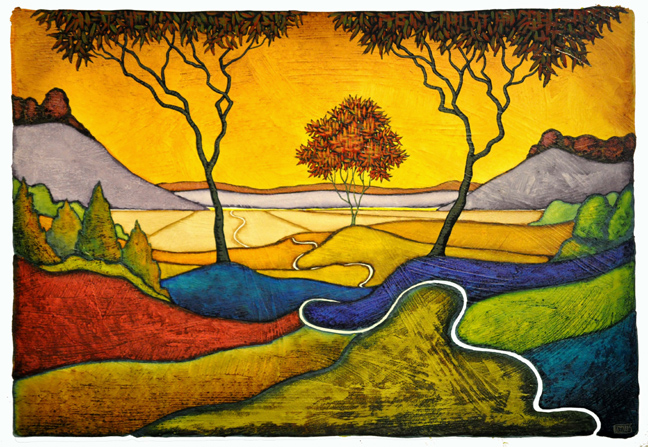
I call this new painting Gem.  It’s an 18″ by 26″ piece on paper.  The gem part came obviously from the deep and rich colors that run through and define  it.  It reminds me at first of a colorful bracelet or brooch dotted with bright gems.  Rubies and sapphires, emeralds and amethysts all set in a citrine yellow sky.  It definitely has a jewelry-like  appearance.  Bright and easy.  Almost a trifle.

But there seems to be a feeling in this piece that goes beyond the playful interplay of the surface colors, something that takes it far from being a trifle.  There is for me a feeling of self-realization in the central figure of the Red Tree, a sense of knowing and understanding one’s self.  It’s a sense that comes from knowing one’s strengths and weaknesses,  a realizing of all that one is and is not in an instant, a flash of insight.  And though it comes in as a sudden thought at a singular moment, it is formed through a lifetime of living, taking into account all successes and failures equally.  The trials that form  character, as the proverb above states.

Our lives are very much like a gem-studded bracelet, easy to see with all surfaces shining bright.  But the gems here have underwent eons of transformation through pressure and friction to reach that easy shine.  Maybe that’s what the white ribbon of the trail going through this painting signifies for me, a long and sometimes hard road to reach that final gemlike quality. 

Maybe.  All I really know is that this painting seems easy to take in at first but lingers on the way down.  And there is a great satisfaction in that discovery of something below the surface, an added depth that belies the shine of the gems.

Read Full Post »

Archaeology is the peeping Tom of the sciences. It is the sandbox of men who care not where they are going; they merely want to know where everyone else has been.

Jim Bishop
 
*************************************************************
 
   Maybe I fit into the quote above from the  late journalist Jim Bishop and maybe that’s why the idea of incorporating archaeology into my work, as I have done with my Archaeology series over the last few years, has been so appealing to me.  The idea of diverting our eyes from where we are headed to instead see where we have been, to examine those things which have shaped us as we stand now, is indeed intriguing to me.  We are the products of our past and where we are headed is often determined in the how and the why of the past.  Unfortunately, and to our detriment I fear, we often fail to look back and, as a result, are continually reliving  pasts that could and should  have been avoided.
 
This thought is definitely behind the title of this new piece, Archaeology: Formed in the Past, a 10″ by 16″ painting on paper.  I see the central Red Tree here as being formed and twisted by the artifacts below the surface, remnants of the past.  The trees in line behind stand  like stoic witnesses to this history.  The artifacts contain tools and toys, books and bottles, shoes and other items of the everyday– the things that make up a life and a world.  There is also evidence of the creative side of life here– a painting, paint brush, a drama mask, a ukulele and an artist’s mannequin. 
 
It’s always interesting to look at these pieces after finishing them and to see how they come together to offer up some sort of narrative in the collection of artifacts.  Interesting because I don’t really think about how the items will interact as I am painting.  No forethought at all really.   They’re just painted in rhythm as they come to mind, often just because a shape or form fits at the moment.  So when I see the commonality of thought and narrative  running through them, I wonder what the source might be. 
 
Is it just a reflection of my own psyche and interests? 
 
Perhaps.  Probably.  But even so, there’s something somehow compelling in sifting through the debris, even the debris of one person’s mind.

Read Full Post »

At the Movies #1

I watch a lot of movies in the studio when I am painting, mostly older films from the 30’s and 40’s because of their strong use of dialogue.  That’s important because I can’t always look at the screen.  But the beauty of the language and the way a story is told makes up for the sometime lack of visuals.  Every so often I want to share a quote or a moment from some of my favorites.  This is from Jimmy Stewart’s character, Elwood P. Dowd in the classic  “Harvey”:


“Years ago my mother used to say to to me, she’d say, ‘In this  world, Elwood, you must be’ – she always called me Elwood – ‘In this world, Elwood, you must be oh so smart or oh so pleasant’  Well, for years I was smart. I recommend pleasant. You may quote me.”

Something to think about.  Thanks, Elwood.

Read Full Post »

« Newer Posts