Feeds:
Posts
Comments

Posts Tagged ‘Red Tree’

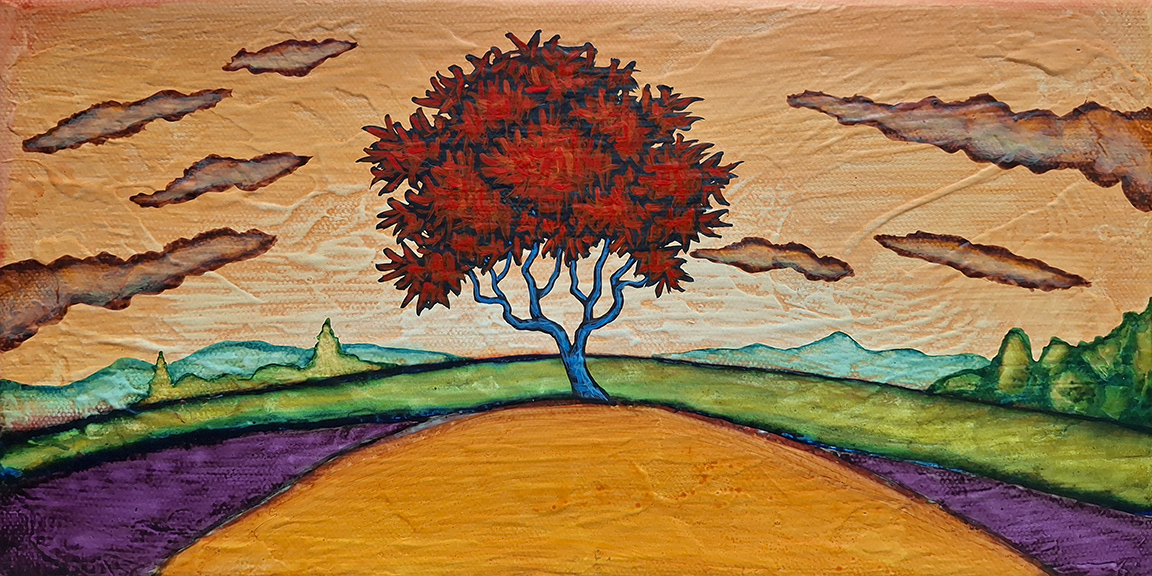
The Heart is Free— At West End Gallery


At Epidaurus, in the stillness, in the great peace that came over me, I heard the heart of the world beat. I know what the cure is: it is to give up, to relinquish, to surrender, so that our little hearts may beat in unison with the great heart of the world.

–Henry Miller, The Colossus of Maroussi (1941)


Que sera, sera.

Whatever will be, will be.

There’s a certain fatalistic aspect to this well-worn phrase that seems questionable in troubled times. On its face it seems to be saying that we should just accept things as they come. Don’t worry, be happy to quote another popular song.

Again, if that is the case, it seems like poor advice in dangerous times such as those through which we are now travelling.

But I don’t think the phrase or song can be taken at such face value. I don’t think it is saying that we should just accept whatever is put on our plate or that we should simply acquiesce to those who seek to subjugate us.

It doesn’t say that we should end resistance to that which offends all sense of decency.

No, in my eyes, it says that we should release our sense of dread and fear, that we should trust that the light of our better angels, with all the help we can muster, will push away the darkness. It says that the future is never fully written even though there are those who might wish you to believe it is already deeply engraved with their dark visions for the future.

It says to me that you have to set aside fear and panic and to replace it with resolve and calmness that allows you to trust that the future will still be filled with light.

I see it as a more proactive song than the title may seem. You may not be able to control the future, but you can nudge it so long as you don’t fall prey to the paralysis created by fear and worry. The only thing we need to relinquish is fear and the only thing we should hold tightly to is our love and compassion.

Whatever will be, will be but remember that you still have a say it what it will be.

That reminds me– it’s election day across the country. Vote for the future you want.

This post came about as a result of recently stumbling on a version of this song, which is, of course, the beloved trademark of Doris Day, from Sly and the Family Stone, recorded in 1973. I had never heard this version before and it sent me thinking.


Read Full Post »

First Peace— At West End Gallery


The great quality of true art is that it rediscovers, grasps and reveals to us that reality far from where we live, from which we get farther and farther away as the conventional knowledge we substitute for it becomes thicker and more impermeable.

–Marcel Proust, The Maxims of Marcel Proust (ed. 1948)


Proust certainly knew what he was talking about when it comes to the reality of one’s inner landscape. In his case, it is a place populated with layers of memory. The memories described in his monumental seven-volume Remembrance of Things Past are both voluntary and involuntary, those triggered and animated in his inner world by a sensory prompt– a taste, smell, sight, or sound– occurring in the outer real world.

His maxim above clearly states what I have been trying to say with my work for years now. And that is that art reveals realities that we often fail to observe. As he points out, it is a reality that has been barricaded from us by the common perceptions of what makes up reality that have been built up over the years. We have become so entrenched in only dwelling in that reality that we have lost the ability to sense and appreciate the other, that being one’s inner reality and its connection to an even greater outer reality.

My hope as an artist is that my work serves as a device or a prompt for the viewer to find their way to their own inner world, to see things from a viewpoint inside themselves rather than from their usual position in the outer world. And maybe that is what true art is, a device or tool that exists beyond its surface.

Proust mentioned this in the final volume of Remembrance of Things Past, writing how the reader (or in my case, the viewer) uses the work as instrument in which they can better see themselves.:

In reality every reader is, while he is reading, the reader of his own self. The writer’s work is merely a kind of optical instrument which he offers to the reader to enable him to discern what, without this book, he would perhaps never have perceived in himself.

In that way, a piece of art becomes something more than mere wall coverings or ear or mind candy. It becomes a portal to another reality, another dimension, in which we are inhabitants whether we know it or not. It’s kind of miraculous to see this in action, to see someone engage with a piece of art that instantly reveals something of themselves of which they were either unaware or were blindly seeking.

I’ve been fortunate to witness this several times over the years and it may well be the primary motivator for my work now. 

Well, that was not expected when I started this post this morning. Hope it makes sense in an hour or a day from now. Maybe we will talk about this on Saturday at the Gallery Talk at the West End Gallery.

Maybe not. Who knows which way the wind will blow on Saturday?

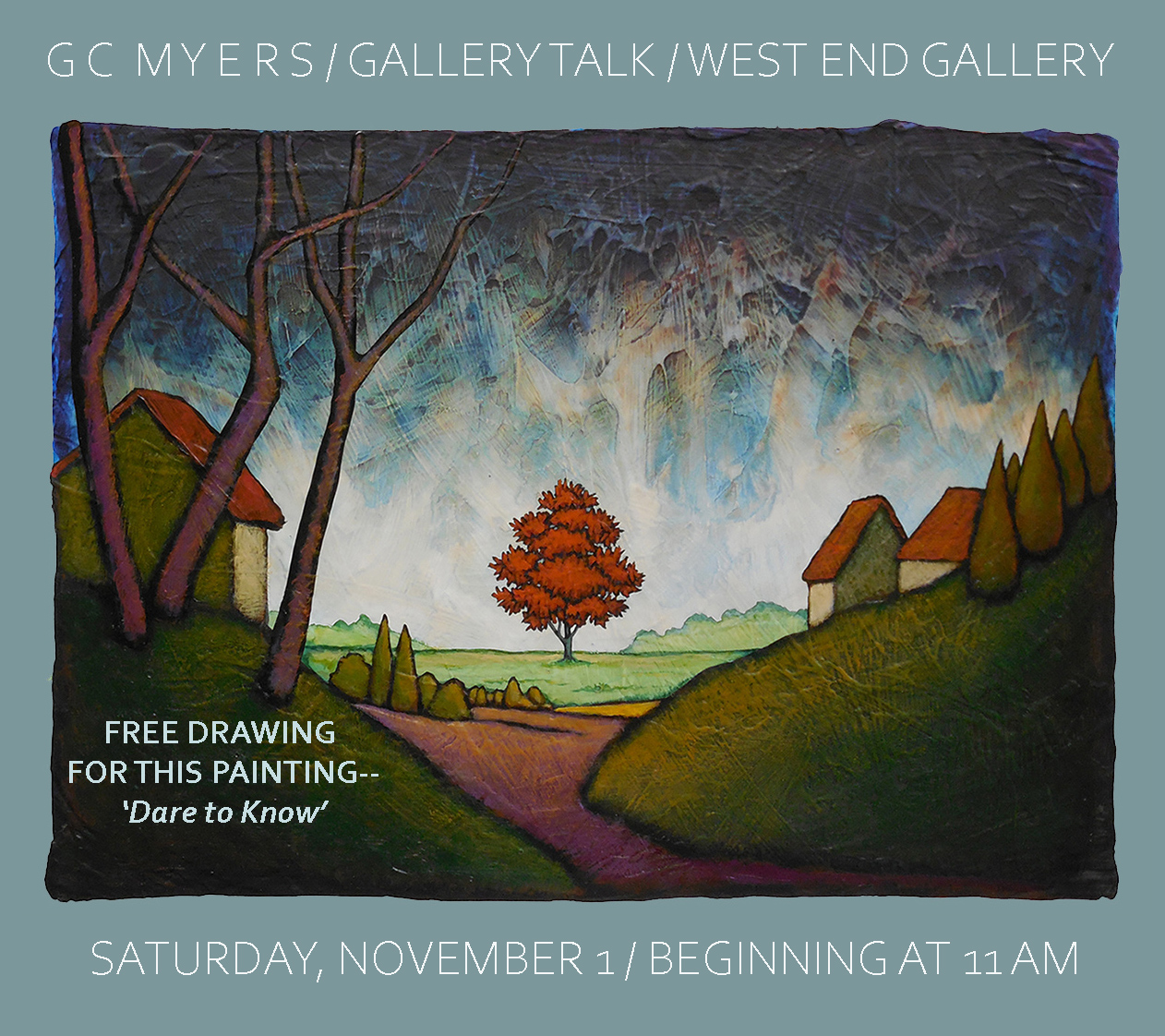
The Gallery Talk at the West End Gallery begins at 11 AM and lasts about an hour, ending with the drawing for the paintingDare to Know, shown at the bottom of this page. The Gallery Talk and the drawing for the painting are free and open to all. You must be in attendance to win prize. Seating is limited so I would suggest you arrive early to claim your seat and settle in. We can chat or you can take in the exhibit. Doors Open at 10:30 AM.

Here’s a favorite song, Killing the Blues. It is best known as performed by John Prine which to me is the gold standard. I hesitated in playing this version that I like very much from Alison Krauss and Robert Plant since I have played it here before. I thought it was recently but, after checking, discovered that I had shared it last in 2011. I guess a 14-year gap between plays is acceptable.


Read Full Post »

The Wisdom Beyond Words– At West End Gallery


But the Wise Perceive Things About to Happen

“For the gods perceive future things,
ordinary people things in the present, but
the wise perceive things about to happen.”

–Philostratos, Life of Apollonios of Tyana, viii, 7.

Ordinary people know what’s happening now,
the gods know future things
because they alone are totally enlightened.
Of what’s to come the wise perceive
things about to happen.

Sometimes during moments of intense study
their hearing’s troubled: the hidden sound
of things approaching reaches them,
and they listen reverently, while in the street outside
the people hear nothing whatsoever.

–C.P. Cavafy (1915)


I have mentioned C.P. Cavafy a few times here in the past. In 2021 I wrote the following in a post about one of his more famous poems, Waiting For the Barbarians:

Been reading some verse lately from Constantine P. Cavafy, the great Greek poet who lived from 1863 until 1933. He lived his entire life in Alexandria, Egypt and his work often captured the sensual and exotic cosmopolitan feel of that time and place. Readers of Lawrence Durrell and his Alexandria Quartet, in which Cavafy appears as a character, will know what I mean.

Though Cavafy was known for his poetry among the Greek community in Alexandria he spent most of his life working as civil servant. He didn’t actively seek widespread acclaim, turning down opportunities to have his work published while often opting to print broadsheets of his poetry that were distributed to only a few friends. His work didn’t realize wider acclaim until later in his life (and afterwards) when his friend, novelist E.M.Forster, wrote about his work, describing him as a Greek gentleman in a straw hat, standing absolutely motionless at a slight angle to the universe.

I love that description from Forster: standing absolutely motionless at a slight angle to the universe. I am not exactly sure what Forster meant but part of me thinks I know exactly what he is saying.

He sees Cavafy as both part and apart from the world around him. Seen and unseen. Engaged and disengaged.

My perception could well be the result of my own experience of having often felt both part and apart from all things. Not knowing anything but my own experience, I assumed that many others felt exactly the same. But over time, I realized that while there were many others, it wasn’t as many as I had thought.

I don’t know why this was the case. Maybe it’s simply easier to choose one or the other. Choosing and seeing oneself as part of things allows one to be absorbed into the crowd, to take on the voice and thought of the crowd. It requires so much less effort than thinking or speaking in your own voice. And it feels safer in the protection of the crowd.

When you stand apart, you are vulnerable and dependent upon your own wits, senses, and perceptions. There is a sense of danger in this, knowing that whether you stand or fall depends on your own choices and actions.

But with that comes a sense of freedom. You speak your own words and hear clearly beyond the din of the crowd. You think and decide on your own. 

You become the tree, still part of the forest yet standing apart.

And maybe that is what Forster was implying with his slight angle to the universe

I don’t know and I am not sure that this makes one whit of sense to anyone. Probably doesn’t. I don’t mind though. I have often not made sense in many things. Maybe I am standing a little off level myself.

Hey, here’s a lovely piece from Yo-Yo Ma. It’s Gabriel’s Oboe by Ennio Morricone from his soundtrack to the film, The Mission.


REMINDER

MY ANNUAL GALLERY TALK

AT THE WEST END GALLERY

TAKES PLACE

THIS COMING SATURDAY, NOVEMBER 1, 2025. BEGINNING AT 11 AM

SEATING IS LIMITED. THE DOORS OPEN AT 10:30 AM. IT IS SUGEESTED THAT YOU ARRIVE EARLY.

YOU COULD WIN A PAINTING!


Read Full Post »

Follow the River— At West End Gallery


Look down the long valley and there stands a mountain
That someone has said is the end of the world.
Then what of this river that having arisen
Must find where to pour itself into and empty?
I never saw so much swift water run cloudless.
Oh, I have been often too anxious for rivers
To leave it to them to get out of their valleys.
The truth is the river flows into the canyon
Of Ceasing-to-Question-What-Doesn’t-Concern-Us,
As sooner or later we have to cease somewhere.
No place to get lost like too far in the distance.
It may be a mercy the dark closes round us
So broodingly soon in every direction.

–Robert Frost, Too Anxious for Rivers (1947)


The canyon of Ceasing-to-Question-What-Doesn’t-Concern-Us…

This line (and the title) caught my eye when I first came across this Robert Frost poem, Too Anxious for Rivers. I thought the first half the poem shown above (the full poem is included at the bottom of the page) was a fine companion to the painting at the top, Follow the River.  Both have an existential theme and feel.

I could see this river flowing into that particular canyon. There is something about that slash of that particular blue cutting through the center of the painting that speaks to me, something that calms me. I guess that is a good thing, as I, much like the title states, am sometimes too anxious for rivers. Too anxious to simply float along with the current.

So much energy wasted struggling against the rhythm and force of the river when I should be letting it guide me, rather than trying to make it deliver me where it refuses to go. 

The river will deliver you on its own terms and schedule.

This painting, Follow the River, is 30″ by 15″ on canvas. It is included in my current exhibit, Guiding Light, at the West End Gallery. The show is hanging until November 13.

Next Saturday, November 1 I will be giving a Gallery Talk at the West End Gallery, beginning at 11 AM. Today or tomorrow, I will be choosing the painting that will be given away in a drawing at the end of the talk to someone in attendance. As always, the Gallery Talk is free and open to everyone. I will be announcing the prize painting in the next few days so keep an eye out here.

Here’s a song, River Man, from Nick Drake. Nick Drake recorded three albums from 1969 to 1972 that never really found an audience at the time. Tragically, he died from an overdose of antidepressants in 1974 at the age of 26. In the years since, his work has gained that audience that eluded him during his short lifetime and has a cult following. I find this song particularly haunting.

And soothing like the flow of a river.


Look down the long valley and there stands a mountain
That someone has said is the end of the world.
Then what of this river that having arisen
Must find where to pour itself into and empty?
I never saw so much swift water run cloudless.
Oh, I have been often too anxious for rivers
To leave it to them to get out of their valleys.
The truth is the river flows into the canyon
Of Ceasing-to-Question-What-Doesn’t-Concern-Us,
As sooner or later we have to cease somewhere.
No place to get lost like too far in the distance.
It may be a mercy the dark closes round us
So broodingly soon in every direction.
The world as we know is an elephant’s howdah;
The elephant stands on the back of a turtle;
The turtle in turn on a rock in the ocean.
And how much longer a story has science
Before she must put out the light on the children
And tell them the rest of the story is dreaming?
“You children may dream it and tell it tomorrow.”
Time was we were molten, time was we were vapor.
What set us on fire and what set us revolving,
Lucretius the Epicurean might tell us
‘Twas something we knew all about to begin with
And needn’t have fared into space like his master
To find ‘twas the effort, the essay of love.

Read Full Post »

Idyllica-At West End Gallery


Each for himself, we all sustain
The durance of our ghostly pain;
Then to Elysium we repair,
The few, and breathe this blissful air.

–Virgil, Aeneid (29–19 BC)


This year’s edition of my annual solo show at the West End Gallery, Guiding Light, opens this coming Friday, October 17. The painting above, Idyllica, is one of the larger pieces from the show, coming in at 30″ by 48″ on canvas.

I might call this a signature piece, if I were to put a label on it. By that, I mean it might be a painting that I feel neatly sums up what my work means for me. A painting that symbolizes who I am and how I see the world and my existence.

Kind of like a self-portrait that portrays the artist in their best light as they see it.

I have had this feeling a number of times about paintings, feeling that they represent a totality of what I hope I am. Mybe it is really more that they represent all the things I aspire to but knowingly lack personally.

Grace, balance, and harmony, for example. You can also add boldness, confidence, and courage. Maybe throw in Inner peace and strength, as well.

Maybe I am not seeing this so much as a self-portrait, a picture of who I am now, but rather as a laundry list of everything I have yet to find fully in myself. An image of what I desire to be.

Perhaps that is what I see in this– a clear statement of my hopes for myself as a human.

Maybe in some way it can serve as a template or roadmap to the attainment of these qualities?

I don’t know. Maybe.

But for the time being I find myself basking placidly in this piece. And in these days now filled with uncertainty, lies, malevolence, and moral cowardice, it is refreshing to rest for a moment in something that aspires to the better parts of our humanity.

It’s what I need right now…

Here’s a song that haunts me for days every time I hear it. It plays, in a way, into what I am saying this morning. It’s from Glen Hansard and Marketa Irglova, best known for their performances and music from the film Once, performing as The Swell Season. I am a big fan of their work, especially Hansard’s solo work. This is their version of Don’t Want to Know from a tribute album to the late British singer/songwriter John Martyn that came out soon after his death in 2009 at the age of 60. I don’t have time to go into his life right now, but Martyn was an interesting and enigmatic character, a mass of contradictions and conflicts and talents. The 1973 album that this song is from, Solid Air, is considered a gem that is little known here.

Here’s Don’t Want to Know from The Swell Season.


Read Full Post »

The Awakening— At West End Gallery


Life always bursts the boundaries of formulas. Defeat may prove to have been the only path to resurrection, despite its ugliness. I take it for granted that to create a tree I condemn a seed to rot. If the first act of resistance comes too late it is doomed to defeat. But it is, nevertheless, the awakening of resistance. Life may grow from it as from a seed.

–Antoine de Saint-Exupéry, Flight to Arras (1942)


What awakens us?

What are the sacrifices that created us and brought us to this point in our existence?

What seeds have been condemned to rot so that we might stand on this rock?

So many questions.

Few, if any, answers.

It sometimes like we have evolved enough to ask the questions but not enough to recognize the answers.

We are left standing on this rock with only a vague sense of what that answer might be. 

A nebulous feeling of what is and what is not.

And sometimes that feeling is enough in the moment to sooth whatever it is within us that asks such questions.

It is enough to allow us to feel as though we have been given an answer.

The real question is: What do we do with that answer?


I don’t know if any of this makes sense to you this morning. It just felt right for what I was feeling from the combined stimulus from the passage along with the painting at the top and the song below. There seemed to be some thread of sense running between the three, containing some sort of answer to whatever question I was asking.

But then again, I could be delusional. I wouldn’t be at all surprised– I hear there’s a lot of that going around. 

The painting shown here is The Awakening, 24″ by 12″ on canvas, that is included in my solo show, Guiding Light, that opens at the West End Gallery next Friday, October 17. The Red Tree in it represents, for me, the growth from that sacrificed seed, the newly formed consciousness that feels the wonder of the world into which it has emerged. It seeks to understand the answers it feels it is being given.

The song below is a new song from the new album from Robert Plant called Saving Grace.  It features the vocals of singer Suzi Dian and the group Plant. I really like this recent performance on Jools Holland’s show and felt it fit well with some of my work, including this new painting.

Feels like there’s an answer in there somewhere if I could just make it out…


Read Full Post »

RedTree: Continuum— Coming to West End Gallery


“We’re only here for a short while. And I think it’s such a lucky accident, having been born, that we’re almost obliged to pay attention. In some ways, this is getting far afield. I mean, we are — as far as we know — the only part of the universe that’s self-conscious. We could even be the universe’s form of consciousness. We might have come along so that the universe could look at itself. I don’t know that, but we’re made of the same stuff that stars are made of, or that floats around in space. But we’re combined in such a way that we can describe what it’s like to be alive, to be witnesses. Most of our experience is that of being a witness. We see and hear and smell other things. I think being alive is responding.”

—Mark Strand, interview with Mihaly Csikszentmihalyi (Flow)


Mark Strand (1934-1914) was a Pulitzer Prize-winning poet and essayist who served as the US Poet Laureate in the early 1990s.

I often wonder what, if any, purpose we have here on this planet. This thought from Mark Strand that we are put here in our present form as an assemblage of the molecules and matter of the universe so that the universe could see and analyze itself intrigues me.

Are we some sort of diagnostic tool? Is this planet a testing ground to reveal what works and what falls short? 

As I said, it’s intriguing. I have dozens of more questions pertaining to it. 

But perhaps Strand is closer to the reality of the matter, whatever the hell that is these days, when he opines that our ultimate purpose might be as witnesses. I guess that might still fall into diagnostic tool category as we would be serving as sensory indicators for the universe, cataloging everything–all the sights, sounds, smells, tastes, textures, emotions, etc.– that we encounter in our time here. 

I like this idea of us as witnesses or observers. I have thought for some time that many artists of all sorts began their lives as observers, as the quiet kid off to the side taking in everything in great detail.

Maybe in those formative years, we are simply new and fresh out-of-the-box sensors that work at full speed and capacity? That makes sense to me since I now often feel that many of my particular sensor’s storage unit is just about full and my operating speed is greatly lagging. 

But beyond that, it is this idea of us being witnesses that speaks to me. We all want to believe that the thoughts, feelings and experiences that make up our existence have served a purpose, that they matter beyond our own small bit of self.

That our voice will be heard somehow as testimony to our existence, as well as to the lives and existence of those around us.

I know that this desire to have my voice heard, to articulate somehow my purpose and experience of living in this world, was the primary reason behind my beginnings as an artist. 

To add my data to the catalog of the universe as fulfill my purpose as part of its continuum.

I will finish by adding the following from Tennessee Williams, in an interview with James Grissom:

All of us require a witness. A witness who will let us–and the world–know that we have lived, that we have contributed. As artists we need to know that our contributions mattered, touched the heart, evoked a thought, led someone else off to their own pale judgment to scribble something out. When we create characters, we are witnesses to ourselves and to those to whom we have reacted, to those we have loved, to those who inspire us.

The greatest artists are, I think, witnesses. They have been, to steal a line, present at the creation….of whatever they have seen.


The painting at the top is RedTree: Continuum, 18″ by 36″ on canvas, that is included in my solo exhibit Guiding Light, that opens next Friday, October 17 at the West End Gallery in Corning, NY. The show’s Opening Reception, which is free and open to all, runs from 5-7 PM.

A Gallery Talk is also scheduled at the West End Gallery for Saturday, November 1, beginning at 11 AM.

Here’s Doctor My Eyes from Jackson Browne. Seemed right this morning.


Read Full Post »

The Heart is Free— Coming to West End Gallery


Stone walls do not a prison make,
Nor iron bars a cage;
Minds innocent and quiet take
That for an hermitage;
If I have freedom in my love
And in my soul am free,
Angels alone, that soar above,
Enjoy such liberty.

― Richard Lovelace, To Althea, from Prison, 1641


Some folks that freely walk around are as imprisoned by their behaviors and beliefs as anyone behind the stone walls of any prison. As the 17th century poet Richard Lovelace pointed out nearly four hundred years ago, freedom is a state of mind.

For the most part, we often make our own prisons and do our own time. And conversely, we have the ability to define and make our freedom in any situation.

I was struggling to title this new painting that is headed to the West End Gallery for my annual solo exhibit in October. I saw it as representing the type of solitude that I enjoy, one that is not hindered by imposed restrictions or apartness.

The freedom of the heart and the mind.

But I also realized that my perception is not shared by a majority of folks. Most people don’t relish extended periods of time alone.  They need the sound and engagement of others and look outward, avoiding reflection and introspection.

I am not criticizing here, just noting the difference. As with everything, to each their own.

As I said, I wasn’t sure about expressing the type of solitude I saw in it in its title. Then I came across the lines from Lovelace in a prior blog entry from a few years back. It seemed to speak directly of what I was seeing in this painting.

The freedom of the heart and the mind cannot be caged or restricted. It is an island and world unto itself.

Hence, the title The Heart is Free came to be. 

I can only speak for myself, but for me it fits.

The Heart is Free is 14″ by 14″ on canvas and is included in Guiding Light, my 24th annual solo show at the West End Gallery that opens Friday, October 17.


Read Full Post »

Bound in Time— At Principle Gallery


Chaos is the first condition.

Order is the first law.

Continuity is the first reflection.

Quietude is the first happiness.

— James Stephens / The Crock of Gold (1912)


The lines above are from a novel, The Crock of Gold, from Irish author James Stephens. The form above is not how they were presented in the book originally. They were actually dialogue spoken by the main character, the Philosopher, in the comic/fantasy novel that deals with philosophy, murder, love and marriage, and Irish folklore, including Leprechauns and a stolen crock of gold.

From the bits of it I have read on Internet Archive where it is available, it seems like a wild ride. It has had continuing influence, too. The late Shane McGowan, leader of the Irish band The Pogues, used the title for his last studio album before his death.

But it is the bit of dialogue that caught my eye. It seemed to capture much of what I have been seeing in my work in recent times. Or. at least, hoping to see. You’re never quite sure what will emerge when you’re pulling things out of the ether.

This procedural list seems to match with what I am trying to depict. We try to identify order within the chaos in which we find ourselves. Having revealed whatever bit of order there is to be found, we try to maintain it through repetition of conditions and behaviors. Having done so, we find a bit of tranquility in whatever small patch of order we are able to maintain. Therein lies happiness.

That might be all you need to know about life.

I don’t know, that’s for damn sure. But it sounds like a decent recipe.

Maybe that is the gold in the Leprechaun’s crock?

Here’s a song that probably has nothing to do with post. Maybe that’s the chaos part of it?

Anyway, it came on the station I often listen to just a few minutes ago. I hear it every couple of days, and it always catches my attention, even if I am really focused on painting at that time. It’s One of Those Days from singer/songwriter Eilen Jewell.

Maybe the appeal for me is that I’ve had a lot of those days. Bet a lot of you have, as well.


Read Full Post »

Under the Compass– Now at Principle Gallery


“I have no right to call myself one who knows. I was one who seeks, and I still am, but I no longer seek in the stars or in books; I’m beginning to hear the teachings of my blood pulsing within me. My story isn’t pleasant, it’s not sweet and harmonious like the invented stories; it tastes of folly and bewilderment, of madness and dream, like the life of all people who no longer want to lie to themselves.”

― Hermann Hesse, Demian


I have a new painting on the easel waiting for me this morning. I thought it was complete when I finished up yesterday but just as I was leaving, I saw that it needed a small but critical adjustment. I didn’t have the time then to complete it, so it’s been nagging at me all night.  Therefore, I will be short this morning even though the subject deserves much more time and effort than I can give it at the moment.

Today is a triad of word, image, and song centering around the seeker. By that I mean the seeker of inner discovery, of the self. I am including a passage from a Hermann Hesse book, Demian, that was very influential in my life. It came to me at a time when I was struggling mightily and it helped me rethink what my life was and could be. It allowed me to recognize that I was exhausted from the lies I told not only to others but mainly to myself.

Without coming across this book, I doubt I would be painting or writing at this moment. God only knows what, if anything, I might be doing.

I am accompanying the passage with a painting that is very much about seeking, Under the Compass. For me, I see it as being about the inner search though it might also apply to the seeker who still looks for outer validation of their existence. I a also sharing a performance from The Who of their song The Seeker. It first came out in 1970 and this is how Pete Townshend described it in a Rolling Stone interview at the time:

Quite loosely, “The Seeker” was just a thing about what I call Divine Desperation, or just Desperation. And what it does to people. It just kind of covers a whole area where the guy’s being fantastically tough and ruthlessly nasty and he’s being incredibly selfish and he’s hurting people, wrecking people’s homes, abusing his heroes, he’s accusing everyone of doing nothing for him and yet at the same time he’s making a fairly valid statement, he’s getting nowhere, he’s doing nothing and the only thing he really can’t be sure of is his death, and that at least dead, he’s going to get what he wants. He thinks!.

Divine desperation. Maybe that is the unifying bond here, the driving force behind the Seeker.


Read Full Post »

Older Posts »