Feeds:
Posts
Comments

Posts Tagged ‘Red Tree’

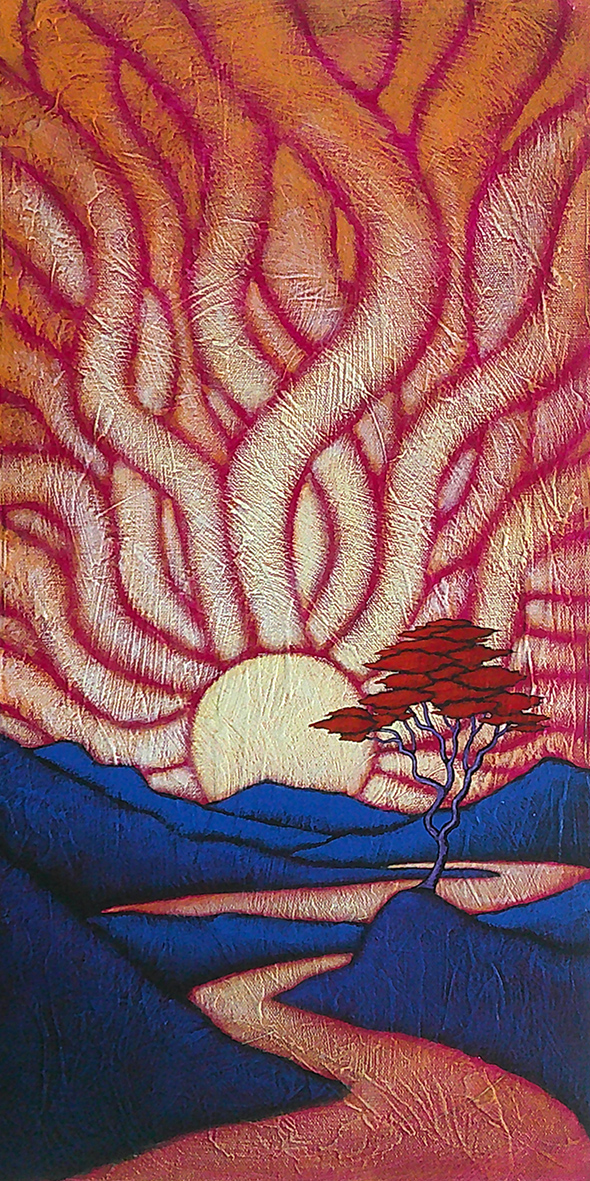
NightFlare– At Principle Gallery


I say in speeches that a plausible mission of artists is to make people appreciate being alive at least a little bit. I am then asked if I know of any artists who pulled that off. I reply, ‘The Beatles did’.

— Kurt Vonnegut, Timequake (1997)


To make someone else appreciate the fact that they are alive is an admirable goal for any artist– or any person, for that matter.

I can’t say that it was my mission when I first began painting. I don’t know that I actually had a mission other than trying to find something that would release the pent-up feelings within me. It began as a selfish act, for me alone.

There was never a consideration of its effect on other people. Actually, I doubted that it would have any effect on others. At the time, I didn’t have a lot of faith in my ability to do much of anything, let alone make others appreciate the fact they were alive. I wasn’t sure that I was that thrilled about being alive so who was I to make others feel that way?

But as time passed, the work I was doing, after first being an expression of self for myself alone, became a way of reaching out to people, many who recognized their own feelings in that work. I have been blessed to have heard from so many people over the years that tell me how the work has affected them. 

The effect this has had on me is immeasurable. I can’t say that it measures up to Vonnegut’s mission aim of making people appreciate being alive.  But I can unequivocally say that the reactions these folks pass on to me make me glad I am alive.

Maybe that should be a corollary to Vonnegut’s words, that the mission for the artist should also be to find a gladness for their own life in making others realize their appreciation for being alive.

If so, mission accomplished.

Here’s a favorite song and performance by those very same Beatles. This is from their legendary concert that took place in January of 1969 from the rooftop of their Apple Corps headquarters in London. It was their last public performance. I am not going to try to explain the effect that the Beatles had on everything in their short lifespan, not just on music. There are no contemporary comparisons, nor have there been any since, to make someone who came of age after they were around understand their influence and reach since the world had already changed by then. The shortest way I can describe it as the world was in black-and-white before the Beatles and in full, vivid color afterwards.

I love this performance of I Got a Feeling, particularly that of Paul McCartney, though everyone shines, including Billy Preston on keyboards, though you only get brief glimpses of him.

Makes me glad to be alive. 

Mission accomplished.


Read Full Post »

Placidarium (2017)


I long for scenes where man hath never trod
A place where woman never smiled or wept
There to abide with my Creator, God,
And sleep as I in childhood sweetly slept,
Untroubling and untroubled where I lie
The grass below—above the vaulted sky.

–I Am, John Clare, ca 1845


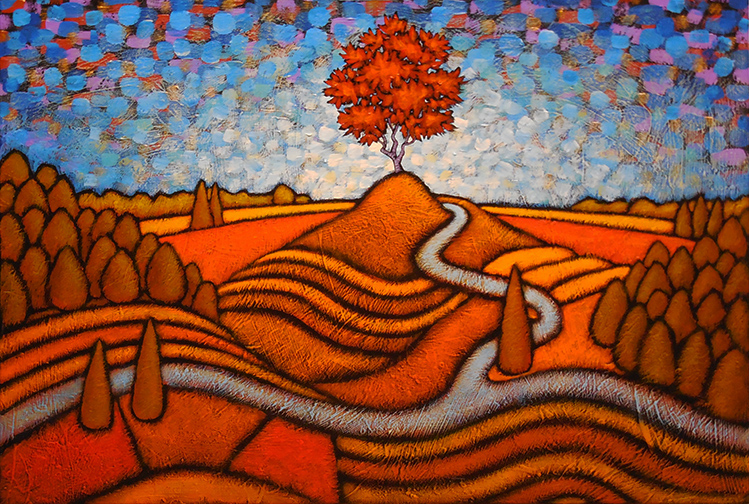
I came across the post below from several years ago and was reminded of the painting shown above, Placidarium. It was painted in 2017 and instantly became a favorite of mine. The title was a conjured word that described a self-contained environment much like a terrarium or aquarium. I saw this as a self-contained ecosystem of tranquility. Over the years this painting has traveled far and wide in attempt to find a home that needs a placidarium of its own. And time and again, it has always returned to me like a boomerang.

Though I was pleased to have it with me once more, it was always a little disappointing when it would come back. Was there something in it that only I could see, a voice that only I could hear? That was certainly a possibility. Some work speaks so loudly to me that it feels like it must be audible to many others and sometimes that’s just not the case.

Some voices speak to only one person. Kind of like the many voices in my head that tell me to do terrible things. I am just kidding, of course– there’s not many voices, just one.

All kidding aside, the fact that this painting’s voice seemed to go unheard and the tranquil world it portrayed reminded me of this poem and the life experience of poet John Clare. I could see him lying untroubled as he slept among the flowers under this sky.

Sounds pretty damn good to me, as well.


[From 2021]

John Clare was an interesting case. He led a troubled existence for much of his 70 years on this planet. Born in Northampton in England to a family of rural farm laborers, Clare bounced from job to job and place to place, living a life of poverty. In an attempt to raise money to prevent his parent’s eviction from their home, Clare, through a local bookseller, submitted his poetry to the publisher who had published the works of John Keats. His book of verse, as well as a second soon after, was published and praised.

But even then, recognized as he was as a poetic genius in farmer’s garb, he struggled with his own mental demons. Much of the rest of his life was spent in English asylums. His most famous poem, I Am, whose final verse is shown above, was written in one such asylum, Northampton General Lunatic Asylum, around 1844 or 1845.

His work was somewhat overlooked after his death in 1864 at the Northampton Asylum, where he had spent his final 23 years. But in the 20th century his worked received new attention and Clare’s work was elevated and he has been deemed a major poet of the 19th century.

It’s a sad life, indeed. It reminds me of those times when I have been going through genealogy records, following an ancestor’s life as it progresses, and come upon a record from some sort of institution. It might be an almshouse– a poorhouse– or a county home, a place where they gathered the paupers, the handicapped and those with mental problems so that they would be out of sight.

Coming across these records always makes me very sad. I can imagine myself in these ancestors’ places, the feelings that I would no doubt be experiencing– the loss, the alienation, the confusion that must have plagued their minds.

But even more than that, my sadness comes from knowing that their voices were no doubt unheard by the time these records were registered. They had, by that time, become problems to be swept aside.

And they, no doubt, wanted little more than the peace of mind that Clare describes in that final verse– the untroubled sleep of a child in the grass beneath a high, clear sky.

I find my own desires for this life dwindling down to those same simple wants. And in this, I find a bond with these poor, troubled relations. And with Clare in that English asylum.

And that in turn makes me grateful for the small graces that allow me to live the life I live and to find expression for my own small I Am.

Sigh.

Here’s a fine reading of I Am from Tom O’Bedlam:


Read Full Post »

The Choice— GC Myers 2017


There is nothing in this world that does not have a decisive moment.

–Cardinal de Retz  (1613-1679)


Photographer Henri Cartier-Bresson , a favorite of mine, took that phrase from the quote above and used it to describe that moment in searching for an image when the photographer makes the creative decision to snap the photo. But I see the term at play in everything we do, everything we are. Who, what, and where we are is all the result of random moments of decision. Every day offers us new choices for moving ahead and very seldom do we ponder where these often simple and mundane decisions might ultimately lead our lives.

I think about this all the time when I consider the course my life and career has taken. Several of the galleries in which I show came about as the result of a series of random decisions– and a few moments of serendipity!– and if any of those choices leading up to the final result had differed in any way, my life as it is now might be completely different.

Even the beginning of my painting career might not have occurred if I had decided that working off a ladder on that September day twenty years ago was not a great idea. I would not have fallen and would not have found the time or inspiration to begin painting. Maybe it would have come anyway at some other point but who knows? And would that decision to follow painting at that later date yield the same results?

I see it in genealogy as well. When I look at the charts that show one’s whole ancestry laid out in an ever-widening mesh of connections all I can think is how we are all built on a huge set of random choices and pure chance. If any single one of those many thousands of connections had not been made the whole mesh that brought us here would fall away and our very existence would most likely not have occurred.

Our existence relies on so many ifs: If one ancestor had not returned from the many wars, if one ancestor had not been the lucky child that survived the many diseases that took so many children from most families in the earlier days of our country, if one ancestor had turned left instead of right and not met that person who became their other half.

It’s a delicate dance of decisive moments that leads us all to the here and now.

We can try to consider what each conscious decision we make might someday yield but there are so many decisions made on a daily that seem so inconsequential that they easily escape our notice. We often don’t realize the magnitude of a decision until much later and are either enjoying or suffering the result of a decision from our past.

Only then do we recognize it as the decisive moment.

I guess the best we can do is to use our best judgement in those decisions we truly consider and hope that who we are at our core allows us to make wise choices on those that we fail to consider fully.

I am reworking an old blog post from about 12 years ago to highlight the painting at the top from 2017, The Choice. It’s one of those pieces that jumped at me when I painted it, becoming an instant favorite of mine, but never clicked for anyone else. Over the years, as much as I liked it from the start, my appreciation for it has only grown. Maybe it’s because I see it as a representation of the choices and decisive moments that brought me to this here and now.

Or maybe not. I can’t decide…

Read Full Post »

Quiet Revelation-Now at Principle Gallery


The problem in middle life, when the body has reached its climax of power and begins to lose it, is to identify yourself, not with the body, which is falling away, but with the consciousness of which it is a vehicle. And when you can do that, and this is something learned from my myths, What am I?  of which the bulb is a vehicle?

One of the psychological problems in growing old is the fear of death. People resist the door of death. But this body is a vehicle of consciousness, and if you can identify with the consciousness, you can watch this body go like an old car. There goes the fender, there goes the tire, one thing after another— but it’s predictable. And then, gradually, the whole thing drops off, and consciousness rejoins consciousness. It is no longer in this particular environment.

~Joseph Campbell, The Power of Myth


That is a great question: Are we the bulb that carries the light, or are we the light?

While I believe there may be an absolute answer that is deeply etched in whatever makes up and energizes the universe, the answer for our time here in this small world is determined by each of us.

We can see ourselves as being only a physical being. A body with a brain that is simply another part of it. And maybe that is all the brain is, a control module that exists to help the body maneuver and survive this world, with very little to do with our actual consciousness– that light, that lifeforce, that we carry and emit.

Or we can see ourselves as that light that is something apart from and only temporarily contained by our physical vessels. That we are that lifeforce that exists beyond our time here in this plane.

In our youth, we tend to see only the physical nature of our being- strength and beauty and the quickness of the mind. I thought that way for a while. But over the years, witnessing others struggle with disease and death while experiencing my own aging with the dings, dents, and slipping gears that accompany it, to continue the old car metaphor Campbell employed above, I definitely see things more in the latter mode, that we are the light, the consciousness, that is carried by the bulb that is our body. And someday, sooner or later, when our engine is blown and our fenders rotted off as the tow truck comes to haul us to the junkyard, our consciousness will go on. 

Cosciousness shall rejoin the greater consciousness. Our light will rejoin the greater light.

Just a thought, my own viewpoint as an old Subaru, this morning. I could go on, of course, and maybe I am remiss in not doing so. But I think I’ve said enough this morning and I’ll let you fill in the blanks like it’s some sort of philosophical Mad-Libs.

Besides, I want to get to the Sunday Morning Music for this week.

Here’s a great version of This Little Light of Mine from bluegrass legend Ralph Stanley. I had the great pleasure of seeing him perform a number of years back at Radio City Music Hall as part of the Down From the Mountain tour which featured the many singers and musicians– Alison Krauss & Union Station, Emmylou Harris, Gillian Welch, Patty Loveless, and Stanley— whose music played a large role in the film O Brother, Where Art Thou? Stanley’s performance of O Death was perhaps the most powerful moment from a memorable show.


Read Full Post »

In the Rhythm of the World– At West End Gallery


I recently came across a book of graduation speeches given by Kurt Vonnegut over the years. The speeches are witty, insightful, and bitingly to the point, much like his writing. I thought I would share one of these commencement speeches, one that includes the story behind the title of his book of speeches, If This Isn’t Nice, What Is? 

This speech from 1999 was given at Agnes Scott College, a private women’s liberal arts college in Decatur, Georgia. 26 years later, Vonnegut’s words ring true as we see ourselves vying to survive in a world that proclaims that we should adhere to Jesus’ words from the Sermon on the Mount while simultaneously prodding us to follow the Code of Hammurabi.  

Below is that speech. It’s worth a few minutes of your time. It covers a lot of ground in a short time.


Kurt Vonnegut Commencement Speech, Agnes Scott College, 1999–

I am so smart I know what is wrong with the world. Everybody asks during and after our wars, and the continuing terrorist attacks all over the globe, “What’s gone wrong?” What has gone wrong is that too many people, including high school kids and heads of state, are obeying the Code of Hammurabi, a King of Babylonia who lived nearly four thousand years ago. And you can find his code echoed in the Old Testament, too. Are you ready for this?

“An eye for an eye and a tooth for a tooth.”

A categorical imperative for all who live in obedience to the Code of Hammurabi, which includes heroes of every cowboy show and gangster show you ever saw, is this: Every injury, real or imagined, shall be avenged. Somebody’s going to be really sorry.

When Jesus Christ was nailed to a cross, he said, “Forgive them, Father, they know not what they do.” What kind of a man was that? Any real man, obeying the Code of Hammurabi, would have said, “Kill them, Dad, and all their friends and relatives, and make their deaths slow and painful.”

His greatest legacy to us, in my humble opinion, consists of only twelve words. They are the antidote to the poison of the Code of Hammurabi, a formula almost as compact as Albert Einstein’s “E = mc2.

I am a Humanist, or Freethinker, as were my parents and grandparents and great grandparents — and so not a Christian. By being a Humanist, I am honoring my mother and father, which the Bible tells us is a good thing to do.

But I say with all my American ancestors, “If what Jesus said was good, and so much of it was absolutely beautiful, what does it matter if he was God or not?”

If Christ hadn’t delivered the Sermon on the Mount, with its message of mercy and pity, I wouldn’t want to be a human being.

I would just as soon be a rattlesnake.

Revenge provokes revenge which provokes revenge which provokes revenge — forming an unbroken chain of death and destruction linking nations of today to barbarous tribes of thousands and thousands of years ago.

We may never dissuade leaders of our nation or any other nation from responding vengefully, violently, to every insult or injury. In this, the Age of Television, they will continue to find irresistible the temptation to become entertainers, to compete with movies by blowing up bridges and police stations and factories and so on…

But in our personal lives, our inner lives, at least, we can learn to live without the sick excitement, without the kick of having scores to settle with this particular person, or that bunch of people, or that particular institution or race or nation. And we can then reasonably ask forgiveness for our trespasses, since we forgive those who trespass against us. And we can teach our children and then our grandchildren to do the same — so that they, too, can never be a threat to anyone.

A woman’s reach should exceed her grasp, or what’s a heaven for?

You should know that when a husband and wife fight, it may seem to be about money or sex or power.

But what they’re really yelling at each other about is loneliness. What they’re really saying is, “You’re not enough people.”

If you determine that that really is what they’ve been yelling at each other about, tell them to become more people for each other by joining a synthetic extended family — like the Hell’s Angels, perhaps, or the American Humanist Association, with headquarters in Amherst, New York — or the nearest church.

Computers are no more your friends, and no more increasers of your brainpower, than slot machines…

Only well-informed, warm-hearted people can teach others things they’ll always remember and love. Computers and TV don’t do that.

A computer teaches a child what a computer can become.

An educated human being teaches a child what a child can become. Bad men just want your bodies. TVs and computers want your money, which is even more disgusting. It’s so much more dehumanizing!

By working so hard at becoming wise and reasonable and well-informed, you have made our little planet, our precious little moist, blue-green ball, a saner place than it was before you got here.

Most of you are preparing to enter fields unattractive to greedy persons, such as education and the healing arts. Teaching, may I say, is the noblest profession of all in a democracy.

One of the things [Uncle Alex] found objectionable about human beings was that they so rarely noticed it when they were happy. He himself did his best to acknowledge it when times were sweet. We could be drinking lemonade in the shade of an apple tree in the summertime, and Uncle Alex would interrupt the conversation to say, “If this isn’t nice, what is?”

So I hope that you will do the same for the rest of your lives. When things are going sweetly and peacefully, please pause a moment, and then say out loud, “If this isn’t nice, what is?”

That’s one favor I’ve asked of you. Now I ask for another one. I ask it not only of the graduates, but of everyone here, parents and teachers as well. I’ll want a show of hands after I ask this question.

How many of you have had a teacher at any level of your education who made you more excited to be alive, prouder to be alive, than you had previously believed possible?

Hold up your hands, please.

Now take down your hands and say the name of that teacher to someone else and tell them what that teacher did for you.

All done?

If this isn’t nice, what is?

Read Full Post »


The Answering Light— At Principle Gallery,

make a poem that does not disturb
the silence from which it came.

Wendell Berry


I run the post below every five years or so. Since I’m busy this morning (trying to not disturb the silence) and it’s been five years, thought today would be as good a time as any to replay it.

Regardless of what we do, we all need a reminder now and then to heed the silence.


I came across this poem a while ago from poet/author Wendell Berry on Maria Popova‘s wonderful site, Brain Pickings. It’s a lovely rumination that could apply to any creative endeavor or to simply being a human being.

I particularly identified with the final verse that begins with the line: Accept what comes from silence and ends with the lines above. I’ve always thought there was great wisdom and power in silence, a source of self-revelation and creative energy. Perhaps that self-revelation is why so many of us shun the silence, fearing that it might reveal our true self to be something other than what we see in the mirror.

Berry’s words very much sum up how I attempt to tap into silence with my work, to find those little words that cone out of the silence, like prayers, and to find inner spaces to paint that are sacred to me and not yet desecrated by the din of the outside world.

At the bottom is a recording of Wendell Berry reading the poem which gives it even a little more depth, hearing his words in that rural Kentucky voice. It’s fairly short so please take a moment and give a listen.


HOW TO BE A POET
(to remind myself)

Make a place to sit down.
Sit down. Be quiet.
You must depend upon
affection, reading, knowledge,
skill — more of each
than you have — inspiration,
work, growing older, patience,
for patience joins time
to eternity. Any readers
who like your poems,
doubt their judgment.

Breathe with unconditional breath
the unconditioned air.
Shun electric wire.
Communicate slowly. Live
a three-dimensioned life;
stay away from screens.
Stay away from anything
that obscures the place it is in.
There are no unsacred places;
there are only sacred places
and desecrated places.

Accept what comes from silence.
Make the best you can of it.
Of the little words that come
out of the silence, like prayers
prayed back to the one who prays,
make a poem that does not disturb
the silence from which it came.

Wendell Berry


Read Full Post »

The Wakening Light— At Principle Gallery


Strange as it may seem today to say, the aim of life is to live, and to live means to be aware, joyously, drunkenly, serenely, divinely aware. In this state of god-like awareness one sings; in this realm the world exists as poem. No why or wherefore, no direction, no goal, no striving, no evolving. Like the enigmatic Chinaman, one is rapt by the everchanging spectacle of passing phenomena. This is the sublime, the a-moral state of the artist, he who lives only in the moment, the visionary moment of utter, far-seeing lucidity. Such clear icy sanity that it seems like madness. By the force and power of the artist’s vision the static, synthetic whole which is called the world is destroyed. The artist gives back to us a vital, singing universe, alive in all is parts.

In a way the artist is always acting against the time-destiny movement. He is always a-historical. He accepts Time absolutely, as Whitman says, in the sense that any way he rolls (with tail in mouth) is direction; in the sense that any moment, every moment, may be the all; for the artist there is nothing but the present, the eternal here and now, the expanding infinite moment which is flame and song. And when he succeeds in establishing this criterion of passionate experience (which is what Lawrence meant by ‘obeying the Holy Ghost’) then, and only then, is he asserting his humanness. Then only does he live out his pattern as Man. Obedient to every urge — without distinction of morality, ethics, law, custom, etc.

— Henry Miller, The Wisdom of the Heart, 1941


I’ve had this passage from Henry Miller sitting in a draft file for a long time now. Maybe it was his use of the dated stereotype of the enigmatic Chinaman that kept me from using it. It sounds cringey, yes. Definitely not the preferred nomenclature today, as Walter from The Big Lebowski would be quick to point out.

But I understand that his reference is not a slur as he was referring to the wise and stoic sages such as Confucius and Lao Tzu. It was about artists acquiring a similar Zenlike state in their work one that transports them to the eternal here and now, as Miller put it.

The expanding infinite moment which is flame and song…

That is what struck me about this passage. It is something I understand and maybe the main reason I am a painter today. More so than any reasons based on practicality or talent.

It is that moment that comes while working on a painting when I am no longer in the studio on that particular day but instead find myself in the place and time of the painting on which I am working–the eternal here and now

 A different reality has taken hold then and its feeling is palpable. It is both liberating from and unifying with the world in which I live. Liberating in that the world outside my studio with its lies, hatred, corruption, and stupidity seems like a distant planet in that time and place. Unifying in that this act of creation, this other time and place, allows me to express a connection with humanity that I sometimes struggle to find on the outer world. Asserting my humanness, as Miller wrote.

Of course, this does not happen here in the studio every time I stand before my easel. No, it is a rare gem that is buried deep and has to be excavated. The world impinges further into the studio on some days and in recent weeks I have lacked the energy and mental clarity to be transported fully to that other place and time– the eternal here and now— for any extended visits.

But it’s getting better every day. Yesterday I was able to once again find that place and time for a spell and it was like a trip to a spa for me. As free and easy a day in the studio as I have had in well over a month. It didn’t last long but it felt good for the time I was there and not here.

I hope to find that place and time again today. And to stay a little longer. 

Read Full Post »

Echoes of Time— At West End Gallery


The lonesome friends of science say
“This world will end most any day”
Well, if it does, then that’s okay
‘Cause I don’t live here anyway
I live down deep inside my head
Well, long ago I made my bed
I get my mail in Tennessee
My wife, my dog and my family

John Prine, Lonesome Friends of Science (2018)


Another short post this morning. Not even the normal triad of word, image and song since the chorus from the song is serving as the word leg of the three-legged stool I am building here.

So, it’s a two-legged stool. Hope, it stands up.

At least for today.

The same goes for me.

Here’s the song, Lonesome Friends of Science, from John Prine‘s last album, The Tree of Forgiveness, from 2018. As you might know, John Prine passed away in 2020 from covid. II am using the painting above, Echoes of Time, because this morning I am seeing it as that tree of forgiveness as John Prine put it.


Read Full Post »

The Welcome Tree–At the West End Gallery


There is one thing one has to have: either a soul that is cheerful by nature, or a soul made cheerful by work, love, art, and knowledge.

—Friedrich Nietzsche, Genealogy of Morals (1887)


Nietzsche wrote a lot more about cheerfulness than one might expect. Not that I suspect that he himself was a cheerful soul. Maybe he was one of those, as the quote above implies, was made cheerful through work, love, art and nature.

I don’t know and I’m not interested enough right now to explore it any further at the moment. This quote seems to be one that is not verbatim from its source but was instead a compilation of thought.

That, too, doesn’t matter to me at the moment. I just like the quote as it stands, without full context.

It makes me wonder about my own nature and that of many others I know. Do I consider myself one who is cheerful by nature? I don’t believe I am though I have certain aspirations of being naturally cheerful, to not feel the weight of periodic depression or be eternally optimistic. I am not to that point yet and seriously doubt I will ever be there.

Actually, I know I won’t ever be that person. Whatever cheerfulness I possess comes from those potential sources that Nietzsche mentions. I think that holds true for most people, but I can’t say for sure. We all wear masks that sometimes cover our true natures.

I am sure we could go into a whole psychological examination of one another here but let’s save that for our diaries this time. 

Instead let us enjoy another song from Chicago that plays into the theme today, as does the painting at the top. This is Make Me Smile. I wasn’t a big Chicago fan when I was younger and they were in their heyday. But we change with time– hopefully and thankfully– and I have become quite a fan over the years.


Read Full Post »

The Pacifying Light– At Principle Gallery


A man’s work is nothing but this slow trek to rediscover through the detours of art those two or three great and simple images in whose presence his heart first opened.

-Albert Camus


These lines above are from an early essay, Between Yes and No, written by the French Nobel Prize-winning writer Albert Camus. It basically states, in sometimes grim detail, his belief that art “exalts and denies simultaneously.” In short, truth is generally somewhere in the middle, never absolutely in yes or no.

Yes or no is generally an oversimplified view, the extreme ends of the pendulum’s arc on which we swing.

While I may not fully understand all the subtleties of Camus’ essay, I do fully agree with the premise as I see it in my own simplified way. I think that art communicates best when it contains both the yes and the no— those polar oppositions that create a tension to which we react on an emotional level. For example, I think my best work has come when it contains opposing elements such as the light of hope or optimism tinged with the darkness of fear or remorse.

The Yes and The No of things. The certainty and uncertainty of all things.

Beyond that, I find this line about the artist’s effort to rediscover those few simple images that somehow first stirred something within their heart and soul intriguing. I certainly recognize it within my own work. I had no idea what I was trying to find when I first began to paint those many years ago. But the idea that there were some inner images that needed to be expressed nagged at me, even though I wasn’t fully aware of what those images were. They were slowly revealed to me and though I often didn’t fully understand their meaning, they somehow made sense and began to fill an emptiness.

That continues to this day. It is, as Camus, says, a slow trek. I still don’t know what to expect when I begin to paint and still have the nagging feeling that there is still an image out there– or in there– that eludes me. But I have some small degree of certainty, for whatever that is worth, that it is there waiting to be discovered. I just have to keep moving towards it.

Here’s a favorite song from a favorite artist, Rhiannon Giddens.  The song is the folk classic Wayfaring Stranger. It’s one of those songs that has been covered by a multitude of singers and is such a strong tune that every incarnation is equally wonderful.


Read Full Post »

« Newer Posts - Older Posts »