Feeds:
Posts
Comments

Posts Tagged ‘Red Tree’

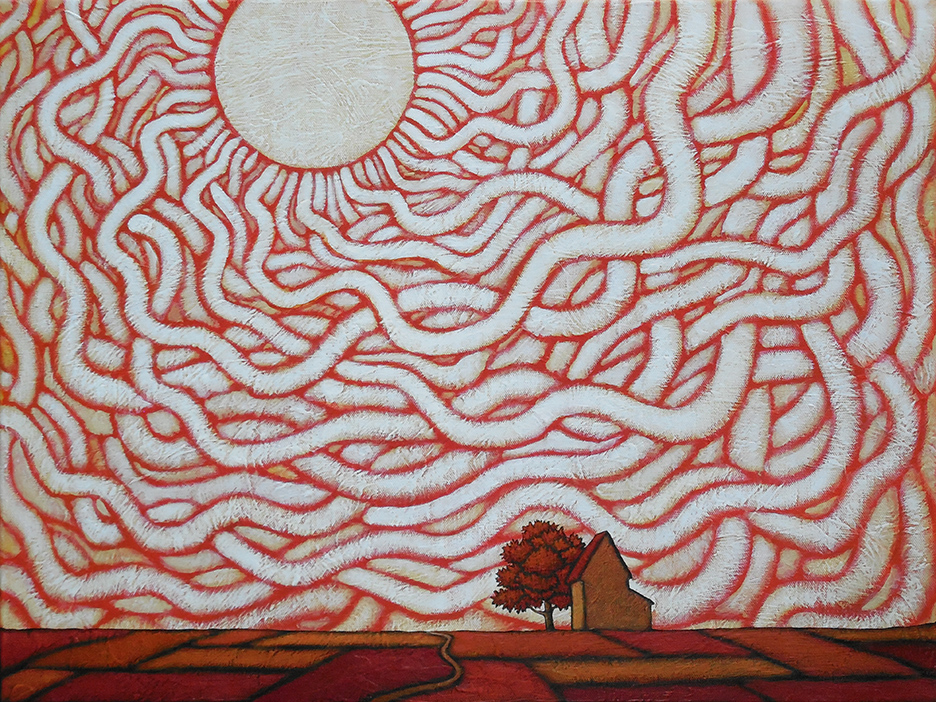
New Day Rising– Now at West End Gallery


Art is not a plaything, but a necessity, and its essence, form, is not a decorative adjustment, but a cup into which life can be poured and lifted to the lips and be tasted.

–Rebecca West, Black Lamb and Grey Falcon (1941)


In what is considered her masterpiece describing the history and culture of Yugoslavia, author Rebecca West wrote in Black Lamb and Grey Falcon that art and culture, especially in the form of myths and storytelling, provide both countries and individuals with a revitalizing well from which they can drink in order to survive the difficulties of life and history. Art and culture connects us with symbols, stories, and myths that changes our mere existence into one brimming with purpose and meaning. 

I know that West is writing primarily about storytelling and the myths of nations, which is evident in the passage from which the lines above are taken, which I am sharing below. But I feel that the purpose they serve, as West sees it, is very much the same for art in general. Art moves us beyond our own day-to-day existence, connecting us with our known and unknown pasts and futures. It allows us to feel as though we are part of some greater vehicle, serving both as a function of memory and desire.

Indeed, art is not a plaything. It is an elixir that invigorates the spirit and soul.

Below is the expanded passage from Rebecca West. I think there may be relevance in it for this country at this juncture in history.


Art is not a plaything, but a necessity, and its essence, form, is not a decorative adjustment, but a cup into which life can be poured and lifted to the lips and be tasted. If one’s own existence has no form, if its events do not come handily to mind and disclose their significance, we feel about ourselves as if we were reading a bad book. We can all of us judge the truth of this, for hardly any of us manage to avoid some periods when the main theme of our lives is obscured by details, when we involve ourselves with persons who are insufficiently characterized; and it is possibly true not only of individuals, but of nations. What would England be like if it had not its immense Valhalla of kings and heroes, if it had not its Elizabethan and its Victorian ages, its thousands of incidents which come up in the mind, simple as icons and as miraculous in their suggestion that what England has been it can be again, now and for ever? What would the United States be like if it had not those reservoirs of triumphant will-power, the historical facts of the War of Independence, of the giant American statesmen, and of the pioneering progress into the West, which every American citizen has at his mental command and into which he can plunge for revivification at any minute? To have a difficult history makes, perhaps, a people who are bound to be difficult in any conditions, lacking these means of refreshment.

Read Full Post »

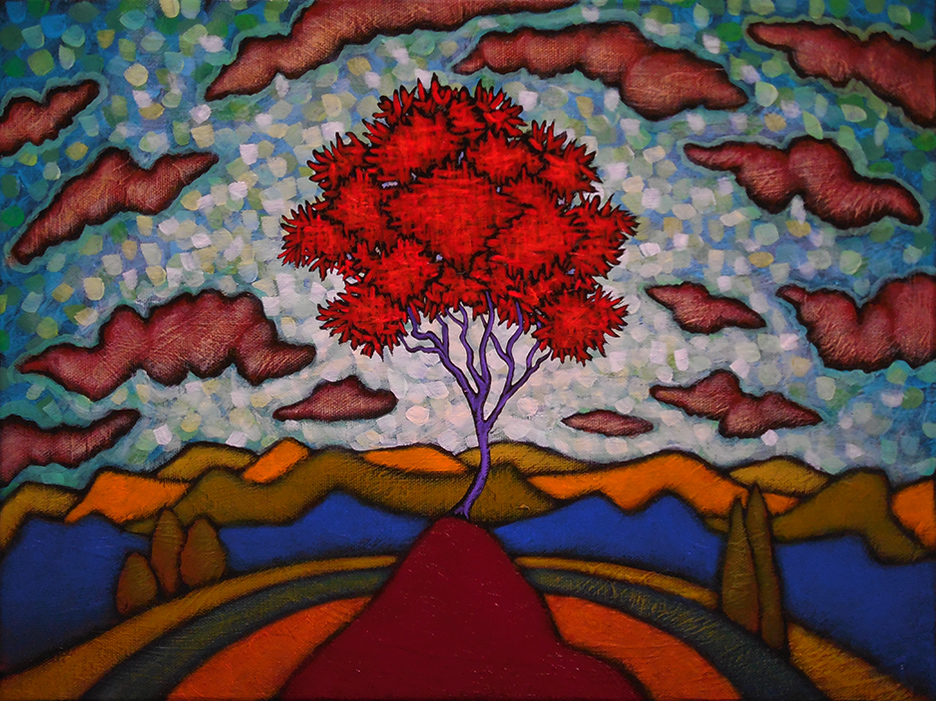
Moment Revealed — At West End Gallery


We have five senses in which we glory and which we recognize and celebrate, senses that constitute the sensible world for us. But there are other senses – secret senses, sixth senses, if you will – equally vital, but unrecognized, and unlauded… unconscious, automatic.

–Oliver Sacks, The Man Who Mistook His Wife for a Hat


Maybe that’s the purpose of art, to prompt us to some sort of sixth sense, one that otherwise goes unnoticed and underutilized in our usual five-sense lives. It is something that we don’t even know that we have been needing and missing until we are awakened to it.

This sixth sense enables us to detect the many dimensions which exist between and beyond that which we observe with our five senses, adding depth and richness to our sense-limited world. 

And art does just that, serving as the activating agent for this sixth sense and beyond that, acting as the connecting link between the known and the unknown. I believe that is what is taking place when one is moved by art in any form.

It transports you into dimensions beyond the five senses. 

And that’s where the good stuff is…

Here’s a song this morning about one type of sixth sense from Irish singer/songwriter Imelda May. With a style that covers many genres of music including jazz and rockabilly, she wasn’t on my radar until just a couple of years ago. I stumbled across a video of Robert Plant and her performing a rockabilly-Big Band rave-up of Led Zep‘s Rock and Roll that I very much enjoyed. I’ll throw that on below as well.


Read Full Post »

The Entanglement— Now at Principle Gallery


The force that through the green fuse drives the flower
Drives my green age; that blasts the roots of trees
Is my destroyer.
And I am dumb to tell the crooked rose
My youth is bent by the same wintry fever.

The force that drives the water through the rocks
Drives my red blood; that dries the mouthing streams
Turns mine to wax.
And I am dumb to mouth unto my veins
How at the mountain spring the same mouth sucks.

The hand that whirls the water in the pool
Stirs the quicksand; that ropes the blowing wind
Hauls my shroud sail.
And I am dumb to tell the hanging man
How of my clay is made the hangman’s lime.

The lips of time leech to the fountain head;
Love drips and gathers, but the fallen blood
Shall calm her sores.
And I am dumb to tell a weather’s wind
How time has ticked a heaven round the stars.

And I am dumb to tell the lover’s tomb
How at my sheet goes the same crooked worm.

–Dylan Thomas (1933)


This is considered the poem that more or less brought Dylan Thomas to fame as a poet. I read it again recently and was surprised at how well it aligns with the theme of my show, Entanglement, at the Principle Gallery. It basically describes how our timed existence here on this world is simply part of the timeless driving force of the universe. How that in this place made of time, the very force allowed us for our short stay here, the life force that energizes us, ultimately destroys then leaves us to regather with its timeless source.

Not sure that it is something that is easily explained and I am not sure if I was able to adequately convey that message with this show. But since the show ends today, I felt it was worth sharing this morning along with a splendid reading from Thomas’ fellow Welshman Richard Burton. And for good measure, I added a favorite song from a favorite guitarist, Martin Simpson. Last shared here a couple of years back, it’s titled She Slips Away, and was written about the death of his mother, as she moved from time to timelessness.

As does my Entanglement show which ends today. So, if you want to see it, today is your last opportunity to see it in its entirety before it moves into the realm of the timeless.


Read Full Post »

To the Main Road– At Principle Gallery


I knew that I had ample room in which to wander, since science has calculated the diameter of space to be eighty-four thousand million light years, which, when one reflects that light travels at the rate of one hundred eighty-six thousand miles a second, should satisfy the wanderlust of the most inveterate roamer.

–Edgar Rice Burroughs, Pirates of Venus (1932)


Still feeling a bit off kilter and definitely not feeling celebratory in any way for the Fourth of July tomorrow. In fact, I am a little crotchety this morning. Writing that makes me wonder about the origins of the word crotchety. One of the numerous benefits of the instant information of the InterWebs– we won’t go into its equally numerous pitfalls — is that one can answer questions like this within seconds. No more finding and dragging out the dictionary or encyclopedia or whatever reference book you have stacked on your shelves. I accumulated a bunch of compendiums of knowledge, both general and odd facts, over the years that sometimes answered such queries. Not always which meant writing it on a list to be looked up the next time I went to the library. Information moved much slower then and usually by the time I got an answer I had lost interest.

FYI, crotchety is derived from the word crochet which refers to the craft and hook used in it. The term came to represent someone who was hooked by peculiar thoughts, resulting in a brusque, rude attitude towards others.

Yeah, I fall into that category this morning. Crotchety old man shaking my fist at the sky.

Anyway, the theme today is wanderlust. Maybe by the description of searching for info that should be changed to wonderlust. Is that even a word? I guess I will have to take to the InterWebs once more.

While I am doing that, here’s a tune called Wanderlust from the immortal Duke Ellington and sax legend Coleman Hawkins. This came up on my playlist earlier setting this whole fiasco in motion.

Now, either listen or get out. I got things to do. Like I said, I am crotchety this morning and wonderlust  calls…


Read Full Post »

Betwixt and Between— At Principle Gallery


Don’t think. Thinking is the enemy of creativity. It’s self-conscious, and anything self-conscious is lousy. You can’t try to do things. You simply must do things. 

— Ray Bradbury


I ran a post featuring a Ray Bradbury quote the other day which reminded me of another of his quotes and a favorite blog entry from the past that employed the above quote. It’s a refinement of a quote from a 1962 essay, The Queen’s Own Evaders, in which Bradbury wrote about his time in Ireland writing the screenplay for the 1956 John Huston film, Moby Dick.

Never wanting to be a screenwriter, Bradbury adapted only his work for movies or television but made an exception when offered the chance to adapt the Melville classic. He struggled for months and months trying to adapt the novel then one day realized he was being too self-conscious, overthinking every word and element. He began anew and, at the end of an epic eight-hour writing session, finished the script.

The original quote was:

Self-consciousness is the enemy of all art, be it acting, writing, painting, or living itself, which is the greatest art of all. 

Ridding one of self-consciousness was a subject that popped up in many of his essays and interviews over the next 20 years or so as he refined the message. I well understand his view since I feel that I am least self-conscious when I am painting. My paintings are my world much like Bradbury’s world was that of Mars or the October Country or the strange, animated skin of the Illustrated Man.

Bradbury also stated over the years that an artist should not attempt to explain an artwork while it is being created. That’s how I feel about painting, as well. You do it. Then you think about it. As a result, that is why I seldom even begin to think about what the painting is about or what it might be called until it is done or at least well into its process.

Bradbury’s words on creativity are worthwhile for anyone, not just writers or artists. As he said, living is the greatest art of all. Here’s that earlier blog post, last shared here in 2018:


I came across this quote from famed sci-fi writer Ray Bradbury on an online site with quotes on creativity. This struck close to the bone for me as I have proudly not thought for years now. I have long maintained that thinking usually inhibits my work, making it less fluid and rhythmic.

It’s a hard thing to get across because just in the process of doing anything there is a certain amount of thought required, with preliminary ideas and decisions to be made. I think that the lack of thought I am talking about, as I also believe Bradbury refers, is once the process of creating begins. At that point you have to try to free yourself of the conscious and let intuition and reaction take over, those qualities that operate on an instantaneous emotional level.

I can tell instantly when I have let my conscious push its way into my work and have over-thought the whole thing. There’s a clunkiness and dullness in every aspect of it. No flow. No rhythm. No brightness or lightness. Emotionally vacant and awkward. Bradbury’s choice in using the term self-conscious is perfect because I have often been self-conscious in my life and that same uncomfortable awkwardness that comes in those instances translates well to what I see in this over-thought work.

So, what’s the answer? How do you let go of thought, to be less self-conscious?

I think Bradbury hits the nail on the head– you must simply do things. This means trusting your subconscious to find a way through, to give the controls over to instinct.

And how do you do that? I can’t speak for others but for myself it’s a matter of staying in my routine. Painting every day even when it feels like a struggle. Loading a brush with paint and making a mark even when I have no momentum or idea or at hand. Just doing things and not waiting for inspiration.

You don’t wait for inspiration– you create it.

So, stop thinking right now and just start doing things.

Read Full Post »

The Wisdom Beyond Words– At Principle Gallery


The hero adventures out of the land we know into darkness; there he accomplishes his adventure or again is simply lost to us, imprisoned, or in danger; and his return is described as a coming back out of that yonder. Nevertheless—and here is a great key to the understanding of myth and symbol—the two kingdoms are actually one. The realm of the gods is a forgotten dimension of the world we know. And the exploration of that dimension, either willingly or unwillingly, is the whole sense of the deed of the hero.

-Joseph Campbell, The Hero With A Thousand Faces


“The realm of the gods is a forgotten dimension of the world we know.”  

This sentence from the late Joseph Campbell could well summarize what the work from my current solo show at the Principle Gallery, Entanglement, is trying to convey. It is a show about those forgotten, hidden, and unrecognized dimensions that surround us every minute of every day during our time in this physical plane.

They are dimensions made up of energy and rhythm woven into deeply entangled patterns. Some of these patterns manifest themselves in this physical plane, resulting in a template or pattern of mythic behaviors that have been manifested and recalled with reverence in the stories of every culture throughout history.

Patterns of mythic action that exist in every time and place.

Here and now.

In my eyes, this work is a representation of the psychic unity of mankind, a theory to which Joseph Campbell’s work adhered.  It basically states that all people in this world share patterns of thought and behavior. Patterns that replicate those that exist in the dimensions beyond our recognition or understanding that these paintings represent.

If you’re familiar with Campbell’s work, you know that the great myths, such as Homer’s Odyssey, are not the sole province of the hero’s journey. Most people, in every time and place, at some time in their lives recreate the hero’s journey. It may be on a smaller, more intimate scale. They surely will not see it as being mythic or heroic. But it is woven from the same cloth and in the same patterns of the great myths, those same patterns that I see in these paintings.

 I could go on and on but that’s all I want to say this morning. I have things that need to be done. 

Heroic things?

Probably not. But then again, who knows?

Here’s an all-time favorite song of mine, one that I have probably share a little more here than I should. It’s Heroes from David Bowie. The line from the song that repeats and resonates- We can be heroes, just for one day— pretty much sums up this post. 

We can be heroes…


Read Full Post »

In the Free World-– Now at Principle Gallery, Alexandria


Every artist dips his brush in his own soul, and paints his own nature into his pictures.

–Henry Ward Beecher, Proverbs from Plymouth Pulpit (1887)


As an artist, if you will allow to call myself that, I believe these words the famous 19th century preacher Henry Ward Beecher are true. I know that I feel closest to my work when it most reflects a feeling and tone that I recognize deep within myself. You just hope that this aspect of your nature is equally reflected outward, that people see that same aspect in you as a person.

Sometimes they do and sometimes they do not. It is not always an easy transition when trying to bring anything from the inner to the outer world. I guess the best one can do as an artist is to be sincere, to represent those aspects which truly are part of your true nature.

To try to do otherwise produces insincere work. And while it can exist and even prosper in the short term, it eventually reveals its insincerity.

I don’t know, maybe I am just spinning my wheels this morning. I often do that in the aftermath of a show opening. It’s a matter of finding something to hold on to before I fully fall into the abyss of funk that I seem to encounter after every show. In this year’s case, I am holding on to the fact that I know the work I produced is indeed sincere and represents what I believe is my true nature.

Well, most of my true nature. You know, the good parts. The aspirational. The inspirational. But in reality, even the darker aspects of my true nature show up in what I consider my best work. I think it is that tension between the dark and light aspects of an artist’s nature that produce meaningful art.

Sincere art. Art of the soul.

Okay, a little more info on Henry Ward Beecher, for those of you not familiar with the name. He was one of the biggest celebrities of the late 19th century, on an equal footing with the actors, musicians, and writers of the era. At one point, he was referred to as the Most Famous Man in America. He was even on popular trading cards and had his own sex scandal that culminated in one of the most celebrated trials of the time. He was also a great social reformer as an abolitionist and advocate for women’s suffrage. He was the brother of Harriet Beecher Stowe of Uncle Tom’s Cabin fame, as well as the brother of Thomas K. Beecher. I throw in Thomas because of his local connection to my hometown. He was the big fish in our small pond at the time, a preacher who drew huge congregations as well as a civic leader. He was a good pal of Mark Twain and buddied around with him, playing pool and such, during Twain’s many summer stays here in Elmira. Beecher also presided over Twain’s wedding to local girl Olivia Langdon.

Okay, enough extra info. Let’s have a song. Since we’re discussing the nature of the soul, here’s Soul Time from Shirley Ellis. You might know her from her fun big hits The Name Game and The Nitty Gritty. A video for The Nitty Gritty with some exuberant dancer, highlighted by the wild moves of well-known dancer/choreographer Bobby Banas, became a viral hit. Lots of fun.


Read Full Post »


It makes no difference how deeply seated may be the trouble, how hopeless the outlook how muddled the tangle, how great the mistake. A sufficient realization of love will dissolve it all.

-Emmet Fox, The Sermon on the Mount (1938)


I was a little hesitant in using the quote above from Emmet Fox. I didn’t know much about him. You never want to quote someone then have them turn out to be some hideous creature. Been there, done that. Learned my lesson.

But I decided to go ahead after seeing on Wikipedia that Fox was: an Irish New Thought spiritual leader of the early 20th century, primarily through the years of the Great Depression until his death in 1951. Fox’s large Divine Science church services were held in New York City. He is today considered a spiritual godparent of Alcoholics Anonymous.”

I don’t know anything about the New Thought movement outside it being one of those fringe spiritual/semi-religious movements that took hold in the late 19th/early 20th century when people were scrambling for answers to troubled times in which they lived. You know– the Gilded Age. That time of  the abrupt change from a relatively independent agrarian society to an industrial society that spawned Robber Barons and the exploitation of the working class, that glorious time that so many regular folks seem to now think were the Good Old Days.

That commentary aside, I figured the Fox quote was safe to use since this show itself represents a belief system outside that of religion, at least in the organized sense. Trying to make sense of the world or universe and our place in it is not the province of any one person or group and what may seem crazy to me may very well make sense to you. We may even hold the same beliefs but with a different vocabulary and symbology. 

And that’s what I see in this quote from Emmet Fox– the idea that love and our recognition that it connects us to the greater forces of the universe is the balm for so much of what ails us. I think, to a great extent, that is the true theme of this show. We belong. We are drawn from the beginning of all time and will be part of it until its end. Love, compassion, and empathy creates the harmony that binds us in these entangled bands of energy.

Is that so crazy a thing to believe? 

I don’t know. To some, I am sure it is.

Like art, there is no absolute consensus of right or wrong. In fact, our whole existence dwells in a plane that exists between certainty and uncertainty. 

Okay. That’s the end of today’s sermon, truncated (or confusing) as it may seem here at the end. All I really planned to do this morning was introduce a short video preview of some of the paintings from my Entanglement show that opens Friday at the Principle Gallery. All the pertinent info is in the image at the top, outside of the fact that I will also be giving a painting demonstration the following day, Saturday, June 14, beginning at 11 AM.

Here’s that promised preview of some of the work from this year’s show. Please note that this does not show all the paintings. I will be posting a link to a virtual walk-through of the show either tomorrow or Friday that will allow you to see all the work as it is on the gallery walls. Bet they didn’t have that back in the Good Old Days!


Read Full Post »

Pax Omnis– At Principle Gallery


The creation of a more peaceful and happier society has to begin from the level of the individual, and from there it can expand to one’s family, to one’s neighborhood, to one’s community and so on.

Tenzin Gyatso, 14th Dalai Lama, The Art of Happiness in a Troubled World (2004)


The name of this new painting is Pax Omnis which translates roughly as Peace for All or Peace Everywhere. I consider this painting to be one of the anchors for my Entanglement exhibit that opens Friday at the Principle Gallery. With the richness of its surface and message, it felt that way for me from the minute it was completed.

Much of the work from the Entanglement show has to do with how we, comprised as we are of bands of energy, are interwoven with all other things. Many of the paintings depict the interaction of the individual, often represented by the Red Tree, with the bands of energy that surround us.

That holds true in this painting but extends the interweaving to the earth and its inhabitants beyond the Red Tree. I see it as reflecting the sentiment expressed at the top from the Dalai Lama which basically says that the world we inhabit here is created by the attitude and actions of each of us.

We shape our world. A peaceful world is created by peaceful people. Tranquility begets tranquility.

The hatred, dishonesty, and greed of people creates a world filled with the same.

I submit the world as it currently stands into evidence.

This painting represents a best-case scenario, of course. The idea that we can eradicate hatred, greed, or any of the other darker parts of ourselves is pretty much a pipedream. But we need to keep such scenarios in our mind if only to remind us of the world we hope to create–a place of peace and harmony that makes us wish to linger here a bit longer before moving on to reunite with the entanglement of forever. 

I think this piece serves that function well. It has a very centered feel for me, if that makes sense to you. I wish it were here right now so that I might dwell in it for just a bit longer before looking at this morning’s news of the outer world’s disharmony and dysfunction.

At least I have the image of it to remind me of where I want to be and that I have a responsibility, as does everyone else, in doing my part to create that place of peace.

Amen.


I am sharing a song to go along with this post. Yesterday, the great Sly Stone (born Sylvester Stewart) passed away at the age of 82. His music was built with the strength and unity of all people in mind. I have written here in the past that the world would be a far better place if his songs were played out in the streets around the clock. Below is his classic song, Everyday People. The first line in the song– Sometimes I’m right and I can be wrong/ My own beliefs are in my song— fits in well with the theme of my show. A later line–I am no better and neither are you/ We are the same, whatever we do– reinforces that theme

Welcome back to the entanglement, Mr. Stone. Pax Omnis…


Pax Omnis is 16″ by 40″ on canvas and is now at the Principle Gallery, for my 26th annual solo show, this year called Entanglement, which opens this coming Friday, June 13. The paintings for the show are now in the gallery and are available for previews. The show will be up on the walls of the gallery by tomorrow, Wednesday.

I will be attending the Opening Reception for the show that runs on Friday from 6-8:30 PM. I look forward to chatting with you.

And the following day, next Saturday, June 14, I will also be giving a Painting Demonstration at the galleryThe demo, my first there, should run from 11 AM until 1 PM or thereabouts. Hope you can make it.


Hulu documentary on Sly

Read Full Post »

The Floating World— Now at Principle Gallery


Living only for the moment, turning our full attention to the pleasures of the moon, the snow, the cherry blossoms and the maples, singing songs, drinking wine and diverting ourselves in just floating, floating; caring not a whit for the poverty staring us in the face, refusing to be disheartened, like a gourd floating along with the river current: this is what we call ukiyo.

–Asai Ryōi, Tales of the Floating World (1661)


Back in the studio this morning. The paintings for my new show, Entanglement, have been safely delivered to the Principle Gallery and will soon to be on its walls in time for Friday’s opening. All that’s left for my part with the show is to write several blogposts this week before making my way back down to Alexandria on Friday. And figure out how to proceed with the Painting Demonstration that follows on Saturday.

A relatively easy week. Well, if I could just shake the anticipatory anxiety that comes with such shows as I wait to see if my hard work will create sparks within others or if what I see in it is but an illusion only visible to myself.

But it’s out of my hands now and I will just do what I can. Maybe I should adhere to the words above from the novelist Asai Ryōi who wrote in the early Edo Period of Japan (1660’s) about the ukiyo or Floating World.

You may have seen the term ukiyo-e in reference to the beautiful Japanese woodblock prints, of which I am a big fan and have shared many on this blog over the years. These prints were first produced at a time when there was a strict class system in Japan with the merchants being low on that particular totem pole. In a time of prosperity, these merchants attained great wealth but were unable to move beyond their low rank in the class system, so they began to show off their wealth through lavish lifestyles and conspicuous consumption, including attaining what little art was available to them, which is where these prints found their way into their culture. 

This lifestyle of earthly pleasures– brothels and excesses in food and drink were all part of it— was described by the word ukiyo which meant for them this transient world in which one should live for the moment, taking in all that this world has to offer. Grab for the gusto, in other words.

Their use of the word derived from the same word in the Buddhist religion which meant the Floating World, which referred to the earthly plane of death and rebirth from which Buddhists sought release. The Buddhist use of the word encouraged using the time spent in this earthly plane in ways that would be of use when one is finally released from it into the ethereal and eternal planes of being. Living the ukiyo lifestyle as it was seen in Edo Period of Japan might actually hinder one from release from this plane of existence.

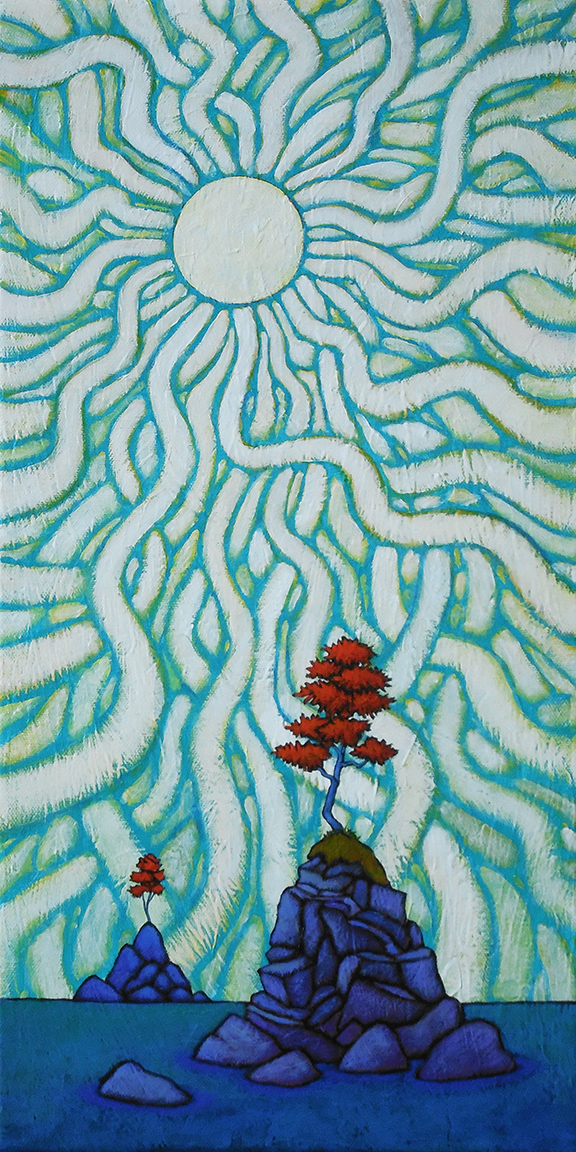
Though I love the Japanese ukiyo-e prints depicting scenes of the earthly pleasures of that era, it’s this Buddhist definition that I feel better suits the new painting shown at the top, The Floating World. That thought was not in mind when I painted it but it soon became evident that, for me, those small islands represented our tenuous and temporary existence here. The basketlike weave or entanglement of the sky represents our ultimate destination, a return to our place in the harmony and rhythm of that universal energy. 

Our true home, if you will. 

Our time here is short and fleeting. Ultimately, we are but tourists, visitors, and sightseers in this world. It is what we take home with us when our visit here is done that matters.

That’s my reading for this painting. Actually, when I look at this painting, I find myself barely noticing the islands, instead losing myself in the entanglement. I find it very calming and reassuring.

It does exactly what I need it to do for me. For you? I can’t say.


The Floating World is 20″ by 20″ on canvas and is now at the Principle Gallery, for my annual solo show, this year called Entanglement, opens this coming Friday, June 13. As I wrote, the work for the show is now in the gallery and is available for previews.

I will be attending the Opening Reception for the show that runs on Friday from 6-8:30 PM. I look forward to chatting with you.

And the following day, next Saturday, June 14, I will also be giving a Painting Demonstration at the galleryThe demo, my first there, should run from 11 AM until 1 PM or thereabouts. Hope you can make it.


Read Full Post »

« Newer Posts - Older Posts »