Feeds:
Posts
Comments

Posts Tagged ‘Red Tree’

NIghtFlare– At Principle Gallery


If we cherish the virtues and the principles of our fathers, Heaven will assist us to carry on the work of human liberty and human happiness. Auspicious omens cheer us. Great examples are before us. Our own firmament now shines brightly upon our path.

–Daniel Webster, Eulogy for John Adams and Thomaas Jefferson, 1826


All the work for my solo show at the Principle Gallery, Entanglement, is complete. Well, the painting and preparation part of it. Today, I pack it all up for delivery tomorrow down in Alexandria. This means a final few moments with each piece before they become whatever it is they are destined to become for someone other than me.

Most of the paintings have taken on distinct meanings for me, personal readings of the paintings that elicit certain emotional responses in me. Once it sets itself in my mind in a certain way that is how I normally continue to see that painting forever.

They define themselves to me.

But sometimes there are pieces that remain an enigma. They raise emotional responses but in a way that makes whatever meaning they hold feel like a mystery. I often find them deeply appealing but can’t quite figure out what they are saying to me.

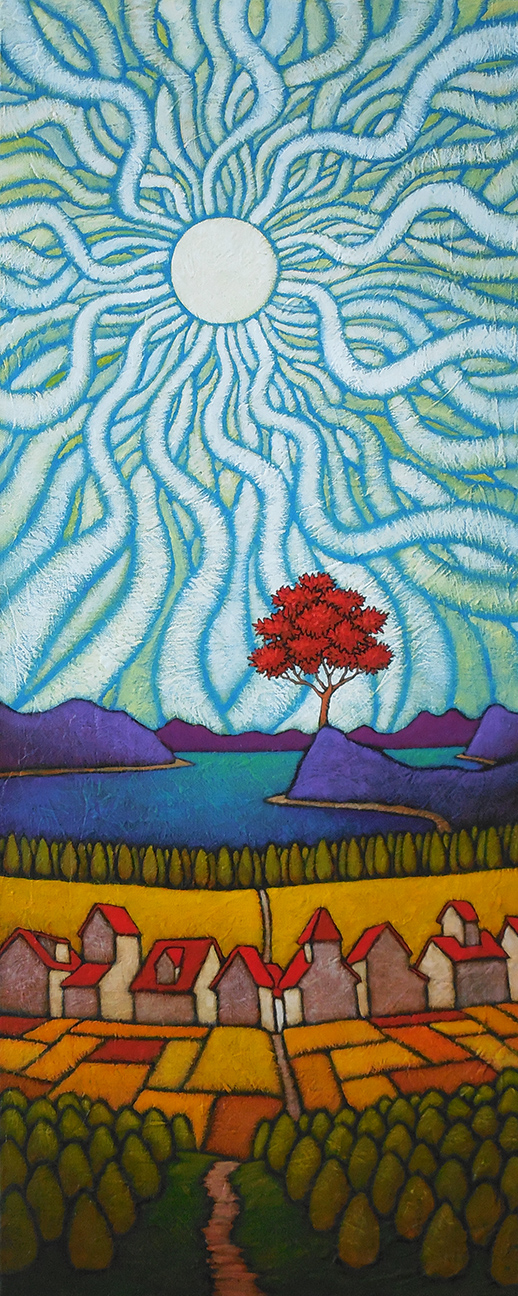
This new painting from the show, NightFlare, is such a painting. If you asked me what it is saying I would most likely turn the question around on you. Your answer would be as valid as my own.

Even so, I am deeply attracted to this painting with its calmness and warmth.  It feels soothing but in a mysterious way, as though that moon with its strange corona bears an omen for us– represented by the Red Tree and the house that stands like sentinel–but with an assurance that the future will work itself out, that things will be okay in the end.

Maybe that’s wishful thinking for the times we’re enduring. Maybe it is one of the auspicious omens sent to cheer us on, as Daniel Webster alluded to in the passage above from his 1826 eulogy for Adams and Jefferson. As you might recall, both died on July 4th of that year, on the 50th anniversary of our Independence Day. 

Auspicious omens cheering us on?

I would like to think so but really don’t know about that or the true meaning of this painting. It remains a mystery, an enigma. All I know of this piece is how it makes me feel.

And that is enough for me. For now. Forever.


NightFlare is 36″ by 12″ on canvas. It is included in my 26th annual solo exhibit at the Principle Gallery, Entanglement, that opens this coming Friday, June 13. I will be attending the Opening Reception for the show that runs from 6-8:30 PM. 

And one week from today, next Saturday, June 14, I will also be giving a Painting Demonstration at the galleryThe demo, my first there, should run from 11 AM until 1 PM or thereabouts.

Read Full Post »

Song of the Heliotropes– At Principle Gallery, June 13


In the world of the dreamer there was solitude: all the exaltations and joys came in the moment of preparation for living. They took place in solitude. But with action came anxiety, and the sense of insuperable effort made to match the dream, and with it came weariness, discouragement, and the flight into solitude again. And then in solitude, in the opium den of remembrance, the possibility of pleasure again.

–Anaïs Nin, Children of the Albatross (1947)


I was searching for something to begin this post and came across the passage above from Anaïs Nin. It gave me pause for a moment as it so well described the cycle that I seem to repeat time and time again in preparing for my shows, such as my Entanglement exhibit that opens next week at the Principle Gallery.

The work is created from dreams and solitude, as she points out. As the works gather and come together there is a building excitement and joy within me as I ponder sharing the work with the world outside my den of solitude. But, as Nin observes, this building excitement brings with it an increased sense of anxiety, one built on a fear of failure or of having become irrelevant as an artist. This, along with the grinding effort that takes place in finishing all the tasks required to make the work presentable, produces a deep weariness. It is both a physical and mental exhaustion. 

Then the show opens and inevitably there comes afterward, with even the most successful shows, a great letdown–the discouragement that Nin mentions. I find myself second-guessing my choices for the show, completely overlooking the successes and high points, instead focusing on things that I could have or should have done. There is seldom, if ever, a period of what you might call basking in any sort of glory.

But as miserable as that sounds, I am soon back to my dreams and solitude– my opium den of remembrance– high on the possibility that comes with a new show.

It’s a cycle that’s been repeated for well over 25 years and around 70 shows. Outside of my marriage and the knowledge that the sun will rise and fall each day, it’s the most dependable thing in my life. 

I am at the bone-weary state right now but the excitement from the work and its creation remains. Take the painting at the top, Song of the Heliotropes, for example. It’s a piece that feels like music to me, one that brings me a lot of joy. It’s the kind of joy that makes the harder aspects of the cycle tolerable.

The Red Trees remind me of flowers being pulled upward by the energy and light of the sun and sky. For my botanical friends out there, I do realize they are not actually the flowers called Heliotropes. I am instead referring to heliotropism, the act of growing toward the sun that takes place in many plants and flowers. I tend to think we all experience heliotropism of some sort, always moving towards some sort of light.

Perhaps in a way we are all Heliotropes. For this painting, I am saying that is the case. 

There’s more that I could say about Song of the Heliotropes, an 18″ by 24″ painting on canvas, but if you want to hear it, you’ll have to ask me about it at the Opening Reception on Friday, June 13 at the Principle Gallery which runs from 6-8:30 PM. This painting and all the other work for this show will be delivered to the gallery on Sunday and will be available for previews, though the show will not be hung until later in the week.

The day after the show’s opening, on Saturday, June 14, I will also be giving a Painting Demonstration at the gallery. The demo, my first there, should run from 11 AM until 1 PM or thereabouts.

Here’s a well-known classical piece that immediately comes to mind when I look at this piece. It’s from composer Léo Delibes from his 1883 tragic opera, Lakmé. This is the Flower Duet. This performance is from soprano Sabine Devieilhe  and mezzo-soprano Marianne Crebassa. Most of you will recognize this about a minute or so into this video. That is certainly the part of the song that comes to mind with this painting. Just lovely.


Read Full Post »

Quiet Revelation– At Principle Gallery June 13, 2025


When the brain is completely quiet, it is empty. It is only through emptiness that anything can be perceived. You need space, you need emptiness to observe. To observe you, I must have space between you and me, and then there is seeing. So, a mind that is crippled with sorrow, with problems, with its vanities, with its urge to fulfill, and frustrated, caught in nationalism – you know, all the petty, little things of life – such a brain has no space. It is not empty, and therefore it is utterly incapable of observing. And when a mind that is being petty and shallow says, ‘I must explore,’ it has no meaning. It must explore itself, not whether there is something beyond itself. So when the brain is completely quiet, empty – and that demands astonishing awareness, attention – that is the beginning of meditation. Then it can see, listen, observe. Then it will find out if there is something beyond the measure that man has made to discover reality.

–Jiddu Krishnamurti (1895-1986), From Public Talk 10 in Saanen, Switzerland July 1963 


Quiet the brain. Empty the brain.

Such a difficult task that feels like it should be easy, given how much space is actually occupied up there. Don’t be offended– I was talking about my brain. Not yours. Well, maybe a little about your brain.

I don’t know.

A big part of my work has to do with finding this sort of quietness, of stilling a mind reeling from the ceaseless bombardment of stimulus that this modern world serves up. My search is often futile with only short interludes of true quietude. Perhaps, as the philosopher Krishnamurti points out, by consciously searching– a product of a brain filled with the petty and trivial– I was actually preventing myself from actually observing the quiet that is always present.

I’ve been somewhat aware of this, often saying that my work is at its best when the brain is taken out of the equation, when I just let things happen on an instinctual or organic level. Getting there is much like the quieting or the emptying of the brain that Krishnamurti describes. A difficult task.

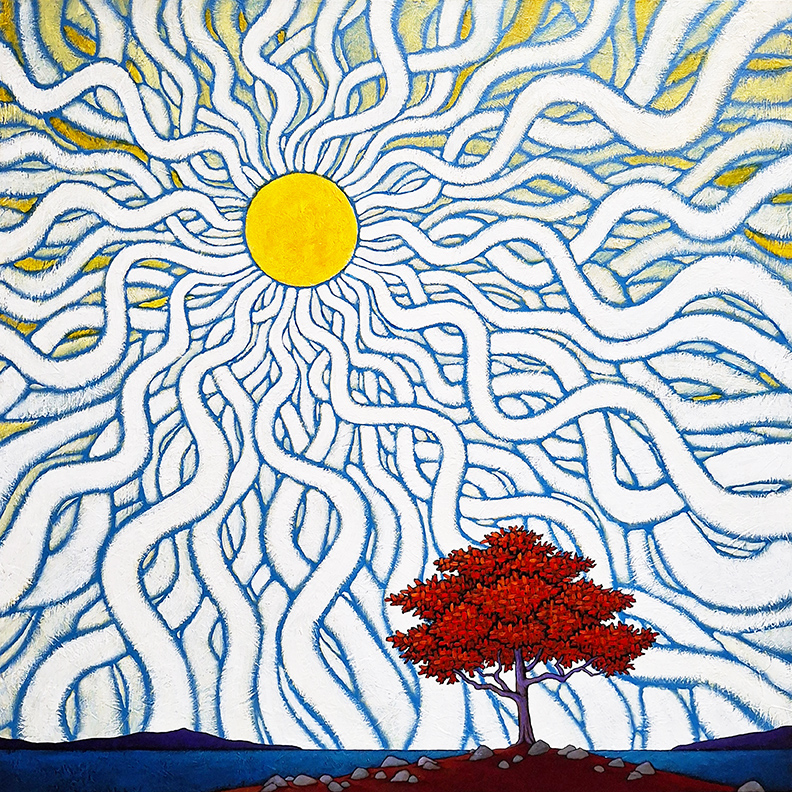
This new painting, Quiet Revelation, reminds me of the appearance of one of these rare moments of quietude. For me, the Red Tree here seems to have been able to block out the clang and furious rumble of this world, elevating to a point where it can observe the reality and harmony of the animating force that is just beyond our measure.

This energy source of which everything is comprised is the theme for my upcoming show, Entanglement, at the Principle Gallery. I see this piece with its quiet harmony, as a fine example of coming across that meditative stillness which is being sought, a feeling I experienced for a time while painting this piece.

And that’s always a gift. All I could ask for in my work.


Quiet Revelation is a larger painting, at 36″ by 36″ on canvas. It is part of my annual solo exhibit — this year marks my 26th show at the Principle– of new paintings, Entanglement, that opens less than two weeks from today, on Friday, June 13 at the Principle Gallery with an Opening Reception from 6-8:30 PM.

The day after the show’s opening, on Saturday, June 14, I will also be giving a Painting Demonstration at the gallery. The demo, my first there, should run from 11 AM until 1 PM or thereaboutsHope you can make it either or both events.

Read Full Post »

The Pacifying Light

What I dream of is an art of balance, of purity and serenity, devoid of troubling or disturbing subject matter, an art which could be for every mental worker, for the businessman was well as the man of letters, for example, a soothing, calming influence on the mind, something like a good armchair which provides relaxation from physical fatigue.

–Henri Matisse, Notes of a Painter (1908)


I love this passage from Henri Matisse expressing his aspirations for how his work might affect the viewer. I should probably be sharing some of his work but I am instead sharing a new painting from my upcoming show at the Principle Gallery. I can rationalize this by saying that I very much share Matisse’s desires for my own work and have often found it to be a soothing, comforting influence, as he put it, on my mind.

A good armchair in which to relax.

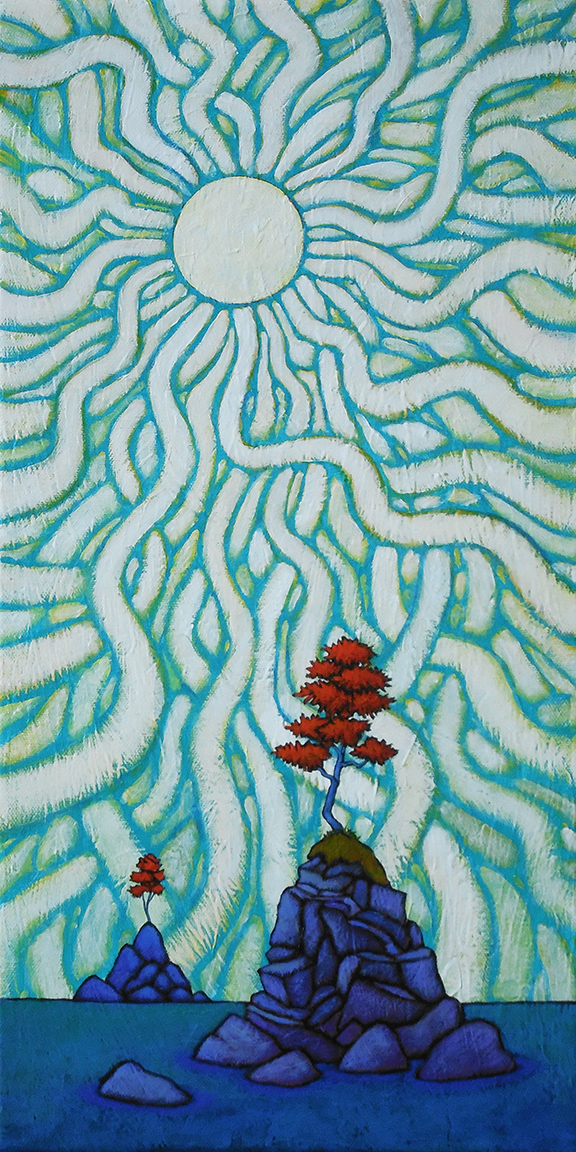
This new painting, The Pacifying Light, fits that description very well, at least to my eyes and mind. I find something very soothing in the color and rhythm of this piece, something that instantly puts me at ease without even pondering any meaning in it. It makes it very inviting, giving the viewer an easy entrance into it.

This accessibility is often half the battle in creating a piece of art that engages or moves people in any way. Feeling comfortable in the created space of an artwork allows the viewer to relax and really explore what they are seeing in the work and what that meaning that holds for themselves.

There is that sort of easiness in this piece. It feels quiet and invitingly peaceful while still maintaining space for deeper reflection. I guess that would serve as my corollary to Matisse’s stated aspirations– to put the viewer at ease while still giving them something to think about.

I think The Pacifying Light fulfills that goal.


The Pacifying Light is 20″ by 10″ on canvas.

 is included in my exhibit of new work, Entanglement, that opens less than two weeks from today, on Friday, June 13 at the Principle Gallery with an Opening Reception from 6-8:30 PM.

Two weeks from today, I will also be giving a Painting Demonstration at the gallery on Saturday, June 14, from 11 AM until 1 PM. Hope you can make it either or both events.


Read Full Post »

Skip the Light Fandango–At Principle Gallery June 13, 2025


We skipped the light fandango
Turned some cartwheels across the floor
I was feeling kind of seasick
When the crowd called out for more
The room was humming harder
And the ceiling flew away

A Whiter Shade of Pale, Procul Harum


I can’t exactly say why the opening line from the old Procul Harum song came to mind when I was putting the finishing touches on this new painting. It really doesn’t have much to do with the song itself but since that moment that line seems glued to this painting in my mind.

I think it may have to do with the sky here, with the rolls crossing it reminding me both of pinwheels and cartwheels. There’s also something in the tone of this painting that feels a bit like that of the song to me. Unlike some of the other paintings from this show that employ this pinwheel/cartwheel sky, this piece carries more darker undertones. It shows a bit in the image above but is more evident when seen in person.

Even with the reference to the song, this is a painting that very much fits in with the theme of my upcoming Entanglement show at the Principle Gallery that opens two weeks from today, on Friday, June 13. I see the Red Tree here recognizing its relationship with the greater patterns of energy that make up all, understanding that it has descended from it and will eventually ascend back to it.

I’ve spent quite a bit of time glancing at this painting over the past several months. It has the ability to pull me in and hold my attention while creating a deep emotional response within me, a trait I find appealing in any piece of art.

Whether this applies to others as far as this painting is concerned, I cannot say. You can never tell for sure. That’s the beauty and mystery of art.

Now let us listen to that Procul Harum song that inspired this piece’s title. This is A Whiter Shade of Pale from 1967. If you’re of a certain age, you know that this song was radio staple throughout the late 60’s and 70’s and was played at every high school prom in that era. I can’t say for sure, but I think it was required by law.

Give a listen then let yourself out– I have tons to do this morning and need to get to it pronto.


Skip the Light Fandango is 15″ by 30″ on canvas and is included in my exhibit of new work, Entanglement, that opens two weeks from today, on Friday, June 13 at the Principle Gallery with an Opening Reception from 6-8:30 PM. I will also be giving a Painting Demonstration at the gallery on the following day, Saturday, June 14, from 11 AM until 1 PM.


Read Full Post »

The Internal Landscape– 2012


Eternal tourists of ourselves, there is no landscape but what we are. We possess nothing, for we don’t even possess ourselves. We have nothing because we are nothing. What hand will I reach out, and to what universe? The universe isn’t mine: it’s me.

― Fernando Pessoa, The Book of Disquiet


Wasn’t going to post anything this morning until I came across this post from just a couple of years back. Though it doesn’t deal with my upcoming show, Pessoa’s words certainly match up perfectly with the theme of my June show. Thought it was worth sharing again. Plus, there’s also a great Mavis Staples/ Levon Helm song. Win-win…


I recently came across the passage above from The Book of Disquiet, the “factless autobiography” of Fernando Pessoa, the Portuguese poet/author, that was published after his death in 1935. Reading it made me look further into the book and I was surprised at how his description of his internal travels lined up with my own. He wrote of the landscapes he saw within while I paint mine.

There is another similar quote from Pessoa that is supposed to come from The Book of Disquiet as well:

The true landscapes are those that we ourselves create. I’ve crossed more seas than anyone. I’ve seen more mountains than there are on earth. The universe isn’t mine: it’s me.

I haven’t been able to find this specific passage in the book yet. I believe it has to do with the variance between the several translations of the book from the Portuguese. However, this one rings even more true for my work. That sentiment of traveling the internal landscape has been the driving force behind my work for my entire career. It manifested itself in the large painting from 2012 shown at the top, The Internal Landscape.

It’s an image that has been shown here a number of times over the years and remains what I would consider a signature piece, a truly representative image of my inner world.

It felt like it needed to be seen again this morning.

Have to run because there are new places to see and explore this morning. In parting, here’s a song that feels like it fits. This is Wide River to Cross from Mavis Staples and the late great Levon Helm.

See you somewhere down the road.


Read Full Post »

The Calming Flow— Coming to Principle Gallery, June 2025


In my youth the heart of dawn was in my heart, and the songs of April were in my ears.
But my soul was sad unto death, and I knew not why. Even unto this day I know not why I was sad.
But now, though I am with eventide, my heart is still veiling dawn,
And though I am with autumn, my ears still echo the songs of spring.
But my sadness has turned into awe, and I stand in the presence of life and life’s daily miracles.

Youth and Age, Kahlil Gibran (1926)


I recently came across the opening portion above from the poem Youth and Age from poet/philosopher Kahlil Gibran (1883 –1931) and felt that it spoke deeply to both what I have been feeling in my recent work and in my own life. I suppose that makes sense since my work very much reflects the experience and feeling of my life. I 

I think that anyone who is into the autumn or winter of their life can identify with the message of these lines. The face in the mirror shows the wear of the years and the body often aches and groans but the heart and spirit still feel youthful. As Gibran puts it, my ears still echo the songs of spring.

But it is a youthfulness that comes with much more understanding and acceptance than when one was actually the age felt. I think this is put best in a passage from later in this poem:

And in my youth I would gaze upon the sun of the day and the stars of the night, saying in my secret, “How small am I, and how small a circle my dream makes.”
But today when I stand before the sun or the stars I cry, “The sun is close to me, and the stars are upon me;” for all the distances of my youth have turned into the nearness of age;
And the great aloneness which knows not what is far and what is near, nor what is small nor great, has turned into a vision that weighs not nor does it measure.

The extremes of smallness and largeness of self that one sometimes felt in their youth has mellowed with the knowledge that while we are but small and seemingly insignificant bits of whatever you want to call this swirling, chaotic mass that is our existence and the universe, we occupy a place in it.

Born of a singularity, we are of it. 

And with that knowledge, as Gibran puts it so well, my sadness has turned into awe, and I stand in the presence of life and life’s daily miracles.

I think this thought is an apt description for what I see in this new painting, The Calming Flow, an 18″ by 18″ canvas that is part of my upcoming solo exhibit, Entanglement, at the Principle Gallery. I recognize that same sense of acceptance and realization that I read in Gibran’s verse. It is one of the calmness and patience that comes with age for some.

The complete poem Youth and Age is below.


Entanglement opens Friday, June 13 at the Principle Gallery with an Opening Reception from 6-8:30 PM. I will also be giving a Painting Demonstration at the gallery on the following day, Saturday, June 14, from 11 AM until 1 PM.


In my youth the heart of dawn was in my heart, and the songs of April were in my ears.
But my soul was sad unto death, and I knew not why. Even unto this day I know not why I was sad.
But now, though I am with eventide, my heart is still veiling dawn,
And though I am with autumn, my ears still echo the songs of spring.
But my sadness has turned into awe, and I stand in the presence of life and life’s daily miracles.
The difference between my youth which was my spring, and these forty years, and they are my autumn, is the very difference that exists between flower and fruit.
A flower is forever swayed with the wind and knows not why and wherefore.
But the fruit overladen with the honey of summer, knows that it is one of life’s home-comings, as a poet when his song is sung knows sweet content,
Though life has been bitter upon his lips.
In my youth I longed for the unknown, and for the unknown I am still longing.
But in the days of my youth longing embraced necessity that knows naught of patience.
Today I long not less, but my longing is friendly with patience, and even waiting.
And I know that all this desire that moves within me is one of those laws that turns universes around one another in quiet ecstasy, in swift passion which your eyes deem stillness, and your mind a mystery.
And in my youth I loved beauty and abhorred ugliness, for beauty was to me a world separated from all other worlds.
But now that the gracious years have lifted the veil of picking-and-choosing from over my eyes, I know that all I have deemed ugly in what I see and hear, is but a blinder upon my eyes, and wool in my ears;
And that our senses, like our neighbors, hate what they do not understand.
And in my youth I loved the fragrance of flowers and their color.
Now I know that their thorns are their innocent protection, and if it were not for that innocence they would disappear forevermore.
And in my youth, of all seasons I hated winter, for I said in my aloneness, “Winter is a thief who robs the earth of her sun-woven garment, and suffers her to stand naked in the wind.”
But now I know that in winter there is re-birth and renewal, and that the wind tears the old raiment to cloak her with a new raiment woven by the spring.
And in my youth I would gaze upon the sun of the day and the stars of the night, saying in my secret, “How small am I, and how small a circle my dream makes.”
But today when I stand before the sun or the stars I cry, “The sun is close to me, and the stars are upon me;” for all the distances of my youth have turned into the nearness of age;
And the great aloneness which knows not what is far and what is near, nor what is small nor great, has turned into a vision that weighs not nor does it measure.
In my youth I was but the slave of the high tide and the ebb tide of the sea, and the prisoner of half moons and full moons.
Today I stand at this shore and I rise not nor do I go down.
Even my roots once every twenty-eight days would seek the heart of the earth.
And on the twenty-ninth day they would rise toward the throne of the sky.
And on that very day the rivers in my veins would stop for a moment, and then would run again to the sea.
Yes, in my youth I was a thing, sad and yielding, and all the seasons played with me and laughed in their hearts.
And life took a fancy to me and kissed my young lips, and slapped my cheeks.
Today I play with the seasons. And I steal a kiss from life’s lips ere she kisses my lips.
And I even hold her hands playfully that she may not strike my cheek.
In my youth I was sad indeed, and all things seemed dark and distant.
Today, all is radiant and near, and for this I would live my youth and the pain of my youth, again and yet again.

–Youth and Age, Kahlil Gibran 


Read Full Post »

The Wisdom Beyond Words– Coming to Principle Gallery, June 2025


There is in all visible things an invisible fecundity, a dimmed light, a meek namelessness, a hidden wholeness. This mysterious Unity and Integrity is Wisdom, the Mother of all, Natura naturans. There is in all things an inexhaustible sweetness and purity, a silence that is a fount of action and joy. It rises up in wordless gentleness and flows out to me from the unseen roots of all created being, welcoming me tenderly, saluting me with indescribable humility. This is at once my own being, my own nature, and the Gift of my Creator’s Thought and Art within me, speaking as Hagia Sophia, speaking as my sister, Wisdom.

— Thomas Merton, Hagia Sophia (1961)


I was looking for something to accompany the new painting shown here, The Wisdom Beyond Words, and came across this passage from Thomas Merton. It’s the opening section of his prose poem Hagia Sophia written sometime around 1961.  Though it speaks through the dogma of Catholicism, it matches very well the belief system I somewhat laid out here a week or so back. As it often is with most religions, the underlying structure and belief is very much the same idea but with symbols, stories, and representations that reflect cultural differences. 

In short, this passage captured in words what I see and sense in this painting. It could very well be used to describe the theme of my Entanglement exhibit that opens June 13 at the Principle Gallery, which I have described as being how everything is contained in small part in every other thing. Much as it is in the theory put forward by Stephen Hawking that when a star dies it collapses into itself until it is finally a single tiny point of zero radius, infinite density, and infinite curvature of spacetime at the heart of the black hole formed from the star’s collapse. A single point of immense mass and energy This was referred to as a Singularity

Hawking looked at this singularity and wondered since this was the end point of star’s death could it not also be the starting point for future new universes that might emerge if this singularity were to explode outward– the Big Bang Theory.

The underlying thought is that the universe and all that it is was once a single thing before the Big Bang created all that we know the universe to be now from that single point.

We were all part of one thing. We were that one thing.

And it’s that unity and wisdom of all things, much like that of which Merton wrote, that I sense in this painting. 

Read Full Post »

Waiting For the End of the World – At Principle Gallery, June 2025


Someone called from across the water
‘Are you coming off that island soon?’
I hollered back
‘No, not yet—
I’m waiting for the end of the world.’
Then I turned back to watch the sky
As its currents and clouds
Surged and volleyed
In every way we know
And some we don’t know
And I thought to myself
With the sky racing around me
‘What a fine day it is–
Waiting for the end of the world.’


At the West End Gallery painting demo this past Saturday, someone asked when I titled my paintings, if I ever had title in mind as I worked on a piece. I said that generally it came after the painting was complete, when it was fully formed and whatever it was going to say was written on its surface. I didn’t say it quite that way, of course. 

I added to my answer and spoke about the painting at the top, a small 6″ by 12″ canvas, that is headed to the Principle Gallery for my June show there. I described that, while painting this piece, the verse above came into my head and was all I could think of as I worked. Shifting colors and words, it was a strange collaboration of thoughts for me, as I simultaneously edited and adjusted both the painting and the verse as I worked.

It made the words and the image bind one to the other in my mind.

Now, I realize the title may not seem compatible with the painting at first glance. I initially worried that the title was out of step with the theme of my upcoming show, Entanglement, which is about the unity of all energies and the idea that there is no beginning or end.

But what I see in the painting is a kind of tranquil acceptance of whatever hand fate deals in the here and now. An acceptance that allows you to recognize and appreciate the beauty of this moment and place.

A feeling of oneness with the universe, realizing that the end of the world is not the end of being. 

And that thought is completely in line with the theme of the show.

It’s a simple piece that packs a lot into a small space. But sometimes even the tiniest of things contain all that makes up this universe. As do we all.

Here’s song that I shared about five years back. It’s Push the Sky Away from a 2019 performance at the Sydney Opera House by Nick Cave, pianist Warren Ellis and the Sydney Philharmonic Orchestra. The song was originally from Nick Cave with the Bad Seeds.

Okay, that’s the end. No, not of the world– just this blog post.

But glimpsing out the window, it looks like a fine day to be waiting for the end of the world.


Read Full Post »


I would maintain that thanks are the highest form of thought; and gratitude is happiness doubled by wonder.

–G. K. Chesterton, A Short History of England (1917)


Many, many, many thanks to everyone who came out yesterday morning for the painting demonstration I gave at the West End Gallery. I know how precious time is so the idea that such a lovely group of people chose to spend a good portion of their Saturday watching me work blows me away. It was wonderful group that was attentive, inquisitive, gracious, and fun, with friends coming from as far away as Toronto, Syracuse and Binghamton for the event. 

I was nervous at the prospect of painting in front of a group, but these folks quickly alleviated my jitters with their easy laughter and questions.  I started the demo with a 12″ by 16″ canvas that had been prepped with multiple layers of gesso then a final layer of deep purple paint. Since I was determined to get as far into the painting as I could during the demo I painted faster than I normally would in the studio. I had decided that I would employ a blockish style in the sky that I sometimes use as it would get maximum surface coverage in the shortest time. The blocks were slapped in in multiple colors that often had a flat appearance to me at first.  That would be rectified in subsequent layers.

I had a vague idea of how I would compose the landscape below the sky but that was thrown out the window as I worked. Adjusting on the fly is often the case with my work. I opted for a simpler landscape with patchwork fields that is seen in much of my work. I asked the group if they would prefer the landscape with hills in the distance and they said yes to that. I blocked those in and then began shaping the landscape with payer of lighter colors.

I hustled along and finally decide to finish up with the prerequisite Red Tree. Of course, I had inadvertently forgot to pack the particular red that has been the staple for my red trees for the past 25 years. But as I said, art is seldom done under perfect conditions and often requires working with what is at hand. I ended up using a crimson that was a little heavier bodied and darker than I would normally use.

Without getting into all the details, the piece was more or less finished after a little before 1 PM. I was as surprised as anyone. I hadn’t anticipated getting anywhere near completion on this painting.

All in all, I am very pleased with the result. The image at the top shows how the demo piece turned out. Though it has a look of completion, it needs a bit of work before I would call it done. There are a number of areas in it that need to be refined and just looking at the painting now I see a number of small changes and adjustments that will be made. That includes reshaping and repainting the crown of the Red Tree which is not quite as expressive as I would like. As I said, I was hurrying a bit at the end in order to get to some form of completion.

All in all, I think the demo went well. I think it gave some insight into how this type of my work comes about and how creative decisions are made along the way in making any piece. It showed how the work seldom if ever proceeds in a straight line from beginning to end and that it is the ability to adjust and adapt that transforms a piece. 

Thank you once more for everyone that showed up yesterday. You made my task much easier and, while I can’t speak for you, you made it fun for me. And as fun is sometimes a rare commodity these days, I really appreciate that part of yesterday.

And a special Thank You to Jesse and Lin at the West End Gallery for coaxing me out of my cave for the day. Maybe we will do it again sometime in the future. Maybe with the other style, the wet work in transparent inks, that I began my career with. We’ll see…

Here’s this week’s Sunday Morning Music. It’s Bonnie Raitt’s cover of Thank You (that fits the theme here, right?) which was written by Isaac Hayes and famously recorded by the great Sam & Dave.

Thank you!


Read Full Post »

« Newer Posts - Older Posts »