Feeds:
Posts
Comments

Posts Tagged ‘Red Tree’

Skip the Light Fandango–At Principle Gallery June 13, 2025


We skipped the light fandango
Turned some cartwheels across the floor
I was feeling kind of seasick
When the crowd called out for more
The room was humming harder
And the ceiling flew away

A Whiter Shade of Pale, Procul Harum


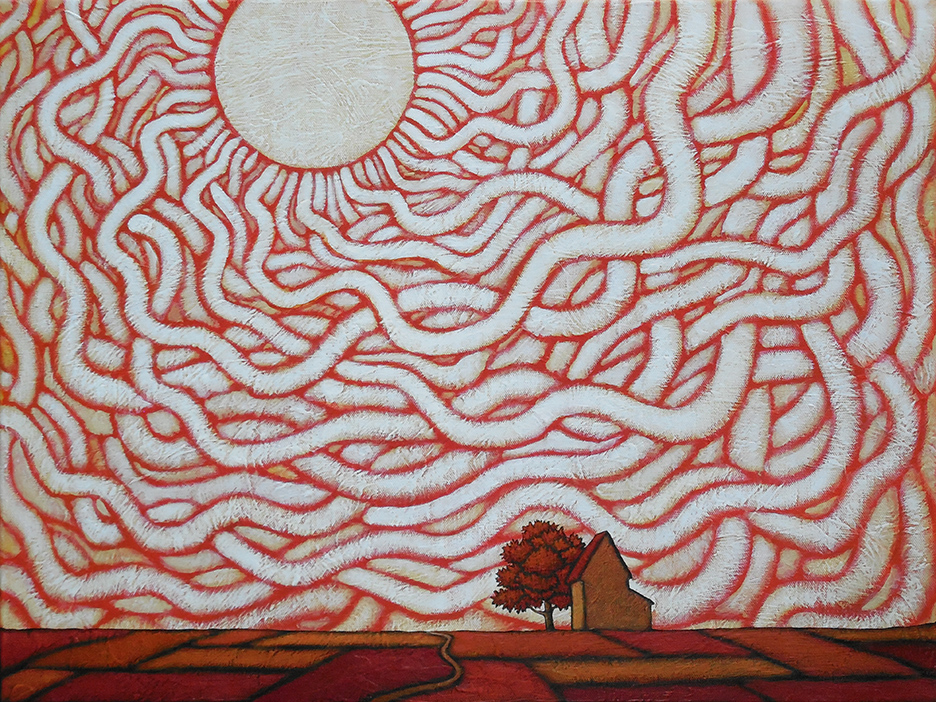
I can’t exactly say why the opening line from the old Procul Harum song came to mind when I was putting the finishing touches on this new painting. It really doesn’t have much to do with the song itself but since that moment that line seems glued to this painting in my mind.

I think it may have to do with the sky here, with the rolls crossing it reminding me both of pinwheels and cartwheels. There’s also something in the tone of this painting that feels a bit like that of the song to me. Unlike some of the other paintings from this show that employ this pinwheel/cartwheel sky, this piece carries more darker undertones. It shows a bit in the image above but is more evident when seen in person.

Even with the reference to the song, this is a painting that very much fits in with the theme of my upcoming Entanglement show at the Principle Gallery that opens two weeks from today, on Friday, June 13. I see the Red Tree here recognizing its relationship with the greater patterns of energy that make up all, understanding that it has descended from it and will eventually ascend back to it.

I’ve spent quite a bit of time glancing at this painting over the past several months. It has the ability to pull me in and hold my attention while creating a deep emotional response within me, a trait I find appealing in any piece of art.

Whether this applies to others as far as this painting is concerned, I cannot say. You can never tell for sure. That’s the beauty and mystery of art.

Now let us listen to that Procul Harum song that inspired this piece’s title. This is A Whiter Shade of Pale from 1967. If you’re of a certain age, you know that this song was radio staple throughout the late 60’s and 70’s and was played at every high school prom in that era. I can’t say for sure, but I think it was required by law.

Give a listen then let yourself out– I have tons to do this morning and need to get to it pronto.


Skip the Light Fandango is 15″ by 30″ on canvas and is included in my exhibit of new work, Entanglement, that opens two weeks from today, on Friday, June 13 at the Principle Gallery with an Opening Reception from 6-8:30 PM. I will also be giving a Painting Demonstration at the gallery on the following day, Saturday, June 14, from 11 AM until 1 PM.


Read Full Post »

The Internal Landscape– 2012


Eternal tourists of ourselves, there is no landscape but what we are. We possess nothing, for we don’t even possess ourselves. We have nothing because we are nothing. What hand will I reach out, and to what universe? The universe isn’t mine: it’s me.

― Fernando Pessoa, The Book of Disquiet


Wasn’t going to post anything this morning until I came across this post from just a couple of years back. Though it doesn’t deal with my upcoming show, Pessoa’s words certainly match up perfectly with the theme of my June show. Thought it was worth sharing again. Plus, there’s also a great Mavis Staples/ Levon Helm song. Win-win…


I recently came across the passage above from The Book of Disquiet, the “factless autobiography” of Fernando Pessoa, the Portuguese poet/author, that was published after his death in 1935. Reading it made me look further into the book and I was surprised at how his description of his internal travels lined up with my own. He wrote of the landscapes he saw within while I paint mine.

There is another similar quote from Pessoa that is supposed to come from The Book of Disquiet as well:

The true landscapes are those that we ourselves create. I’ve crossed more seas than anyone. I’ve seen more mountains than there are on earth. The universe isn’t mine: it’s me.

I haven’t been able to find this specific passage in the book yet. I believe it has to do with the variance between the several translations of the book from the Portuguese. However, this one rings even more true for my work. That sentiment of traveling the internal landscape has been the driving force behind my work for my entire career. It manifested itself in the large painting from 2012 shown at the top, The Internal Landscape.

It’s an image that has been shown here a number of times over the years and remains what I would consider a signature piece, a truly representative image of my inner world.

It felt like it needed to be seen again this morning.

Have to run because there are new places to see and explore this morning. In parting, here’s a song that feels like it fits. This is Wide River to Cross from Mavis Staples and the late great Levon Helm.

See you somewhere down the road.


Read Full Post »

The Calming Flow— Coming to Principle Gallery, June 2025


In my youth the heart of dawn was in my heart, and the songs of April were in my ears.
But my soul was sad unto death, and I knew not why. Even unto this day I know not why I was sad.
But now, though I am with eventide, my heart is still veiling dawn,
And though I am with autumn, my ears still echo the songs of spring.
But my sadness has turned into awe, and I stand in the presence of life and life’s daily miracles.

Youth and Age, Kahlil Gibran (1926)


I recently came across the opening portion above from the poem Youth and Age from poet/philosopher Kahlil Gibran (1883 –1931) and felt that it spoke deeply to both what I have been feeling in my recent work and in my own life. I suppose that makes sense since my work very much reflects the experience and feeling of my life. I 

I think that anyone who is into the autumn or winter of their life can identify with the message of these lines. The face in the mirror shows the wear of the years and the body often aches and groans but the heart and spirit still feel youthful. As Gibran puts it, my ears still echo the songs of spring.

But it is a youthfulness that comes with much more understanding and acceptance than when one was actually the age felt. I think this is put best in a passage from later in this poem:

And in my youth I would gaze upon the sun of the day and the stars of the night, saying in my secret, “How small am I, and how small a circle my dream makes.”
But today when I stand before the sun or the stars I cry, “The sun is close to me, and the stars are upon me;” for all the distances of my youth have turned into the nearness of age;
And the great aloneness which knows not what is far and what is near, nor what is small nor great, has turned into a vision that weighs not nor does it measure.

The extremes of smallness and largeness of self that one sometimes felt in their youth has mellowed with the knowledge that while we are but small and seemingly insignificant bits of whatever you want to call this swirling, chaotic mass that is our existence and the universe, we occupy a place in it.

Born of a singularity, we are of it. 

And with that knowledge, as Gibran puts it so well, my sadness has turned into awe, and I stand in the presence of life and life’s daily miracles.

I think this thought is an apt description for what I see in this new painting, The Calming Flow, an 18″ by 18″ canvas that is part of my upcoming solo exhibit, Entanglement, at the Principle Gallery. I recognize that same sense of acceptance and realization that I read in Gibran’s verse. It is one of the calmness and patience that comes with age for some.

The complete poem Youth and Age is below.


Entanglement opens Friday, June 13 at the Principle Gallery with an Opening Reception from 6-8:30 PM. I will also be giving a Painting Demonstration at the gallery on the following day, Saturday, June 14, from 11 AM until 1 PM.


In my youth the heart of dawn was in my heart, and the songs of April were in my ears.
But my soul was sad unto death, and I knew not why. Even unto this day I know not why I was sad.
But now, though I am with eventide, my heart is still veiling dawn,
And though I am with autumn, my ears still echo the songs of spring.
But my sadness has turned into awe, and I stand in the presence of life and life’s daily miracles.
The difference between my youth which was my spring, and these forty years, and they are my autumn, is the very difference that exists between flower and fruit.
A flower is forever swayed with the wind and knows not why and wherefore.
But the fruit overladen with the honey of summer, knows that it is one of life’s home-comings, as a poet when his song is sung knows sweet content,
Though life has been bitter upon his lips.
In my youth I longed for the unknown, and for the unknown I am still longing.
But in the days of my youth longing embraced necessity that knows naught of patience.
Today I long not less, but my longing is friendly with patience, and even waiting.
And I know that all this desire that moves within me is one of those laws that turns universes around one another in quiet ecstasy, in swift passion which your eyes deem stillness, and your mind a mystery.
And in my youth I loved beauty and abhorred ugliness, for beauty was to me a world separated from all other worlds.
But now that the gracious years have lifted the veil of picking-and-choosing from over my eyes, I know that all I have deemed ugly in what I see and hear, is but a blinder upon my eyes, and wool in my ears;
And that our senses, like our neighbors, hate what they do not understand.
And in my youth I loved the fragrance of flowers and their color.
Now I know that their thorns are their innocent protection, and if it were not for that innocence they would disappear forevermore.
And in my youth, of all seasons I hated winter, for I said in my aloneness, “Winter is a thief who robs the earth of her sun-woven garment, and suffers her to stand naked in the wind.”
But now I know that in winter there is re-birth and renewal, and that the wind tears the old raiment to cloak her with a new raiment woven by the spring.
And in my youth I would gaze upon the sun of the day and the stars of the night, saying in my secret, “How small am I, and how small a circle my dream makes.”
But today when I stand before the sun or the stars I cry, “The sun is close to me, and the stars are upon me;” for all the distances of my youth have turned into the nearness of age;
And the great aloneness which knows not what is far and what is near, nor what is small nor great, has turned into a vision that weighs not nor does it measure.
In my youth I was but the slave of the high tide and the ebb tide of the sea, and the prisoner of half moons and full moons.
Today I stand at this shore and I rise not nor do I go down.
Even my roots once every twenty-eight days would seek the heart of the earth.
And on the twenty-ninth day they would rise toward the throne of the sky.
And on that very day the rivers in my veins would stop for a moment, and then would run again to the sea.
Yes, in my youth I was a thing, sad and yielding, and all the seasons played with me and laughed in their hearts.
And life took a fancy to me and kissed my young lips, and slapped my cheeks.
Today I play with the seasons. And I steal a kiss from life’s lips ere she kisses my lips.
And I even hold her hands playfully that she may not strike my cheek.
In my youth I was sad indeed, and all things seemed dark and distant.
Today, all is radiant and near, and for this I would live my youth and the pain of my youth, again and yet again.

–Youth and Age, Kahlil Gibran 


Read Full Post »

The Wisdom Beyond Words– Coming to Principle Gallery, June 2025


There is in all visible things an invisible fecundity, a dimmed light, a meek namelessness, a hidden wholeness. This mysterious Unity and Integrity is Wisdom, the Mother of all, Natura naturans. There is in all things an inexhaustible sweetness and purity, a silence that is a fount of action and joy. It rises up in wordless gentleness and flows out to me from the unseen roots of all created being, welcoming me tenderly, saluting me with indescribable humility. This is at once my own being, my own nature, and the Gift of my Creator’s Thought and Art within me, speaking as Hagia Sophia, speaking as my sister, Wisdom.

— Thomas Merton, Hagia Sophia (1961)


I was looking for something to accompany the new painting shown here, The Wisdom Beyond Words, and came across this passage from Thomas Merton. It’s the opening section of his prose poem Hagia Sophia written sometime around 1961.  Though it speaks through the dogma of Catholicism, it matches very well the belief system I somewhat laid out here a week or so back. As it often is with most religions, the underlying structure and belief is very much the same idea but with symbols, stories, and representations that reflect cultural differences. 

In short, this passage captured in words what I see and sense in this painting. It could very well be used to describe the theme of my Entanglement exhibit that opens June 13 at the Principle Gallery, which I have described as being how everything is contained in small part in every other thing. Much as it is in the theory put forward by Stephen Hawking that when a star dies it collapses into itself until it is finally a single tiny point of zero radius, infinite density, and infinite curvature of spacetime at the heart of the black hole formed from the star’s collapse. A single point of immense mass and energy This was referred to as a Singularity

Hawking looked at this singularity and wondered since this was the end point of star’s death could it not also be the starting point for future new universes that might emerge if this singularity were to explode outward– the Big Bang Theory.

The underlying thought is that the universe and all that it is was once a single thing before the Big Bang created all that we know the universe to be now from that single point.

We were all part of one thing. We were that one thing.

And it’s that unity and wisdom of all things, much like that of which Merton wrote, that I sense in this painting. 

Read Full Post »

Waiting For the End of the World – At Principle Gallery, June 2025


Someone called from across the water
‘Are you coming off that island soon?’
I hollered back
‘No, not yet—
I’m waiting for the end of the world.’
Then I turned back to watch the sky
As its currents and clouds
Surged and volleyed
In every way we know
And some we don’t know
And I thought to myself
With the sky racing around me
‘What a fine day it is–
Waiting for the end of the world.’


At the West End Gallery painting demo this past Saturday, someone asked when I titled my paintings, if I ever had title in mind as I worked on a piece. I said that generally it came after the painting was complete, when it was fully formed and whatever it was going to say was written on its surface. I didn’t say it quite that way, of course. 

I added to my answer and spoke about the painting at the top, a small 6″ by 12″ canvas, that is headed to the Principle Gallery for my June show there. I described that, while painting this piece, the verse above came into my head and was all I could think of as I worked. Shifting colors and words, it was a strange collaboration of thoughts for me, as I simultaneously edited and adjusted both the painting and the verse as I worked.

It made the words and the image bind one to the other in my mind.

Now, I realize the title may not seem compatible with the painting at first glance. I initially worried that the title was out of step with the theme of my upcoming show, Entanglement, which is about the unity of all energies and the idea that there is no beginning or end.

But what I see in the painting is a kind of tranquil acceptance of whatever hand fate deals in the here and now. An acceptance that allows you to recognize and appreciate the beauty of this moment and place.

A feeling of oneness with the universe, realizing that the end of the world is not the end of being. 

And that thought is completely in line with the theme of the show.

It’s a simple piece that packs a lot into a small space. But sometimes even the tiniest of things contain all that makes up this universe. As do we all.

Here’s song that I shared about five years back. It’s Push the Sky Away from a 2019 performance at the Sydney Opera House by Nick Cave, pianist Warren Ellis and the Sydney Philharmonic Orchestra. The song was originally from Nick Cave with the Bad Seeds.

Okay, that’s the end. No, not of the world– just this blog post.

But glimpsing out the window, it looks like a fine day to be waiting for the end of the world.


Read Full Post »


I would maintain that thanks are the highest form of thought; and gratitude is happiness doubled by wonder.

–G. K. Chesterton, A Short History of England (1917)


Many, many, many thanks to everyone who came out yesterday morning for the painting demonstration I gave at the West End Gallery. I know how precious time is so the idea that such a lovely group of people chose to spend a good portion of their Saturday watching me work blows me away. It was wonderful group that was attentive, inquisitive, gracious, and fun, with friends coming from as far away as Toronto, Syracuse and Binghamton for the event. 

I was nervous at the prospect of painting in front of a group, but these folks quickly alleviated my jitters with their easy laughter and questions.  I started the demo with a 12″ by 16″ canvas that had been prepped with multiple layers of gesso then a final layer of deep purple paint. Since I was determined to get as far into the painting as I could during the demo I painted faster than I normally would in the studio. I had decided that I would employ a blockish style in the sky that I sometimes use as it would get maximum surface coverage in the shortest time. The blocks were slapped in in multiple colors that often had a flat appearance to me at first.  That would be rectified in subsequent layers.

I had a vague idea of how I would compose the landscape below the sky but that was thrown out the window as I worked. Adjusting on the fly is often the case with my work. I opted for a simpler landscape with patchwork fields that is seen in much of my work. I asked the group if they would prefer the landscape with hills in the distance and they said yes to that. I blocked those in and then began shaping the landscape with payer of lighter colors.

I hustled along and finally decide to finish up with the prerequisite Red Tree. Of course, I had inadvertently forgot to pack the particular red that has been the staple for my red trees for the past 25 years. But as I said, art is seldom done under perfect conditions and often requires working with what is at hand. I ended up using a crimson that was a little heavier bodied and darker than I would normally use.

Without getting into all the details, the piece was more or less finished after a little before 1 PM. I was as surprised as anyone. I hadn’t anticipated getting anywhere near completion on this painting.

All in all, I am very pleased with the result. The image at the top shows how the demo piece turned out. Though it has a look of completion, it needs a bit of work before I would call it done. There are a number of areas in it that need to be refined and just looking at the painting now I see a number of small changes and adjustments that will be made. That includes reshaping and repainting the crown of the Red Tree which is not quite as expressive as I would like. As I said, I was hurrying a bit at the end in order to get to some form of completion.

All in all, I think the demo went well. I think it gave some insight into how this type of my work comes about and how creative decisions are made along the way in making any piece. It showed how the work seldom if ever proceeds in a straight line from beginning to end and that it is the ability to adjust and adapt that transforms a piece. 

Thank you once more for everyone that showed up yesterday. You made my task much easier and, while I can’t speak for you, you made it fun for me. And as fun is sometimes a rare commodity these days, I really appreciate that part of yesterday.

And a special Thank You to Jesse and Lin at the West End Gallery for coaxing me out of my cave for the day. Maybe we will do it again sometime in the future. Maybe with the other style, the wet work in transparent inks, that I began my career with. We’ll see…

Here’s this week’s Sunday Morning Music. It’s Bonnie Raitt’s cover of Thank You (that fits the theme here, right?) which was written by Isaac Hayes and famously recorded by the great Sam & Dave.

Thank you!


Read Full Post »

The Entanglement— Coming in June to Principle Gallery


So the universe is not quite as you thought it was. You’d better rearrange your beliefs, then. Because you certainly can’t rearrange the universe.

–Isaac Asimov, Nightfall (1941)


 I have been extraordinarily fortunate to have had solo exhibits at the Principle Gallery in Old Town Alexandria, VA every year since 2000. This year’s exhibit, my 26th solo effort there, opens Friday, June 13, and is titled Entanglement. The painting at the top is the first piece from this show that I am sharing. It is titled The Entanglement.

At my last Gallery Talk at the Principle Gallery this past September, I spoke briefly about my own belief system. I can’t remember exactly how I put it since I pretty much speak off the cuff at Gallery Talks, but I vaguely remember beckoning at my work on the walls behind me and stating that one could observe my entire belief system in those paintings. It was not of any particular religion nor was it a rejection of any other. I pointed out that we all have a belief system of some sort. Even Atheism or whatever else you might call believing in nothing is a belief system. Mine, as shown in my work, was simply how I saw the totality of the world and the universe, expressed in a way that my simple mind could comprehend and accept. 

I don’t know that I was able then to fully explain it in a way that was satisfactory to anyone but myself. Probably not. But I felt kind of freed up by just admitting to a belief system, however unformed and vague it might seem. Thought I had felt this way about the link between my work and my beliefs, saying it aloud made me look at my work in a different way. It became the impetus for this year’s exhibit.

Entanglement, the title of this exhibit, also is perhaps the most vital aspect of what I believe. Over the coming weeks, I will try to explain it a bit more, though my perception of it shifts and moves all the time.

You see, my belief system is not based on any dogma or doctrine or on any sort of demand for certainty. Human uncertainty is a given in my belief system.  I say human uncertainty because I do believe there is some sort of certainty in my belief system. But it’s more in the way of the immutable laws of physics. Well, the laws physics as an ill-educated person sees them.

And that’s where Entanglement enters the picture here. I see us as being manifestations of waves and bands of energy that have merged together to manifest and create flesh and blood beings. These beings, we humans, are temporary, existing for but a limited time on this physical plane. When that time comes to an end, their energy rejoins the bands and waves are constantly in motion around us.

We have free will in my belief system. There is no central figure overseeing and guiding our movements or choices while we in our physical form. Our freely chosen actions either create harmony or disharmony with these bands of energy. Good as we understand it might be seen as being in harmony with this energy while Evil might be seen as being in disharmony, which creates a disruption in the intricate pattern which these energy bands create.

However, it is a self-healing system, one that instantaneously begins to modulate and return itself to a state of harmony. The results of these healing actions within the system are sometimes referred to here as karma. As far as I my limited knowledge of history tells me, though there is always someone using their free will to choose disharmony, the system always comes back to a state of harmony within a reasonably short time. In short, evil seldom prevails for an extended period of time.

Much of what makes up this belief system of energy waves and bands is not inconsistent with other religions or systems of belief. Much of the underlying theology for most religions, once you strip away parochial dogma, is fairly consistent throughout the world. The Ten Commandments, after all, are generally rules which aim to create harmony and discourage disharmony. You needn’t be Christian to see that they aren’t bad rules to live by.

I am going to take a break from this for now. I get a little self-conscious talking about this, imagining someone reading this and rolling their eyes and saying, “What a nutjob!”

Not that I need to defend myself, I will say that it makes this world somewhat tolerable for me. When things are going bad for us as species, it allows me to believe that the system is already beginning to correct itself, aided by those on this physical plane who sense this disharmony and attempt to bring the world back into rhythm with their efforts.

There’s a lot more to it that I will share in the near future.  Actually, if you have read along for a while, you probably know what I believe already.

Now, getting back to this painting, The Entanglement. For me, I see this as being a scene of the harmony of which I have describing. The bands of energy move all around in patterns and directions we cannot sense and will never fully understand while we are here. It also creates a feeling of placidity in the scene as well as a sense of connection to the immense power behind it.

We are, after all, built from that energy, distinct parts of it. Our energy, our spirit, as we might call it, will forever be entangled with those ever-swirling bands of energy.

This connection and entanglement is the focus of much of the work from this year’s show. I find myself staring intently at the swirls and tangles in the skies I have painted for this show. Engrossed by its layers and shifts, I find myself sitting for a long time in front of some of these new pieces, often asking where it begins and where it ends. 

And I know there are no answers to these questions. And that’s just fine with me.

I don’t need an answer from that which I am.


The Entanglement is 18″ by 24″ on canvas and will be part of Entanglement, my annual exhibit at the Principle Gallery, opening Friday, June 13, 2025.


Read Full Post »

Serene Gratitude— At West End Gallery


On the day I was born,
Said my father, said he
I’ve an elegant legacy waiting for ye.
Tis a rhyme for your lips
And a song for your heart
To sing it whenever the world falls apart. Look, look, look to the rainbow
Follow it over the hill and stream
Look, look, look to the rainbow
Follow the fellow who follows a dream.

Yip Harburg, Look to the Rainbow from Finian’s Rainbow


I have a lot of faith in the ability of younger generations to see the horror show taking place in this country with clear eyes. That they will recognize the outright lies, the cruelty, the bullying, the hypocrisy, the corruption, and the stupidity that washes over us like a tidal wave every day.

But I have begun to question that belief in recent days.

I now finding myself worrying about what will come from the constant exposure to behaviors from our leaders that were once shameful and even disqualifying but have now become the accepted norm.

What is the legacy being created here? What kind of future world will it be when it becomes totally accepted to outright lie or cheat?  Or when selfishness is viewed as strength and compassion as weakness? When intelligence and science is derided while ignorance and unfounded belief is held in the highest esteem? When accountability and responsibility is replaced with buck-passing and scapegoating? When generosity and true charity is set aside in favor of piggish greed?

How will a society whose citizens have been raised with these shameful behaviors function?

From where I sit, it seems like it would be a hellish landscape, ugly and violent. A dystopian nightmare of cruel and crude people. 

Maybe I am dead wrong or overstating the case here. Maybe.

But how can we expect any different when every word and deed they now witness from those in power lacks traditional virtues of any kind and is considered acceptable? 

I know there are counterarguments here. For example, there are still many empathetic, caring folks whose parental influence will outweigh societal pressures. And maybe that will hold off us falling completely into the abyss for a time. But if we can’t reign this in soon and reestablish what we see as out of the norm and unacceptable, I fear it will eventually overtake us.

I can’t believe that is the legacy we want to leave for our future generations.

I wish I had answers instead of questions. Perhaps it’s not for me to answer. Perhaps the best we can do is to try to serve in our own small way as examples of kindness and compassion. 

Maybe by doing that we can serve as rainbows which others will follow. That would be a good start.

Here’s the song from which the lyrics at the top were taken. It’s Follow the Rainbow from the musical Finian’s Rainbow. The lyrics were written by Yip Harburg who also wrote the lyrics for many great songs– Over the Rainbow and all the other songs from The Wizard of Oz, Brother, Can You Spare a Dime?, April in Paris, Lydia the Tattooed Lady, and It’s Only a Paper Moon. There are a number of versions of this song out there, including one by Petula Clark from the film, but I prefer this version from the always great Dinah Washington.


Read Full Post »

The Steadying Light– At the West End Gallery


But hell can endure for only a limited period and life will begin again one day. History may perhaps have an end; but our task is not to terminate it but to create it, in the image of what we henceforth know to be true. Art, at least, teaches us that man cannot be explained by history alone and that he also finds a reason for his existence in the order of nature.

–Albert Camus, The Rebel (1951)


With the hope that this doesn’t turn into an extended rant, let me point out that the hell that Camus refers to in the passage above from his book, The Rebel, is one created by authoritarian governments. As he puts it:

Modern conquerors can kill, but do not seem to be able to create. Artists know how to create but cannot really kill. Murderers are only very exceptionally found among artists. In the long run, therefore, art in our revolutionary societies must die. But then the revolution will have lived its allotted span. Each time that the revolution kills in a man the artist that he might have been, it attenuates itself a little more. If, finally, the conquerors succeed in moulding the world according to their laws, it will not prove that quality is king but that this world is hell.

Authoritarians come to power through destructive means and not having the ability to create or govern, stifle free thought, art, and the artistic impulse– anything that might in any way question their right to power. As a result, art dies which creates, in effect, a hell on earth. But he adds that each time they kill the artistic impulse, they weaken their authority, bringing their hellish reign closer to its inevitable end. As Camus writes: But hell can endure for only a limited period and life will begin again one day.

I guess my point here is a simple one– Art Endures. It is the realm of thought, feeling, and creation that cannot be suppressed for long because it is an innate and indomitable part of humanity, more so than the rule of any king or tyrant. 

Like a buried seed, it persistently seeks light and air.

So, though the days may seem dark and hellish, that seed is planted, always there, growing unseen beneath the surface. Waiting to emerge once more.

Art endures. And with it, our humanity and hope.

Here’s a favorite song from Richard Thompson. This is a duet with the great Bonnie Raitt of his The Dimming of the Day, that I haven’t shared here before.


Read Full Post »

The Center Found– At the West End Gallery


The tumult of sorrow, of anger, of bitterness, of despair, was drifting farther and farther away. Even the terror, which was worse than any tumult, had vanished. In that instant of renunciation she had reached some spiritual haven. What she had found, she understood presently, was the knowledge that there is no support so strong as the strength that enables one to stand alone.

–Ellen Glasgow, The Difference (1923)


There really is something cleansing and ultimately clarifying in taking a stand or taking a path that diverges from the crowd. It sharpens your vision and centers you, washing away those depleting feelings– the tumult to which Glasgow referred above–that define and bind you to a herd.

Just reading that short paragraph, I am inclined to stop right here. What more need I say?

I will add that I really didn’t know the name Ellen Glasgow before I came across this passage. Glasgow, who was born and lived her entire life, from 1873 to 1945, in Richmond Virginia, is another of those folks who were celebrated in their time but whose work never quite reached the status of being iconic enough to span generations. I did know the title of her most famous novel, In This Our Time, which won the Pulitzer Prize in 1942 but only from the fact that it was also made into a Bette Davis film, one I have never actually seen.

But reading other passages and quotes from her, as well as reading several pages of the short story from which the passage at the top was taken, I am impressed by the depth of her observations. I certainly agree with her words on the enabling power that comes in standing alone.

Here’s a song from folk singer/songwriter Buffy Saint-Marie that emphasizes this point. It is the title track from her 1964 debut album, It’s My Way, that in 2016 was added to the National Recording Registry. Each year the Library of Congress selects 25 recordings that they deem to be “culturally, historically, or aesthetically significant.” It’s a richly deserving album with many significant tracks but for today we’ll focus on this one. It’s good stuff…

A late addition: Special kudos to Sen. Corey Booker for having the strength to stand alone. His record-breaking filibuster may seem a symbolic gesture in the moment but may inspire greater action for the future. But only if others have the strength to stand alone…


Read Full Post »

« Newer Posts - Older Posts »