Feeds:
Posts
Comments

Posts Tagged ‘spirituality’


It makes no difference how deeply seated may be the trouble, how hopeless the outlook how muddled the tangle, how great the mistake. A sufficient realization of love will dissolve it all.

-Emmet Fox, The Sermon on the Mount (1938)


I was a little hesitant in using the quote above from Emmet Fox. I didn’t know much about him. You never want to quote someone then have them turn out to be some hideous creature. Been there, done that. Learned my lesson.

But I decided to go ahead after seeing on Wikipedia that Fox was: an Irish New Thought spiritual leader of the early 20th century, primarily through the years of the Great Depression until his death in 1951. Fox’s large Divine Science church services were held in New York City. He is today considered a spiritual godparent of Alcoholics Anonymous.”

I don’t know anything about the New Thought movement outside it being one of those fringe spiritual/semi-religious movements that took hold in the late 19th/early 20th century when people were scrambling for answers to troubled times in which they lived. You know– the Gilded Age. That time of  the abrupt change from a relatively independent agrarian society to an industrial society that spawned Robber Barons and the exploitation of the working class, that glorious time that so many regular folks seem to now think were the Good Old Days.

That commentary aside, I figured the Fox quote was safe to use since this show itself represents a belief system outside that of religion, at least in the organized sense. Trying to make sense of the world or universe and our place in it is not the province of any one person or group and what may seem crazy to me may very well make sense to you. We may even hold the same beliefs but with a different vocabulary and symbology. 

And that’s what I see in this quote from Emmet Fox– the idea that love and our recognition that it connects us to the greater forces of the universe is the balm for so much of what ails us. I think, to a great extent, that is the true theme of this show. We belong. We are drawn from the beginning of all time and will be part of it until its end. Love, compassion, and empathy creates the harmony that binds us in these entangled bands of energy.

Is that so crazy a thing to believe? 

I don’t know. To some, I am sure it is.

Like art, there is no absolute consensus of right or wrong. In fact, our whole existence dwells in a plane that exists between certainty and uncertainty. 

Okay. That’s the end of today’s sermon, truncated (or confusing) as it may seem here at the end. All I really planned to do this morning was introduce a short video preview of some of the paintings from my Entanglement show that opens Friday at the Principle Gallery. All the pertinent info is in the image at the top, outside of the fact that I will also be giving a painting demonstration the following day, Saturday, June 14, beginning at 11 AM.

Here’s that promised preview of some of the work from this year’s show. Please note that this does not show all the paintings. I will be posting a link to a virtual walk-through of the show either tomorrow or Friday that will allow you to see all the work as it is on the gallery walls. Bet they didn’t have that back in the Good Old Days!



Read Full Post »

The Wisdom Beyond Words– Coming to Principle Gallery, June 2025


There is in all visible things an invisible fecundity, a dimmed light, a meek namelessness, a hidden wholeness. This mysterious Unity and Integrity is Wisdom, the Mother of all, Natura naturans. There is in all things an inexhaustible sweetness and purity, a silence that is a fount of action and joy. It rises up in wordless gentleness and flows out to me from the unseen roots of all created being, welcoming me tenderly, saluting me with indescribable humility. This is at once my own being, my own nature, and the Gift of my Creator’s Thought and Art within me, speaking as Hagia Sophia, speaking as my sister, Wisdom.

— Thomas Merton, Hagia Sophia (1961)


I was looking for something to accompany the new painting shown here, The Wisdom Beyond Words, and came across this passage from Thomas Merton. It’s the opening section of his prose poem Hagia Sophia written sometime around 1961.  Though it speaks through the dogma of Catholicism, it matches very well the belief system I somewhat laid out here a week or so back. As it often is with most religions, the underlying structure and belief is very much the same idea but with symbols, stories, and representations that reflect cultural differences. 

In short, this passage captured in words what I see and sense in this painting. It could very well be used to describe the theme of my Entanglement exhibit that opens June 13 at the Principle Gallery, which I have described as being how everything is contained in small part in every other thing. Much as it is in the theory put forward by Stephen Hawking that when a star dies it collapses into itself until it is finally a single tiny point of zero radius, infinite density, and infinite curvature of spacetime at the heart of the black hole formed from the star’s collapse. A single point of immense mass and energy This was referred to as a Singularity

Hawking looked at this singularity and wondered since this was the end point of star’s death could it not also be the starting point for future new universes that might emerge if this singularity were to explode outward– the Big Bang Theory.

The underlying thought is that the universe and all that it is was once a single thing before the Big Bang created all that we know the universe to be now from that single point.

We were all part of one thing. We were that one thing.

And it’s that unity and wisdom of all things, much like that of which Merton wrote, that I sense in this painting. 

Read Full Post »

The Communing– Coming to Principle Gallery, June


In the spell of the wonderful rhythm of the finite he fetters himself at every step, and thus gives his love out in music in his most perfect lyrics of beauty. Beauty is his wooing of our heart; it can have no other purpose. It tells us everywhere that the display of power is not the ultimate meaning of creation; wherever there is a bit of colour, a note of song, a grace of form, there comes the call for our love. Hunger compels us to obey its behests, but hunger is not the last word for a man. There have been men who have deliberately defied its commands to show that the human soul is not to be led by the pressure of wants and threat of pain. In fact, to live the life of man we have to resist its demands every day, the least of us as well as the greatest. But, on the other hand, there is a beauty in the world which never insults our freedom, never raises even its little finger to make us acknowledge its sovereignty. We can absolutely ignore it and suffer no penalty in consequence. It is a call to us, but not a command. It seeks for love in us, and love can never be had by compulsion. Compulsion is not indeed the final appeal to man, but joy is. And joy is everywhere; it is in the earth’s green covering of grass; in the blue serenity of the sky; in the reckless exuberance of spring; in the severe abstinence of grey winter; in the living flesh that animates our bodily frame; in the perfect poise of the human figure, noble and upright; in living; in the exercise of all our powers; in the acquisition of knowledge; in fighting evils; in dying for gains we never can share. Joy is there everywhere; it is superfluous, unnecessary; nay, it very often contradicts the most peremptory behests of necessity. It exists to show that the bonds of law can only be explained by love; they are like body and soul. Joy is the realisation of the truth of oneness, the oneness of our soul with the world and of the world-soul with the supreme lover.

Rabindranath Tagore, Sādhanā: The Realisation of Life (1913)


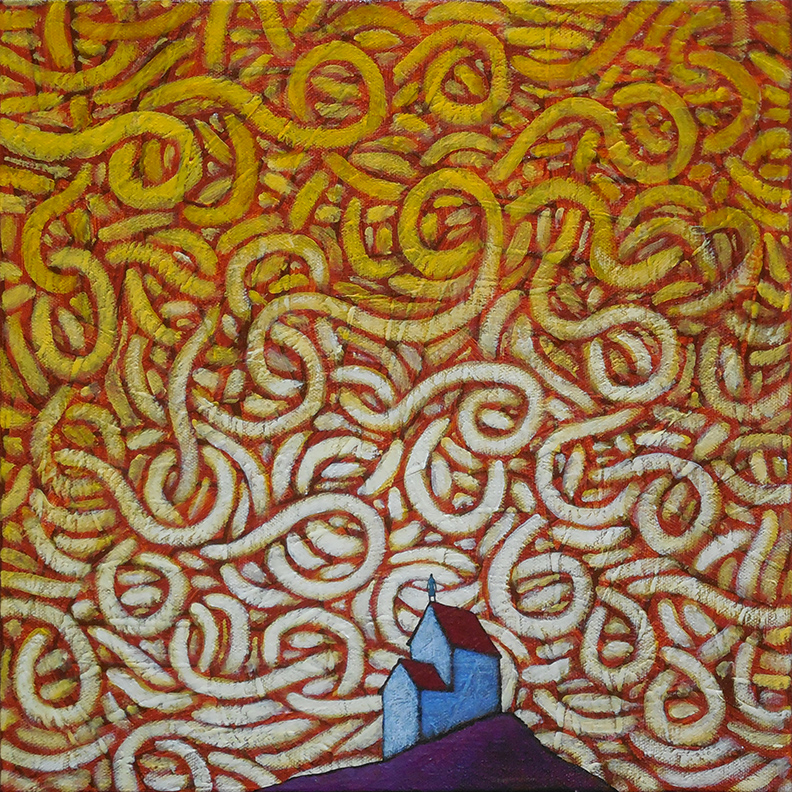
This is a new painting that is included in Entanglement, this year’s edition of my annual solo exhibit which opens June 13 at the Principle Gallery in Alexandria, VA. This painting while modest in size at 14″ by 14″ speaks volumes about the theme behind much of the work in this show, of which I gave a rough outline in a post here on Monday.

This painting is titled The Communing. and it speaks to, as the great Indian poet/philosopher Rabindranath Tagore put it in the passage above: the truth of oneness, the oneness of our soul with the world and of the world-soul with the supreme lover.

This goes back to the concept of singularity, one expounded by Stephen Hawking that theorized that the universe and all that it is was once a single thing, a single tiny point of zero radius and infinite density, before it the Big Bang exploded it and created all that we know the universe to be now.

We were all part of one thing. We were and, for that matter, still are that one thing. A oneness.

That’s what I see in this piece. I see myself as the figure on the rooftop, reaching out to the hidden knowledge of the universe that are represented here by the twists and entanglements of the bands that make up the sky. They create a sense of both mystery and interconnectedness. Of our oneness. They raise questions that can’t be answered while at the same time giving a sense of understanding.

And isn’t that the basis of all belief systems?

This was the first piece that employed these knot-like bands in the sky, and it immediately sparked something within me. It was like I needed to see them and this piece at that point. I have no idea how people will react to this painting and the ones that followed it. But, as I commented to my wife, it doesn’t matter– I needed to paint this now, if only for what I take from it.

It speaks to something needed by me now. And if it speaks or doesn’t speak to others at this time, so be it.

That’s the story of all art, right?

If you like, I’ll see you up on the roof…

Read Full Post »


GC Myers- In Eminence 2024

In Eminence– At Principle Gallery, Alexandria

“This is why alchemy exists,” the boy said. “So that everyone will search for his treasure, find it, and then want to be better than he was in his former life. Lead will play its role until the world has no further need for lead; and then lead will have to turn itself into gold.

That’s what alchemists do. They show that, when we strive to become better than we are, everything around us becomes better, too.”

— Paulo Coelho, The Alchemist


This is a rehash of a post from 2013. It was originally about a solo show from that year titled Alchemy I chose that title because it often feels as though art is akin to alchemy, the ancient and mysterious practice that is defined by its stated goals of turning base metals into gold or silver and creating an elixir that would give man’s life great longevity, possibly immortality.

Most of us likely think of it in terms of some wild-eyed, wild-haired scientist futilely seeking a way to transform lead into gold.

But at the heart of alchemy is the simple concept of the transformation of something ordinary into something more than it initially appears to be. That really strikes home for me. I have often written of sometimes feeling surprised when I finish a piece, as though the end result, the sum of my painting, is often far more than what I have to personally offer in terms of talent or knowledge. Like there is a force beyond me that is arranging these simple elements of this work into something that transcends the ordinariness of the subject or materials or the creator.

This feeling has remained a mystery to me for almost twenty years, driving me to write here in hopes of stumbling across words that would adequately describe this transformation of simple paint and paper or canvas into something that I sometimes barely recognize as being my own creation, so marked is the difference between the truth of the resulting work and my own truth.

Even as I write this, I can see that my words are inadequate to describe this vaporous process. So, I will stop here. But, of course, I will probably continue to try to describe it again and again in the future.

And will inevitably come up short.

I chose the painting here for this rehash because I thought it was a good example. It is simply composed with basic elements. While I was working on it, it felt as though it was a bit dull. Flat. Then at a certain point, it suddenly transformed in almost every way. It felt like it had come to life, from a leaden, flat surface to animated being within the blink of an eye.

It must be alchemy…

Read Full Post »

GC Myers- Between Order and Chaos

Between Order and Chaos– Coming to Principle Gallery


In all chaos there is a cosmos, in all disorder a secret order.

–Carl Jung


I am busy getting ready this morning for the Gallery Talk I will be presenting this coming Saturday, September 28, at the Principle Gallery, beginning at 1 PM. Part of this preparation is finishing new work and packing up that work as well as the painting that will be given away in a free drawing for those at the talk, along with a few other surprises. You have to come to the talk to know what those will be.

GC Myers- Point of Contact 2016

Point of Contact — You Could Win It!

Along with the new work, I am also bringing four favorites of mine from the past decade. One is the painting above, Between Order and Chaos, shown above. It is a piece that jumped out at me in many ways since it was first painted. The post below from a couple of years back explains one of those aspects.


There is a philosophical concept called Unus Mundus— Latin for One World. Its premise is basically that behind the evident chaos of this world and the universe there is a unifying realm of absolute knowledge on which all existence is based.

It has been around for ages, going back in some form to the ancient Greeks. In the last century, Carl Jung became the biggest advocate of this theory, using it to explain the similarity in the content and construct of the myths and stories of the cultures and their belief systems. Each represents the discovery of some small bit of the order or pattern contained in chaos surrounding this world and becomes a recurring symbol, forming what Jung termed as an archetype. 

I describe an archetype as being how there are universal reactions and interpretations to certain images. One of the main reasons I use the Red Tree and the Red Roof, the Red Chair, and the ball in the sky that serves as the sun/moon is that each translates seamlessly across cultures. You don’t need specific cultural knowledge to understand the reality they symbolize. Each carries universal meaning.

This theory, the Unus Mundus, is what I see as the force behind the new painting at the top, Between Order and Chaos. It’s about how we struggle to create order in the face of constant chaos (represented in the sky’s slashing marks) with the orderliness of the flower beds representing this attempt.

The round flower bed caught in the curve of the path echoes the sun above. I see it somewhat as a symbol of synchronicity, another term coined by Jung. He uses it to explain some coincidences that seem to have some sort of meaning though there is no explanation for this feeling.

A coincidence might be just that or it might be that we have unwittingly come in contact with a strand of the Unus Mundus.

I sometimes feel as I have had fleeting moments of synchronicity but I can’t be sure of that.

How does one really know such a thing?

And I can’t say that we will ever learn more about or understand the Unus Mundus or the meaning of synchronicity, even though it might be for the betterment of us all as a species.

Perhaps we have become too comfortable living in this slice of the universe between order and chaos?

I don’t know. But for now, it’s all we have.

Read Full Post »