It is the artist’s business to create sunshine when the sun fails.
–Romain Rolland, Jean-Christophe, (1904)
I am generally a fan of winter weather. I like colder weather and snow and the quiet it brings. Even so, I have to admit that I am getting tired of it this year. Tired of slipping and sliding on ice, probably because I am still working off a slight concussion from a fall this past weekend that had me stumbling around like a middleweight boxer who had just been hit flush with a haymaker and is forced to take a standing eight count to regain his bearings. Tired of the oppressiveness of the sky’s constant grayness which matches my mood or that of the country a little too much. Tired of wearing layers and layers of clothing and having to put on crampons (ice cleats) just to walk to the studio.
Even the beauty of the snow is compromised at the moment. Here in the woods, it has no fluffiness or moisture now. The thought of going out and perhaps laying in the snow to make snow angels is gone as the thin layer of snow is hard surfaced with sharp icy edges.
Just want some sunshine. Want some brightness. Something to burn away the grayness of the sky and my spirit. Want to feel its warmth on my skin again. That has been such a rare occurrence this winter.
There is some consolation in that I do, at the very least, have my work. I have the luxury of being able to go into it and make my own sunshine, much like passage above which the Nobel Prize-winning French author Romain Rolland wrote in his best-known work, Jean-Christophe.
It does help to have some capacity to create one’s own sunshine. But it only goes so far. It’s not a self-sustaining perpetual motion kind of thing. It needs some input, some help, some influx of outside energy every so often.
It needs to see and feel the real sun occasionally, even if to simply be reminded that it is still there. With it, the bitterness of cold, the trudge of snow, and the skeletal trees of winter are tolerable.
Okay, enough. The gray light of morning is coming through the studio windows. Barely. I have to go make some sunshine.
Here’s an old song from Donovan about a guy I could use right about now, Sunshine Superman.
We cast a shadow on something wherever we stand, and it is no good moving from place to place to save things; because the shadow always follows. Choose a place where you won’t do harm – yes, choose a place where you won’t do very much harm, and stand in it for all you are worth, facing the sunshine.
–E.M. Forster, A Room With a View
Choose a place where you won’t do harm…
Man, that sounds like advice coming to us from a distant time and place. So much so that it seems almost quaint, almost to the point where many of us do exactly the opposite, choosing places where we can do nothing but harm.
I know this is nothing new. There has always been a streak of malice and vindictiveness within our character. We would often rather sacrifice to harm others rather than to help them.
That’s part of the dark shadow that follows us, obscuring what little remains of our empathy. Not sure why I am writing this this morning, outside of the utter disappointment I sometimes feel in the choice many make to turn away from the sunshine of compassion and live in the deep shadows that are devoid of it.
Actually, this all started when I came across an old blog post that had a Johnny Cash performance of a Loudon Wainwright song, The Man Who Couldn’t Cry. Simply put, it’s a song about a man who lived a life without feeling. This performance is from a time when Johnny Cash was just beginning to reinvent himself, having become irrelevant, seen as a relic of country music’s past. He couldn’t get airplay for his music. He decided to make music that was out of the box.
It is written that though he was a legendary performer, he was terrified for this show as it was one of the first times he had played alone on stage without a backing band. Just a man and his guitar. I like that story, that this man who headlined around the world and had throngs of adoring fans felt the need to move ahead with deeply personal work that was meaningful and often raw. That it meant so much to him that he felt exposed, that he was nervous and afraid.
He chose a place where he wouldn’t do very much harm, and stood in it for all he was worth, facing the sunshine.
Why one writes is a question I can answer easily, having so often asked it of myself. I believe one writes because one has to create a world in which one can live. I could not live in any of the worlds offered to me — the world of my parents, the world of war, the world of politics. I had to create a world of my own, like a climate, a country, an atmosphere in which I could breathe, reign, and recreate myself when destroyed by living. That, I believe, is the reason for every work of art. The artist is the only one who knows the world is a subjective creation, that there is a choice to be made, a selection of elements. It is a materialization, an incarnation of his inner world. Then he hopes to attract others into it, he hopes to impose this particular vision and share it with others. When the second stage is not reached, the brave artist continues, nevertheless. The few moments of communion with the world are worth the pain, for it is a world for others, an inheritance for others, a gift to others, in the end. When you make a world tolerable for yourself, you make a world tolerable for others.
We also write to heighten our own awareness of life, we write to lure and enchant and console others, we write to serenade our lovers. We write to taste life twice, in the moment and in retrospection. We write, like Proust, to render all of it eternal, and to persuade ourselves that it is eternal. We write to be able to transcend our life, to reach beyond it. We write to teach ourselves to speak with others, to record the journey into the labyrinth, we write to expand our world, when we feel strangled, constricted, lonely. We write as the birds sing. As the primitive dance their rituals. If you do not breathe through writing, if you do not cry out in writing, or sing in writing, then don’t write. Because our culture has no use for any of that. When I don’t write I feel my world shrinking. I feel I am in prison. I feel I lose my fire, my color. It should be a necessity, as the sea needs to heave. I call it breathing.
― Anaïs Nin, The Diary of Anaïs Nin
Why do it?
Even after nearly 30 years of doing what I do–which is paint, if you were still wondering– I still often find myself asking why I do this. There are certainly easier and more lucrative ways to make a living but they normally don’t offer the autonomy, solitude, and non-financial rewards that this life offers.
However, I don’t think it’s as simple as putting everything on a spreadsheet and comparing columns of pros and cons, of which there are plenty of both. I don’t think any single line item on such a spreadsheet would justify doing or not doing what I do.
No, I think it’s something beyond quantification or even justification. It’s something that I know is there, and have known for some time, from a point in my life where I was yet to fully live this life. It’s something I often struggle to put into words. That’s probably why I often find a rationalization for what I do from writers who struggle with that same question. Though they are writing about the act of writing, their observations carry cross all creative disciplines.
I have recently read two wonderful books that deal with this question. One, Art & Fear from David Bayles and Ted Orland, touches on it while dealing broadly with art and creativity while the other The Writing Life from Annie Dillard, gives deep insight into the essential part of the writing impulse which moves, as I said above, across the creative spectrum. Annie Dillard’s book, by the way, was a gift from the Great Veiled Bear this past Christmas and ranks as one of my favorite gifts and reads in a long, long time.
It scratched my itch.
Reading it right after Art & Fear came at a time when I was truly struggling. The two books clarified a lot of issues that had been plaguing me. As a result, I felt that I was less alone in my struggles, that my questions and issues were much the same as other people in the creative fields, even those who appear to be at the top their fields.
I came across the passage at the top from The Diary of Anaïs Nin which neatly sums up much of what I had pulled from these two books. It also lined up well with my view of the need to create one’s own inner world or inner vision, a setting is built on your own beliefs and truths. Perhaps new and inhabitable planet?
Whatever the case, this Passage from Anaïs Nin struck a chord with me and I will be filing it along Annie Dillard’s book, Art & Fear, and Rainer Maria Rilke’s Letters to a Young Poet, so that I can pick it up at any time when I need an answer to that question.
Here’s a favorite song that I have only shared a couple of times over the many years I have done this blog. It seems to make sense with this post and for those of us who are struggling with the time we are now experiencing. This the great Mavis Staples and Jeff Tweedy with an acoustic version of You’re Not Alone.
In Fond Memory— Part of Little Gems at the West End Gallery
When it is said that an object occupies a large space in the soul or even that it fills it entirely, we ought to understand by this simply that its image has altered the shade of a thousand perceptions or memories, and that in this sense it pervades them, although it does not itself come into view.
–Henri Bergson, Time and Free Will (1889)
I have talked a number of times about why I chose the Red Chair as a recurring icon in my work. It is a universal object, one that doesn’t need an explanation of what it is. It even carries with it its own meanings as a symbol. It can be a symbol of power– the seat of authority or throne. It can represent having input or of being heard– having a seat at the table. It can represent a seat in the halls of justice– a seat on the jury or a seat on the witness stand. Or a seat of cross-examination, a seat where one gives information as they know, either willingly or through harsher coercion, to some figure of authority.
I could labor on with more examples and you might even have some that pop in your mind that I might miss. But the one symbol that stands out for the Red Chair is one of memory. For me I tend to mean all memory, but it also represents, more specifically, the memory of those who have died. That empty chair symbolizes the place they hold in our memories and our hearts. This symbolism of the chair in that way crosses many cultures around the world, an empty chair being placed at a dinner table for those recently past.
I saw this come into play as I attended a memorial service yesterday for a friend who recently passed away from brain cancer, a glioblastoma. She was a lovely person and it was obvious from the sizable crowd that she had touched many lives with her own that had ended much too soon.
She had been a teacher at a local school and when the fall semester rolled around, it was obvious to her that she would not be teaching or likely to ever return to it. She and her family started a project to make Red Chair ornaments, some in wood and some in origami, to give to her students to let them know how much they meant to her and to give them something by which they might remember her and the lessons of creativity and optimism she had passed on to them. Her family created a brochure explaining the severity of her illness and the meaning of the Red Chair as she saw it.
It was a lovely and touching gesture. They had a number of the Red Chairs there for those attending the service to take with them as reminder of her life. I have mine here in the studio now and will certainly have her memory in mind when I look at them.
For this Sunday Morning Music, here’s an all-time favorite of mine from Harry Nilsson. This is Don’t Forget Me.
Fortify yourself with contentment, for this is an impregnable fortress.
–Epictetus
Epictetus probably personally knew a thing or two about building a fortress out of contentment. He was a Greek Stoic philosopherborn into slavery in the middle of the first century AD. In Rome, he served as a slave to a powerful and wealthy man who was secretary to Emperor Nero. His owner recognized that Epictetus, who also had a disability caused in his childhood which required him to use a crutch, possessed a passion for philosophy and allowed him to study under a Stoic master.
Eventually the owner released Epictetus from servitude, and he began teaching philosophy in Rome. Around 93 AD, Emperor Domitian banished all philosophers from Rome and Epictetus left for Greece where he established his school of philosophy which became well known and revered.
Having survived slavery, disability, and banishment, Epictetus was someone who knew hardship and loss. Even so, it seems as though he was able to find his own fortress of contentment that was beyond the reach– the influence, opinion, and injury– of the outside world.
I think that idea applies to the new painting from the Little Gems show (opening today at the West End Gallery) shown at the top, Heart’s Fortress. I know that it is just an idealized condition, that no one can fully isolate from the world. But we all need a place of our own, even if it exists only for short periods of time in our inner landscape, where we can be free from the world. A safe island of quiet where we can examine all that we are and find some degree of satisfaction in that.
I try.
Occasionally, I succeed.
And sometimes the world comes in the form of tidal waves that crash on the cliffs of my fortress, shaking away much of my contentment.
Still, my fortress remains. Perhaps a little disheveled and in need of some maintenance. But it stands.
And in that alone, there is some satisfaction, some contentment.
Heart’s Fortress is a small painting, 3″ by 4″ on paper that is now at the West End Gallery in Corning as part of the annual Little Gems show. There is an opening reception for the show today from 5-7 PM. Hope you can make it.
Here’s a lovely song that, while it may not be about the specific island of my heart’s fortress, is about the love of an island. This is Island in the Sun from the late great Harry Belafonte.
“All who are not lunatics are agreed about certain things. That it is better to be alive than dead, better to be adequately fed than starved, better to be free than a slave. Many people desire those things only for themselves and their friends; they are quite content that their enemies should suffer. These people can only be refuted by science: Humankind has become so much one family that we cannot ensure our own prosperity except by ensuring that of everyone else. If you wish to be happy yourself, you must resign yourself to seeing others also happy.”
— Bertrand Russell, The Science to Save Us from Science, NY Times (19 March 1950)
The final sentence above from Bertrand Russell from 75 years ago seems almost quaint in the selfish and cynical times in which we find ourselves. The idea of making others happy as a measure of our success or our satisfaction with our lives is not particularly popular these days.
It raises many questions for me.
How does anyone define success? Or happiness?
Can anyone be successful and happy while denying the same to others?
That would be the old climb-to-the-top-and pull-up-the-ladder-behind-you trick that’s so popular these days. We have sadly come to believe that our own success and happiness is somehow diminished or devalued by the success and happiness of others. Many see it as some sort of reality show competition and not only pull the ladder up behind them but roll boulders down at those attempting to climb a bit higher.
This all came from thinking about what I was seeing in this new small painting, Height of Achievement, that is part of the Little Gems show now hanging at the West End Gallery. I see it as being about defining your success and happiness on your own terms, about claiming your own small pinnacle and laying a path that gives others the opportunity to climb as well. I see the Red Tree here as not a ruler over a domain but as an explorer or guide showing the way.
I also saw a slightly different interpretation, one where the Red Tree has climbed to the top, achieving the success it sought, and found it a lonely place. And happiness was in short supply, as well, since it was forever preoccupied about keeping its place up there. It never was able to enjoy the view or share it with others.
I guess both translations say much the same– strive for yourself but for others, as well.
That works for me this morning.
Here’s a song that is well-worn, both in airplay and on multiple film soundtracks, for good reason. Just a great song. This is the 1967 hit, Ain’t No Mountain High Enough, written by Ashford & Simpson and performed by Marvin Gaye and Tammi Terrell, who both died tragically young. Diana Ross did a great version of the song as well in 1970 but I thought I’d go with this one.
And even if you were in some prison the walls of which let none of the sounds of the world come to your senses—would you not then still have your childhood, that precious, kingly possession, that treasure-house of memories? Turn your attention thither. Try to raise the submerged sensations of that ample past; your personality will grow more firm, your solitude will expand and become a place where you can live in the twilight, where the noise of other people passes, far in the distance.
–Rainer Maria Rilke, Letters to a Young Poet
Little time this morning as I have some maintenance issues around here that demand immediate attention. Before I get to those issues, I thought I would share a triad of image, word, and song to serve as a reminder that the annual Little Gems exhibit of small works is now hanging at the West End Gallery and that the opening reception takes place this Friday, February 7, from 5-7 PM.
Above is a new painting, Twilight Time, 6″ by 12″ on canvas, that is included in the show. The words at the top are from the always relevant Letters to a Young Poet from Rainer Maria Rilke. This passage is from a letter where he was instructing a struggling young poet to stop trying to satisfy the critics or publishers and focus on creating an inner world where his work can grow and prosper. It then takes on its own life based on the poet’s unique self, instead of an imagined criteria set by other people. It then takes on a reality that others will recognize.
For the music, I am selecting the obvious song, Twilight Time. I probably should share the old beautiful Platters hit that most will recognize but I am going with a version from Willie Nelson. I enjoy his takes on the American songbook of standards. It always gives the work a somewhat different dimension, an easiness that is comforting to my ears.
Okay, got to run. There are things to do that cannot wait.
What if culture itself is nothing but a halt, a break, a respite, in the pursuit of barbarity?
–Slavoj Žižek, Living in the End Times
This is another new small painting (only 2″ by 4″!) that is included in the Little Gems show now hanging at the West End Gallery. It’s called On the Lake Road. The first thing that came to mind for me was that it reminded me of the feel of the some of the roads that run around the edges of the lakes here in the Finger Lakes region of NY, especially in the summer when the roads are filled with summer residents and vacationers all seeking a pastoral break from their regular lives. There’s an almost palpable feeling of ease as you drive on those roads with the lake right there with you amid the quaint summer cottages.
I saw that feeling in this piece and named it accordingly.
While looking for a literary bit to pair with it, I came across this quote from Slovenian philosopher Slavoj Žižek and it stopped me in my tracks. It made me wonder if our natural instinct as a species was one of barbarity and if art was one of the few things that kept from fully following that instinct.
Were all forms of art just a means to stifle our barbaric impulse? Is it meant to remind us that we have another option beyond our inborn tendency toward cruelty, selfishness, and tribalism? Does it exist to let us know that, though it is naturally within us, we have ability to reject that instinct and instead choose compassionate kindness?
I don’t know. I am sure there all sorts of examples and differing definitions of art that contradict this but sitting in the dark in the computer screens glow at 5 AM, it sounds plausible. After all, so much great art in all forms has come from times when we were battling our own barbarity, often offering us another vision of what might be. And I believe we might find that the barbarians among us, those who are without empathy and compassion, also have no room in their life for art.
I might expand the old saying musichas charms to sooth the savage breast (which, by the way, goes back to the first line from the 1697 play The Mourning Bride by William Congreve) to include all forms of art.
Can even a small painting like On the Lake Roadserve as a levee against our potential floods of barbarity?
Maybe. I would like to think so.
Here’s a song I’ve loved for many years now from the legendary bluegrass duo of Flatt & Scruggs. This is their cover of a Bob Dylan song, Down in the Flood.
The best kept secret in America today is that people would rather work hard for something they believe in than live a life of aimless diversion.
–John W. Gardner, Living, Leading, and the American Dream, 2003
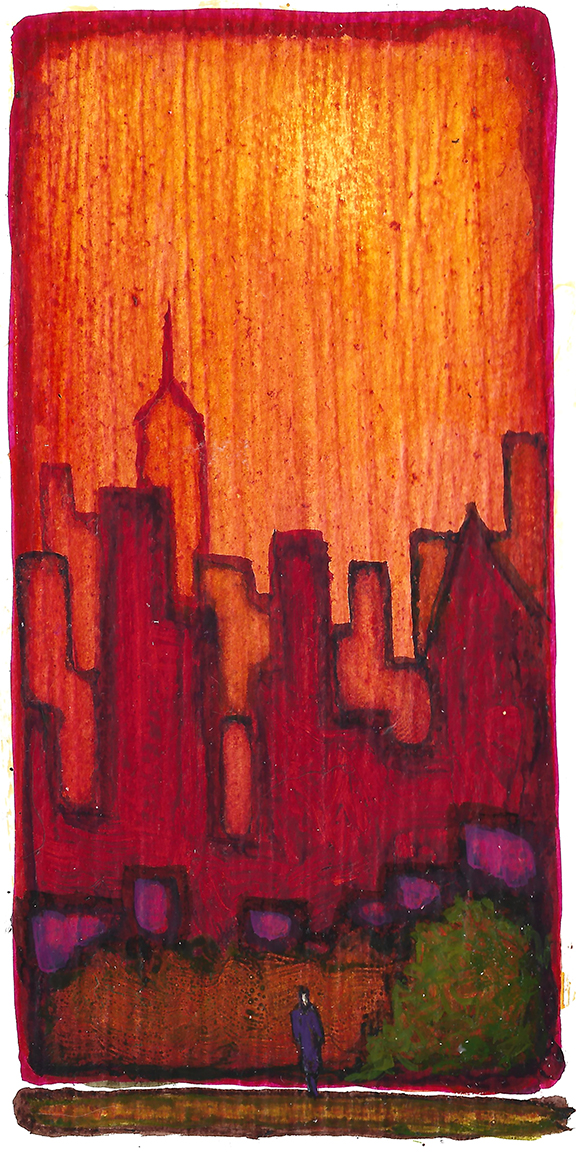
This is another new Little Gem that is now at the West End Gallery for their annual exhibit of small works. This piece really hit me in a visceral way when it was done. It exuded a lot of different things that all hit the mark for me. The color was right on with its mood, tone, and temperature harmonizing perfectly. The shapes and forms felt right in relation to each another and the small figure in the foreground added great depth to the scene.
There was a lot packed into this very small painting. Yet, I struggled with what it was saying to me. The wildfires in LA were burning at the time and I thought that with its extra warm coloration it might be saying something about fleeing the heat and flames.
But that didn’t feel right. The nature of the tiny figure was a nagging question for me. Was it fleeing the city’s hustle and bustle? Or was it returning from the city to its home in a cooler, calmer remote place? I couldn’t answer that definitively, but I loved the ambiguity. It didn’t really matter whether the figure was seeking diversion in the heat of the city or in the cool of the country. The point I saw was that it was seeking something different, if only to provide a contrast to what it experienced every other day.
The daytripper, of course.
I looked for a short quote or passage that somewhat summed up what I was seeing here and came across this short passage from a posthumously published book the late John W. Gardner (1912-2002) who had served as the U.S. Secretary of Heath, Education, and Welfare under LBJ. I wasn’t sure it spoke directly to this painting, but it spoke to something that had been on my mind, something that seemed to manifest itself in recent times.
It was this idea that we have become a country that leans into constant diversion, that we seek easy, instant, and short-lived gratification in lieu of working or sacrificing for something that would more deeply satisfy our needs and desires. Something that would benefit us in a lasting manner. It’s a tendency that has been exploited by the powerful and influential for their own benefit
It is a hard offer to resist. We all want things to come easy., with little thought or effort. on pour part. And after being exposed to easy diversion for so long, we expect and demand it. We no longer value the day trip– we expect it each and every day.
It’s all an illusion. And a dangerous one at that. We have lost that muscle memory of the need for work and sacrifice for something greater, something more lasting. We have exchanged that ability for shiny trinkets.
I know that sounds much like the rants of an old codger at the local diner crowing about how things were so much better back in the day. To be honest, it wasn’t any better. We still wanted everything to be easy and thoughtless. That desire just wasn’t being as fully exploited as it is now.
I’m going to stop now because I can’t fully link that thought to the painting outside of saying that we need diversion and the occasional day trip. But it should remain that– a day trip. Not a life filled with diversion that keeps us from attending to the real needs of ourselves and others. We need to pay attention, to look away from the shiny and easy a little more often.
Divert ourselves not with the meaningless, but with things that feel our souls.
And I think John W. Gardner was correct in believing that most people today would be willing to shuck constant diversion in order to have something worth working or fighting for.
Maybe that tiny figure is turning its back on the diversions presented to it in order to seek its purpose? Or maybe the painting itself is a diversion?
I don’t know.
But like I wrote earlier, this little painting has a lot of things packed into it.
Here’s the song that gave the title to this little guy, Daytripper. I am sharing both the Beatles’ original along with a wonderful version from fingerpicking wiz Tommy Emmanuelle that also includes Lady Madonna from the Beatles. If you like watching a master guitarist play, this is a must see.
A little diversion, yes, but it feeds the soul. Or so I think.
We have been silent witnesses of evil deeds: we have been drenched by many storms; we have learnt the arts of equivocation and pretense; experience has made us suspicious of others and kept us from being truthful and open; intolerable conflicts have worn us down and even made us cynical. Are we still of any use? What we shall need is not geniuses, or cynics, or misanthropes, or clever tacticians, but plain, honest, straightforward men. Will our inward power of resistance be strong enough, and our honesty with ourselves remorseless enough, for us to find our way back to simplicity and straightforwardness?
–Dietrich Bonhoeffer, Letters and Papers from Prison
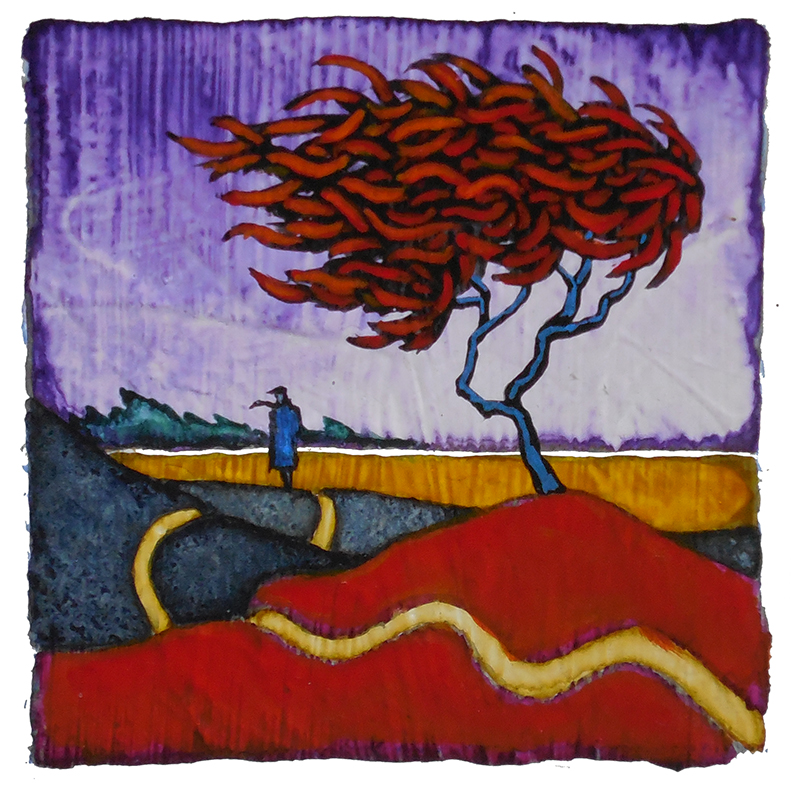
I see this new painting, The Resistance, as being about the willingness to stand one’s ground when the prevailing winds bellow against, trying to force you in a direction in which you do not want to go. You can read that interpretation as being political, topical, or merely symbolic of one holding tight to their principles. It’s a painting, ostensibly a piece of art, so that’s up to you.
Whatever the case, it’s a little piece that speaks loudly for me which is why I had not hesitation in coupling it with the words at the top from Dietrich Boenhoeffer. He and his writings, especially his posthumous Letter and Papers from Prison, are the subject of what has easily been my most popular blog post, On Stupidity.
Dietrich Boenhoeffer (1906-1945) was a German pastor and theological writer who stood in direct opposition to the Nazi regime and spoke out against its programs of eugenics, euthanasia, and genocide. He fled Germany and had an opportunity to stay in the US in the late 1930’s, safe from the reach of the Nazis. But after only two weeks in NYC, he insisted on returning, believing that if he were to rebuild the German church in the war’s aftermath, he must endure the conflict with its people. In June of 1939, he returned and joined the German resistance to Hitler and Naziism.
He was imprisoned in a German prison in 1943 and later transferred to a concentration camp. He was implicated in a plot to assassinate Hitlerin April of 1945 and was sentenced to death after a court martial trial in which there were no witnesses, evidence or any form of defense provided for him. He was hanged in the final days of the war. The legacy of his courage and the strength of his resistance are still celebrated around the free world today.
As I said, this painting may represent that sort of resistance for you. You might well just see it as simply being about a strong wind blowing against a person and a tree. Or you might be a bit of a contrarian (as I am) and see it as a symbol of not being swayed by popular opinion as symbolized by the wind’s effect here. Or you might expand that reading of this painting and see it in an existential sense. Again, that decision is your privilege and responsibility.
However you see it, I hope you see something for and of yourself in it.
This small painting, The Resistance, is 3″ by 3″ on paper, and is now at the West End Gallery for their annual Little Gemsexhibit. The show is hung in the gallery for viewing now and the opening reception is next Friday, February 7.
Here’s a song from Bob Seger and the Silver Bullet Band to go with this all. Maybe it’s a little too on the nose but the song is Against the Wind. For some unknown reason, I have never shared anything from Bob Seger here even though I was big fan of his work, especially in the 70’s and 80’s. I think it’s just a case of holding on to some things and losing track of others. But it’s almost always solid stuff.


 Redtree Times