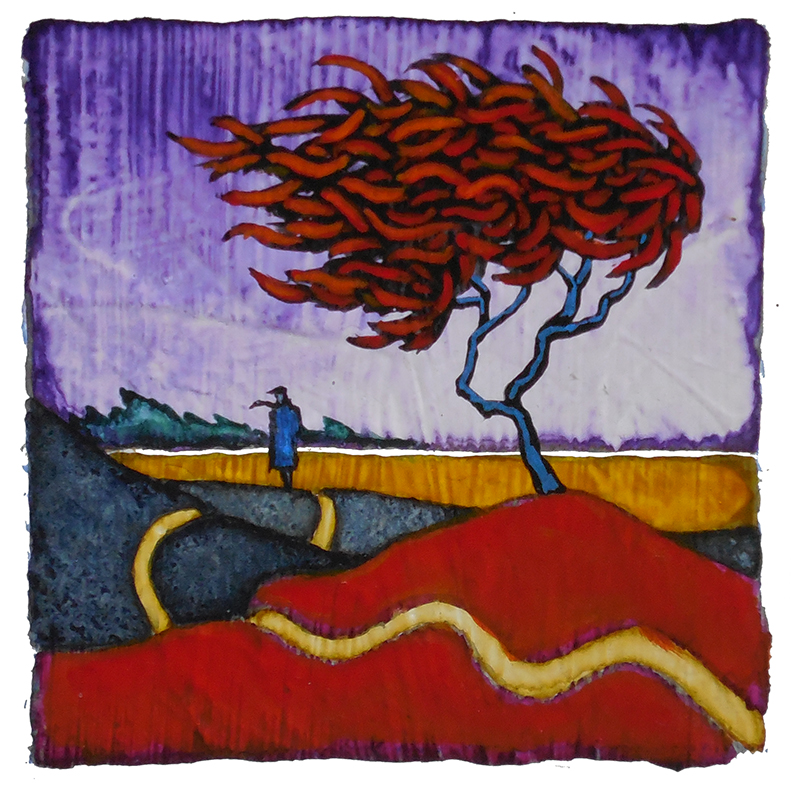
The Resistance– At West End Gallery
The aim of every artist is to arrest motion, which is life, by artificial means and hold it fixed so that a hundred years later, when a stranger looks at it, it moves again since it is life. Since man is mortal, the only immortality possible for him is to leave something behind him that is immortal since it will always move. This is the artist’s way of scribbling “Kilroy was here” on the wall of the final and irrevocable oblivion through which he must someday pass.
–William Faulkner, Paris Review interview (1958)
Faulkner perfectly captures something I have been writing about here for years, the urge to leave something behind as evidence of your onetime existence in this world. It’s the driving force behind creation of all sorts, from human procreation to multiple forms of artistic expression, from the caves of Lascaux to the Sistine Chapel to the simplistic image of Kilroy left all over the world by American soldiers in WW II. Graffiti, which might be the purest form of saying I was here, has been around as long as mankind.
For the artist, it is an act of faith that your work will somehow survive into the future. You can never know with any degree of certainty. Oh, it may well make its way into museums or collections that span generations. It might well exist.
But will it be truly seen? Will it stay relevant, will its voice clearly speak in the future? Will it still maintain its movement, its life?
This idea of relevance– or rather irrelevance– is not a concern that only applies to the future for the artist. As an artist, after decades of creating work, I often question the relevance of my work at any given moment. Is it alive in this present, let alone the future?
I don’t know that you can fully know the answer to that question for anyone but yourself. Your relevance, now or a hundred years in the future, is not something you have a lot of say in.
The best you can do is to focus only on creating something that feels alive now. If it captures the motion, the feeling, the voice, and the humanity of our existence, it might well escape oblivion and might make its presence known in the future.
If it does, great. If not, you at least created something for this moment in time. And that’s great in its own right.
I chose the painting at the top, The Resistance— currently part of the West End Gallery’s Little Gems show– not only because of the obvious motion of it but because so much of what we do as humans is comprised of acts of resistance, of fighting to be heard or not relegated to some form of oblivion, one where we have no control over who and what we are.
I guess that could be applied to creating unique work, as well. Here’s a performance that I shared here several years ago. It is Ukrainian guitarist Nadia Kossinskaja performing an Asor Piazzolla composition, Oblivion. Felt like it went well this painting this morning.
 Redtree Times