Feeds:
Posts
Comments

Posts Tagged ‘writing’

To the Main Road– At Principle Gallery


I knew that I had ample room in which to wander, since science has calculated the diameter of space to be eighty-four thousand million light years, which, when one reflects that light travels at the rate of one hundred eighty-six thousand miles a second, should satisfy the wanderlust of the most inveterate roamer.

–Edgar Rice Burroughs, Pirates of Venus (1932)


Still feeling a bit off kilter and definitely not feeling celebratory in any way for the Fourth of July tomorrow. In fact, I am a little crotchety this morning. Writing that makes me wonder about the origins of the word crotchety. One of the numerous benefits of the instant information of the InterWebs– we won’t go into its equally numerous pitfalls — is that one can answer questions like this within seconds. No more finding and dragging out the dictionary or encyclopedia or whatever reference book you have stacked on your shelves. I accumulated a bunch of compendiums of knowledge, both general and odd facts, over the years that sometimes answered such queries. Not always which meant writing it on a list to be looked up the next time I went to the library. Information moved much slower then and usually by the time I got an answer I had lost interest.

FYI, crotchety is derived from the word crochet which refers to the craft and hook used in it. The term came to represent someone who was hooked by peculiar thoughts, resulting in a brusque, rude attitude towards others.

Yeah, I fall into that category this morning. Crotchety old man shaking my fist at the sky.

Anyway, the theme today is wanderlust. Maybe by the description of searching for info that should be changed to wonderlust. Is that even a word? I guess I will have to take to the InterWebs once more.

While I am doing that, here’s a tune called Wanderlust from the immortal Duke Ellington and sax legend Coleman Hawkins. This came up on my playlist earlier setting this whole fiasco in motion.

Now, either listen or get out. I got things to do. Like I said, I am crotchety this morning and wonderlust  calls…


Read Full Post »

Betwixt and Between— At Principle Gallery


Don’t think. Thinking is the enemy of creativity. It’s self-conscious, and anything self-conscious is lousy. You can’t try to do things. You simply must do things. 

— Ray Bradbury


I ran a post featuring a Ray Bradbury quote the other day which reminded me of another of his quotes and a favorite blog entry from the past that employed the above quote. It’s a refinement of a quote from a 1962 essay, The Queen’s Own Evaders, in which Bradbury wrote about his time in Ireland writing the screenplay for the 1956 John Huston film, Moby Dick.

Never wanting to be a screenwriter, Bradbury adapted only his work for movies or television but made an exception when offered the chance to adapt the Melville classic. He struggled for months and months trying to adapt the novel then one day realized he was being too self-conscious, overthinking every word and element. He began anew and, at the end of an epic eight-hour writing session, finished the script.

The original quote was:

Self-consciousness is the enemy of all art, be it acting, writing, painting, or living itself, which is the greatest art of all. 

Ridding one of self-consciousness was a subject that popped up in many of his essays and interviews over the next 20 years or so as he refined the message. I well understand his view since I feel that I am least self-conscious when I am painting. My paintings are my world much like Bradbury’s world was that of Mars or the October Country or the strange, animated skin of the Illustrated Man.

Bradbury also stated over the years that an artist should not attempt to explain an artwork while it is being created. That’s how I feel about painting, as well. You do it. Then you think about it. As a result, that is why I seldom even begin to think about what the painting is about or what it might be called until it is done or at least well into its process.

Bradbury’s words on creativity are worthwhile for anyone, not just writers or artists. As he said, living is the greatest art of all. Here’s that earlier blog post, last shared here in 2018:


I came across this quote from famed sci-fi writer Ray Bradbury on an online site with quotes on creativity. This struck close to the bone for me as I have proudly not thought for years now. I have long maintained that thinking usually inhibits my work, making it less fluid and rhythmic.

It’s a hard thing to get across because just in the process of doing anything there is a certain amount of thought required, with preliminary ideas and decisions to be made. I think that the lack of thought I am talking about, as I also believe Bradbury refers, is once the process of creating begins. At that point you have to try to free yourself of the conscious and let intuition and reaction take over, those qualities that operate on an instantaneous emotional level.

I can tell instantly when I have let my conscious push its way into my work and have over-thought the whole thing. There’s a clunkiness and dullness in every aspect of it. No flow. No rhythm. No brightness or lightness. Emotionally vacant and awkward. Bradbury’s choice in using the term self-conscious is perfect because I have often been self-conscious in my life and that same uncomfortable awkwardness that comes in those instances translates well to what I see in this over-thought work.

So, what’s the answer? How do you let go of thought, to be less self-conscious?

I think Bradbury hits the nail on the head– you must simply do things. This means trusting your subconscious to find a way through, to give the controls over to instinct.

And how do you do that? I can’t speak for others but for myself it’s a matter of staying in my routine. Painting every day even when it feels like a struggle. Loading a brush with paint and making a mark even when I have no momentum or idea or at hand. Just doing things and not waiting for inspiration.

You don’t wait for inspiration– you create it.

So, stop thinking right now and just start doing things.

Read Full Post »

The Passing Parade— Included in Entanglement at the Principle Gallery


Therefore, dear Sir, love your solitude and try to sing out with the pain it causes you. For those who are near you are far away… and this shows that the space around you is beginning to grow vast…. be happy about your growth, in which of course you can’t take anyone with you, and be gentle with those who stay behind; be confident and calm in front of them and don’t torment them with your doubts and don’t frighten them with your faith or joy, which they wouldn’t be able to comprehend. Seek out some simple and true feeling of what you have in common with them, which doesn’t necessarily have to alter when you yourself change again and again; when you see them, love life in a form that is not your own and be indulgent toward those who are growing old, who are afraid of the aloneness that you trust…. and don’t expect any understanding; but believe in a love that is being stored up for you like an inheritance, and have faith that in this love there is a strength and a blessing so large that you can travel as far as you wish without having to step outside it.

― Rainer Maria Rilke, Letters to a Young Poet


There is something in this new painting, The Passing Parade, from my upcoming Principle Gallery exhibit that just fills me up. It would be easy to simply say that there’s a joyfulness in it and let it stand at that. It does have an unmistakable sense of joyous verve, after all.

But that feels more on the surface, almost like it is the painting’s mask. No, there’s something more beneath that, something deeper and more internalized. Not joyful but not sad nor remorseful.  

A feeling of apartness.

Don’t take that to mean loneliness. It’s an altogether different animal. 

I went looking for a something that might better describe it than my impoverished words and came across the passage at the top from Rilke, one that I shared here a number of years back. It seemed to capture exactly what I was feeling in this piece, about how we change internally and how we express these changes to the outer world.

Some become more solitary and, in their solitude, grow away from people in general. I count myself among this group. But as Rilke advised, I try to not display that outwardly when dealing with people, understanding that not everyone will understand or desire this apartness. Or care, for that matter.

You might think that since I write about my work and perhaps too much more here on a daily basis, that I would easily talk about the doubts, uncertainties, and beliefs I possess and write about. That’s not the case at all. I will answer questions honestly and openly but still try to keep my apartness somewhat hid.

And that’s what I see in this piece– an inward-looking solitude that outwardly watches the passing parade of life from a distance.

I understand that to some that might seem sad. Of course, I don’t see it that way since I know that my apartness is often filled with the joy and love that you see on the surface of this painting. It is not sad at all except when sadness is present, as it sometimes is in every life.

It is hard to explain in words. Maybe that’s why I paint. A painted image transmits and translates itself to others in ways that they alone understand.

Much better than my words. In this case, I hope my meager words haven’t garbled your translation of this painting.

Now, leave me alone and get back into the parade. As Garbo said– I vant to be alone. Actually, I need to be alone. Still lots of work to be done for the show and I can’t get anything done if you’re still hanging around…


The Passing Parade is 12″ by 24″ on panel and is part of my annual solo exhibit — this year marks my 26th show at the Principle– of new paintings, Entanglement, that opens on Friday, June 13 at the Principle Gallery with an Opening Reception from 6-8:30 PM. The work for this show will be delivered to the gallery on Sunday and will be available for previews, though the show will not be hung until later in the week.

The day after the show’s opening, on Saturday, June 14, I will also be giving a Painting Demonstration at the gallery. The demo, my first there, should run from 11 AM until 1 PM or thereabouts.


Read Full Post »

Peak of Solitude— At West End Gallery


Loneliness is the poverty of self; solitude is the richness of self.

–May Sarton, Mrs. Steven Hears the Mermaids Singing (1965)


Some of the most serious problems with our society stem from the hoarding of great wealth by the ultra-rich. Their constant need for more and more can only be fulfilled by sapping the wealth from those economically beneath them. But I’m not here to bitch about the super-wealthy today.

After all, there are problems that come with one hoarding anything. As it is with wealth, this drive to attain and hold on to more and more of anything generally causes a deprivation of something else. Everything we choose to do or attain has a cost of some sort.

We give up one thing for some other thing. If I do this, I won’t be able to do that. This might result from the cost in time, comfort, money, attention or almost any other thing. Time and money tend to be the biggest factors, or at least it seems so as I write this now. I will probably think of other examples moments after I post this.

I am a hoarder of solitude.  It is my precious in the same way the Ring of Power was for Gollum. I hold greedily onto it and am always seeking more and more. And also like Gollum, when I am without it, I am frantically seeking to regain it.

And I am willing to pay almost any price for it. I have paid for it with the relationships and time I might have with others or loss of opportunities and income for my work, among many other things. 

And the older I get, the more precious it becomes because solitude’s main currency is time, an ever-decreasing asset.

That may sound pretty sad to many of you. Maybe even a bit crazy. I get that and I can offer little if any defense or rationale to sway your opinion. Because when I am in the midst of my gathered solitude, what others think seems inconsequential. 

I think only another hoarder can understand that.

Here’s a lovely guitar version of Astrud Gilberto’s Corcovado also known as Quiet Night of Quiet Stars


Read Full Post »

Night Karma (2002)


For the keynote of the law of Karma is equilibrium, and nature is always working to restore that equilibrium whenever through man’s acts it is disturbed.

–Christmas Humphreys, Karma and Rebirth (1948)


I came across the quote above from a book on Buddhism from a Brit named Christmas Humphreys. I had never heard the name but agreed the sentiment that nature is a continuously bringing the world into equilibrium despite our best efforts to disrupt and destroy its balance. Turns out that Christmas Humphreys was a famous British barrister as well as a judge at the Old Bailey later in his career.

But the more interesting part for me was that he was, in his lifetime from 1901 to 1983, one of the highest profiled Buddhists in Britain, having founded the London Buddhist Society and authoring a large number of books on the religion. After his death his home in St. John’s Wood became a Buddhist temple.

His involvement in a number of famous trials led to him being portrayed in several films, including a recent one (it’s on the streaming service BritBox now) concerning the Ruth Ellis trial, in which he was the prosecuting barrister. Ruth Ellis was convicted of murdering her abusive lover and was subsequently the last woman executed in the UK, hanged in 1955.

I guess that’s some sort of karma, right? Probably depends on your perspective.

Humphreys was also mentioned with a line– “I went home and read my Christmas Humphreys book on Zen“– in the 1982 Van Morrison song, Cleaning Windows. I thought that make a good final addition to today’s triad alongside Humphreys’ quote and the 2002 painting at the top, Night Karma. which is one only a few pieces that remain with me from what I call my Dark Work, those pieces painted in the period of about 18 months immediately after 9/11. It’s been a longtime favorite of mine here in the studio.

Now here’s Cleaning Windows from Van Morrison.


Read Full Post »

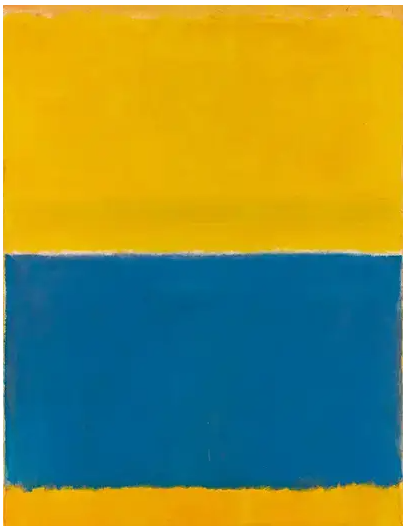
Mark Rothko –Untitled (Yellow and Blue) 1954


“You might as well get one thing straight. I’m not an abstractionist… I’m not interested in the relationships of color or form or anything else. I’m interested only in expressing basic human emotions—tragedy, ecstasy, doom and so on. And the fact that a lot of people break down and cry when confronted with my pictures show that I communicate those basic human emotions… The people who weep before my pictures are having the same religious experience I had when I painted them. And if you, as you say, are moved only by their color relationships then you miss the point.”

― Mark Rothko, 1956 Interview with Selden Rodman


I used a representation yesterday of the colors of the flag of the Ukraine that was actually a detail, shown above, taken from the large Mark Rothko painting shown at the top. I had used this detail before in a post around this time in 2022, one which drew a lot of attention yesterday. Enough so that I went back to check out that post which I am sharing again today as the quotes in that post from Rothko speak so clearly to a lot of things that I have been focusing on recently, on both this blog and in my work.

And since it is Sunday, I am also sharing some Sunday Morning Music at the bottom. In light of what is taking place in this country, the calming effect of Gnossienne No. 1 from Erik Satie seems like the right choice to accompany Rothko as Satie’s work followed similar paths of deep expression and silences. The version I am sharing is a mesmerizing performance from celebrated Finnish guitarist Otto Tolonen.


Busy morning ahead with painting and plowing from what I hope is the last snowfall of this winter. But I thought I would share a Mark Rothko painting (the image at the top is only a detail of its lower section- the whole painting is shown here on the left) and a video on it from Sotheby’s auction house (where it sold for $46.5 million in 2015) along with several Rothko quotes.

Rothko (1903 -1970) was a big influence on my early work. The idea of expressing the big human emotions through simplified forms and color really spoke to me because I never looked at painting as a craft but more as a means to express those forms of emotion that well up inside because they are sometimes too difficult to express in words and voices.

Another aspect that attracts me to Rothko is that he, like Kandinsky, was often eloquent in speaking about his work and art in general. And in those words I found that my own already developed perspectives often largely meshed with and echoed both of these artists’ words and views.

For example, in the quote below the idea that a picture lives by companionship is one that is central to my work.

“A picture lives by companionship, expanding and quickening in the eyes of the sensitive observer. It dies by the same token. It is therefore risky to send it out into the world. How often it must be impaired by the eyes of the unfeeling and the cruelty of the impotent.”

Here a few more that also speak to me, things I have often written about here, about the need of emotional expression in art and of the searching for silence.

“It is the poet and philosopher who provide the community of objectives in which the artist participates. Their chief preoccupation, like the artist, is the expression in concrete form of their notions of reality. Like him, they deal with the verities of time and space, life and death, and the heights of exaltation as well as the depths of despair. The preoccupation with these eternal problems creates a common ground which transcends the disparity in the means used to achieve them.”


“When I was a younger man, art was a lonely thing. No galleries, no collectors, no critics, no money. Yet, it was a golden age, for we all had nothing to lose and a vision to gain. Today it is not quite the same. It is a time of tons of verbiage, activity, consumption. Which condition is better for the world at large I shall not venture to discuss. But I do know, that many of those who are driven to this life are desperately searching for those pockets of silence where we can root and grow. We must all hope we find them.”


Read Full Post »

Little Gems Now at West End Gallery


Why one writes is a question I can answer easily, having so often asked it of myself. I believe one writes because one has to create a world in which one can live. I could not live in any of the worlds offered to me — the world of my parents, the world of war, the world of politics. I had to create a world of my own, like a climate, a country, an atmosphere in which I could breathe, reign, and recreate myself when destroyed by living. That, I believe, is the reason for every work of art. The artist is the only one who knows the world is a subjective creation, that there is a choice to be made, a selection of elements. It is a materialization, an incarnation of his inner world. Then he hopes to attract others into it, he hopes to impose this particular vision and share it with others. When the second stage is not reached, the brave artist continues, nevertheless. The few moments of communion with the world are worth the pain, for it is a world for others, an inheritance for others, a gift to others, in the end. When you make a world tolerable for yourself, you make a world tolerable for others.

We also write to heighten our own awareness of life, we write to lure and enchant and console others, we write to serenade our lovers. We write to taste life twice, in the moment and in retrospection. We write, like Proust, to render all of it eternal, and to persuade ourselves that it is eternal. We write to be able to transcend our life, to reach beyond it. We write to teach ourselves to speak with others, to record the journey into the labyrinth, we write to expand our world, when we feel strangled, constricted, lonely. We write as the birds sing. As the primitive dance their rituals. If you do not breathe through writing, if you do not cry out in writing, or sing in writing, then don’t write. Because our culture has no use for any of that. When I don’t write I feel my world shrinking. I feel I am in prison. I feel I lose my fire, my color. It should be a necessity, as the sea needs to heave. I call it breathing.

Anaïs Nin, The Diary of Anaïs Nin


Why do it?

Even after nearly 30 years of doing what I do–which is paint, if you were still wondering– I still often find myself asking why I do this. There are certainly easier and more lucrative ways to make a living but they normally don’t offer the autonomy, solitude, and non-financial rewards that this life offers.

However, I don’t think it’s as simple as putting everything on a spreadsheet and comparing columns of pros and cons, of which there are plenty of both. I don’t think any single line item on such a spreadsheet would justify doing or not doing what I do. 

No, I think it’s something beyond quantification or even justification. It’s something that I know is there, and have known for some time, from a point in my life where I was yet to fully live this life. It’s something I often struggle to put into words. That’s probably why I often find a rationalization for what I do from writers who struggle with that same question. Though they are writing about the act of writing, their observations carry cross all creative disciplines. 

I have recently read two wonderful books that deal with this question. One, Art & Fear from David Bayles and Ted Orland, touches on it while dealing broadly with art and creativity while the other The Writing Life from Annie Dillard, gives deep insight into the essential part of the writing impulse which moves, as I said above, across the creative spectrum. Annie Dillard’s book, by the way, was a gift from the Great Veiled Bear this past Christmas and ranks as one of my favorite gifts and reads in a long, long time.

It scratched my itch. 

Reading it right after Art & Fear came at a time when I was truly struggling. The two books clarified a lot of issues that had been plaguing me. As a result, I felt that I was less alone in my struggles, that my questions and issues were much the same as other people in the creative fields, even those who appear to be at the top their fields. 

I came across the passage at the top from The Diary of Anaïs Nin which neatly sums up much of what I had pulled from these two books. It also lined up well with my view of the need to create one’s own inner world or inner vision, a setting is built on your own beliefs and truths. Perhaps new and inhabitable planet? 

Whatever the case, this Passage from Anaïs Nin struck a chord with me and I will be filing it along Annie Dillard’s book, Art & Fear, and Rainer Maria Rilke’s Letters to a Young Poet, so that I can pick it up at any time when I need an answer to that question.

Here’s a favorite song that I have only shared a couple of times over the many years I have done this blog. It seems to make sense with this post and for those of us who are struggling with the time we are now experiencing. This the great Mavis Staples and Jeff Tweedy with an acoustic version of You’re Not Alone.


Read Full Post »


The post below is from four years ago, in the runup to the 2020 presidential elections. It was a time at the end of an administration that had buffeted the American people for nearly four years of continuous lies and divisive hate-filled rhetoric. It culminated in the events of January 6, 2021. It’s four years later and the person responsible for that division and violence is frantically operating at an even greater magnitude of darkness in his appeal to his followers. Tomorrow, we will be a mere four weeks from Election Day. The same person who stoked the storm that was January 6 is desperate and is once again attempting to set a whirlwind upon us that he hopes will tear us apart so that he might once more take power.

I thought this post was appropriate to this time, as it was four years before and as it was in 1936. Be mindful, my friends, for there are perilous weeks ahead of us.


Lately, I have been reading bits and pieces from a book of Carl Sandburg poems called The People, Yes. Published in 1936, It is a broad work that attempts to span the multitudes, much like Whitman and his Leaves of Grass. It is a deep reflection on the American people at that time, in the midst of the upheaval of the Great Depression and the rise of Fascism and Naziism in Europe.

As I say, I have been reading it piecemeal, picking it up at loose moments. Each time I am struck how relative it is to this time even though it is nearly 90 years old. For all the technological and societal changes that have occurred, for all the progress and sophistication we assume took place, we are still pretty much the same and pretty much in the same place. Still maintaining many of the same conceptions and misconceptions, still as biased and still as vulnerable to being manipulated.

One verse from this book that I keep coming back to is shown above, at least its beginning, #102.

It begins with bits from President Lincoln’s July 4, 1861 speech to Congress, one in which he justified his actions in the aftermath of the Confederate’s attack on Fort Sumter. In it, he outlined how the leaders of the Southern rebellion stoked the enthusiasm for conflict among the people living there through the dispersal of misinformation and fallacies. Some things never change, eh?

Reading Sandburg’s take on this is a bit scary. It seems to reflect what has happened here so well. The public has been barraged with lies and hateful, divisive rhetoric for the last four [now eight] years to the point that we are without moorings. Many of us have lost the ability to discern truth from the lie and right from wrong. And now, in this unsteady state, we are experiencing the convergence of events that have been precipitated by these actions.

We are reaping the whirlwind.

And, unfortunately, the man and his accomplices who have done this, who have unleashed this awful power, can no longer control its direction or the scope and range of its destructive power.

As Sandburg put it:

Is there a time to repeat,
“The living passions of millions can rise
into a whirlwind: the storm once loose
who can ride it? You? Or you? Or you?
only history, only tomorrow, knows
for every revolution breaks
as a child of its own convulsive hour
shooting patterns never told of beforehand”?

As I say, some things never change. There will always be those who try to benefit from inciting chaos and division upon the people. But, as it has always been, these devious people have never been able to reliably predict or control the whirlwind they let loose.

The public mind generally has the final word in such matters.

And it is speaking now.


Let us hope the people answer the call in the coming four weeks…

Read Full Post »

Comes a Wind

GC Myers- Comes a Wind  2024

Comes a Wind— Now at Principle Gallery


That man’s best works should be such bungling imitations of Nature’s infinite perfection, matters not much; but that he should make himself an imitation, this is the fact which Nature moans over, and deprecates beseechingly. Be spontaneous, be truthful, be free, and thus be individuals! is the song she sings through warbling birds, and whispering pines, and roaring waves, and screeching winds.

Lydia Maria Child, Letters from New York (1843)


Be spontaneous, be truthful, be free, and thus be individuals!

Is there any better advice than those words from Lydia Maria Child way back in 1843? She is best known for writing the famous Thanksgiving poem, Over the River and Through the Woods. But more than that, she was a forward thinker in her time– an abolitionist, women’s rights and Native American rights activist, journalist, poet and novelist whose work often took on white supremacy and male dominance, issues that plague us to this day.

She would no doubt be a forward thinker in our time. Her words certainly ring true, then and now.

I am using her words today to accompany the new painting above, Comes a Wind. It’s one of the larger pieces, 30″ by 48″ on canvas, from my Principle Gallery show that opens tomorrow night. I chose her words because I felt they somewhat described how I view my landscape work. I never have tried to imitate the reality nature, never wanting exactitude or even a representation of a single real location.

I just wanted to capture the feel and rhythm of the landscape. We live in it and with it. We are part of it, carrying that same feel and rhythm within us. At least, that’s the hope. I believe we sometimes lose that feel and rhythm that connects us to the land. We fail to see the grace and inevitability of nature. When left to its own devices, the landscape achieves an organic perfection.

It is as it should be and only as it can be.

I think this piece is a great example at my attempt to capture that feel and rhythm. It has an organic quality in the curves and lines of the landforms that calms me in much the same way that I feel looking at a panoramic landscape in reality. Like much of my work, there is an area somewhere near the center of the landscape where the landscape’s layers go down then rises up, creating what I call the saddle or easy chair (taken from an old Dylan song) of the painting. I don’t know exactly why I do that, but it feels like it acts as place for the eye to settle in and rest, like one might in a saddle. Or easy chair.

When I first finished this painting, I saw it as being about some forewarning brought on the wind. I still see that somewhat but I now also see the wind as pictured as being about letting ourselves go with the rhythms of nature, about reconnecting to our place within the greater forces.

Or as Ms. Child may have put it: Be spontaneous, be truthful, be free, and thus be individuals!

Here’s that Bob Dylan song with the easy chair reference, You Ain’t Goin’ Nowhere. From1967, it was part of his Basement Tapes and more famously recorded by the Byrds in 1968. This is a newer version that I like very much from Glen Hansard and Marketa Irglova. It’s a great tune. Worth a listen.


Comes a Wind is included in Continuum: The Red Tree at 25 which opens tomorrow, Friday, June 14, at the Principle Gallery in Alexandria. The opening reception runs from 6-8:30 PM on Friday. I will be there so please stop in and check out the show. Maybe have a chat.


Read Full Post »