“It is not because things are difficult that we do not dare; it is because we do not dare that they are difficult.”
– Seneca
I’m at a point in my year when I have a little time to start working on new things, new directions for the work. It’s always an interesting time at which I’m always a little anxious, not wanting to squander this time by not pushing myself enough. To not dare myself to push through whatever barriers I have erected that I fear may be keeping my work static at the moment.
I view whatever small amount of talent or ability I have as being a ship and I am a sailor. I may know how to sail the ship and may have ventured fair distances. But there comes a point when I must dare to go further, past what I know. See places unseen by few others.
And that’s how it feels at the moment. The ship is at dock, waiting. The sea is there and the horizon clear. Now it’s up to me.
Oh, my mistake. They’re a group of concerned citizens raising valid, well thought out points in civil public debates about changes to our health care system.
At least that’s what they’re screaming at the top of their lungs.
It’s hard to watch these town hall debacles. I have yet to hear one cogent point raised by any of the screaming mass of citizens. Haven’t heard anything based on what has truly been put forth yet.
I hear “death panels” and “socialism” and “euthanasia.” I hear a lot of fear, many even saying outright that they fear Obama.
Baracknaphobia.
Now, some of those who prod this mob forward use the Thomas Jefferson quote- When the people fear the government, it is tyranny. When the government fears the people it is liberty- as proof that indeed this government is tyrannical and will kill your Granny, your baby and all your houseplants. It must be- the people fear it.
The problem is that this is misguided fear fed by misinformation that plays to the most basal, instinctual fears of the sheep in this flock. They are not afraid of the government, they’re afraid of the unknown and that is a powerful fear. Unfortunately, it the one that is easiest to stir by those who wish to maintain the status quo. They play to the weaknesses of those who will join the flock, sometimes using a clouded racism to vilify Obama then screaming that the other side always plays the race card. It is an easily fed, gullible mob.
I haven’t seen enough of anything yet proposed to get too worked up over. I voted on the premise that there would be fundamental changes to some of the systems that run our country and I’m eager to see these changes. I have no fear of the unknown in this case. Rather, I am more afraid of maintaining things as they now are.
And that includes the mob of the dull-witted and unreasoning.
Ay my opening, a friend who is also a painter and I were talking and the name of Charles Burchfield came up. My friend asked if liked his work and when I said that I did very much admire Burchfield’s work, my friend shook his head and said that I’d have to explain it to him because he just didn’t get it. Thought it was crap.
I told him that I always immediately engaged with Burchfield’s paintings, that I felt that I understood in a small way how his mind conceived his imagery and how he translated that to paper. His work just made sense in my mind. It was more about getting across something more than a scene or mere image and that clicked for me.
Charles Burchfield is a real presence in the art world of western New York state, having created most of his work while living in the Buffalo area in the early and middle part of the past century. There is a well known art center and museum bearing his name at the University of Buffalo and his work is in the collections of many major museums.
For me, his work is more about the spiritual elements of the everyday world. Things that are seen all the time and simply overlooked take on a meaning and a life of their own. This excites me because I consider that an important element of what I try to do. I always pull inspiration from his work and hope that someday someone will feel the same thing from mine.
Knowledge of what is possible is the beginning of happiness.
— George Santayana
WhenI give gallery talks, generally there is a part at the beginning where I run through how I came to be a painter. I usually tell how I wanted to paint when I was a small child, maybe 7 or 8 years old, and my parents bought me an oil painting set from the old Cardinal Paint store in Elmira, where they sold art supplies alongside their house paints.
Of course, I didn’t have the first idea how to use the paints and the canvas panel ended up covered with a smear of a color that could best be described as pukish looking. Discouraged, I moved on to other things. Many other things through the years.
Now, that might seem, at first blush, like a sad little story but it always touches me. My parents didn’t know how to go about helping me but they did what they could and never discouraged me from whatever avenue I chose to follow. I was never told I couldn’t be this or that I should be that. They didn’t know what was possible and never tried to put limits on my hopes.
In high school, I harbored dreams of being a writer and for Christmas one year they gave me a Remington Rand office typewriter. It was a reconditioned monster of a machine, must’ve weighed 75 pounds. I had it for years and when I did finally get rid of it, it was with great sadness. It was one of the best gifts I’d ever been given and was always a symbol of my parents’ encouragement.
The point of this is that my parents allowed me the freedom to discover what was possible for me in my life. Did they always go about it in the best way or guide me in any way? Probably not but that didn’t seem as important as the freedom they gave me to search for what was possible for me.
And being able to find what was possible, as the saying above says, is the beginning of happiness…
In the early 1970’s, I was a teenager living out in the country. At the time FM radio was still not widespread and even if it had been, we didn’t have an FM radio. The world has changed an awful lot in a relatively short time.
So it was AM radio for us and in our area WENY was the main source for music of all sorts. This was before pre-recorded broadcasts and there were still real DJ’s who were on the job, taking requests and making radio patter of the sort that a 13 year old boy might find enjoyable.
I used to listen to a DJ named Paul Lee who also did double duty for WENY on their TV side, hosting a late Saturday night movie as his alter ego, The Undertaker. The low quality horror flicks were beyond bad. I think they were public domain films that barely qualified as horror or, for that matter, films. The Undertaker was best known locally for the skits that came at the beginning of the films, most notably him dancing to Bette Midler‘s version of The Boogie Woogie Bugle Boy.
On the radio, Lee spun the hits of the day and made sophomoric commentary. He also periodically had contests and I would sometimes call in to try to win. I never won anything for the longest time but finally one evening, after redialing numerous times to busy signals on the other end, I finally broke through. I was the winner of a great and grand prize.
25 albums from their collection.
Of course, they were just cleaning out their cupboards, getting rid of all the records they were sent from promoting record companies. Music that hardly, if ever, got played on air. But to a 13 year old it was like a stack of gold platters.
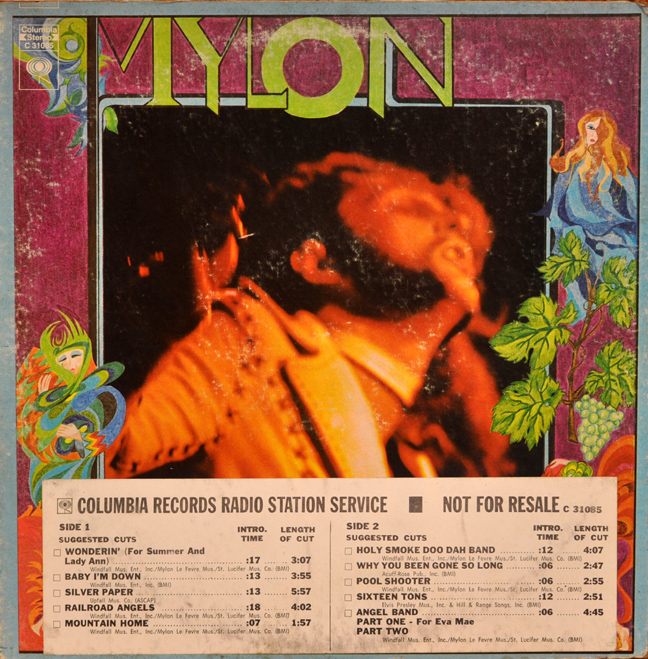
Most were pretty mediocre at best but there were some hidden gems. There was a Delbert McClinton. There was a Fairport Convention. And there was the one shown above. It was Mylon LeFevre with his goup, Holy Smoke, shown here from the back of the album cover. I’ve always loved this picture. It just captures that period of time.
Now, Mylon was from a well known gospel music family and his work past this was very much in the Christian Rock/ Gospel forum. At this point, Mylon was living a very rock and roll lifestyle which ended with a heroin addiction before returning to Gospel. Whatever the case, this album just burned. I still listen to it from time to time and wonder how he didn’t find fame on a wider basis. His version of Why You Been Gone So Long, a song covered by many others, is riveting. The album is just full of passion. I wish I could find some video of his music at the time to share. There is newer music of his available but none of it comes close to this. Good stuff.
Another album I still listen to from that group is the first, self-titled album from David Bromberg. It’s full of great tracks and has both humor and pathos. Good stuff, as well. When I listen to these tracks there’s always a small part of me who is 13 years old once more, looking at the album covers for the first time. Here’s his version of Dehlia.
I had my Gallery Talk yesterday at the West End Gallery in Corning and it went pretty well. Really good group of people who asked insightful questions and seemed very open to the things about which I was talking. I went quite a bit over the hour that was planned but I don’t think it dragged on. Hopefully, they enjoyed it as much as I did. They made it very easy for me.
One of the questions that came up was about whether I worked on more than one painting at a time or if I had paintings in varying degrees of completion. I immediately spoke about this piece, Quietheart, which was the centerpiece of my 2007 show at the West End.
At the end of 2006 I prepped a large panel, 34″ by 60″, layering in multiple layers of gesso to create a visually interesting base to hold up the paint above. I started the piece by painting a large block of color, consisting of varying reds and yellows that had quite a bit of intensity. The orangish color of the sky is this color. So I had this large block of color that I very much liked. It had the intensity I mentioned and the surface had a great texture that seemed to be visually stimulating throughout. It was right on the mark as far as I was concerned.
The problem was that I was now afraid to go any further with piece.
I so liked this first block of color, this base, that I felt I could only do harm to it by making another mark on it at this point. I felt I couldn’t add to, could only diminish from it’s impact. I gloried in the color and form but couldn’t see a next step at that point.
So I set it aside. It sat, prominently displayed in my studio, for six months and I would look at it each day and think that someday that would truly be something I would be proud of if I could ever dare to step into it once more. Finally, one day I pulled it down and said this is the day and with great trepidation, put a new brush of paint to it.
I was immediately engaged and the image as you see it above fell in place quickly. I breathed easier. I hadn’t diminished the original block, hadn’t made it secondary to the scene above it. I felt that its strength bonded with what I had added. I was pleased.
And that is the main criteria I have to meet.
So, yes I do have pieces at different points and most are just waiting for the right moment.
Again, many thanks to those who came out yesterday. It was most appreciated.
Well, today’s my annual Gallery Talk at the West End Gallery in Corning in conjunction with my show, Dispatches, which is hanging there until the end of August. I’ve done quite a few of these talks over the years, probably 11 or 12, so I know what to expect. But there’s always a little anxiety anytime you have to speak in front of any group of people.
My gallery talks are always pretty much off the top of my head which, when it works and the audience is receptive and interacting, is good. When it doesn’t work, it’s pretty ugly. A lot of blank stares and awkward silences. Luckily, that’s only happened once or twice.
The first talk I did at the West End was back in 1997 and I had put everything I wanted to get across into a short speech that I wrote out and memorized. Well, the talk began and I reeled off my little speech. It was pretty good until I came to the end of it and glimpsed the clock. It had lasted about 4 minutes and my mind was a totally blank slate.
Tom Gardner, then co-owner of the gallery and a well known painter, had told me a little trick before the talk. He told me to always have a glass of water and when I came to a spot where I was stuck with nothing to say to simply walk back and forth in front of the audience and take a very slow sip of the water. Look thoughtful. I thought it was pretty good advice until I realized I would be pacing back and forth, sipping water, for 56 minutes.
Luckily, Tom rescued me with a question and from there it snowballed with the rest of the crowd asking questions, one subject leading to another. Phew! Over the years I’ve gotten more comfortable with the whole thing and have an assortment of anecdotes to fall back on when things start to falter.
Another reason I don’t go in with a prepared speech is that each group of people is different. Some groups are more interested in talking technique, wanting to know how each piece is painted. What type of paint I use and how I achieve certain aspects in the paintings. That kind of thing. But others are not so interested in the how but in the why. They prefer to hear what the stories are behind the paintings. So, there’s a moment at the beginning of each talk when I have to gauge what approach suits this particular group best. I really try to stay away from the technical side for the most part because sometimes, when I’m droning on about such things, I can see the non-painters’ eyes glazing over. I try to get off the subject as soon as possible when I spot this and try to engage their interest.
It usually goes pretty well and we all have a few laughs. I’m hoping today is no different. If you’re in the area today, the talk takes place at noon at the West End Gallery in Corning, NY.
When I was a kid I thought it would be pretty cool to have a tattoo. A couple of my uncles had tattoos, a naked lady and a black panther among them, and I was always kind of fascinated by them. They were older tats and kind of blotty in areas, the lines starting to break apart a bit. But I still thought they were sort of cool.
When we moved in 1972 and I started junior high school in Elmira, a more urban setting than I had come from, I was exposed for the first time to the homemade tattoos that some of the rougher kids wore. They were made by taking a pin or needle , wrapping it with thread and dipping it ink. The thread would absorb the ink and would would deposit it under the skin as they poked their designs with the needle. They were pretty crude. A lot of crooked initials and “Mom”‘s . “LOVE ” and “HATE” on the knuckles- that kind of thing. I was still fascinated but more in a “why the hell would you do that?” sort of way.
Years passed and I found myself working at Perkins Restaurant as a waiter. When I first started I worked the overnight shifts, which were, for the most part, the province of the drunk and alienated. There were a lot of young adults who would come in and sit for hours, drinking coffee and smoking ( you could do that still) with no place else to go. I came to know several of them and they liked me because I treated them well and listened to what they had to say.
There was one guy who wanted to be a tattoo artist. Tattoos were gaining popularity and you were starting to see them more and more. He had bought some equipment and was practicing on himself. He would come in and pull up his pant leg, showing me his calf. It was covered in scrawls of unsure lines and letters and shapes. It was awful, reminding me of the homemade tats from junior high. I asked if there wasn’t a better way to practice, maybe an orange or something? He said there was nothing like using the real thing.
Over the years, I have seen some great tattoos and am always amazed that these people are so sure of who they are now and who they will be in the future. As I’ve aged my view of the world is always changing, evolving with new knowledge and insights. I would hate to have an emblem of who I was at age 18 emblazoned on my body for all to see. It would be like being doomed to wearing a KISS ARMY t-shirt for eternity.
Tattoos have always been viewed as symbols of individualism, something that sets one apart from the crowd. But as they become more and more popular, I’ve started to view them more as symbols of conformity. It’s become so common that there I find myself less and less fascinated when I see one. I still appreciate a well done tattoo that is composed well and executed with great care and really says something about its owner but I get a feeling from so many of them that it simply means that they are part of the crowd. Almost as though they are being used to make the wearer blend in rather than stand out.
So, I don’t have any tattoos and will never do so. It would feel too much like conforming…
There were a couple of events in the world of athletics and beyond this past weekend that really caught my eye. First, there was swimmer Michael Phelps’ victory Saturday versus Milorad Cavic in the 100m butterfly at the World Championships. Cavic was the swimmer who was on the short end of the stick at the Olympics when Phelps made his miraculous lunge in this same event that kept alive his hopes for the medal sweep that he eventually accomplished. Cavic sparkled in the semi-finals, breaking Phelps’ existing world record.
But he made the mistake of not keeping his mouth shut and just doing his job. He was everywhere talking about he was still positive he had won in Beijing. Even crowing that Phelps was missing the boat by not using the soon-to-be outlawed plastic swimsuits and would be left behind. It wasn’t a lot but it was enough. Phelps came out angry and beat Cavic without any doubts, regaining his world record. His glares and gestures afterward said it all:
Don’t poke the tiger.
Which brings us to Tiger Woods‘ victory at the Buick Open, where he started slowly then methodically dominated the field. It was a thing of beauty to see how he managed his rounds and how he could recover from even the worst of shots. It’s a testimony to his dominance that on a day when he was beating the field by several shots, the television commentator remarked after a good drive off the tee that he had finally hit a good shot. Even on a day when he wasn’t at his best, he still could prevail.
It’s a remarkable thing to watch on a single weekend two athletes who may easily go down as the most dominant ever in their respective fields. We’re lucky, those of us who care about such things, to be witnesses to these performances.
Another performance I saw was by Orly Taitz, the crazy Russian-born attorney/ real estate agent/ dentist who is the figurehead for this insane birther movement on MSNBC. She almost froths at the mouth, she’s so rabid. I began to wonder about all this fuss and I pulled out my own birth certificate. The original had been lost years ago and this replacement was from around 1973 or 1974. It doesn’t list my doctor, doesn’t list the time of birth. But it’s worked fine for me throughout my life and there has never been any question of my citizenship when dealing with the government. I wonder how many of us have just such birth certificates and if to nutjobs like Orly Taitz this raises questions of our legitimacy as citizens. This stuff has got to just stop.
One thing I didn’t see was any glimpse of Dick Cheney. Where has he gone? I mean, for a while I thought he was trying to fill the void left by television pitchman Billy Mays’ death. He was everywhere, all the time. Then suddenly silence. I guess the disclosure of a few incriminating documents and the screamed pleas of his legal team that he just shut up finally got through to him. Back to his subterranean lair.
It’s a shame though- I think he could have done a hell of an ad for Oxy-Clean…
I’m showing an older piece today, one from around 1996 , called Interloper, mainly because I have mentioned the Kada Gallery over the last few days and am reminded of how I came to show with them quite a few years back. There was a bit of serendipity involved.
It was in late summer of 1995 and I had been showing at the West End Gallery for several months which was my first experience exhibiting in public. I was still waiting tables at the local Perkins Family Restaurant full-time, working on building our house and painting every other available minute. Man, I had a lot more energy then! I still had no idea that I would or could have a real career as a painter. My work at that time was very small in size for the most part and was just starting to gain some notice locally but I really didn’t know if it would ever transfer outside our local area.
One Saturday morning, I was at my job waiting tables when a family with a daughter about 10 or 11 years old sat in my station. They were very nice, smiling and talkative. Typical chit-chat. I took their order and that was that. After a bit, as they were eating I was going through my station checking on each party and I stopped at their table.
The daughter, Hillary, asked, “Are you a painter?”
I was a little taken aback by the question. Nothing was said about painting or art, to them or any of my other tables and that was the last thing on my mind at the moment.
“Well, yeah. I am.”
“My mother said you were. She said that anyone that happy doing their job had to be a painter.”
I just stood there with nothing to say. How do you respond to that?
It turned out that the mother was a painter as well who lived, for the time being, in our area. Her name was Suzi Druley and she was on their way out to a gallery that sold a lot of her work in Erie, Pennsylvania. They had me run out to their vehicle to take a look at her work, which was very interesting, particularly for our area. It had a sort of Southwestern/Native American feel with with vivid, deep colors and a lot of symbology. Turns out she was from Texas originally and they had moved here for a job her husband had taken. She asked what my work was like, saying she would like to see it.
A few weeks passed and I decided to take her up on her offer and went out to their home. I took photos and some pieces and she really seemed excited by the work. She said I should show the work to Kathy at the Kada, that she would really like it.
Long story short, she called Kathy and a visit was arranged. I hauled my bits of paint and paper out there and I’ve been showing with them for going on 14 years.
I’m glad I was in a good mood that Saturday morning at Perkins- I most certainly would not have found made my way to the Kada Gallery without Suzi’s simple observation that I must be a painter.






 Redtree Times