Feeds:
Posts
Comments

Archive for September, 2009

Obama Health CareI have said it before that I am hesitant to talk about political things in this blog, instead focusing on my work as a painter.  It’s kind of like the old advice about not talking about religion or politics, especially given the fact that I am, in fact, a small businessman.  But there are some things that are too important and this is one of them: healthcare.

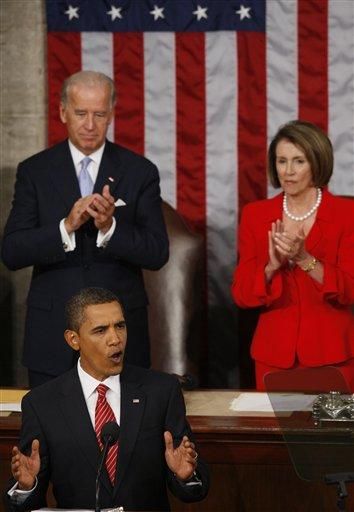
President Obama addressed the congress and the country last night in what I thought was a very effective speech.  I could’ve done without all the standing ovations which I thought sometimes disrupted the president’s rhythm but the shots of congress were very revealing.  It was very effective to see the sour faces of the Republican opposition all gathered together and to see the doubt on their faces at points as to whether they should  stand and applaud.  There was Eric Cantor disgracefully disrespectful as he twittered away.  There were some who stood and waved papers as though they were birthers holding up their birth certificates.

But most revealing was the shout of You lie! that  emerged as the President spoke about the plan not covering illegal immigrants, a point that has been verified by a number of non-partisan fact checking organizations.  The culprit was Joe Wilson, a South Carolina republican who showed the world the face of the party who has devolved into one of obstruction for their own short-term political gains rather than of one who fights for the betterment of the American people.  It was ugly and was an overt indicator of the disrespect the republicans have for the President.  He thought this was a town hall meeting, I guess, where you can yell down anyone even when you’re obviously wrong.  The only bright spot from this is that his opponent in the next congressional race, Rob Miller, has raised over $100,000 in contributions since last night .

I was glad to hear the President speak about the cost of reforming healthcare in relation to the cost of the wars in Iraq and Afghanistan  and to the costs of the Bush Tax Cuts.  The very same republican congressmen who wholeheartedly voted to ransack  our future to line the pockets of the the very wealthiest now claim we just can’t afford to do this now.  Well, the Bush Tax Cuts by most accounts will cost us over 2 trillion dollars over the decade with some putting the cost at closer to 2.5 trillion.  Close to a trillion dollars of that went to the top 5% of the population.

Now to be fair,  these figures don’t take into account the stimulative effect of the tax cuts but even right-leaning sources such as the Heritage Institute put that figure at about 25% of the total cost which means that these tax cuts still are almost twice as expensive as reforming all of healthcare.  And that’s before you factor in the stimulative effects of a better and more universal healthcare system, such as jobs being created to meet the needs of expanded care and costs being lowered via better preventative care.  The worst part of the tax cuts is that they directly depleted our coffers, reducing our income tax revenues to a point where we would be in trouble at this point even without the wars in Iraq and Afghanistan, whereas the proposed healthcare will not,  in theory, add anything to our deficit.

So how any of these republicans who voted for the tax cuts can seriously declare that reforming healthcare now is simply another indicator of their willingness to sacrifice the betterment of the American public for their own political gain.  I hope President Obama was serious in his promise to directly confront those who spread lies and fear, to make them accountable for their actions.  This is also something we can do as citizens.

Be aware.  Check the facts.  Be proactive, not reactive.  Let your voice be heard.  Now.

Read Full Post »

GC Myers 2009This is a new painting, sized at 24″ by 24″ on canvas, that I finished last night.  It has a wonderful warmth in the studio and really nice depth into the picture plane.  There is a real feeling of completeness in this piece and I get a real sense of satisfaction when I look at this.  I have talked about a sense of rightness in the past, about an instinctual feeling of whether something works or not, and  this piece has this feeling for me.  It’s one of those pieces that, if it were not to find another home, I would gladly keep for myself, which is something I don’t say very often.

 Open Your Eyes I did something with this piece that I have never done in the past.  I painted over an existing piece, meaning that the image shown here on the right, no longer exists.  It was a piece I created last year and had planned to show at one of my fall exhibits.  It seemed to work, had a nice surface and good color.  But as it sat in the studio it just seemed lifeless.  It lacked a certain brilliance, appeared flat up close.  It was missing that sense of rightness.  It actually appears better on the screen or printed page, unlike much of my work.

So one piece is no longer and another lives on in its place.  Even though it’s a mere image, a simple composition at that, there is a slight sense of loss, as though a little bit of possibility has been erased.  This would actually bother me if the new painting didn’t far surpass for me the first.  And it does and I am pleased to look upon the new work but still have a feeling of the work beneath.

Read Full Post »

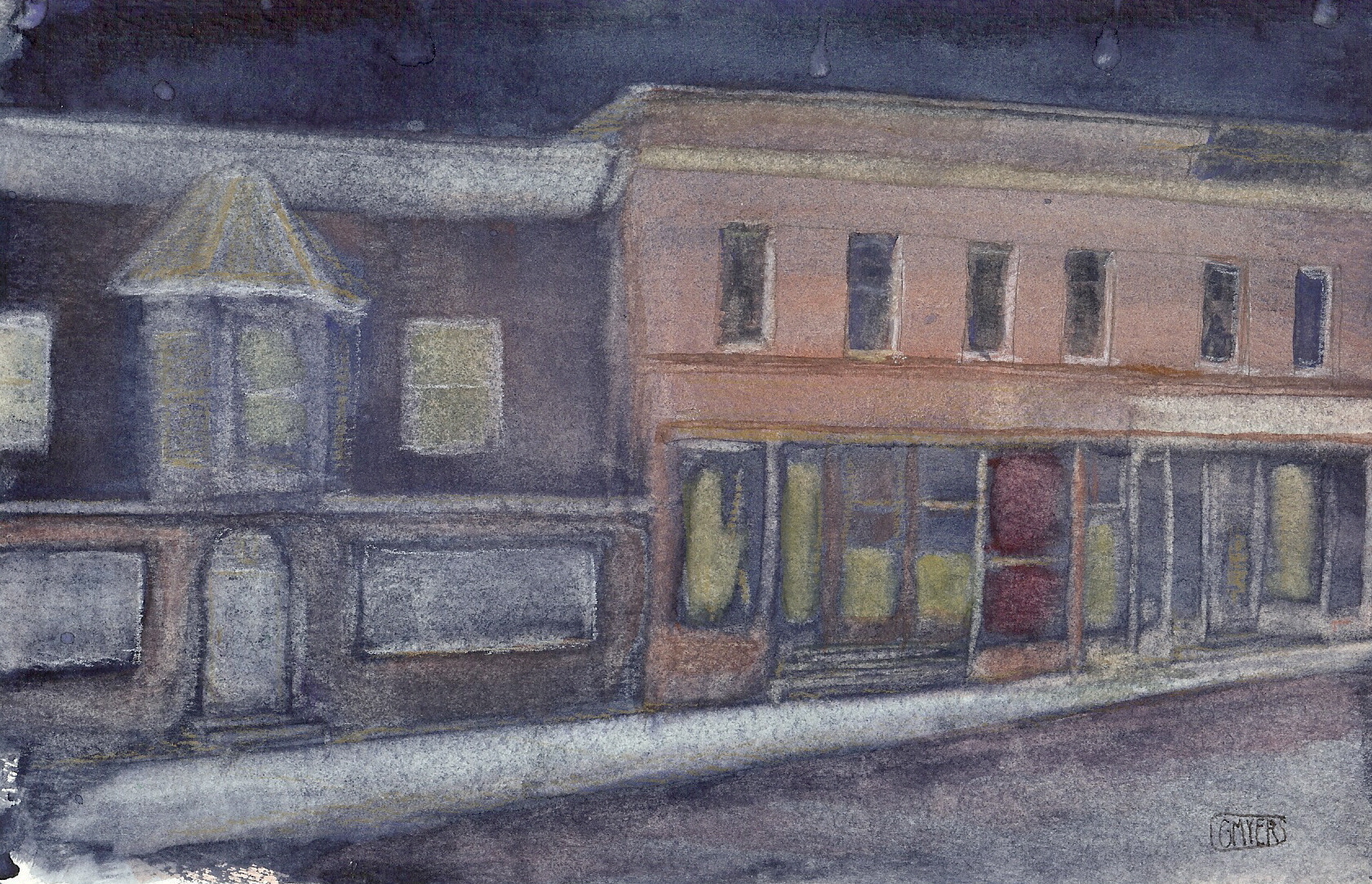
Elmira Street 1994This is an old piece from 1994 when I was still just beginning to realize that I might find something in all the time and effort I was putting into painting.  It’s not a great piece but there are things I like about, things that gave me a feeling of potential, at least in my own head.

I bring this up because of a brief conversation I had with a friend this past weekend.  I attended an opening at the West End Gallery and ran into a friend, also a painter, so naturally our conversation turned to baseball.  We were discussing a well known pitcher who had great abilities, great stuff, who, while occasionally displaying his brilliant talents, often performed far below his talent level.  His efforts seemed to betray his potential.

In the conversation, I equated the pitcher to a painter we both knew.  I had followed his work for a number of years ever since he had graduated from a pretty good college program, having seen a group of his collegiate work at a time not too long after I had painted the piece above.   I remember being very impressed at the time.  Actually, envious is a better word for what I felt.  I saw real potential in that work and realized that I was struggling to achieve things that obviously came easily to him.  I remember being a little disheartened at the time at my own talents compared to his.

But his subsequent work has yet to live up to the potential I saw.  It has been okay but hasn’t made any leaps above that early work.  It’s always puzzled me and made me feel he was somehow betraying his obvious talent and potential.  I pointed this out to my friend this past Friday and he had a different take.  He thought I was seeing more potential in that collegiate work than may have been there, that while there was talent most of what I was seeing was the result of a lot of supplied direction from his instructors, not the result of his own natural output.  He also pointed out that the other painter had other avenues that he was following, that his real potential might not even lay in the same field I was seeing it.

At that point in my head I immediately realized that I was so wrong in my appraisal of this painter’s potential.  I was seeing his potential against my own desires, not taking into account his own desires, which might include goals that were a million miles from my own.  I was imagining what I could do with the talent I saw in that early.  I was assuming that he had the need to express himself solely through his art, the same as I did.  His failure to followup on the potential I placed on his work was not his failure, it was mine in not seeing that his potential had merely moved in different directions.

It made me look at my whole attitude on the expectations of other’s potential.  What I might see as important might not seem so important in the lives of others and vice versa.  I see this artist’s life and potential in a whole different light, one not shaded with my own expectations of what he could or should be.

Phew, that feels good to get off my chest…

Read Full Post »

fasanella great strike lawrence 1912

If hard work were such a wonderful thing, surely the rich would have kept it all to themselves.

——Lane Kirkland

On this day, Labor Day, I am showing a a painting from the great American folk primitive  painter Ralph Fasanella, depicting the famed Bread and Roses strike that took place at the textile plants in Lawrence, Massachusetts in 1912.  I thought it fitting that something be shown that is closer to the spirit of this holiday which has faded from the public’s knowledge in recent years.

I was a union member in my first job at a Loblaw’s grocery store when I was sixteen years old and a few years later I was a Teamster at the A&P factory where I was employed for several years.  I was the union steward in my department for the last few years, a position that I took because nobody else wanted the hassle of it and meant that I was protected from being laid off so long as my department was operating.  The hassle came from the fact that there was always an argument to be had, either with company supervisors who tried to twist the rules to their advantage or with co-workers who felt the union didn’t go far enough.  It was a very educational experience.

The image of labor unions over the years has crumbled, perceived now as corrupt and self-serving.  Probably a well deserved image.  But the failings of these unions are the failings of men, the same failings that the company owners possessed that the early unions organized against.  Greed and a lack of empathy for their workers.  It doesn’t take much research to discover that the work conditions of the last 130 or 140 years were deplorable.  Long hours.  Low pay.  Incredibly unsafe conditions.  Dismissal for any reason.  No rights whatsoever.

Today, many view industry as this amiable, father-like figure but don’t realize how much blood was spilled by early union organizers and members to obtain the things we now take for granted as our rights.  Industry did not willingly give up anything to the worker without being forced.  I can imagine what our world would look like without the efforts of our unions.  This very holiday would not exist to have it’s roots forgotten.  The idea of vacations would only exist for the company owners.  The pay scale would be similar to those places on the Earth where many of our jobs have migrated, places that allow the avarice of the companies to override the rights and safety of the workers.  Places where sweatshops still operate, as they once did here.  Places where unschooled children toil in dirty, dank conditions, as they once did here.  Places where the health and safety of the workers is secondary to the profit they provide, as it once was here.

You may despise the unions now for their corruption but make no mistake about it- without them our country would look much different.  And not in a good way…

I will be posting more on Ralph Fasanella in a later post but for more info, check out this book from my friend Paul D’Ambrosio, who is perhaps the foremost authority on Fasanella and his work, Ralph Fasanella’s America.

Read Full Post »

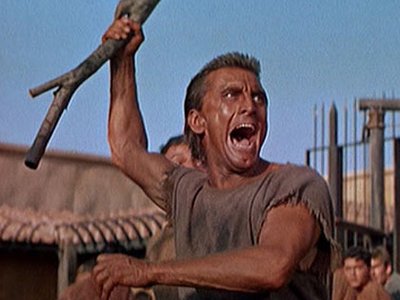
I Am SpartacusI am Spartacus.

If you’re familiar with that classic line or the movie Roman Holiday with Audrey Hepburn and Gregory Peck or Steve McQueen’s gritty performance in Papillon, you already know the work of Dalton Trumbo, the great screenwriter/novelist who died in 1976.  I was lucky to have found him in a high school class where we read his anti-war classic Johnny Got His Gun, a book that still haunts me.

I was finally able to catch an episode of American Masters on PBS that focused on Trumbo and his involvement in the Communist witch hunts of the late 40’s and 50’s here in the US.  Without rehashing all the hideous events of that time, Trumbo and a number of others, called the Hollywood Ten, were called before Sen. Joe McCarthy’s now infamous senate committee, the House Un-American Activities Committee (HUAC), to testify as to their Communist leanings.

It was an ugly spectacle, a black mark on our history.  Trumbo and others refused to cooperate and many were imprisoned, Trumbo for eleven months.  Some that called cooperated and named names, destroying the lives of many.  A blacklist existed throughout the 50’s that kept many people in many different fields from working, although the blacklisted Hollywood writers and actors are the best known.  Trumbo was able to keep working somewhat under fake names and behind fronts, people who would put their name to his work.  There was an incident where Trumbo’s script for The Brave One won the Academy Award in 1957 but was never claimed as it was under another name.  He finally received it in 1975.

It was truly a terrible time in our country, a time of fear-mongering and ignorance.  The reason I bring it up today is that in it, watching those grainy films of the bloated bullies of the HUAC acting like the Spanish Inquisition, I cannot fail to see huge parallels between the behavior of those enemies of free speech and the behavior of those who oppose all change today, awash in stupidity and fear.  And as much as their actions then and now seem, it is the actions of those enable them that most disappoint.  Once you kowtow to the demands of the rabidly fearful and ignorant, all hope is lost.  In the 50’s those participated in blacklisting citizens enabled the hatred of the accusers.  Today, when we allow lies and mistruths to go unchallenged, we do the same.

We cannot let the fearful and the ignorant choose our path.

Okay, I know this is probably not as coherent as it might be.  I highly recommend that anyone interested try to watch this episode of American Masters.  Perhaps you’ll see what I’m flailing to say…

Here is a small bit from the end of the episode, featuring a piece of Trumbo’s writing where he defended his experience as an American to those who questioned his love and loyalty for this land-

Read Full Post »

gorey gashlycrumb tiniesOne of my favorite children’s books ( well, kind of children’s book) is from the slightly skewed mind of Edward Gorey, the late, American born ( although he is widely thought to be British) artist-illustrator/nonsense writer.  The book is The Gashlycrumb Tinies which is set up as a primer for the ABC’s, a veritable alphabet of the Gashlycrumb children’s demises.

It is macabre and perhaps not really for children but it is full of humor and imagination that Gorey brought to much of his work, up until his death in 2000.  You can easily see the influence of Gorey on the work of Tim Burton and others.

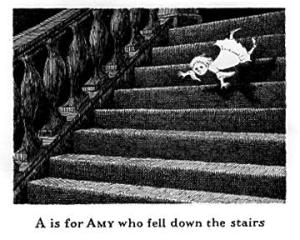
gorey a is for amy

It starts with A is for Amy who fell down the stairs and finishes with Z is for Zillian who drank too much gin.  In between are 24 other little scenarios that play (or haunt) on the imagination.  My favorite might be N is for Neville who died of ennui although I do like B is for Basil assaulted by bears.  If you would like to see the whole alphabet simply click on the image of Amy or Basil and you’ll be whisked to it so you might enjoy it in it’s entirety.

gorey b is for basil

Read Full Post »

djangoWalking down to grab the paper this morning and everything was shrouded in fog.  It was very early, before 6, and the morning light was still trying to gather,  giving the scene a haunting, ghostly appearance.  Chill in the air.

September.

It really made me think of one of my favorite songs, September Song, the beautiful old Kurt Weill song that has been performed by hundreds of artists over the last seventy years, from Sinatra to Willie Nelson, who does a lovely, delicate version.  On this cool, misty morning I am reminded of one of my favorite versions, that being the one from Django Reinhardt, the jazz guitarist from the middle of the last century whose distinctive gypsy-tinged plucking, the result of basically playing with only two fingers on his left hand as a result of an injury received in a fire in his youth, has influenced artists long after he passed away.

Here’s Django’s September Song.  Hope you’ll enjoy…

Read Full Post »

ali in  irelandSaw this in the paper yesterday, about Muhammad Ali making a trip to visit the home of one of his great-grandfathers in Ireland.  It turns out that Ali’s ancestor emigrated from Ennis in County Clare to the States around 1860 and settled in Kentucky, where he married a freed slave, Ali’s great-grandmother.

muhammad_ali_versus_sonny_listonI only mention this because Ali has been one of my idols since I was a very small child.  I grew up watching his fights, seeing his wonderful combination of speed, grace and power that made him seem different than the other fighters who entered the ring against him.  There  was something very beautiful in the way he glided around the ring, feet barely touching the ring as he circled.  It belied the brutish, ugly aspect of the sport, gave him an almost ethereal quality, especially in the early part of his career.

Then there was his personality that absolutely glowed from the TV screens in those years.  His float like a butterfly, sting like a bee, rat-at-tat poetry and his over the top mugging before and after his bouts were candy to the kid I was at that time.    There was a level of intelligence at play with Ali that seemed so unusual for a boxer.  I remember reading Wilfrid Sheed’s early biography of Ali (a beautifully photographed book I bought when I was a kid and still get shivers when I open it today) where he wrote that Ali had been tested and found to have a very low IQ in standardized tests of the time.  Knowing Ali, the author deduced that the tests were deeply flawed and couldn’t measure the natural brilliance and innate  intelligence that Ali possessed.

There is so much to say about Ali, who may possibly be the most recognizable man on the planet, his photos hanging in mud huts in Africa and thousands filling the streets in Ireland to see the aging king.  The controversies over the name change from Cassius Clay to Muhammad Ali upon his conversion to Islam and his subsequent refusal to enter the armed services made him a polarizing figure but never quieted his voice.  And that trueness to his beliefs, agree with or not, made him even larger than life.

Even his last fight, his tragic struggle with Parkinson’s, has grown his myth as this man who was truly a beautiful creature in his youth has somehow gracefully made his fight public, raising awareness for the disease.

And now, he adds the luck of the Irish to the myth.  Good for you, Ali O;Grady.

ali with crowd in ennis

Read Full Post »

Muse

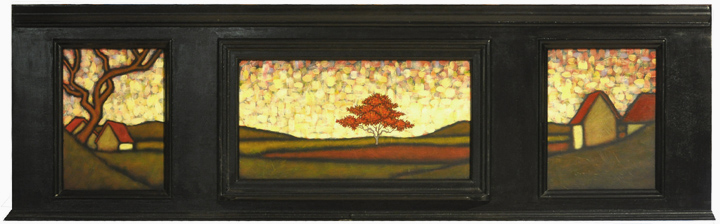
Muse GC MyersThis is a piece I’m working on at the moment, something I’m calling Muse.  It’s a triptych done on the insert panels of an old upright piano, making it somewhere in the 18″ high by 60″ long range.

It’s still a work in progress so I’m sure this will change at some point.  I’m still playing with the idea of incorporating words on the black of the frame  or building a pedestal so the piece would be freestanding but it’s all unsure at this point.

I really like the feel of the architecture of the panel itself, the way it holds the paintings.  I have several other pieces of this piano’s cabinet for which I have plans and if they work in the manner I hope may lead to a group of other pieces featuring architectural/ furniture elements.  More of an object than a painting.  The concern with such a thing is to not let it devolve into kitsch or decoration alone.  The painting that adorns such objects needs to be able to stand on its own, making the viewer forget the surrounding environment, which should, in theory,  enhance the painting.

But so far, I’m pretty happy with the way this progressing.  This will probably not leave my studio but will hopefully inspire further forays into this look.  We’ll see.

Read Full Post »

Inks

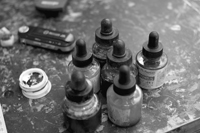
GCMyersInkBottlesBlumerSThis a photo that Barbara Hall Blumer took of ink bottles on the table where I paint a few years back for her book, In Their Studios, which documented artist studios in the Finger Lakes region. I’ve always liked this simple photo and am showing it to just talk for a bit about one of my favorite materials to use in my work, acrylic inks.

I started using acrylic inks about fifteen years back as an addition to the watercolors I was using at that time.  I had been told about Dr. Martin’s Hydrus inks and found them and some Daler Rowney FW Artists Inks at a local art supply.  I was immediately excited by the way the inks reacted in my work.  The colors were deep in intensity as the pigments were very finely ground and the transparent colors I chose mixed tremendously well.  I was also happy with their high level of light fastness which prevented the colors from fading from exposure as is the case with many watercolors.  I wanted to make my work as durable as possible.

Over the years, as my work evolved, several colors became staples in my paintbox, particularly those from Daler Rowney.  I was using several quarts a year of certain colors and they had become almost trademark colors in my work.  For instance, their Indian Yellow , which I use as a first layer of stain on my frames.  I was buying dozens of their 8 ounce bottles of ink every year.

I was thrown a curve last year when Daler Rowney, a British company, chose to stop selling the FW inks on which I so depended in large bottles, only selling one ounce bottles.  I panicked a bit, knowing I wouldn’t be able to keep up with my needs with the small bottles even if I could find them.  I started trying different brands of inks.  I was able to find comparable quality in certain colors but I couldn’t match other important colors.  I tried and tried, mixing different colors to try to achieve the same quality of color that I had become accustomed to with the Daler Rowney, but it always came up short and the inks reacted differently on the painting surface which altered how I painted.  It was discouraging and I felt that my work would change forever.

So earlier this year I contacted the Daler Rowney office in Britain,  desperately appealing for any help that could offer.  I really didn’t expect much in response but was surprised when they emailed back that they had a surplus quantity here in the States that they had made for a private firm and would gladly sell me whatever they could offer.  I was able to match colors with the help of their chemists and within a week I had 30 gallons of ink sitting in my studio.  Enough for several years.  At least long enough for my work to continue to evolve beyond the need for a single product.

I know I could have survived without the inks, necessity being the mother of invention that it is, but having the security of knowing that this paint will be available for a while eases a bit of the anxiety that would come from having to change immediately.  Now I can ease into it.

Read Full Post »

« Newer Posts