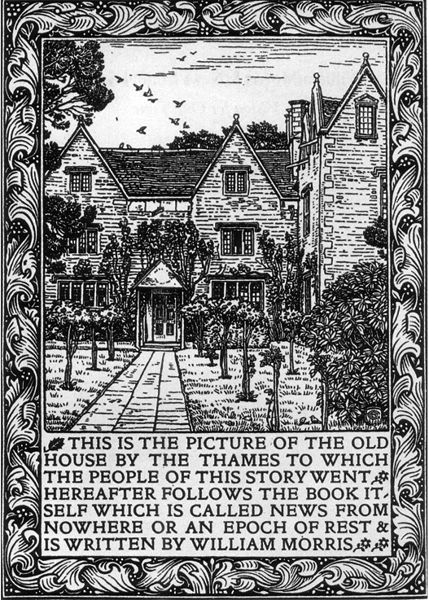
 “When a writer knows home in his heart,
his heart must remain subtly apart from it.
He must always be a stranger
to the place he loves,
and its people.”
—William Morris
I came across this quote from William Morris, the English artist/designer/writer who basically set the Craftsman aesthetic movement into motion in Britain and here in the States. I found this as a quote without any context and was immediately intrigued by it.
It seems somewhat sad at first glance, that one should remain somewhat aloof in one’s home but I think I understand what he’s saying. To understand what home means to you, you must be able to step away and view it with a slightly distant eye, to put yourself in the corner as a dispassionate observer. From this vantage point one can see and understand the bonds of home.
 I don’t know why I mention this today. Maybe it’s that lately my work has dealt with the concept of home and what it means symbolically. What does home really mean? Is it a place or a state of being? Is it formed by the sense of security one experienced and maintains from their childhood? Does the search for home ever feel fulfilled? Maybe it’s questions such as these that draw me to these words.
Like anything, to truly understand something you must be able to step back from it and view it from a distance. When you’re in a house you may have only an idea of what it looks like put together from going from room to room, getting a sense of size and shape. But it’s only when you step outside the house and take it all in from a more distant view, that you truly see how the house looks and sits in its environment. I think this is what Morris is saying about one’s sentimental home as well.
 Redtree Times
Gary – I think about the concept of “home” as well. It’s difficult to put into words…
For more than 20 years, a physical sense of “home” did not exist for me – divorce, changing jobs, temporary living arrangements, etc. However, all my life, I have been blessed with the a number of strong and enduring relationships. Mentors and freinds have seemingly “popped up” at just the right times – often nudging me along the right path.
A few years back I was with a group of 15 friends in Maryland. We see each other as a large group every couple years. At our gathering, I told them that when we are together, I feel “home.” It’s comfortable, filled with cheer and of course we have our share of dysfunctions, idiosyncrasies, etc. However, these men are my mentors, my best friends, role models and confidants. Although we are spread throughout North America we are connected by a special bond.
It’s an interesting discussion. Now that I am (in part) responsible for creating “home” for my own children, what will it ultimately look and feel like? For now, I am going with what I know – the feeling mentioned above. Hopefully the physical structure will become a symbol of that – just like the iconic symbols in your work.
Better get back to work…Thanks for the tangent in my morning. Scott
Thanks, Scott. I think what you’ve written fits very well with this post. Home is not simply a physical place but a sense of being and belonging. Something that is carried within. I have no doubt that you and Jess will create a sense of home for your children that will give them the type of inspiration and security that we all seek.
I remember reading a quote from, I think it was Monet (I can’t find it right now), that said something about wanting to be born blind and regaining his sight at age 20 so he could see the world with a virgin eye.
The problem for any artist is seeing that one specific detail that gives the picture life. If you see the same street, the same intersection, the same shops, the same shopkeepers, the same everything every day you can become numb to the details. And details are everything.
As for home, I never had a geographic one growing up which makes my rather shallow roots in North Carolina all that much more precious. But no matter how long I live here, I’ll never be a true North Carolinian.
It’s the difference between playing guitar and being a guitar player. I play guitar. I am not a guitar player. More is the pity.
The more I think about this the more I think that artists and writers use their mediums to create a form of home, a place of comfort and security in which they feel free to move about.
And I understand the guitar player/ playing guitar distinction. I envy those folks who find something, as a real guitar player does, which meshes so well with who they are that it becomes truly part of them.
Morris created the most beautiful homes but was ultimately very sad in them (i suspect) as his wife loved another man (Rosetti). You might enjoy this picture of his front door on my Morris blog:
http://wmmorrisfanclub.blogspot.com/2010/01/door-that-makes-you-never-want-to-leave.html
Your paintings are lovely and I’m very happy to have seen Van Gogh’s flower beds, a painting I was unfamiliar with.
Thanks so much for the comment and the bit of info on Morris and Rosetti. Morris’ door on your blog is really spectacular. Thanks for sharing!
I was sitting here thinking about your post and the concept of home when I happened to glance off to the sidebar. “The Waiting Flowers” is right there, and I made an immediate association with the Van Gogh flower beds you posted recently. I printed out images of each and have them taped next to each other here at my desk. The effect is really quite intriguing.
I was caught by your suggestion that to truly understand something you must be able to step back from it and view it from a distance. I’m not certain about that. Just as often, it seems that understanding comes from being able to penetrate into the depths, not to maintain a dispassionate distance.
In any event, Morris’ words are intriguing and worth pondering, and I appreciate you offering them. I also have very much appreciated the film you created about your art and your creative process. I’ve linked to it here and there for others, and they’ve appreciated it as well.
Thanks, as always, for the comments. Just to clarify: you’re right when you say that understanding comes from being able to penetrate the depths of whatever you’re involved with. But sometimes, even when you have been fully involved, you need to take a moment and step back and take in the whole panorama. I equate this with being in front of a painting that I’m working on. There are points when I am very close to the surface, engulfed and totally captivated in the small part of the scene before me. But to see how that small part plays within the whole painting I must step back and take it all in. See how the scene I was in relates to the rest.
That may or may not be what Morris what describing. Whatever the case, it provided fodder for some thought.
Again, thank you.