Feeds:
Posts
Comments

Archive for January, 2011

A question asked of me this weekend inspired me to go back into my archives and pull out the images of a few pieces done several years back.  I was asked if I used this time of the year as a starting point for new work and I said that I often did,  using it as a time to begin new ideas that I want to try.  I explained that it was important for me to continue trying new things as it excited me in the studio and that this excitement was important to all of my work.  This new work provides a vibrancy that permeates all my work and helps me find the new in compositions that I have painted in the past.

I explained that I liked to try new concepts in series in most years and that some are more embraced than others and become part of my regular painting vocabulary for years.  The Red Roof series is such a series.  I have painted examples in this series for several years and it has become engrained.  The Archaeology series is another. 

Other series last but a season.  While they may be popular from a sales standpoint,  they soon exit my routine.  The In the Window series is an example of such a series.  Done in 2005, they were a series of paintings that featured simple interior scenes with large windows that were highlighted by examples of my typical landscapes.  The idea was that the interior scene acted as a setting to show the landscapes in a different manner, much like the setting for a piece of  jewelry dictates how a gem is seen.  The gem here was  my landscape.

This painting shown on the left, In the Window: Dream Away, was the first piece.  It seemed to jump off the paper on which it was painted.  Very vibrant.  The setting of the window pushed the scene of the tree atop the mound overlooking the water out of the frame and seemed to intensify it.  I was immediately taken with the concept and a number of others soon followed, including the one at the top.  These pieces sold pretty well but they eventually lost steam for me from a creative standpoint.  While I still felt that they were vibrant , I sensed that I had done as much as I could with the concept and didn’t want it to become labored and tired.  My excitement was passing and I wanted to stop near a peak rather than at a low when the work was completely played out when I was viewing it as a toil rather than a joyous activity.

I still feel excitement personally when I see these pieces from this time and I know they are of a certain time for me.  I want them to stand as they are in my body of work.   As I described this this past weekend, I explained that the interesting thing about stopping a series is that it creates a finite number of pieces within it.  They become more distinctive over time, more representative of a certain time in my own artistic continuum.  So while these series, such as the In the Window series, are short-lived they have a longer viewpoint.


Read Full Post »

Moonlight is sculpture.

Nathaniel Hawthorne

****************************

I find myself with nothing to say this morning.  I am still somewhat seething from listening to media reports from Tucson, hearing the new spin from those on the defensive.  It bothers me that I allowed myself to be pulled emotionally back into the fray caused by this event.  It distracts my mind and keeps me from what I want to be doing so I try to block it out.  Instead I pull up this older piece and remember it and try to focus on the feeling I take from it.

It’s a painting that I’ve always liked from the moment I finished it.  The sculptural quality of the sky  gives the piece a very three-dimensional feel and heightens the sense that it is more than a painting, more like an object.  A relic captured behind glass.  This is something I started to seek in my earlier work and have maintained up to the present day, this sense of being more than a painting of a scene.  A relic.  An icon.  In this case, I feel that it truly works. 

I am pacified greatly by this piece, as though the blues in the sky and water have an absorbent quality that pulls away the tension, allows anxiety to easily slip away.  There is simplicity here and the chaos and idiocy that appears rampant in this world is nowhere to be seen.  All is still.  All is connected.

Okay.  I’m calmer now and maybe tomorrow will bring a more interesting day for the blog.  I’m hoping.

Read Full Post »

Who’s Next?

When I heard of the Arizona shooting of 18 people, including Congresswoman Gabrielle Giffords, that left 6 dead, I was shocked.  Shocked, but not surprised.  If anything, I was surprised that this next shoe had not fallen sooner.

Maybe Pima County Sheriff Clarence Dupnik at the site of the shooting  has it right when he says, “When you look at unbalanced people, how they respond to the vitriol that comes out of certain mouths about tearing down the government. The anger, the hatred, the bigotry that goes on in this country is getting to be outrageous.  And unfortunately, Arizona, I think, has become the capital. We have become the mecca for prejudice and bigotry.”

How can anyone be surprised that people with an unbalanced mind respond violently especially given the manner in which demonization of our political opponents has taken place in the past few years.  I mean, you’ve got Sarah Palin literally targeting Giffords in an ad for the 2010 election, placing her district in her gunsight.  You’ve got entire news networks devoted to destroying one agenda while propping up another, endlessly spitting out hatred without a moment’s rest. 

 Hyperbole rules the day.  There is no nuance, no gray area in our political discourse.  Compromise has become a word to be avoided, a sign of weakness rather than the virtue it once was with politicians of the past.  Think of  Henry Clay who was  called admiringly The Great Compromiser.  That is a thing of the past.  Now, if you’re not with me, you’re against me.  I am trying to save America, you are trying to destroy it.

Is anyone truly surprised that a person, especially one with an unhinging in his mind, who feels as though his voice is lost in the ever more shrill universe he knows ultimately picks up his gun and does the unthinkable?  One who believes every bit of  rhetoric and every caricature of their supposed enemies put forth? 

Are you really surprised?

You will hear a lot of politicos over the next few days and weeks trying to lay aside any responsibility that their words or actions may have contributed to this atmosphere.  They will try to lay the blame solely on this one individual’s unstable mind and try to gloss over the environment they have fostered.  And maybe this is simply a senseless, horrible act of violence with no connection to anything political.  Maybe.  But I doubt it and the least they should take from this is that this may not be the last such scene. 

And that is a sad thing for our country.

Read Full Post »

Saturday and I’m not in the studio today.  Thought I’d have a little music that feels right for driving.  It’s the  seminal rock song, Hey Joe, recorded by many artists over the decades, most notably by Jimi Hendrix

This is not the Hendrix version.

It’s a version featuring one of my favorites, Tim O’Brien, performing a bluegrass tinged version of the song with the great Jerry Douglas, the master of the dobro.  I saw O’Brien perform several years ago at a local historic church, one that the previously mentioned Mark Twain used to attend.  It was a great acoustic show in a great space, something out of the norm for this area.  I was a fan before the show and his musicianship that evening only made me like his work more.

Anyway, enjoy the song and your Saturday…

Read Full Post »

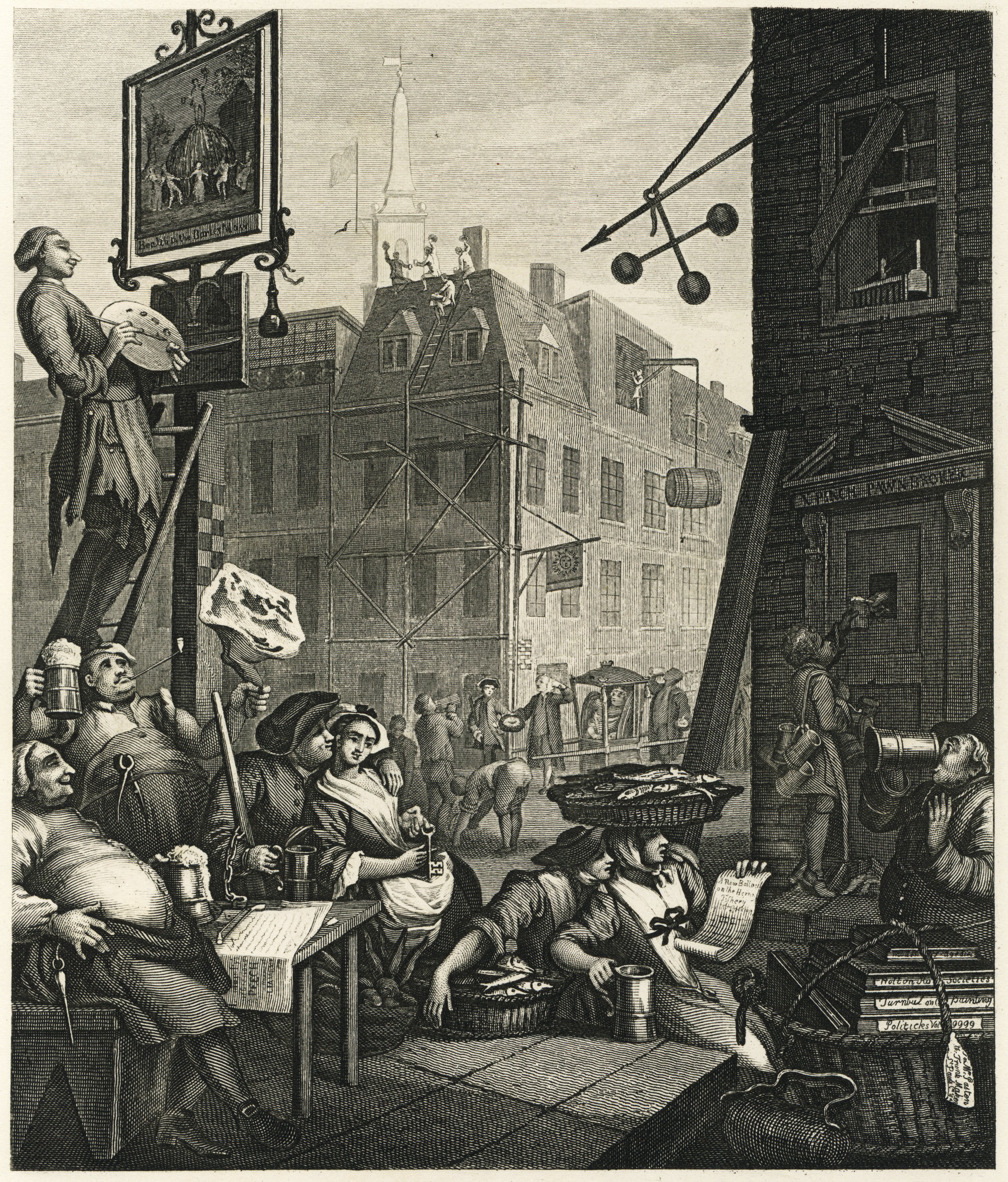
Yesterday I mentioned Bryan Talbot and his book Alice in Sunderland.  One aspect of the book that I failed to mention was an interesting case he made about the beginnings of the British comic books genre.  He cites the Bayeaux Tapestry (which I have been meaning to highlight here for some time) as an early example of a story, the Norman conquest of Britain, being told through the use of pictures.  He also goes into an interesting discussion of  William Hogarth, the British painter/printmaker whose work, particularly his prints, were often serial in nature, telling a story by their relationship to one another.

Hogarth (1697-1764) is an icon of British art and a populist whose prints reached across many levels of British society, hanging in homes of many classes.  His work was often satirical in nature and dealt with pressing social issues of the time.  His most popular was Gin Lane, which was coupled with another print, Beer Street.  They were made in order to garner support fot the Gin Act of 1751 which was enacted to curtail the gin craze that had seized Britain for the first half of the 18th century.  Gin was inexpensive to produce and was sold cheaply.  At the time the average Londoner was purported to be drinking up to 2 pints of gin per week and authorities of the time felt that this was leading to idleness and moral decay.

Hogarth dealt with the issue by showing the contrast between the accepted practice of drinking beer (considered safer than drinking the water of that time, given the unsanitary conditions) to the evils brought on by drinking gin. In Beer Street, Hogarth depicts the drinkers as well clad, jolly and fat– signs of health and wealth.  There is a sense of orderliness with workman at labor and all businesses being prosperous, except for the pawnbroker, whose building is in disrepair.  The artist who is shown painting the sign is in rags and is shown to be a gin addict through the detail on the smaller sign where he has painted a gin flask rather than a beer bottle.

The contrasts in Gin Lane are drastic.  Scenes of decadence and decay abound.  At the forefront is the drunken, bare-chested mother who has lost her grip on her child who tumbles over the railing down to an underground gin house. Her companion is an emaciated balladeer whose sheet music has the title The Downfall of Madame Gin.  In the background, the scenes are evn more lurid.  A barber hangs himself, his business failing because the gin addict spends all his money on drink, not haircuts.  A woman is feeding baby gin.  A man is gnawing on a large bone while his friend is so drunk that a snail has time to crawl upon his shoulder.  Buildings are in disrepair and falling down.  The only businesses that prosper are the undertaker, the gin houses and the pawnbroker, where a workman is pawning his tools for drink.  There are other signs of madness, as the detail shown here illustrates.

It’s pretty powerful stuff and Talbot does a nice analysis of the compositions of the two prints, showing how Hogarth creates a feeling of orderliness and calm with the strong vertical and horizontal lines of Beer Street and contrasts that to Gin Lane with a composition that features frantic motion with clashing diagonals.  There is little stability and chaos reigns in his composition.  Masterfully done.

The Gin Act of 1751 was written into law and by the mid 1750’s the gin craze had subsided, although many cite the higher cost of grain at the time which drove up the price substantially as a larger factor.

Whatever the case, Hogarth has produced two intriguing prints that have great interest even today.

Read Full Post »

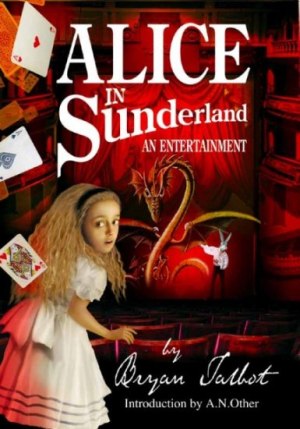
I was having a discussion with a friend several weeks back about graphic novels and the use of illustration in storytelling.  As a result of our conversation, he loaned me this book, Alice in Sunderland by acclaimed British illustrator Bryan Talbot, which I have been poring over for the last few weeks.  It’s a massive enterprise, from a graphic standpoint, containing over 300 densely packed pages of intricate illustration. 

While mainly concerned with Lewis Carroll and his Alice in Wonderland story and the relationship of Carroll to the area of northeast England containing the city of Sunderland, the story goes into great detail about Carroll’s life and the lives of those who inspired the book.  It also tells much of the history, both real and mythical, of the Sunderland area, doing so in the fashion of a writer who loves his home area.

It is a treasure trove of information and story about many subjects, all told in surprisingly coherent manner.  When I first opened the book I was overwhelmed by the amount of graphic information my brain took in.  It seemed scattershot and all over the place at first glimpse but once I entered the mass of color, shape and word I found its composition sensible and functional.   Not to mention very informative.  It made me appreciate the amount of labor and research Talbot put into this work.

I didn’t think I would find the subject matter interesting at first.  I mean, what do I know of northeast England?  And while I admire Alice in Wonderland it is not my favorite childhood tale.  But Talbot’s ability to tell a tale with a mix of word and image and the interesting tangents he pursues make this a great read.  I find myself continually picking it up and rereading sections of it, taking in new details and sometimes simply enjoying the illustration.

So, if you’re looking for something a bit out of the ordinary, soemthing that will send you in all different directions as you’re reading, check out Alice in Sunderland from Bryan Talbot.  Good stuff…

Read Full Post »

Patchwork

It’s the week after New Year’s and I’m still trying to get back into some kind of rhythm in the studio.  This week is filled with several distractions that keep me from fully investing mentally in the work and, as a result, I find myself working on smaller tasks that need to be done around the studio easily.  I keep putting off the full jump back into painting, avoiding the total immersion for a few more days.  This is not unusual for me at this time of the year and has become a behavior that I cultivate now for the effects it produces in the aftermath.

Normally, this extending of the time before I jump back in  is a very fertile time, with ideas and glimpses of where I want to take the work simmering at first , finally coming to a full boil when I ultimately make the move back to painting.  This stewing period often sets the tone for the next several months and I’ve learned that it’s better to just go with the flow during this time instead of worrying about not being at the easel.

Another result of this time is that I find myself mentally chaotic and unfocused until the time I am painting.  It’s probably evident in this blog.  But I wait patiently now for that moment when I’m back in full rhythm, a moment that bursts upon me without notice of any sort.  One moment I am feeling as I do now, unfocused and a bit anxious in my waiting, and the next I am back in full painting mode, mentally attached to the surface before me and clear in my thought process.

That is the patchwork of my days now.  By the way, the piece shown here is another little canvas, a 3″ by 5″, titled Patchwork Days.  It sort of represents for me the path ahead that I am trying to follow and the distractions that keep pulling at my attention, represented by the smaller field segments of differing colors.  This small piece has a very nice rhythm and feel.

Read Full Post »

Turner Classic Movies (TCM) starts a 24 hour marathon tonight  featuring the Our Gang shorts from producer/director Hal Roach

 If you’re not familiar with the Our Gang films (or The Little Rascals, as they were also known), they were a series of shortcomedy  films produced from 1922 up until the late 30’s that featured children as the stars of the storylines.  The children acted in a very naturalistic manner and the stories often had the kids, who were poor, at odds with authority figures and the wealthy.  For the time, there was surprising evidence of racial and gender equality in these films, with girls and young black child actors performing in  starring roles.  There was a level of stereotyping that may not be politically correct today but , at the time, this equality was new and ground-breaking in films.

For those of you who do know them, simply reciting the names of some of the gang are enough to raise some memories.  There was Spanky, Alfalfa, Darla, Chubby, Stymie, Buckwheat ( parodied in a huge way later by Eddie Murphy on SNL), Farina, and Dickie among the many children who appeared in the cast over the years. Not to mention Petey, the white dog with the black ring around his eye. 

I mention this not because of any special love for these films, although I saw and enjoyed most of them over and over again as kid.  I mention it because Hal Roach was a fellow native of this area, born and raised in Elmira, going to the same high school as me.   While known for the Our Gang films, Roach is perhaps better known for his Harold Lloyd and Laurel and Hardy films.  It is legendarily said that Roach’s path in life was greatly influenced by hearing Mark Twain speak at his school when he was a young boy.  Twain spent the better part of twenty summers here in Elmira, writing some of his best loved works from his study overlooking the city, and is buried in the same cemetery here as Roach, who died in 1992 at the age of 100.  I often wonder if those same Eastside Elmira streets above which Twain lived are represented in these Our Gang films.

So, if you get a chance, take a peek tonight or tomorrow at some true Americana.  The Our Gang films represent a unique time in our history and are entertaining,  to boot.

Read Full Post »

The Wending

Every day is a journey, and the journey itself is home.

—Matsuo Basho


****************

I’ve been looking at this piece in the studio for the last several days.  Called The Wending, it’s a painting on paper that’s about 17″ square.  I always get the sense of it being painted on fabric when I glimpse at it.  I don’t know why.  In the color there is a mix of saturation and of a feel of fading, as though the color is slightly worn from use.  Like an old t-shirt that was once sharply bright in its color and over the years, through sun and sweat and repeated washings, has become a softer shade of its original self. 

Comfortable in its place.

And that’s how this piece makes me feel.  There is the sense of the journey yet it doesn’t feel alien or strange.  There is an absence of trepidation about moving ahead, as though, like the words of Basho above, the journey itelf is home.

It’s an immediate and comfortable sensation in this painting and I think most of it derives from this softened color.  The darkness under the color is even softened and less foreboding which adds to the ease of this piece.  It feels like a good path, a good journey.

All I ask of it.


Read Full Post »

I wrote yesterday, in a sanguine manner, of not making resolutions for myself.  But this morning, still under the weather, I have decided to contradict myself.  I will maker a resolution, dammit.  Why not?  So for this year I resolve to read all of the Roald Dahl books that I missed as a kid.  I don’t know how I didn’t come across them in my rabid reading days as a child.  I would have loved them, I’m sure, with their dark humor and their sense of ethereal justice.  I mean who didn’t feel a little better when Veruca Salt got hers at Willy Wonka’s factory?

I decided on this resolution after recently viewing the film version of The Fantastic Mr. Fox, a stop-motion animation from director Wes Anderson who made one of my favorite films, Rushmore, as well as a handful of  other quirky, funny, bittersweet films.  His debut film, Bottle Rocket, is a little known charmer.

I don’t ususally like to suggest films for anyone because, like any artform, it is  highly subjective.  I like what I like and you like what you like based on a whole series of personal preferences and opinions and often that which triggers my emotions may seem silly or shallow to you.  But I highly recommend The Fantastic Mr. Fox.  It is smart and funny and just a lovely film.

So, there.  Anyway, I am off to search for more of Mr. Dahl’s work.

Read Full Post »

« Newer Posts - Older Posts »