Feeds:
Posts
Comments

Archive for April, 2011

Self Portrait-- Jon Sarkin

I was sent a link by a friend in response to yesterday’s post that really sparked some thought early this morning as I read it.  It was a story about author Amy Nutt’s book, Shadows Bright as Glass, which concerns itself with the story of Jon Sarkin.

  Sarkin had been a chiropractor until a day in 1988 when he experienced a stroke which transformed his life in a way.  He began to paint voraciously,  trying to express somehow the new self he suddenly identified in the aftermath of the damage done to his brain by the stroke.  He knew that he was somehow changed, could sense that there were parts of his mind that had transformed him into what he felt was a completely different person.  Painting allowed him a vocabulary to express the new sensations he was experiencing.

It made me think about my own accident years ago and the transformation that has taken place in the time since.  I often think of my life before that time as almost another life in another person’s mind, even though I still feel the continuum of my existence.  I am the same but different.   I can’t put my finger on it exactly but  know that  it has been the seed for much of my work over the years, a seeking and expressing of true identity. 
 
In the Ken Burns’ documentary Baseball, which I’ve been viewing this week in the studio, someone described Babe Ruth after his death as the most natural, unaffected person he had ever met.   He was what he was.  This made me think of this same concept of identity.  How many of us are perceived as what  we really are?  Does anyone ever really know anyone’s true and central self?  I wondered how many of us live in lives that are counter to our inner identities, constantly struggling in our minds, perhaps on a very subconscious level, with maintaining an outer face that we sense is not our true self?  It seems to me that this conflict in ourselves would be the source of much unhappiness in this world.  I know it was for me.
 
I don’t know if there are answers to be found.  Yet.  We still seem to be in the earliest stages of knowing how the brain and  the mind connect and  interact but given the acceleration of  discovery and technology over the past few decades, we may know more soon.  For now, we are who we are.  Or at least, who we appear to be.

Read Full Post »

Work by James Castle, Self-Taught Artist

I came across a very interesting website, The Foundation for Self-Taught American Artists .  I have featured a number of self-taught painters here, always finding their will to create and find a form of self-expression a truly fascinating thing.  I love how they overcome their lack of training or lack of materials to form a vocabulary that speaks of their own unique place in the world.  This site is dedicated to these artists who overcome.

James Castle

On the opening page of the site was a trailer for a documentary featuring the work of James Castle, who was born in 1899 in Idaho and lived there until his death in 1977.  Profoundly deaf since birth, Castle never learned to sign or even read or write but instead found expression in the drawings he created from a mixture of soot and saliva that he applied to scraps of paper with a sharpened stick that acted as a crude ink stylus.  Over the course of his life he created thousands of drawings, collages and other constructions that make up a truly unique and wonderful body of work.  He gained some regional recognition for his work but it wasn’t until after his death that he gained a wider audience.

I find great inspiration in seeing the work of artists like James Castle and hearing their stories.  Their work is a triumph of the creative spirit and I am grateful for the people and institutions that keep the work alive.  If you feel the same, The  Foundation for Self-Taught American Artists is a great site to visit.

Here’s the trailer for the Castle documentary, James Castle: Portrait of an Artist.   I’ll be looking for it.

Read Full Post »

Fork

Another new black and white, or gray, piece, this one an image of about 7″ by 11″.  I call this painting Fork because of the repetitive form of the fork seen in the path as it splits and in the the tree as it reaches upward.

The sun here is oversized, something I have often employed in my work, to create a dramatic visual quality, a sense of immediacy in the moment.  As though it is a guide of sorts, hovering above and reminding the traveler that every decision, small or large, takes them in a new direction, some far afield from where they currently stand.  The sun is not menacing in this position that it maintains.  No, it’s immediacy is more of an urging to see the significance of the ordinary, the importance of seemingly small decisions and thoughts.

Recognize where you are and what is before you, in both a physical and spiritual sense.  The tree here represents the spiritual or mental aspect of this.  Just as the traveler comes to a fork and takes one of the paths which determines what they will see and experience, we make judgments each day, on nearly everything, which shapes how we view everything that we see and experience.

As I always say, this is only how I see this piece.  You may not see it that way.  You may see something completely different or nothing at all but a simple composition.  All are valid.  Art often falls in that gray area.

Read Full Post »

I was going to talk a little about one of Woody Guthrie’s songs about an incident that occurred in the formative years of the labor movement, the Ludlow Massacre of 1914

It’s a haunting song about a haunting event which happend in Colorado where striking miners who had formed a tent village were set upon by the National Guard on the orders of the Colorado governor.  They snuck in and soaked the outer tents with kerosene and set them ablaze then opened fire on the miners and their families as they fled.  20 were killed, including 11 children.  Just another of many incidents in our history that is practically unknown to the average man in the street, the person who doesn’t realize that the importance of protecting the working class against the avarice of those who would exploit them is rooted in such tragedies.  People who don’t realize the historical importance of the labor movement in this country and how it relates to the present standard of living.

There’s a lot more to be said, of course.  But it’s Sunday and the world deserves a rest.  You can find Guthrie’s Ludlow Massacre on YouTube, along with many of his classic documentations of working America.  I thought I would play a little less dark song by the great American troubador/poet/pot-stirrer instead.  Here’s So Long It’s Been Good to Know You. 

Read Full Post »

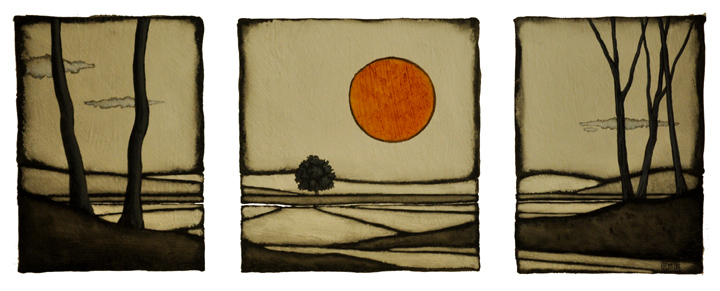
In between the new work I’ve been featuring here as of late, I’ve also been continuing to produce a few other pieces of my black and white ( or gray, as I sometimes refer to it) work.  As I said before, I enjoy the challenge these pieces present in trying to create emotion and feeling without the use of color.  No deep reds or yellows to warm up the scene and give it an inviting glow.  Only the composition and lines and shading to give the piece its lifeblood.

Oh, there is a touch of color.  The most recent group features red and yellow sun/moons which gives this group a great sense of continuity between the individual pieces.  The tryptych shown above, an image about 7″ tall by 18″ wide on paper that I’m calling The Warming, is an example.  In some of my gray work I have reserved the touch og contrasting color for the crown of a red tree but with this group I wanted the color to be only in the orb of light in the sky.  So with this piece the tree has gray foliage.

I like the feel of a tryptych, the way the three images are compartmentalized and relate to one another.  Each stands alone but is strengthened by the next and the sum of the three is infinitely more compelling than any one alone.  Thi breaking apart of the scene also brings a further sense of remoteness that I feel in the work, a feeling that is aided by the removal of color in the foreground.  The dark grays create a somber now from which the viewpoint originates and the yellow of the sun/moon creates a more optimistic future which approaches.

I’ve got plans for another in this series with four or five asymetrical segments creating different visual weights.  I’m still working it out in my head but will show it here-  if it works as I’m envisioning it.

Read Full Post »

We have quite a few pileated woodpeckers that call our woods home.  They’re a very large bird, about the size of a crow, and the clatter of their pecking echoes loudly through the forest as does their distinctive cackle.  They do a hell of a lot of damage to the white pines but I love seeing and hearing them, which  always reminds me of the Woody Woodpecker cartoons from my childhood.  I was a big fan for a short time but moved on eventually to what I felt were more sophisticated cartoons, such as the Warner Brothers work of Chuck Jones and Tex Avery.  But I still have warm memories when I hear that crazy woodpecker laugh clatter through the trees.

I was also reminded of Woody when my friend Brian recently sent me an interesting link to a New York Times article that talked about one of his animators, Shamus Culhane.  During a scene depicting an explosive moment, Culhane inserted cels into the film that contained art that more resembled that of the abstract expressionists that that of a traditional studio cartoonist.  There is a multimedia link on the page that shows the sequence in a frame by frame breakdown and amid the very smooth edged cartoon rendering there suddenly appears a  short series of frames with raw, rough brushstrokes.  When you see it in slow-motion, you realize how different htis was for normal cartoon fare. 

The article points out that this was not Culhane’s only foray into the edgier side of cartooning, describing other cartoons where other abstract imagery is inserted and a prankish few that contained bawdy hidden humor such as doorways  in an Eastern castle being phallic shaped.  Maybe theose caartoons really were a bad influence after all?

Anyway, it was an interesting article and one that will come to mind whenever my pileated woodpeckers send their shrill laughs through my woods.

Read Full Post »

Sirensong

Here is another new painting that is a continuation of the recent work.  This piece that I am calling Sirensong for the time being, is about a 17″ by 25″ image on paper.   The fact that it’s on paper makes a difference in the feel of the piece for me.  The exposed edges create a beginning and an end to the scene and make the painting seem less like a painting than an object.  This gives it a real sense of  self-contained completeness, a quality that really appeals to me personally.

The last piece I showed a few posts back had a similar composition with the red tree as the  very central figure , standing steadfast and strong in its beliefs and hopes.  This piece has a slightly different feel for me.  I see the central red tree here not as the hopeful figure of the last painting but as the object of and reason for hope and belief.  The last painting showed the seeker and this piece, that which is sought.

Perhaps it is something as simple as the narrow body of water that separates the tree from the landscape in the foreground that creates this distinction.  The path that winds toward it goes enigmatically around the final visible hillside before the water and leaves one to wonder if the path indeed finds a way to that tree or if it remains distant and unattainable across a watery barrier.

The last piece also seemed to be in the moment, now.  Sirensong seems to me to be in the next moment, an ideal of the future that, as its name implies, pulls us always forward while always remaining slightly elusive.

Read Full Post »

A friend wrote to me recently, telling me of speaking with an elderly relative who told him about his earlier career as a graphic designer and how he had worked on a number of movie posters.  It made me think of all the great old movie posters I had always seen and enjoyed over the years.  I particularly liked the early ones, pre-computerization, that featured  great graphics and wonderful illustration art.  They were meant to grab the passerby’s eye and quickly give an impression of the film.  Some are quite beautiful and stand up as objects of art in their own right.

Doing a little digging  brought me to a book, Starstruck, by collector Ira Resnick that has about 250 images of posters from his large collection.  There is a nice feature on his website that allows you to browse the first several pages of the book to give you a feel for the artwork shown.  It has some great imagery which puts it on my list of books to get.

Page from "Starstruck" by Ira Resnick

I definitely have been influenced by popular entertainment and advertising in my own work.  It would be easy to deny it but we are so bombarded in our culture that to do so would be disingenuous.  I remember stopping and looking at movie posters in the lobbies of theatres from an early age, pulled in by the colors and images.  There was a poster shop in downtown Elmira (actually a front for their adult books and material in the back) that I used to frequent as a teen.  The posters hung from the ceiling like stalactites, hundreds of them in all sorts of styles.  Some were funny, some were racy and some were plain stupid.  But my faves were the movie posters.  I can still see many of them in my memory.   As I said, they definitely inspired how I see color and shape.

Read Full Post »

Simple?

This is a new piece, a 24″ by 30″ canvas,  that I recently completed.  It’s a very dense painting, filled with a lot of compositional elements and deep colors.   Far from some of my more sparse landscapes, there seems to be a lot going on here visually but I think that there is still a great sense of quietude and stillness in this piece.  Perhaps this is captured in the darkness of the sky with the brighter light of the sun breaking over the distant hills.

There’s something I really like in this piece that I can’t put my finger on at the moment.  There’s a certain earnestness in it that I find attractive.  Maybe earnest is not the right word.  Unaffected innocence?  Naive?  Uncynical? I don’t know.  This is one of those many times when I find myself struggling to describe what I see in a piece. 

The one word that does come to mind is unwavering.  I don’t know if I see that in the context of unwavering innocence or unwavering belief but there is a quality of solidness in this painting that brings up the word.  Steadfast.  Assured of what it is and its place in the world.  Unpretentious.

You know, for a piece that I describe as possibly naive and earnest, I’m having a hell of a time capturing how I’m seeing it.  Any help?

Read Full Post »

One of my favorite performances of live music came about 20 years ago in October of 1991.  It was at The Haunt in Ithaca.  There is a newer, larger Haunt in Ithaca now but the old one was tiny, tucked well off the street in an alley of sorts.  It held maybe a hundred or so people.  I went with a friend to see the legendary Buddy Guy and some opening act we’d never heard of before. John Campbell.  As we stood just off the edge of the very compact stage waiting this tall character with long hair appeared. He was very gaunt with a strange glow about him and and you couldn’t help but look at him as he passed.  He seemed very inward and serious.  A little scary, actually. 

We thought he was just  somebody heading backstage then he stepped up on the small stage with the three fellows following him and picked up a well worn Gibson acoustic guitar as the other three took up their instruments.  He started fingering a few notes, blues progressions then broke into a full fledged guitar attack with the rest of quartet.  The rest of that night was blues guitar nirvana in this little crowded club.  Buddy Guy, appearing afterward,  was, well, Buddy Guy, which is to say great.  A memorable performance  but Campbell was spectacular, belting out all sorts of blues including extraordinary slide moves on his National resonator guitar.  Having expected nothing it was like finding something new and wondeful, something you couldn’t believe had existed without your prior knowledge.

John Campbell died less than two years later at the age of 41.  He never achieved  huge fame although he was well known in the blues community.  But I will always remember being in that tiny club  that night, discovering a hidden treasure, which is what he remains.  Here’s a song he played that night:

Read Full Post »

« Newer Posts - Older Posts »