Feeds:
Posts
Comments

Archive for May, 2011

Si Lewen

Yesterday in the studio, I had a documentary playing on ther television.  It was The Ritchie Boys which tells the story of a group German speaking draftees, primarily  immigrants from Europe, during World War II who were trained in psychological warfare and interrogation at Camp Ritchie, Maryland.  Using their language skills and their knowledge of the German culture, they proved invaluable to the Allied war effort.  Their story is told in often humorous and compelling anecdotes by a  members of the group in the film, many of whom went on to great prominence in a variety of fields.

Image From "The Parade"

One member who caught my eye was Si Lewen, shown here, who went back to the world of art after the war and is shown in the film in his studio.  In the background as he spoke, there were racks filled with a multitude of canvasses, all neatly placed and stored.  It seemed a prodigious amount of work and it made me want to know more about his work. I looked him up and was pleasntly surprised by his internet presence.  Still actively painting at age 92, his site is large and filled with his striking works as well as many of his writings, including an entire memoir.   Also shown there, is his book, The Parade, which tells in 55 impactful images  how war is constantly recurring , moving from celebratory martial parades to the horrific death marches of war. It’s a powerful piece of work that drew praise from Albert Einstein in 1950, when he said of Lewen,” Our time needs you and your work.”

There is so much to be said about Mr. Lewen and his work, so many things that I personally identify with,  that I am leaving most of it to his own website which I heartily encourage you to visit.  I could write on and on but his words and images speak so much more eloquently of his life and spirit.  It is truly a treasure trove, a  fascinating document of a most interesting life, one scarred by the horrors of war and rejuvenated by the power of art.  I feel really fortunate to have stumbled across his work.

Read Full Post »

The aspects of things that are most important for us are hidden because of their simplicity and familiarity.

– Ludwig Wittgenstein

I immediately recognized a relevancy for my own work when I read the words of Wittgenstein’s quote, shown above.  I have always maintained (actually, hoped) that the strength of my best work has been in its simplicity of expression and use of familiar iconography, imagery that finds an immediate and deep rooted connection in many viewers.    Simple and elemental, stripped of detail but not meaning.

I think this new piece, an image of about 8″ by 18″ on paper, fits into this description.  On first examination, this is a very simple piece.  It is stark in it rendering.  Simple lines and shading, with hardly any detail and only a bit of color.  The contrast of the red sun/moon dominates the center of this piece and brings everything into focus, moving the eye far forward into the scene, creating a sense of depth that shrouds the viewer.  The rising trees on either side further funnel the concentration inward.  This focus creates a meditative atmosphere, for me at least, and that speaks to  the aspects of things that are most important for us, as Wittgenstein put it.  The whole of this piece is greater than the sum of its parts. 

Or its merely a simple  composition, pleasant to look upon.  Its all in the eye and mind of the beholder.

Read Full Post »

“Sisyphus” Bruce Shapiro

I stumbled across the video below quite by accident and at first simply wrote it off as some computer generated animation.  But I did a quick search on the man behind it, Bruce Shapiro, and found that it was genuine– real sand with a real steel ball rolling through it to create intricate patterns.  You see, Bruce Shapiro plies his craft in the art of motion control.  That is to say that he blends the scientific and industrial aspects of technology to create something beautiful, something artistic.

 
His sand installations are large tables filled with sand that move ever so slightly, guided by a computer program, so that the steel ball moves a wee bit at a time, leaving a ridge in the sand that creates the visible pattern.  His permanent installations do so endlessly, one pattern beginning atop the last finished pattern.  Hence, the name he has given them,  Sisyphus, after the mythic king who was punished by the gods for his deceitful ways by being forced to push a boulder up a hill each day for eternity, nearly making it to the top each time only to have it roll back to the bottom.  An endless labor.
 
There are two videos below, one showing a pattern in the making and the other showing Shapiro explaining the background of his work.  You can get more info at his site.


Read Full Post »

I was talking to a younger friend last night at an opening of an exhibition.  I have known this person since she was quite young and have always admired her native talent in many disciplines that she has chosen to follow over the years.  She has shown great ability in painting and drawing but also craves to create in video, music and dance.  She said she wants to paint but feels that she wants to equally do all these other things as well.

We talked about whether it was possible to do everything and still reach the highest peak of your potential in any single endeavor.  I cited other artists I had known who had this immense talent and felt the need to go in several different directions with their creative energy.  As a result they never achieved maximum focus in any single creative area and, while the work was good, never felt like it reached as far as it might have with a more singularly focused effort. 

She said she had been thinking about just that thought, that just because you can do everything doesn’t mean you should do everything.  She spoke about Twyla Tharp, the famous choreographer whose 2003 book on creativity  is shown above, and how she had written that sometimes the artist must choose a single route even though they have wide talents in order to achieve the greatest focus.

I joked with her that I felt lucky to be so limited  in talent that I only wanted to paint.  But I wasn’t completely kidding.  I understood early on in this process that I had to choose and focus fully.   I somehow felt that if I went in too many directions my message, my expression of self, would go from being a focused and resonant single note to a cacophony of disparate notes.  That single, shining note would be lost in the chaos, never to be clearly heard. 

I got up this morning and thought about that conversation and about her words about Tharp.  I felt lucky that my choice was made and hope that thoise lucky talented folks, like my young friend, can someday find their own clear resonance.  I found this clip of an interview with Tharp and much of what she says here can be transferred to any endeavor of effort.  It’s worth a listen.

Read Full Post »

Link Wray

I’ve got a lot on my plate this Friday morning as I’m in the last month before my annual show at the Principle Gallery so I thought I’d share a little music.  Wanted something with a bite today and I realized that I hadn’t written about Link Wray over the couple of years that I’ve maintained this blog.  Thought I had better rectify that oversight.

Link Wray, who died in 2005 at the age of 76,  was not part of my childhood and I don’t think his music made much of an impact on the AM radios of our region when he first emerged in the 1950’s.  I didn’t come across him until the late 70’s when he was in the midst of one of many career resurrections, gaining widespread popularity in Europe with his raw guitar instrumentals and with collaborations with other musicians such as Robert Gordon.  I read about him before I heard his music and was intrigued as one writer described how his music stood out from the other music of the 50’s.  This person described Wray’s guitar playing and music as being like long strings of profanity coming out of his radio as a teenager.  It was rough and rude and incendiary for that time.

By the time I heard him, the world had changed.  Wray’s aggressive playing had been adapted and transformed by other artists and he seemed a little in the past.  But listening to it with an eye to how it had contrasted with other contemporary music of its time, I could see the appeal. 

Here’s a clip from 1978 when I first came across him.

Read Full Post »

This small painting is titled Seat of Memory.  It’s a new piece on paper that measures about 6″ by 8″ and is due to be part of my upcoming show, Now and Then,  at the Principle Gallery in Alexandria, VA.  The show opens June 10.

The title of this piece and  show  refers to memory, a subject that has often been portrayed in my work recently.  Memory and history are often interchangeable in my thinking as I view both as that thread, that continuum, that ties our present and past.  That which gives our now definition and perspective.  The list of ingredients, the recipe, for the concoction we call the present time.

You hear a lot of people say that one must live only in the present and I see the wisdom in that.  But I think there is value in holding on to and examining that thread of memory and history, if only to see those patterns in our behaviors that remain consistent over time so we can avoid making the same mistakes over and over, in the present and in the future.  There’s a great quote on this but I can’t remember the exact quote or even whose words they are.  It goes something like: He who disregards history lives every day as a child.  Every step is a new step.  Every discovery a new discovery.  Every stumble a new stumble.

I view my painting as a way of bringing the past into a perpetual now.  I want them to always feel as they portray the present but are firmly rooted in a visible history.  By that I mean that I want people to see the work with childish eyes of discovery, as though it feels completely new to them.  But at the same time I want them to feel a sense of familiarity in the work.  Maybe the familiarity of a shared history, common memory.

I don’t know if that’s something I can do with my work.  I don’t even know if that’s something I should be trying to accomplish.  But when I look at a simply put piece like the Seat of Memory it gives me hope that maybe I am on the right road.

Read Full Post »

There is a documentary film out now that is being premiered locally here tonight called 300 Miles to Freedom.  It tells the story of John W. Jones, an African American born into slavery on a Leesburg, Virginia plantation in 1817.  Fearing his sale to another plantation owner known to be violent with his slaves, Jones and four other slaves escaped in June 0f 1844 and fled north.  After a harrowing journey they arrived in the Elmira area in July, 1844.  Jones made Elmira his home and remained there until his death in 1900.

Elmira was a major stop in the Underground Railroad of the per-Civil War era, the last major stop for many slaves before heading north towards St. Catherines in Ontario.  In 1851, Jones became an agent for the Undergound Railroad and was responsible for the successful passage of at least 860 slaves into freedom.  With the coming of the railroad lines in 1854, Jones made arrangements with rail employees that allowed him to stow the escaping slaves in early morning baggage cars which came to be known as the Freedom Baggage Cars.

In 1859, Jones became the sexton, or caretaker, of  Woodlawn Cemetery in Elmira.  In the next few  years, during the Civil War period, Jones was charged with the burial of the Confederate soldiers who died at the nearby prisoner of war camp, notoriously called Hellmira.  Nearly 3000 southern troops died at that time, all buried by Jones, who was recognized by the federal government for the care he took with these burials and with the precise records he kept for each soldier, eventually making the site a National Cemetery.  My mother and many other relatives are buried in that same cemetery that grew from Jones’ labor.

Jones was paid $2.50 for each burial which made him a tidy fortune which made him the wealthiest black man in the region.  While doing some genealogical research I came across some relatives of mine who lived a few houses away from the home that Jones bought and owned on College Avenue.  This home has been moved to a site across from the National Cemetery and is in the process of being made into a museum celebrating the life and work of John W. Jones.

I’ve always loved the story of John Jones life here in Elmira and am glad that it is being retold in a film.  Here’s the trailer for the film.

Read Full Post »

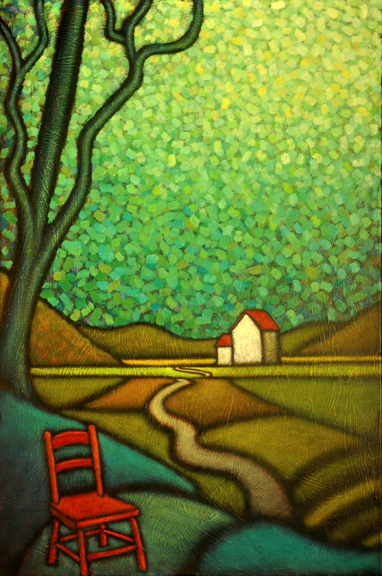
This is a painting, a 24 ” by 36″ canvas,  that I thought was completed a few months back.  I say thought because I felt at that time that it was exactly where I thought it should be.  But there was something about it that kept me from putting it up on this site over the time since.  I kept looking at it and had very conflicting emotions about it.  On one hand, it stood up on its own and had its own momentum and fullness.  It seemed okay.  But on the other hand, there were parts of the painting that seemed a bit too dark and became distracting because there was a flatness in the darkness of the color.  It just created  a nagging doubt in my mind.

Finally, I knew I had to address those doubts and grudgingly put it back on the easel.  I inserted a lot more lightness into this piece,  focusing mainly on the lower third of the painting.  The blue of the foreground really pops now and the lowest blocks of green in the fields of the foreground emerge from darkness.  The changes created a greater sense of depth in the piece which really opens up the whole painting, bringing more  clarity to it.

Time allowed me to see something different in this painting, something beyond my intitial response to the color and composition.  It may have been complete before but now it feels as though that fullness is more visible for all to see.   Now there isn’t a doubt captured in a  darkness that makes me take my focus from what the painting is trying to say.  This lightness and clarity allows the painting to fully convey itself now.  And I think that makes this a better piece.

Read Full Post »

I’ve spent the last hour or so just trying to take in the events of the last day.  There are all sorts of conflicting emotions.  I feel somewhat embarassed to feel elation at the killing of anything or anyone but I can’t help but feel somewhat satisfied, even joyful,  in Bin Laden’s death.  Seeing the spontaneous reaction of the nation has been remarkable.   The singing of the national anthem by crowds in the street outside the White House.  The crowds cheering and chanting at the Mets/Phils game.  Images like the one above from NY Times photographer Michael Poppleton of NY firefighter gathered in Times Square.

I’m hoping that we are now somehow exorcised of the demons from September 11 and that new and better chapters lay ahead for us.  I’m eager to see how we move on from here.

Read Full Post »

Ghost Deer

I was taking advantage of the clear and warm day yesterday, finally daring to take the plow off of my tractor in my garage.  As I finished I stepped out into the sunlight and looked to my right, up towards the edge of the woods about 50 feet away.  I was startled by sight of a strikingly white creature standing in my sightline.  It was a small white deer along with a normally brown colored white tailed deer.  It practically glowed in the sunshine, contrasting sharply with the dark background of the forest.  The two of them bounded a short ways into the woods and turned to watch me.  I put out a scoop of corn and went inside the studio.  They immediately came back and I was able to capture a few photos before they strolled away. 

I had seen a white deer once before, many years ago as my mother and I were blackberry picking on the hill behind our house.  That had been an albino with pinkish eyes.  This guy (although it’s more likely a gal) is not an albino.  It has the normally brown eyes of  the normal deer.  It only lack pigmentation in its hair.

White deer are not completely unusual to this area.  There is a famous herd of them at the Seneca Army Depot  which is probably 30 miles to the north of us.  When the Depot was built in 1941, an area of about 18000 acres was fenced off and a small herd of deer was trapped within the confines.  One or two of the deer in that herd had a mutation that displayed the lack of pigmentation and in the protected environment it was allowed to continue and grow within the herd.  There are estimates that the herd of white deer there is around 250-300 in number.   A small group of white deer has appeared near my home in the town of Horseheads as well, probably the result of a few deer that have their way out of the fenced area of that now retired Army Depot.  I’m sure my gal here  is somehow related as well.

The Native American tribes called the white deer the Ghost Deer and maintained a belief in a prophesy that  a White buck and doe  seen together would signal a time when all people should come together.  I’m hoping my white gal will bring back a white buck. 

For more info on the Seneca Depot herd, go to the Seneca White Deer site.

Read Full Post »

« Newer Posts