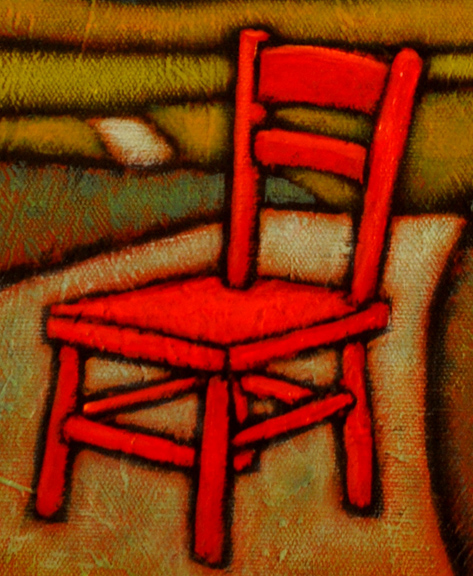
 At last week’s gallery talk at the West End Gallery, I was asked what meaning the Red Chair that is a part of some of my paintings held. It’s a question that I get often but is one for which I have no pat answer. I described how it came to be in my work and how it had evolved in meaning to what I now see it as now.
I have come to view it as a symbol or icon for the memory, both personally and collectively. By personal, I mean memory that is distinct to each of us, moments and perspectives that only we hold. For instance, if I personified the Red Chair as being the memory of my deceased mother, it would be based on my personal recollections of her. My brother or sister’s memories might be quite different and perhaps might even be contradictory to the point that this Red Chair wouldn’t strike the same emotional chord with her.
The collective memory that I spoke of and tried to explain with little success at the talk is based on a cultural accumulation of memory, an icon for those group memories of events that have affected masses of us, directly and indirectly. For example, as we approach the tenth anniversary of 9/11, there is a collective memory for that day. We all have personal memory of our reactions but there is a unified memory that holds for the event as well, a sort of collected emotion that could be represented in an icon. What that icon would be, I have no idea at this point as I’m just writing off the cuff. I’m sure there is one, one item or image, that captures that memory of the event for a wide swath of us. I will have to think about that.
It’s this collective memory that I often see in the Red Chair. Our collective memory of our past. Our experiences in war, both here and abroad. Our struggles as a growing nation with issues of race and social injustice and our westward expansion. Our saddest days and our days of triumph and joy. In short, all those thing that make up our cultural identity and define us as a people.
It doesn’t stop with a national identity. It also applies to the collective memory of us globally, to those events that bind us together as a species, to the memory of ur common bonds and ancestries. When I see the Red Chair now I see our entire past captured in the bare bones of it.
Our past is the seat on which we sit.
Maybe that still doesn’t capture the whole idea but, hey, I’m just thinking here. I think I have more thinking to do.
 Redtree Times