Feeds:
Posts
Comments

Archive for August, 2011

Altarpiece

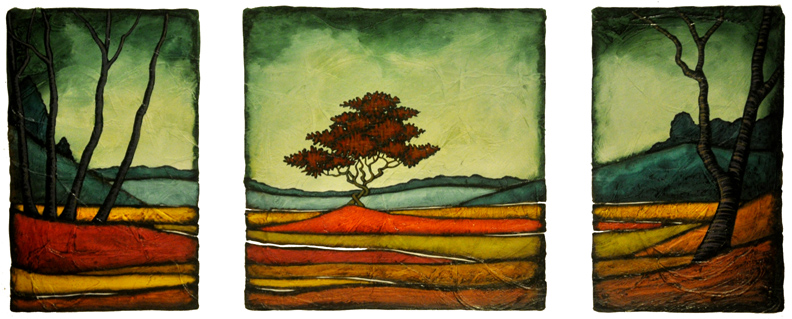
Here’s a new piece I finished this past week, a 13″ by 33″ tryptych on paper.  It will be framed in a 20″ by 40″ frame so it will have some size giving it visual impact on the wall.

From the very start, the colors that were coming out as I built the foreground were deep and saturated.  Each section had dark edges and a brightness in the center that gave it the appearance of having light streaming through it as though it were stained glass.  In fact, as it grew it looked more and more like the stained glass one might find in a cathedral.  I’m not sure the effect will come through in the photography or on the computer screen but in the studio it has that sort of color quality.

It was this feel that prompted the title Altarpiece.  I see the landscape as forming a natural altar, perhaps a marriage altar with the two trees at the center intertwined. Or perhaps the intertwined trees represent the natural world’s connection with the spiritual world.  I don’t know.

 I think there is a sense here of spiritual quiet that you might associate with the the calm silence of a large church, a stillness that prompts reflection and reverence.  I am not a religious man in any sense of the word but I am drawn to religious sanctuaries for that feeling that comes from them, one that I find much like that feeling I experience in the quiet of the forest or in a wide and open field.  It focuses one’s own stillness and clears away the chaff created by normal worry.  Which is my hope for this piece.
 

Read Full Post »

Mind the Pedestrian

I received a comment recently and clicked on the website from which it originated to be pleasantly surprised.  It was from a site called Sheaff: Ephemera and is a fantastic collection of paper ephemera from the past.  It’s a huge collection of interesting advertising and printing and other things.  Bronzed shoes and coal carvings, for example.  Or a great assemblage of photos of people holding the fish they have caught.  There is a treasure trove of imagery for those who love the printed image and the beautiful colors and artistry often employed by printers of the past.  Well worth a visit when you have some time to browse the large group Mr. Sheaff has collected.

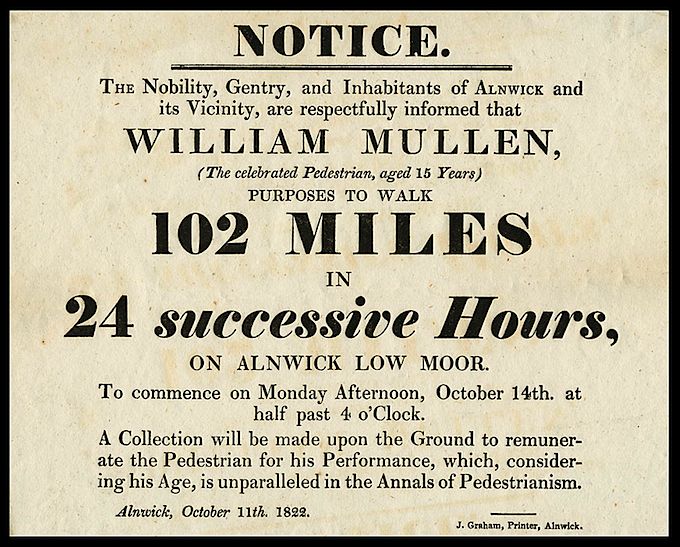
One of my favorites that I first came across was the notice shown above from 1822  for William Mullen (the celebrated 15 year old pedestrian!) and his attempt to walk 102 miles in 24 hours, an event unparalleled in the Annals of Pedestrianism.  I haven’t had a chance to check out the records for pedestrianism so I can’t tell you much about Mullen and this attempt.  Perhaps he was the Babe Ruth of  pedestrianism and somewhere, probably around Alnwick Low Moor, his name is still uttered with deep reverence.

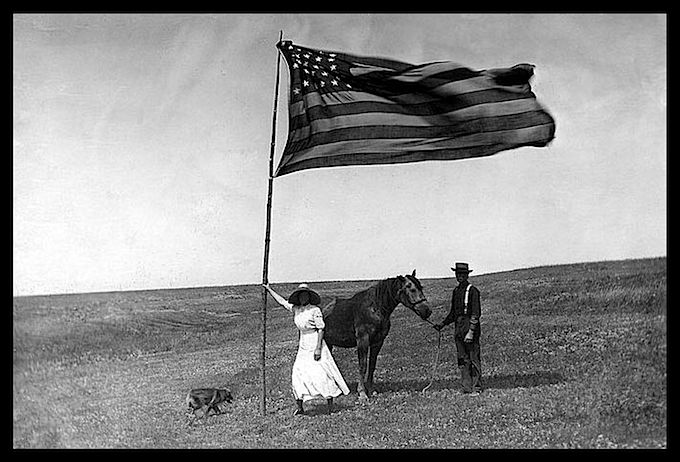
The photo below is also from this site and really brings home how the world has changed in the 99 years since this photo was taken somewhere on the plains of America.  I find this a really striking image.


Read Full Post »

I Love Lucy

Today would have been comedienne Lucille Ball’s 100th birthday.  It’s said that she can be seen on television somewhere around the world any moment of the day, most likely in her classic series I Love Lucy.

Growing up in the 60’s, it was not a personal favorite of mine.  It seemed very old compared to the sitcoms of the day with its very 1950’s settings , hairdos and clothing.  The credits seemed dark and the theme music didn’t have the goofy jingle quality of the 1960’s sitcoms that I watched at the time.   But that was the perception of a child.  Over the years these ideas have faded away and the show  began to shine for me as the classic it always has been.

I Love Lucy became the template that most sitcoms tried to emulate and most ended being mere shadows of Lucy.  The show had everything– a deep and talented cast, great writers, and great production values.

And Lucy.

The more I watch this show, the more I appreciate the immense talents  of Lucille Ball.  Her comedic timing is perfect and her naturalness on camera pulls you in.  In lesser hands, her title character could have appeared irritating and might have turned off her audience but Lucille Ball made them love her flaws and identify with the way she often found herself  finding improbable trouble.

Her physical comedy was remarkable.  She was trained as a dancer and you could see it most shows as she moved gracefully through the sets and danced with husband Ricky.  But when she danced for comedic effect, it was pure brilliance and a testimony to her  to her talents as a dancer.  I still outright laugh at some of the dancing  bits even though I’ve seen them over and over. 

I often think of her when I head out to Erie, PA and pass through the area where she was born and raised around Jamestown in western New York.  It’s an area that is surrounded by a rural emptiness that most people don’t associate with New York and I can imagine how a young and talented girl in the Roaring 20’s might have dreamed of escaping to the bright lights of NYC or Hollywood.  Well, she did but she did return and is buried in Jamestown, not far from the museum there that honors her and Desi Arnaz.

Anyway, here’s to Lucy on her 100th.  May your show forever run.

Here’s her theme song with lyrics sung by Ricky in a n episode.  The actual theme music was an instrumental piece but the lyrics capture the memory of the show well.

Read Full Post »

The Giving Tree

Yesterday I received a copy of the classic children’s book The Giving Tree written by the great Shel Silverstein.  It was sent by a friend who had been at the recent gallery talk at the West End Gallery.  I had been asked during the talk if I had ever read the short tale and I said that while I had heard of it, I had never chanced across it .    I was moved when I found it in my mailbox and even more so after reading the simple story of a  boy and a tree and the loving sacrifices made by the tree.

It’s a lovely story and will have a spot of honor on my studio bookshelf.

I used a Shel Silverstein poem, Smart, a couple of years ago on a Father’s Day post and knew of some of his other books and his song A Boy Named Sue that was a favorite of mine growing up.  But I never knew that he wrote so many other well known songs.  For example, I didn’t know that he had written The Unicorn that is the signature song of the Irish Rovers  or The Cover of the Rolling Stone which became an instant classic for Dr. Hook.  He also wrote a couple of lesser known favorites of mine– 25 Minutes To Go for Johnny Cash and Tequila Sheila for Bobby Bare.  A great talent. 

Silverstein died in 1999.  If you’ haven’t read this lovely story, here’s a short film of Shel Silverstein from 1973 reading The Giving Tree with his animated illustrations.

Read Full Post »

Paris Blues

Wednesday morning in the summer.  Starting some new work, looking forward to trying some new things and psuhing some other things a bit further.  Trying to focus on work and block out the debacle of our current political system, hoping that we somehow emerge from the deep, dark tunnel in which we now find ourselves.  Just writing that sentence gets me agitated.  Who needs that on a quiet August morning?

Seems like a good time to hear a little Django Reinhardt, the late great Gypsy guitarist whose music I’ve featured hear a few times.  There’s something in his distinctive playing that is both sad and happy, with a sort of weariness in even its most joyful passages.  Don’t know if that makes sense .  Guess it doesn’t matter.  His playing simply soothes.

Just give a listen to his Paris Blues and take it easy on this August day wherever you may be.

Read Full Post »

Collective Memory

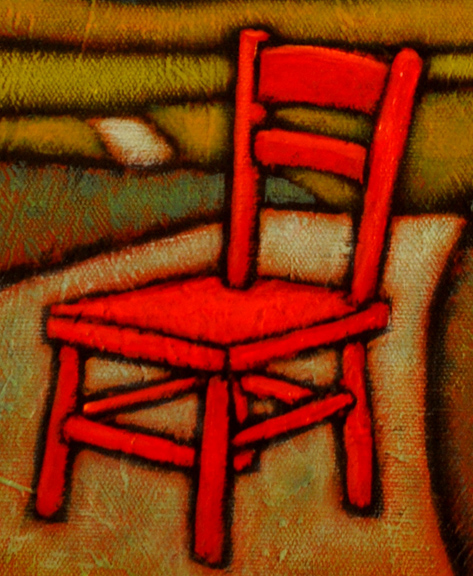
At last week’s gallery talk at the West End Gallery, I was asked what meaning the Red Chair that is a part of some of my paintings held.  It’s a question that I get often but is one for which I have no pat answer.  I described how it came to be in my work and how it had evolved in meaning to what I now see it as now.

I have come to view it as a symbol or icon for the memory, both personally and collectively.  By personal, I mean memory that is distinct to each of us, moments and perspectives that only we hold.  For instance, if I personified the Red Chair as being the memory of my deceased mother, it would be based on my personal recollections of her.  My brother or sister’s memories might be quite different and perhaps might even be contradictory to the point that this Red Chair wouldn’t strike the same emotional chord with her.

The collective memory that I spoke of and tried to explain with little success at the talk is based on a cultural accumulation of memory, an icon for those group memories of events that have affected masses of us, directly and indirectly.  For example, as we approach the tenth anniversary of 9/11, there is a collective memory for that day.  We all have personal memory of our reactions but there is a unified memory that holds for the event as well, a sort of collected emotion that could be represented in an icon.  What that icon would be, I have no idea at this point as I’m just writing off the cuff.  I’m sure there is one, one item or image, that captures that memory of the event for a wide swath of us.  I will have to think about that.

It’s this collective memory that I often see in the Red Chair.  Our collective memory of our past.  Our experiences in war, both here and abroad.  Our struggles as a growing nation with issues of race and social injustice and our westward expansion.  Our saddest days and our days of triumph and joy.  In short, all those thing that make up our cultural identity and define us as a people.

It doesn’t stop with a national identity.  It also applies to the collective memory of us globally, to those events that bind us together as a species, to the memory of ur common bonds and ancestries.  When I see the Red Chair now I see our entire past captured in the bare bones of it. 

 Our past is the seat on which we sit.

Maybe that still doesn’t capture the whole idea but, hey, I’m just thinking here.  I think I have more thinking to do.

Read Full Post »

The Encroachment

This is a new painting that I just finished yesterday.  At least I think I’m finished.  I’ll probably make some touches here and there on this piece simply because there are so mnay different elements, in the form of the many red roofs, that affect the overall feel of it.  A lot going on, in other words.

It’s a 30″ by 30″ canvas  that I’m calling The Encroachment, for what seems an obvious reason.  The Red Tree here is quickly being surrounded and will soon be swallowed by the growing mass of the Red Roofs.  There are many ways you can read this: as a symbol of the way our growing global population has gobbled up available resources.  Or how, though the world seems smaller and more closelyconnected, there is still an  air of alienation by many.  Or maybe it is simply a symbol of nonconformity or  freedom.

Taking it from a different perspective, it could be representing a sort of sermon on the mount with the Red Tree taking on the central role as preacher/messiah.  I hadn’t thought of this perspective until this very moment but I can see how many people might see it this way, especially without seeing the title.

I don’t really know at this point how I ultimately will see it.  I’m still just taking it in, trying to get past that stage where I am still inside it, painting, and can look at it from outside.  We’ll see.

Read Full Post »

« Newer Posts