Feeds:
Posts
Comments

Archive for December, 2011

On my way to deliver some new work to the Kada Gallery in Erie, I was driving across the empty part of western New York yesterday, a couple of hundred miles of very sparse traffic which leaves you lots of time to let thoughts just randomly weave in and out of your mind.  It’s funny, the things that settle at these times.  People you haven’t thought of for many years.  Things that you haven’t done since you were a kid.  Sometimes people and things that have little meaning for you.  Plans and things you want to do in the future.

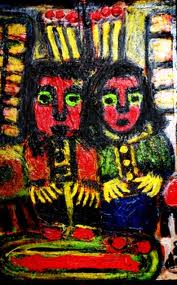
Yesterday, I was thinking about the circus for some unknown reason.  Maybe it was a thought of one of the circus paintings from Pablo Picasso. like the one shown here, or the ones from Seurat that I wrote about here in the past.  There’s something very visually interesting in the circus, with it’s costuming and showmanship.

But more than that it made me think of how I have viewed the circus over the years.  Growing up, the circus and circus style acts were big staple of television in the early 60’s and, I’m sure, the 50’s.  Aerialists, jugglers, clowns of every shape and size, lion tamers and a variety of other animal acts were often part of many variety shows.  I can’t quite remember all the details, but there was even a show that was devoted to circus acts. 

 As a kid, I was enthralled by these acts and performers.  Even my first date with my wife involved going to a circus that was appearing in our local minor league ballpark.  It was one of those things that was sort of engrained in my young psyche.  But over time, the gloss faded from the illusion of the circus for me.  I no longer found the idea of performing animals charming in any way.  In fact,  it bothered me deeply.  It also  became apparent that the  lives of many of the human performers were not easy either.  Their moments in the spotlight in their shiny outfits were short and masked the hours spent in second rate motels and restaurant while crisscrossing the  backroads of this country. 

The illusion was gone for me.

But  still, the idea and ideal of the circus in the mind brings forth strong imagery.  The tension of a daring performance and the anticipation of the crowd.  The aura of the spotlight and how all eyes were focused hard on whatever was going on in that center ring.  It was a great illusion and was part of my childhood memories. 

That was part of my drive yesterday.  Don’t know exactly why.  Maybe someting will appear in my own work.  We’ll see.

Here’s one of my favorite Bruce Springsteen songs, one that fits this post to a tee.  It’s a 1973 performance of his image filled Wild Billy’s Circus Story

Read Full Post »

Color which vibrates just like music, is able to attain what is most general and yet most elusive in nature.

– Paul Gauguin

****************

I came across this line that Gauguin had written in a letter to the poet Andre Fontainas and it made me think about how I often compare painting to music, how I try to find that  rhythm, maybe the vibration to which Gauguin alludes, in my work that has the same effect on the viewer’s unconscious mind as does music.  That thing that would make my work, like music, communicable across all boundaries.  Something that would easily be absorbed as an emotional response without first having to dissect it intellectually, like music that you hearfor the first time and react to without thinking, often finding it still vibrating in your mind for days and weeks afterward.

It’s a grand aspiration and I am never sure if I ever reach that goal.  But I do keep hoping and trying.

I chose the painting above to illustrate this post because I like the simplicity and harmony of it.  Titled Ever, it’s a 15″ by 18 ” piece on paper that is as much an abstraction, with its spare forms and lines,  as it is a depiction of reality.  My hope is that the color and harmony of this piece creates a vibration or rhythm that overcomes the unnaturalness of it, allowing it to makean emotional  contact before the mind finds some intellectual objection.

Again, a grand aspiration.

Reading back over this, I have to say that I don’t sit before my easel or table and ponder these concerns before I start to work.  I often only think about these matters when I come across a line,  like the one above from  Gauguin, that makes me wonder about my own aspirations for my work, what they are and how they compare to the painters of the past whose work I admire.  I guess I am looking for a commonality in our views that connects us somehow, even though our work may not reflect this bond.

Another grand aspiration. 

Read Full Post »

Mr. Eddy

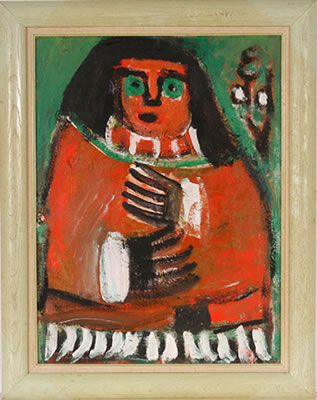
I came across another outsider folk artist whose work really hit with me.  It was from a gentleman by the name of Eddy Mumma who was born in Ohio in 1908 and lived the last part of his life in Gainesville, Florida.  It   Mr. Eddy, as he was known, started painting when he was in his early 60’s and continued in an obsessive fashion until his death at the age of 78 in 1986.  

Having lost both legs to diabetes, his daughter urged him to take some art classes just to get out of the house.  His instructor called his work sloppy.  This both caused him to quit the class and served as the ignition for an obsession that saw him paint hundreds of paintings in his distinctive manner, with heavy layers of paint of mainly figures with round eyes and and five straight fingers on each hand that created a design pattern of their own in his work.  He also painted both sides of his canvasses or boards, sometimes hanging framed pieces with the glassed side to the wall to better show the painting on the back. 

His work was never for sale although he did allow a local artist/teacher, Lennie Kesl, to purchase a number of pieces over the years in exchange for his friendship and assistance in obtaining supplies.  There is a nice recollection of Mr. Eddy from Kesl on the Southern Folk Art site that documents some of Mumma’s idiosyncracies as well as a short bio from Mumma’s daughter.  His work was obtained by a dealer from his family after his death.

There’s something very warm and inviting in the work of Eddy Mumma, something very familiar. In his better pieces, it is bold yet orderly and the repetition of forms that he uses create a running dialogue through his body of work that seems to speak, in a visual manner,  to unspoken parts of the psyches of others.  I often admire the work of obsessives like Mr. Eddy, identifying with that need to experience that  feeling of discovering something in each new piece.  Their work, while appealing to others, is created to satisfy some internal primal need for creation ans expression.  There’s something almost otherworldly in this for me and seeing their work often reinforces that feeling.

I definitely get that from the work of Mr. Eddy.  His work is inspiring to me as any great master and there are things I see in his work that make me want to get right to my brushes. 


Read Full Post »

The Great Smog of ’52

If you watch the TV series Mad Men, you probably know that the London Fog referred to in the name of the famed outerwear company is a myth.  London does not get particularly foggy but it makes a romantic notion for selling raincoats.  However, London has had a different sort of fogginess at different times in its history.

Smog.

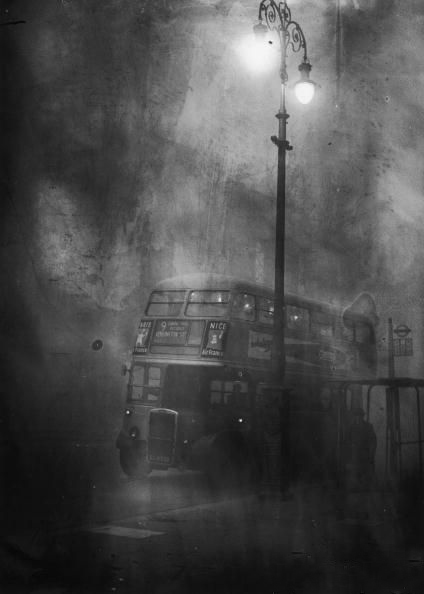
It was on this day, December 4 in 1952, that a heavy smog descended on the city and stayed there for four dark days.  A coinciding series of events led to this.  First, was a hig pressure mass that stalled over the Thames River Valley, bringing windless conditions.  Next was a drop in the temperature which made many of the residents increase their burning of coal to heat their homes.  The particulate pollution from the residential chimneys combined with normal industrial and automotive emissions to form a thick, unmoving fog that blocked out sunlight, eventually bringing all transportation to a halt. 

The worse effect of the Great Smog, as it came to be known, was the human toll.  There are no definitive numbers as to how many people perished in the four day event, which finally came to a halt with a changing weather front that blew away the smog.  Most agree that it was at least 4000 and some suggest that the number is much higher, with some estimates reaching 12,000 victims. 

 Even if it is the lowest of these numbers, I find it astounding that such an event took place a mere 59 years ago.  Even more amazing is that even though measures were taken by the government to lower factory emission and to deter residents from burning coal, a similar, but smaller, event took place ten years later which killed over 100 people in London. 

It brings to mind memories of riding in the family car around Cleveland in the 1960’s when it was still in its industrial heyday.  The factories that crowded the shores of Lake Erie spewed huge plumes of  dark brown mist that gave the sky a sepia soupiness and the smell was sulphury and intense.  Eventually, it would come to light that these factories and others were responsible for the acid rain that defoliated large chunks of the Adirondacks.  Thankfully, regulation took place and driving through Cleveland today is a much different affair with clear skies and views of the lake. 

Take from this what you will.

Read Full Post »

A couple of things stuck out recently for me when following the mass media.  On The Daily Show,  comedy writer Merrill Markoe appeared this week and during her interview made the statement that there are now so many socially acceptable ways to exhibit a pathological lack of empathy.  I knew this  already but it was so succinctly put that it stuck in my mind, especially when listening to the GOP candidates such as Herman Cain and Newt Gingrich basically attack the poor in recent appearances, blaming the poor’s own lack of initiative for their condition. 

 I do not disagree there are ways for some to dig out from the depths of poverty.  But for some it is a pit that can’t be escaped.  I often think of a man I worked with for a number of years at the Perkin’s Restaurant where I worked when I first started painting.  He was a few years older than me which put him around forty years old at the time.  He worked as a dishwasher and busboy making around six dollars an hour.  I can’t remember what the minimum wage was at the time since I was a waiter and was only paid $2.35 per hour.  This fellow’s wife was ill with some sort of chronic disease and it was constant struggle to stay afloat without assistance for their medical bills.  To me, he remains the face of the working poor.

Now this man had no escape routes in his life.  He had little education and it was painfully obvious.  His prospects for doing a lot better than his current position were slim, at best.  The jobs that once might have paid more in the factories and plants of our area were gone and probably weren’t coming back anytime soon.  He couldn’t leave.  He didn’t know where to go and if he did, he couldn’t afford to move what little he did have.   He made a few extra dollars helping a friend pick junk but he was unfortunately near the top of his potential.  This was a man who worked hard and did the right things, all that he knew,  but still found himself at the very bottom. 

He deserves our empathy.  He deserves a hand extended. 

Instead he and many thousands, maybe many millions, like him are categorized as merely lazy slackers who suck on the public teat.  The hubris dispalyed by these politicians makes me angry.  They anxiously seek to protect the wealthiest among us whose fortunes have been made possible by the blood and sweat of people like this dishwasher, who have been both the primary workers and customers for their businesses.  Yet do they feel a tinge of empathy for anyone other than the so-called job-creators?

I don’t think so.  At least, it’s not something they dare to exhibit in public.

Maybe I’m wrong in talking about such things here.  Maybe this verges on political statement.  I don’t care.  Too many of us have remained silent and on the sidelines or have started to buy into that Ayn Rand-ish tenet that selfishness is a virtue that these people spout at every turn.  Maybe someone will not like what I say here and suddenly find my work not to their liking. 

So be it.  I have to believe that people who find something in my work  also have high capacities for empathy towards others.  Those are the people for whom I want to paint.  People who believe there’s a better world a-coming, as Woody Guthrie sang in his song many years ago.  When I see how forcefully he stood up for his beliefs and the rights of others, I am ashamed at how little I have done myself.  Here’s his song:


Read Full Post »

This is a new painting called Path to Clarity, that made its way to the Principle Gallery in Alexandria yesterday.  It’s a 6″ square piece on paper and has a clarity in its color and tone that evoked the title for me.  I was looking at this piece and thought of an item that I came across lately, a test of the flexibility of the mind.  I’m sure this has been around for quite some time, probably for years in circles that cover areas of  psychological/cognitive testing.  When I first saw iit I thought it was just a foul-up in the code for the page I was reading , a seemingly random series of numbers and letters.  But seeing below that I was supposed to read it, I focused a bit and it came very easily.

Here’s the message:

7H15 M3554G3 53RV35 7O PR0V3 H0W 0UR M1ND5 C4N D0 4M4Z1NG 7H1NG5! 1MPR3551V3 7H1NG5! 1N 7H3 B3G1NN1NG 17 WA5 H4RD BU7 N0W, 0N 7H15 LIN3 Y0UR M1ND 1S R34D1NG 17 4U70M471C4LLY W17H 0U7 3V3N 7H1NK1NG 4B0U7 17, B3 PROUD! 0NLY C3R741N P30PL3 C4N R3AD 7H15. PL3453 F0RW4RD 1F U C4N R34D 7H15.

Translated:

This message serves to prove how our minds can do amazing things! Impressive things! In the beginning it was hard but now, on this line your mind is reading automatically without even thinking about it. Be proud! Only certain people can read this. Please forward if you can read this.

I don’t know if there is anything to be gained from this exercise for the general public,but  it made me think about painting and art and how it communicates in very much the same way as this exercise, giving bits of data and filling the blanks with new information that translates in the mind of the viewer.  I looked at this painting and it very much made sense in this context.  I’m sure most people can look at this piece and immediately know what it represents.  Their mind takes in the info and it makes sense and translates very easily.  Their mind probably doesn’t question the white emptiness of the path, the blues of the hills or the orange and reds of the field.  Their mind reads it as one might read the passage above.

What does this mean?  That I really can’t tell except that it only serves as a form of validation of this work’s power as form of communication  rather than something created for mere aesthetics.  Not that aesthetics don’t come into play.   Harmony of color and form play a large part in making the message more palatable.

Anyway, just thought it was interesting.  I guess that’s good enough.

Read Full Post »

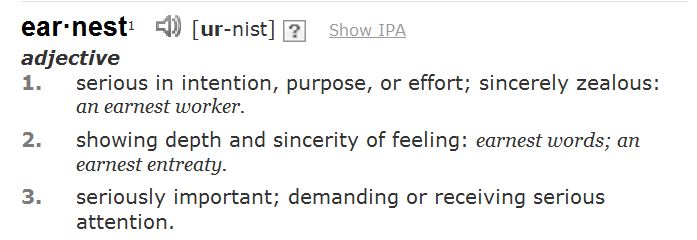
I was recently contacted by someone who had found my work online and had been following it for a while now.  They commented that they liked the honesty in my work and noted that I seemed like an earnest person and painter.  I was kind of taken aback by the word earnest.  I mean, I thought I knew what it meant but I had never been called earnest and was not sure if it was indeed the compliment intended.  But upon checking an online dictionary and discovering that there was no hidden meaning, nothing derisive, I decided that it was indeed a compliment. 

I should be proud to be called earnest.

But this also made me think about how we are perceived by others.  I somewhat know how my work is perceived, online and in the galleries. At least, I think I do.   But personally, do I truly know how I am perceived as an individual?  Do we ever know?  We may know what people feel comfortable in saying about  us to our faces but do we ever get the full view, especially from those who might not see us in a favorable light?

Is the person in the mirror that we see the same person that the outer world sees?

I suppose the answer should be that it doesn’t matter, that we should simply live in a way where we can look in the mirror without guilt or remorse for our actions.  If we can do that, what the outer thinks is moot.

So, I proudly carry the word earnest with me now, as a doctor might wear his PhD. 

Signed– GC Myers, Earnest Painter.

Read Full Post »

« Newer Posts