Feeds:
Posts
Comments

Archive for April, 2012

Archaeology is the peeping Tom of the sciences. It is the sandbox of men who care not where they are going; they merely want to know where everyone else has been.

Jim Bishop
 
*************************************************************
 
   Maybe I fit into the quote above from the  late journalist Jim Bishop and maybe that’s why the idea of incorporating archaeology into my work, as I have done with my Archaeology series over the last few years, has been so appealing to me.  The idea of diverting our eyes from where we are headed to instead see where we have been, to examine those things which have shaped us as we stand now, is indeed intriguing to me.  We are the products of our past and where we are headed is often determined in the how and the why of the past.  Unfortunately, and to our detriment I fear, we often fail to look back and, as a result, are continually reliving  pasts that could and should  have been avoided.
 
This thought is definitely behind the title of this new piece, Archaeology: Formed in the Past, a 10″ by 16″ painting on paper.  I see the central Red Tree here as being formed and twisted by the artifacts below the surface, remnants of the past.  The trees in line behind stand  like stoic witnesses to this history.  The artifacts contain tools and toys, books and bottles, shoes and other items of the everyday– the things that make up a life and a world.  There is also evidence of the creative side of life here– a painting, paint brush, a drama mask, a ukulele and an artist’s mannequin. 
 
It’s always interesting to look at these pieces after finishing them and to see how they come together to offer up some sort of narrative in the collection of artifacts.  Interesting because I don’t really think about how the items will interact as I am painting.  No forethought at all really.   They’re just painted in rhythm as they come to mind, often just because a shape or form fits at the moment.  So when I see the commonality of thought and narrative  running through them, I wonder what the source might be. 
 
Is it just a reflection of my own psyche and interests? 
 
Perhaps.  Probably.  But even so, there’s something somehow compelling in sifting through the debris, even the debris of one person’s mind.

Read Full Post »

Many of us are familiar with the work of Stuart Davis (1892- 1964), the American Modernist whose paintings presaged the Pop Art of the 60’s.  They were bold and colorful abstracted collages that use imagery from the landscape of the popular culture at the time they were created, creating works that immediately evoke a time.  When I see them I a transported to the New York or Paris of the 40’s and 50’s, with Jazz and poetry blossoming in the aftermath of a devastating war that really changed our perceptions of the world.

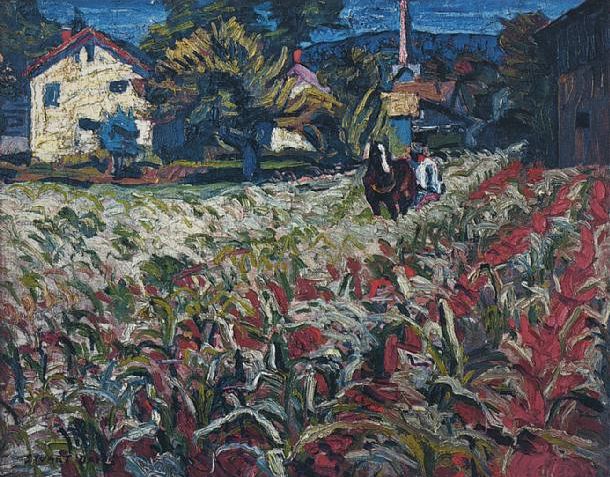
But it is Davis’ early work that always intrigues, particularly a small group that was painted not to far from where I live.  There are three landscapes painted just over the state line  in rural Tioga, Pennsylvania in 1919 that are very different from the work for which Davis is best known.  They show a young artist still working in the style of those artists who inspired him, trying on their style and brushstrokes in an effort to find his own voice. 

You can see how  he had been affected by seeing the work of Van Gogh and Picasso for the first time at the legendary Armory Show in 1913, where his own work hung among the emerging giants of modern painting.  Davis was then a student of Robert Henri and painted in a style associated with the  NYC Ashcan school of painters , of which Henri was a leader.  These three pieces have thick. expressive stokes of paint and scream of Van Gogh and have few hints at where Davis’ road would eventually lead him.

The pieces are very accomplished and have a certain charm but it is obvious that they are still derivative and that Davis is still in the midst of his evolution from talented mimic to an original voice.  To me, they are an interesting insight to how we synthesize our broad spectrum of  influences into something truly original.  I would be hard-pressed to say that the man who painted these pieces would eventually become a leading light of abstract modernism but they somehow moved him along in his search for his own distinct voice.  It only goes to show that we should take in everything that excites us even if it seems out of our normal area of comfort.  It may open new and exciting worlds to us that we could never foresee.

Stuart Davis--Self Portrait 1919


Read Full Post »

I’d Find a Way

“Patience and perseverance have a magical effect before which difficulties disappear and obstacles vanish.”

-John Quincy Adams

^^^^^^^^^^^^^^^


I don’t what made this pop into my head but I was thinking about a conversation from a few years back that I had with a friend who is also a painter. He has been an artist for almost his entire adult life, pretty successful for much of that time. We both agree that we are extremely fortunate to have found the careers that we have, one that feels like a destination rather than a passageway to some other calling.

For me, I knew this was the career for me when I realized I no longer looked at the job listings in the classified section of the paper. For most of my life, I felt there was something else out there that would satisfy me but I didn’t know what it was or how to find it. Maybe it was as simple as finding the right job. Or so I thought. When you don’t know where you’re going, any direction might be the right direction.

But during this particular conversation this friend asked, “What would you do if you suddenly couldn’t paint? What if you were suddenly blind?”

For him, it was unthinkable. His life of creation was totally visual, based on expressing every emotion in paint.

I thought about it for a second and said simply, “I’d do something else. I’d find a way.”

In that split-second I realized that while I loved painting and relished the idea that I could communicate completely in paint, painting was a mere device for self-expression. But it was not the only way to go. I knew then as I know now that the deprivation of something that has come to mean so much to me would, in itself, create a new need for expression that would somehow be satisfied. I have always marveled at the people who, when paralyzed or have lost use of their arms, paint with their toes or their mouth . Their drive to communicate overcame their obstacles. Mine would as well.

If blinded, I could or do something with words, using them to create color and texture. Perhaps not at the same level as my painting but it might grow into something different given the circumstance. The need to communicate whatever I needed to communicate would create a pathway.

It was an epiphany in that moment. Just knowing that I had found painting gave me the belief that I could and would find a new form of expression if needed. And i found that greatly comforting.

Yes, I’d find a way…

Note:  The above was originally ran here in April of 2009


Read Full Post »

« Newer Posts