 I don’t know where to start with the work of Brazilian photographer Sebastiao Salgado. He is widely celebrated for the importance of his work but I was unaware of him until I stumbled across this image from the cover of his most recent and most ambitious book, Genesis. The image of a mountain river valley with a light filled flash of storm filling its upper end fit so perfectly with the title, the stark black and white giving the whole scene a most biblical feel, as though you were witnessing the primal birth of man. The image just filled me with awe and I couldn’t get it out of my head.
I began to look a bit more into the work of Salgado, born in 1944. It is astonishing in many ways. He has over the years documented some of the great brutalities of our time, photographing the plight of refugees, famine victims, migrant communities and manual laborers throughout the world. It is work that is not easy to look on at times. In fact, after one of his books, Exodus, which was about those fleeing genocide, Salgado’s faith was shattered by the horrors which he had witnessed.
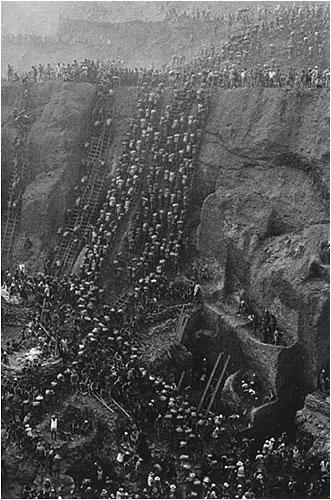
Goldmine, Serra Pelada, Brazil 1986– Sebastiao Salgado
It was this despair that drove him the Genesis project, an eight year odyssey that took him to the furthest corners of the world. His goal is to have us reconnect with the power and intelligence of the natural world, uniting a world that is divided by crises of greed and need.
Though much of his work in Genesis, where he is seeking to show the magnificence of the natural Earth, is downright beautiful, I struggle to call much of his work that same word– beautiful. It is more than that. It is powerful and daunting, not merely pretty pictures. It pushes at you, tests your willingness to witness the rawness of ourselves. It raises so many questions about who we are and what we are doing in this world.
Awe inspiring…
There is so much more that can be said about Mr. Salgado’s life work. I urge you to do some research on your own and suggest you do a Google Images search of his work to get a real sense of the scope of his work. You can do that by clicking here.
 Redtree Times
Once again you’ve introduced me to someone I’d not heard of. Looking at that photo of the miners, “powerful and daunting” seem appropriate. My first thought was of swarming insects. Of course that’s precisely how some see “colonies of workers”, as essentially meaningless and easily replaceable parts in a system.
I’ve always been one to turn away from “scary movies”, and the impulse to do the same with disturbing art is there. Thanks not only for the introduction to Salgado, but also for the reminder that just because we don’t want to look at something, doesn’t mean we shouldn’t.
I, too, often turn away from the disturbing, especially when it seems produced simply for shock value. But this transcends shock. It’s like looking in a mirror– you may not like what you see but it is who you are.
Glad you chose to look.
On Tue, Feb 11, 2014 at 8:34 AM, Redtree Times wrote:
>
One thing about photography, it forces the viewer to acknowledge that its subject matter is real. It is only one small remove from what the photographers saw with their own eyes. You accept as read that paintings are composed, and their subject matter was assembled, edited and manipulated by the artist for whatever purpose. While it is true that a photograph can be edited, cropped, and manipulated by computer, it is still, essentially, a real-time image of a real-world thing, It is that reality that gives a photograph its power to touch us in ways that a painting cannot. When you look into a photograph of a face, you know it for what it is. You recognize it as a real face. You instinctively read and react to that face, those eyes, in the same way you read and react to the faces and eyes of the people in your life. Even when intellectually, you know that the subject has been airbrushed to eliminate “imperfections,” you still react to its reality at a gut level — and America has the epidemic of anorexia, bulemia and suicide in teen-aged girls to prove it. You react to a photograph with an instinctive, “I am looking at something real, something I could possibly have seen for myself, something the photographer saw and reacted to in the same way I am, and who felt the need to capture and preserve that image.” Photographs have the ability to capture, document, and preserve a moment in time. In the hands of a skillful photographer who understands the medium, photographs can have a mind-changing, world-changing impact.
Really well put. Thank you.
On Tue, Feb 11, 2014 at 11:28 PM, Redtree Times wrote:
>
I just finished watching a TED Talk that Salgado gave last year. Check it out.