Feeds:
Posts
Comments

Archive for April, 2015

Ad Marginem C 1930 Painting by Paul Klee; Ad Marginem C 1930 Art Print for salePaul Klee On Modern Art 1924This excerpt from On Modern Art, the 1924 treatise from the great Swiss artist Paul Klee is a bit more than a quote but since this is about art we’ll be a little flexible in our definition.  And that, I believe, would please Klee, whose works often defied definition.

I know for me, he was a big influence if only in his attitude and the distinctness of his work.  I always think of his work in terms of the color– sometimes muted yet intense and always having a melodic harmony to it.

It always feels like music to me.

I like his idea that the world is in the process of creation, of Genesis, and that it is not a final form. It allows for visionary work, for imagining other present worlds that extend beyond our perception because, as he writes, “In its present shape it is not the only possible world.

And to me, that is an exciting proposition.

Read Full Post »

GC Myers From Out of the Blue smIn yesterday’s blogpost, I talked a bit about the influence that stained glass had on my work.  Deep color, the luminosity  and lines defining the forms within are all attributes that have found their way into my work.  It was never a conscious decision, one where I said to myself that I was going to try to emulate the look and effect of stained glass.  It was just one of those things that I took in and integrated into my personal aesthetic. Just something I liked to look at.  And that somehow synthesized into the work.

In fact, I wasn’t even aware of the similarity until a few years into my career when several people pointed it out to me, asking if stained glass was a big influence.  I think I always answered yes to the question.  I mean, I liked it a lot so it had to have been an influence on some basic level.

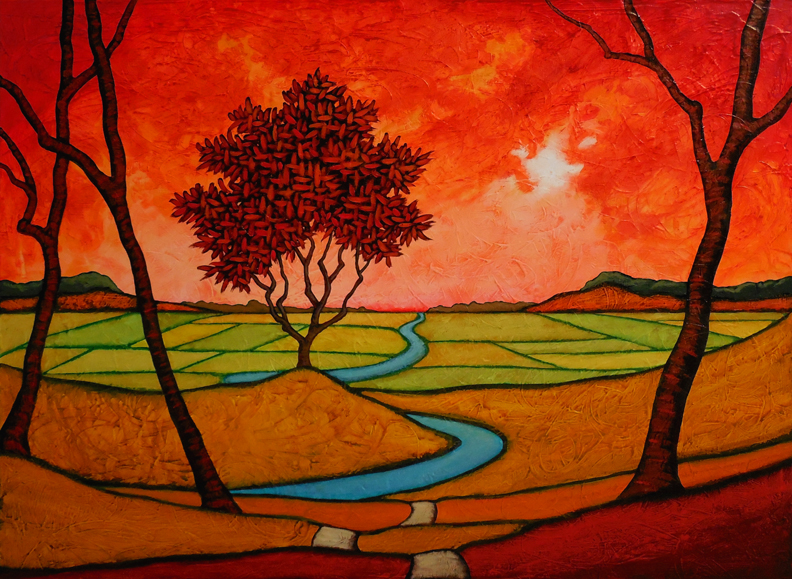
Looking around the studio at the group of new work that is growing for my upcoming June show, Native Voice,  at the Principle Gallery, there are a number of paintings that you can easily see the influence of stained glass.  The piece shown above, From Out of the Blue, really has that feel for me, with the geometry of its puzzle-like pieces in the foreground and the brightness of its sky.  I see that sky in glass as hundreds of small, sharp shards of varying sizes and colors, all radiating outward.

But maybe it being a painting and not stained glass is the attraction for me.  Each medium has its limitations and being able to borrow attributes from one medium and integrate them into the vocabulary and process of another is exciting in itself.  It is painting’s spontaneity that draws me to it, where instinctual moves can be made within moments that change the whole piece.  I don’t know that I could get that with glass and could easily see a piece like From Out of the Blue becoming a contrivance in stained glass.  Too thought out.  Too worked over.  Too clean.

Definitely not from out of the blue— which is how I like it.


Read Full Post »

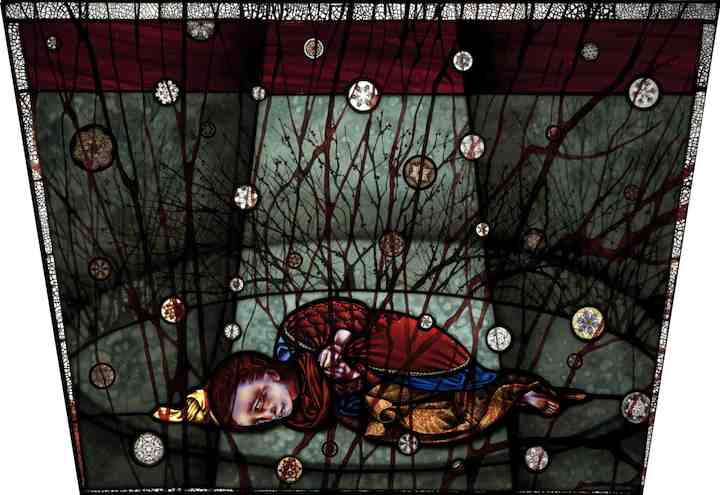
Judith Schaechter- Cold Genius CMOG

Judith Schaechter- Cold Genius CMOG

I’ve been thinking a lot about stained glass lately, both as the influence it has been on my work and as a possible future foray.  Growing up around Corning, glass was always in high visibility and trying to capture some of the luminosity of glass was always a goal in my work.  My fondness for the use of defining lines in my paintings most likely stems from a deep affection for stained glass.

When the new (and spectacular!) Contemporary Art + Design Wing opened recently at the Corning Museum of Glass, among all of the epic glass works it was a more modest sized piece of stained glass tucked away to one side that most caught my eye.  It was from Philadelphia-based stained glass artist Judith Schaechter and it was titled Cold Genius.  The photo of it at the top does not do it justice, doesn’t capture the inner glow created by the integrated lightbox.  Believe me when I say it is a striking piece of art.

Judith Schaechter -Wreck of the Isabella 2005

Judith Schaechter -Wreck of the Isabella 2005

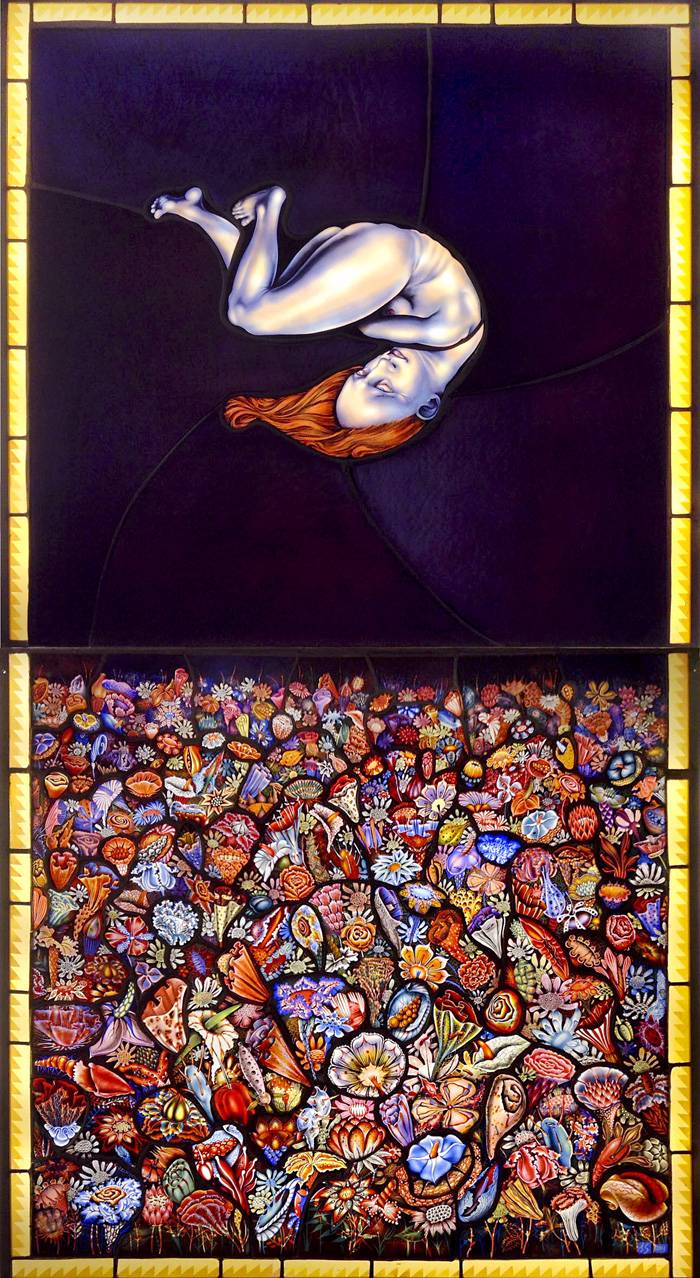
I knew nothing of the work of Judith Schaechter beforehand but this image just triggered something.  Looking her up and  finding her work on her website as well a number of others, I discovered that she was one of the pioneers in modern stained glass, having been at the forefront of the medium for over 30 years.  I was overwhelmed by her productivity, her creativity and innovation as well as the consistency of her vision. As I’ve shown here before, one of my ways of quickly taking in an artist’s personal style is in viewing a page of their work on Google.  As you can see at the bottom, Schaechter’s work has a completeness of voice that any artist would envy.

While it is often macabre in nature, it is always beautiful having a transcendent quality that glows from within.  It feels both contemporary and timeless, which is the goal of any artist.

It was hard to not be in awe and easy to be inspired, to see things in her work that fed my own desire for expression, that set off pangs of wanting to make an attempt in that medium.   It’s not a feeling I often experience with many contemporary artists so you can understand my excitement at finding her work.

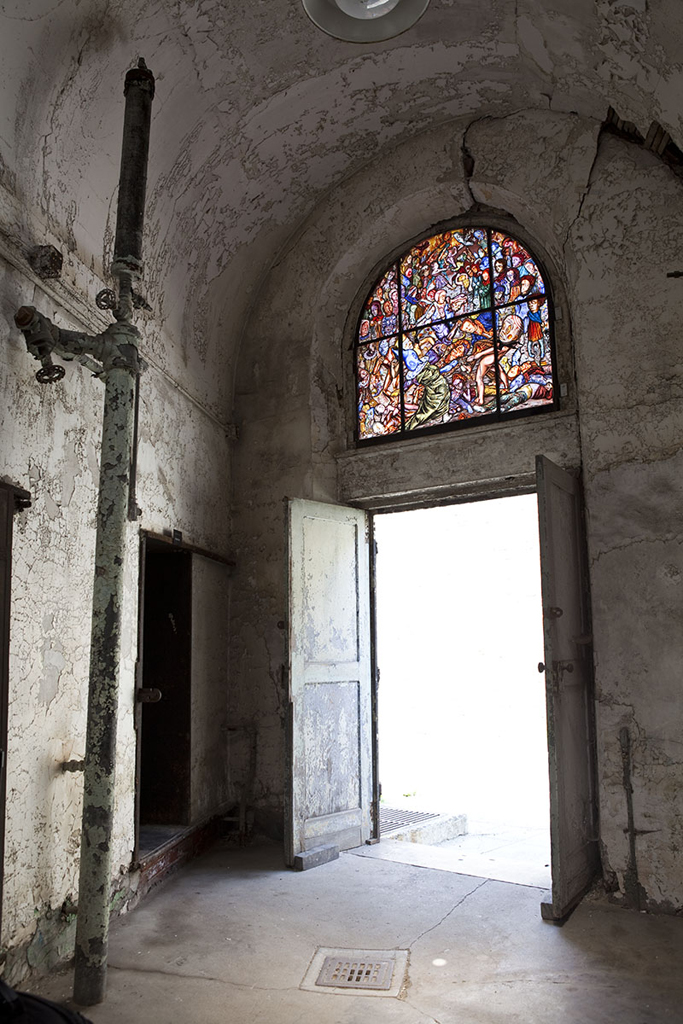
The few images and my short paragraphs here may not fully do her work justice. Check out her work for yourself on her website.  It includes a very interesting project where she installed windows at the infamous Eastern State Penitentiary in Philly.  There’s also a great recent  interview online that is very enlightening– I think many artists will see many things that  jibe with their own experiences.

Judith Schaechter- Google Image Screenshot

Judith Schaechter Eastern State Penitentiary Project

Judith Schaechter Eastern State Penitentiary Project

Judith Schaechter -Battle of Carnival and Lent /Eastern State Pen.

Judith Schaechter -Battle of Carnival and Lent/ Eastern State Pen.

Judith Schaechter Joan_of_Arc 2007

Judith Schaechter Joan_of_Arc 2007

Judith schaechter_23_birthofeve

Read Full Post »

There were some folks at the Gallery Talk the other day who told me that they were either signed up for or were planning to attend the two-day workshop I will be giving in September in the beautiful Finger Lakes.  I was really pleased to hear this and the fact that they were eager for the experience.  I told them I was a bit excited myself as this is the first time I’ve tried my hand at teaching but that I would  give them a real behind-the-scenes look at my process.  I promised that I would make it entertaining and that they will hopefully walk away with new ideas about how they use their materials and look at their own work.

Thinking about that this morning led me to consider what materials would be required for the workshop and the first thing that came to mind was my 1″ squirrel mop, a brush that is always near me when I am at my wet work.  This reminded me of a bog post back in 2009 where I wrote about my brushes and the Good Soldiers they are for me, sacrificing themselves for the good of a painting.  There’s a before and after photo that shows their sacrifice.

Thought I would share that post today:

GC Myers-brushesI was looking at the brush in my hand the other day and I realized how rough I am sometimes on my brushes.  It was a natural bristle brush that was new just a few weeks ago, when it looked like the brush to the far left in the photo.

Over those few weeks, I caressed paint on to canvas.  I also pushed paint into the canvas.  I ground the paint against the canvas, using a lot of force, to almost burnish the surface.  I stroked.  I poked.  And when I looked down the brush had turned into that poor guy shown second from the left.

I can be rough on my brushes.

For my normal wet technique I use a natural hair squirrel mop like the two shown on the right.  It’s a big, soft brush that holds a lot of paint and is a staple in my studio.  The brush on the left is new and the one on the right is obviously not.  This erosion of the bristles shown here represents about 6 or 7 months of use.

Hard use.

I like the way the bristles whittled themselves down to the angle my hand takes when I normally strike the painting surface.  Unfortunately, it has eroded to a point where its capacity to hold paint makes it a hindrance to my technique.  So he is put aside and maybe I will find a use for him at some point, so I keep him with my other spent brushes.  I could never throw such  loyal workers to the trash heap.

I have amassed quite a number of brushes, both well used and brand new, over the years.  I have tiny detail brushes that I go through quickly.  I have  some cheapy brushes that work perfectly well for certain techniques.  I have some of my favorite medium priced brushes that I have stockpiled because they’re no longer made.  I also have some pretty expensive brushes.  I have a set of beautiful Winsor & Newton Series 7  brushes that are handmade with soft, luxurious Kolinsky sable.  I’ve had them for about 13 years and have only used one or two of them for a few minutes.  They’re lovely in the hand but I never felt comfortable with them and just wouldn’t feel right grinding them roughly into the surface.

So they sit and wait for a day when I’m ready to put them in the game.

Maybe today?  Maybe… but probably not.

Read Full Post »

GC Myers-Family Path smYesterday’s Gallery Talk at the Kada Gallery went really well.  Many,many, many thanks to Kathy, Joe and Morgan at the gallery for providing a comfortable setting and the many folks in attendance for taking time out on a rare sunny Saturday afternoon to spend it with me.  They were an absolutely wonderful group –attentive and inquisitive–which made my task much easier, making me feel very welcomed and at ease in front of them.

Hopefully not so much that I over-talked  or came across as too full of myself.  I always worry about things like that on the ride back home, agonizing over things I said or didn’t say.  It comes easy because at that point I am pretty tired of hearing my own voice, tired of pretty much being the public me at that moment.

One thing I forgot to mention which bothered me as I was on my way home was that it was the input that I get from the encouragement and stories shared by the folks that attend these events are such a huge inspiration and the motor that drives my work.  I work untold hours alone in my studio and it is their reaction to the work and the fact that they allow me to glimpse briefly into their lives that make them seem almost present at times in my studio.  Distant eyes looking over my shoulder.

I shared one recent inspirational story that took place very recently right there at the Kada Gallery.  A week or so ago, they received an email inquiry from a lady in Switzerland about a large painting, titled Family Lines with the Red Tree with a Red Chair in its branches.  It turns out that she had recently lost her husband to Alzheimer’s and one of their final exchanges was about that very painting, obviously seeing it in online.  Her husband said that he was the Red Tree and she was the Red Chair.  I have to admit to being made teary-eyed by that.  How can something like not stick with me, not find its way into my thoughts when I am alone in the studio?

That story, like so many others shared with me over the years, brings a sense of purpose to the sometimes abstract and introverted act of painting.  I can never fully thank these people for the gift in their sharing.

991126 Color RisingOne of the ways I do try thank folks at these talks is by having several giveaways, including an original painting.  We had a very good time with it yesterday and the group was so receptive that I thought they deserved another.  I had a painting, Color Rising, from a few years back that won by a young lady in her 90’s which leads me to this week’s Sunday music selection.  The painting, shown left, was a monochromatic piece, shades of back and gray with just a dash of color.  I explained that I do these paintings periodically to just more less refresh my color palette in the period between working on shows and that seeing one of my compositions with the color removed was a bit like hearing a song that you’ve heard a thousand times before done by one person done by somebody else.  The song has the same notes, chords, melody and lyrics but it is somehow different, somehow changed.

That brings me to this musical example, a version of the Beatles‘ song In My Life from 1965‘s Rubber Soul album.  My god, I can’t believe this song is fifty years old!  This version is from the American recordings of Johnny Cash, done in the final months of his life.  His age and ailments changed his delivery and imbued the songs with real heart-felt emotion and purity.  A powerful group of music.  This version of the Beatles’ song is not so different but it has  his own personal meaning which makes it his own.

Again, so many thanks to everyone who came yesterday.  It was my great pleasure to spend the day with you all.  Hope your Sunday is a good one…


Read Full Post »

GC Myers- Warm Welcome sm

GC Myers- Warm Welcome

Just a reminder that I will be in Erie, PA today for a Gallery Talk at the Kada Gallery.  The event starts at 12 noon a and the talk itself begins at 1 PM followed by a Q&A session.  Then come the free drawing for  one of my original paintings as well as a few other assorted  goodies.  Along with the talk and the drawing,  I am showing a new group of work, including the painting shown above, a 30″ by 40″ canvas called Warm Welcome.

Hope you can make it to the Kada Gallery today– I’ll be doing my best to make it a fun and interesting day!  And maybe you can take the painting  shown below home with you for just writing your name on a slip of paper!

Win This Painting Today at the Kada Gallery!

Win This Painting Today at the Kada Gallery!

Read Full Post »

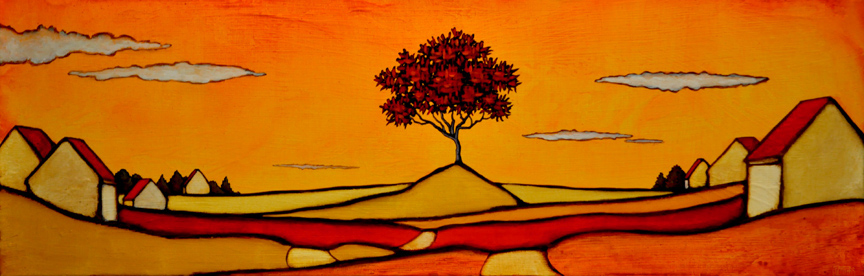
GC Myers- SimplexThe last couple of weeks here I have been mentioning the Gallery Talk at the Kada Gallery in Erie, PA tomorrow, Saturday, April 11.  Events begins at noon with a reception at the gallery with the Talk beginning at 1 PM.  One of the highlights of the day is the drawing which takes place immediately after the talk where one attendee will win one of my paintings.

The painting to be given away is a 10″ by 30″ canvas titled Simplex that is shown above.  As I have pointed out in the past, I try to choose significant pieces to be given away these events and I think this painting fits the bill nicely.  I liked this piece from the moment it emerged and always felt there was a certain understated elegance in it.

The word simplex means having only one component and it fit for me,the painting seeming to be about the idea of  existing in simplicity, focusing on nothing but that very moment of being and the pleasures of that moment : The enjoyment of one’s solitude or  feeling the warmth of of the sun or the coolness of the breeze.  The quiet pleasure in watching the clouds move in the sky.  Simple things and simple moments that, if we recognize them, give our lives greater depth and meaning.

And that’s what I see in my view of this painting.  Hopefully, some lucky person will find similar meaning in it tomorrow.

So, if you are in the Erie area tomorrow please stop in at the Kada Gallery.  The talk looks to be entertaining and there will be some other surprises along with the drawing so I hope to see you there on Saturday.

Read Full Post »

Ralph Fasanella- Bread and Roses

Ralph Fasanella- Bread and Roses

Artistic originality has only its own self to copy.

–Vladimir Nabokov

*******************

Earlier this week a friend sent me a link to a Paris Review interview with the late author Vladimir Nabokov, best known for his novel Lolita.  In response to a question that asked if he was conscious of being repetitive in his work as some critics had claimed, Nabokov said that derivative writers always seemed more versatile because they were free to imitate the writer of both the past and present.  But he added the words above– Artistic originality has only its own self to copy.

That really rang a bell with me.  I have sometimes had people with good intentions give me advice on how I could improve my work by taking on the characteristics of other painters.  I always listen and try to show my appreciation for their recommendations, usually with a smile on my face.  But lately I  politely add that this is what I do and who I am and that that other painter does what they do and is who they are.  I don’t want to be that other painter and I am pretty sure they don’t want to be me.

This vividly reminded me of a blog entry from a few years that  was about the same subject.  Here’s that post:

I came into the studio this morning and immediately sat down to read my emails.  Among them was the most recent post from the Fenimore Museum.s blog titled Ralph’s Take On Rembrandt.  It concerned the late and great American folk artist Ralph Fasanella and his reaction to criticism and unsolicited advice.  I finished reading and burst out laughing.  Boy, did it hit close to home!

Over the years, I have been approached by several people who think they are doing me a great service by telling me that I should change the way I paint in some way or that I should try to paint more like some other artist.  Early on, when I was first exhibiting my work, I had another more established artist tell me that I should change the way I paint my figures, that they should look the way other artists paint them.  I responded to this artist and the others who offered me their advice with a smile and an “I’ll look into that.”  But  that one time,  I also mistakenly heeded the older painter’s words, being inexperienced and seeking a way as I was, and stopped painting figures for a while before realizing that this was not good advice at all. 

Here’s the post about Fasanella and his response to such advice. 

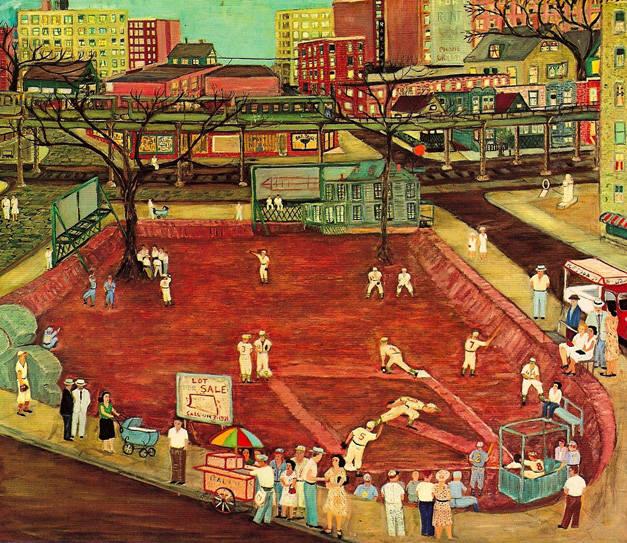
Ralph Fasanella- Sandlot Baseball

Ralph Fasanella- Sandlot Baseball

Ralph Fasanella had trouble painting hands. A lot of trained artists do too, so it is not surprising that a union organizer who turned to drawing suddenly at the age of 40 would struggle with hands early in his career. But he did have something that proved better than years of formal training: he believed that he was an artist and that what he was doing – painting the lives of working people – was a calling that deserved his complete attention and all-consuming passion.

And that made him react when anyone suggested that his paintings weren’t up to snuff. He said that he was painting “felt space,” not real space. His people and the urban settings he placed them in were not realistic in the purest sense of the word, but they sang with spirit and emotion. As Ralph said, “I may paint flat, but I don’t think flat.”

Rembrandt Hands

Rembrandt Hands

His most memorable quote, and the one that says the most about him, occurred very early in his artistic career, when someone told him that his hands looked like sticks. He ought to study Rembrandt’s hands, they said, in order to get it right.

His response is priceless: “Fuck you and Rembrandt! My name is Ralph!”

I may not really adopt Ralph’s approach but you can bet his words will be echoing in my head the next time someone says “You should paint like…”

PS: Maybe Ralph should have had the Quote of the Week, after all.

Read Full Post »

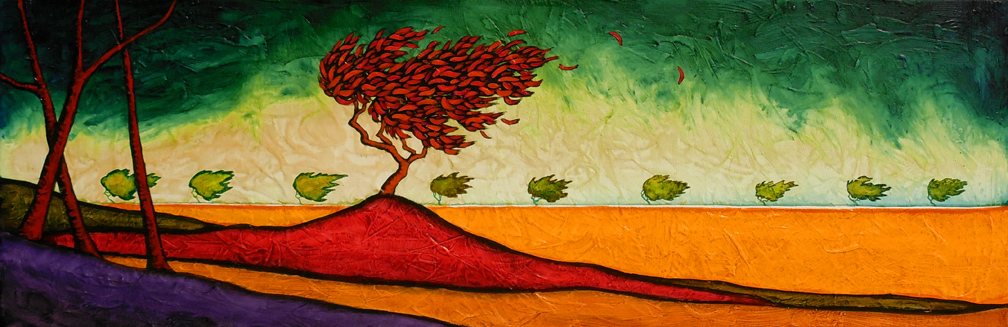
GC Myers- Tides of Change  smIf there is no struggle, there is no progress.

Frederick Douglass

 Narrative of His Life, 1845

***********************************

We humans are an imaginative lot.  When the first light breezes of any sort of change comes rustling through our leaves, our imaginations go into high gear, filling our minds with images of worst possible scenarios.  So we brace ourselves and struggle against the wind as it becomes stronger and stronger.  Some of us topple over and some lose all our leaves as the wind’s intensity continues to grow.

But some of us set aside our fears and adjust to the wind.  We give a bit and relax,  finding a comfortable position to endure the wind and trusting  that our roots will hold us fast.

We adjust and find that we stand as easily in the new day as we did in the days before.

Change is an inevitable force of nature. It is our adjustments to these tides of change that determine whether we fall or stand, fail or prosper.

********************

That’s just one reading for the new painting at the top  which is titled, of course, Tides of Change.  This 12″ by 36″ canvas will be at the Kada Gallery in Erie for the Gallery Talk there that takes place at 1 PM  this Saturday, April 11.  The talk and the drawing  to win one of my paintings is open to all. So if you have a different take on this painting and want to share it, come down to the Kada Gallery on Saturday and we’ll talk.

Read Full Post »

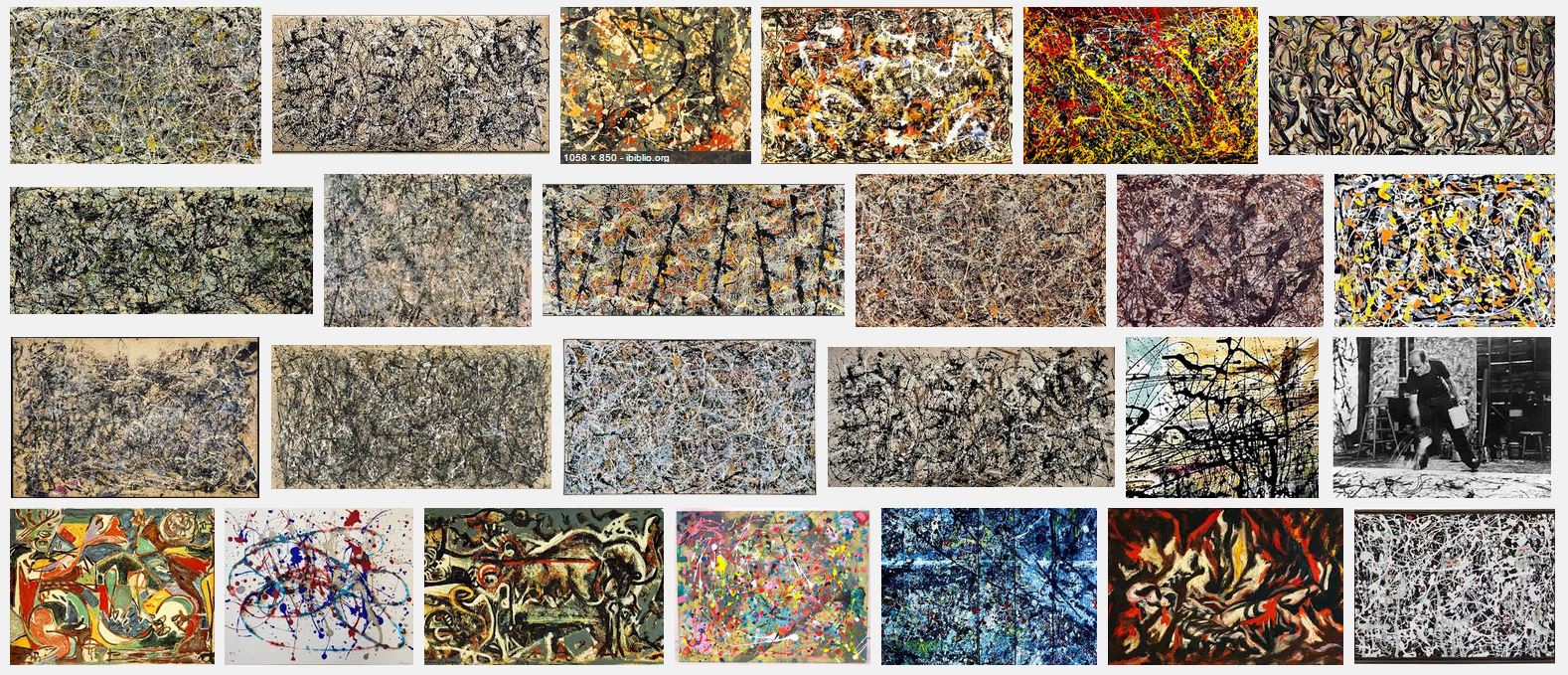
Thomas Hart Benton Google ScreenshotOne of the books in my to-read pile that is more of a tower now is one called Tom and Jack from writer Henry Adams.  It details the long relationship between Thomas Hart Benton and Jackson Pollock, two painters seemingly worlds apart– Pollock known for his vibrant abstracted drip paintings and Benton for his distinct but more objective view of the American landscape.

But Benton was a mentor, teacher and surrogate father for Pollock and many of his lessons found form in Pollock’s work, particularly the ability to create a rhythm in each painting.  Both were masters of the graceful organic rhythms that run through their works.

One of the things I often do when looking at the work of other artists is to do a Google image search for that artist.  Seeing the work grouped together, as you can see in the  images at the top and bottom of the page, allows me to quickly take in the overall tone and feel, to get an idea of the general fingerprint of that artist.  At the top is a screenshot of Benton’s landscapes and the thing that  immediately jumps out at me is the beautiful organic roll  of the landscape that creates a rhythm that instantly draws me in.

Thomas Hart Benton _trail-ridersOne of the paintings from the Benton page is shown here on the left, The Trail Riders, and is a great example of this rhythm.  It creates a sense of movement and gives the forms of the landscape an almost human quality in its curves and rolls which makes it seem familiar.  Part of us, who we are.  For me, that rhythm in Benton’s work was a revelation.  The landscape became something more that a static backdrop.  It was alive and breathing and moving, very often the central character in the work.

And I knew that was what I wanted in my own work, just as I believe Pollock  observed it and wanted for his own work.  And he found a way to take that rhythm and create his own living  landscape through his distinct  visual vocabulary.  Much different than Benton but built on the same underlying energies.

Seeing both their works is really motivating for me, making me chomp at the bit  this morning.  Each spurs me in many directions, but always fast and forward moving.

And that is always a good thing…

Jackson Pollock Google Screenshot

Read Full Post »

« Newer Posts - Older Posts »